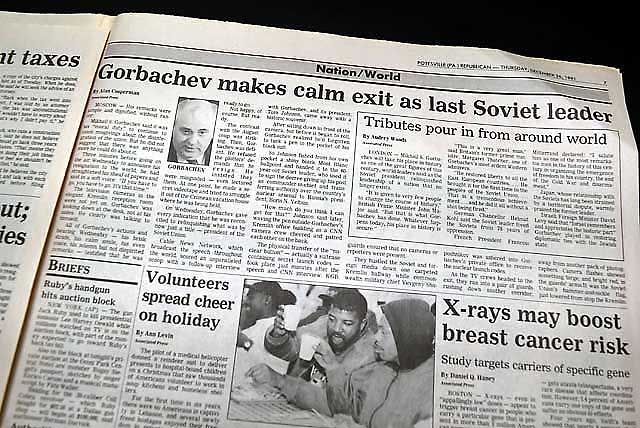
End of the Soviet Union... Cold War ends...
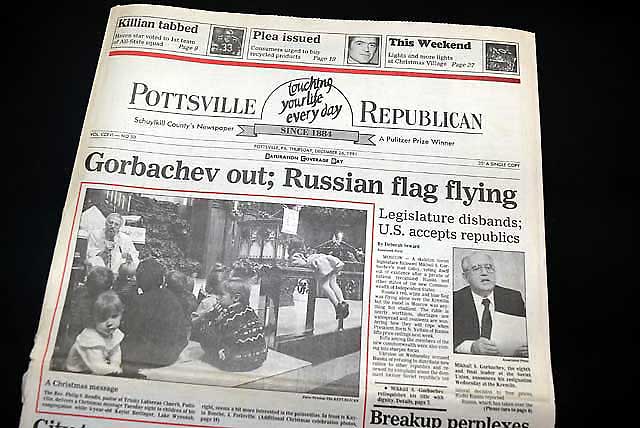
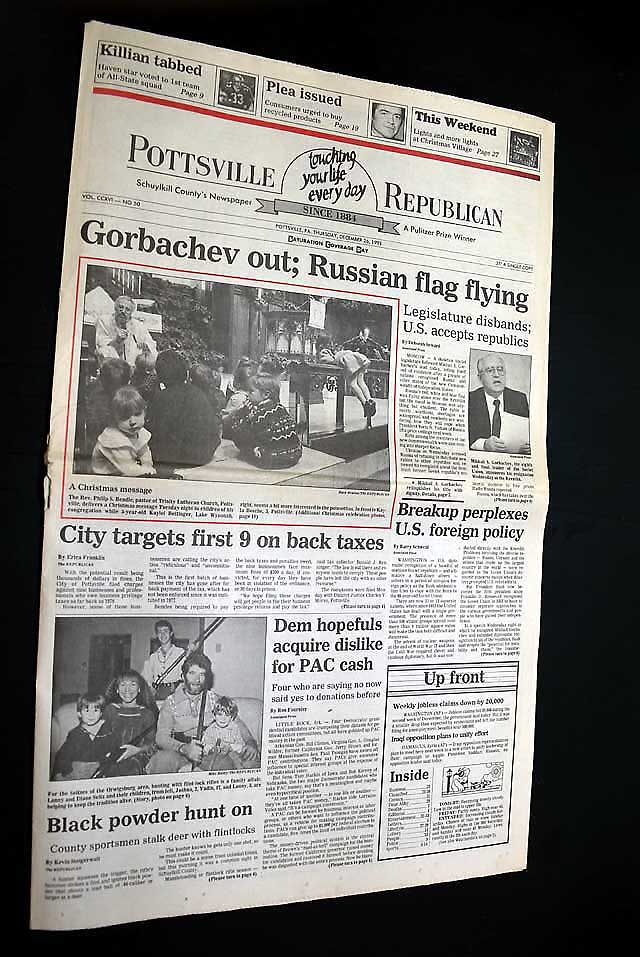
POTTSVILLE REPUBLICAN, Penn., Dec. 26, 1991
- Dissolution of the Soviet Union
- President Mikhail Gorbachev
- End of the "Cold War"
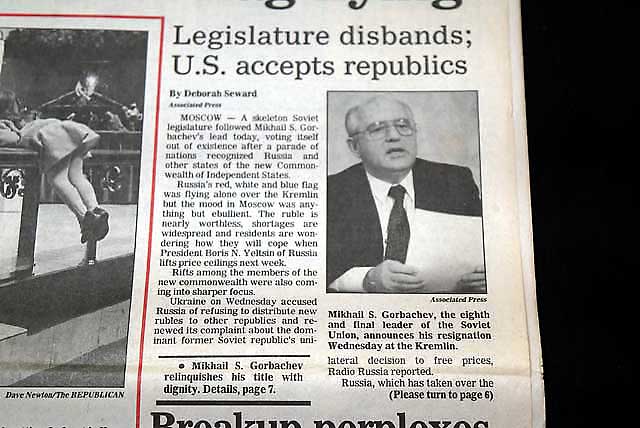
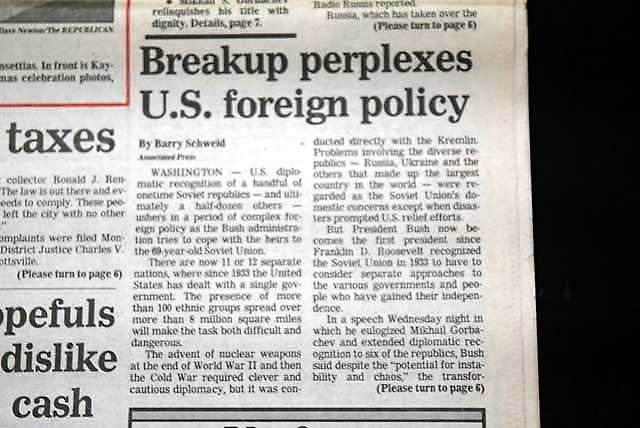
The front page has a banner headline: "Gorbachev out; Russian flag flying" with subheads and photo of Gorbachev. (see images)
Complete with all 34 pages, good condition.
Background: The dissolution of the Soviet Union in 1991 stands as a remarkably rare historical event: the swift, mostly bloodless implosion of a nuclear-armed superpower without a direct foreign war or major revolution on its home soil. Rather than succumbing to an external invasion, the country crumbled from within as systemic economic stagnation, severe supply shortages, and the draining burden of the Cold War arms race converged with Mikhail Gorbachev’s well-intentioned reform policies. Gorbachev’s twin measures—glasnost (political openness) and perestroika (economic restructuring)—were designed to modernize the state, but instead unexpectedly unspooled central authority and ignited long-suppressed ethnic nationalism across its 15 republics. What makes the collapse particularly notable was its rapid cascade in 1991: a botched August coup by hardline Communists backfired completely, gutting central power, empowering opposition leaders like Boris Yeltsin, and prompting a domino effect of independence declarations. In a extraordinary legal maneuver, the leaders of Russia, Ukraine, and Belarus bypassed the central government entirely by signing the Belovezha Accords on December 8 to declare the USSR abolished. This process culminated on December 25, 1991, when Gorbachev resigned, the hammer-and-sickle flag was permanently lowered over the Kremlin, and the world’s largest socialist empire peacefully fractured into 15 independent nations, reshaping global geopolitics and abruptly ending the Cold War.
Other issues you may like
§ related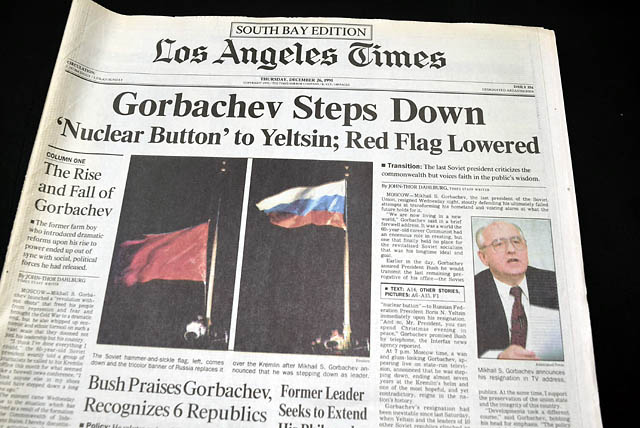
LOS ANGELES TIMES, Dec. 26, 1991
- Dissolution of the Soviet Union
- President Mikhail Gorbachev
- End of the "Cold War"
The ftpg. features a two line banner
...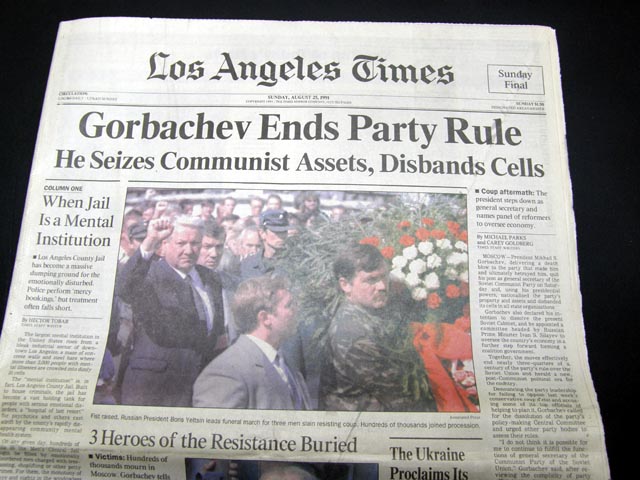
LOS ANGLES TIMES, Aug. 25, 1991
- Declaration of Independence of Ukraine
- Resignation of Mikhail Gorbachev
- Dissolution of the Soviet Union
- President Boris Yeltsin

THE MESA TRIBUNE, Mesa, Arizona, August 19, 1991
- Dissolution of the Soviet Union
- President Mikhail Gorbachev
- End of the "Cold War" - Russia
The full banner
...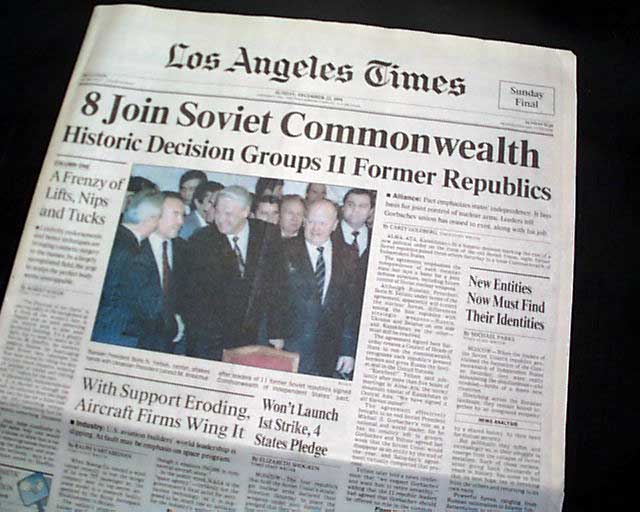
LOS ANGELES TIMES, December 22, 1991
- Dissolution of the Soviet Union - USSR
- Independent states - nations
- First Ukraine president Leonid Kravchuk
The front
...