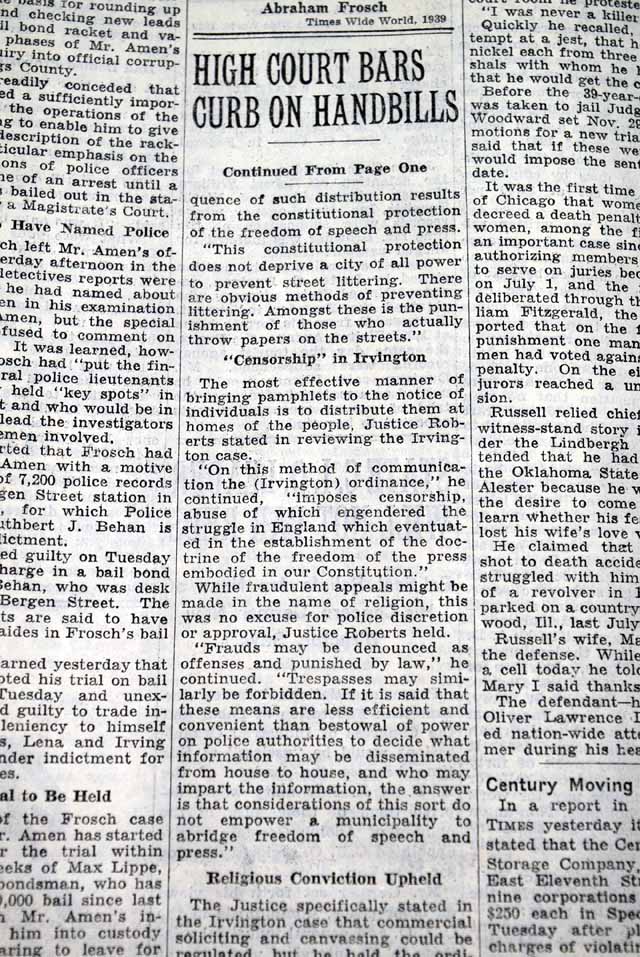
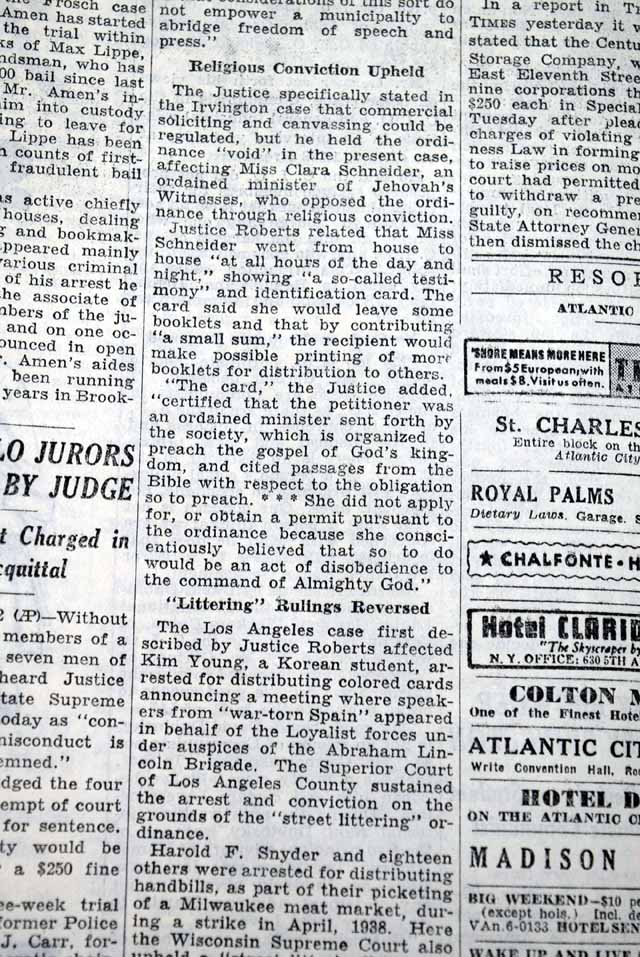
Jehovah's Witnesses and street handbills ruling...
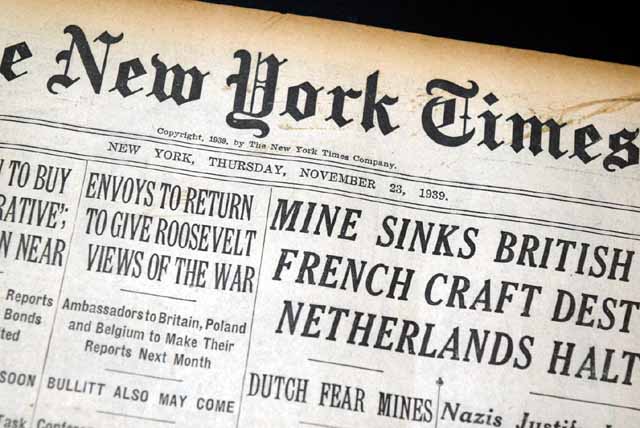
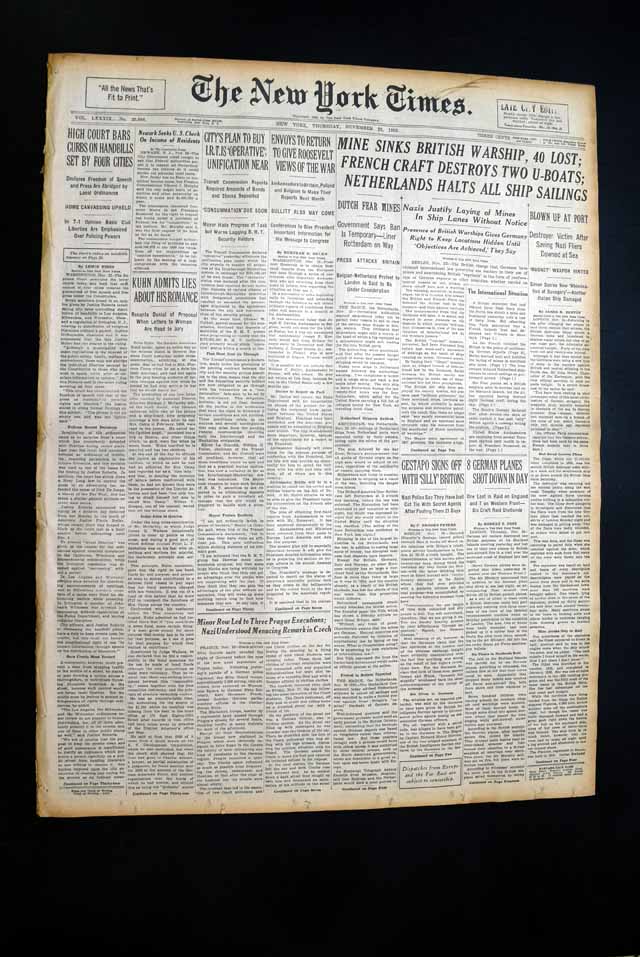
THE NEW YORK TIMES, Nov. 23, 1939
- Schneider v. State of New Jersey (Irvington)
- Supreme Court of the United States ruling
- Jehovah Witnesses victory re. street handbills
- Watch Tower Bible and Tract Society
- Charles Taze Russell followers - Bible Students
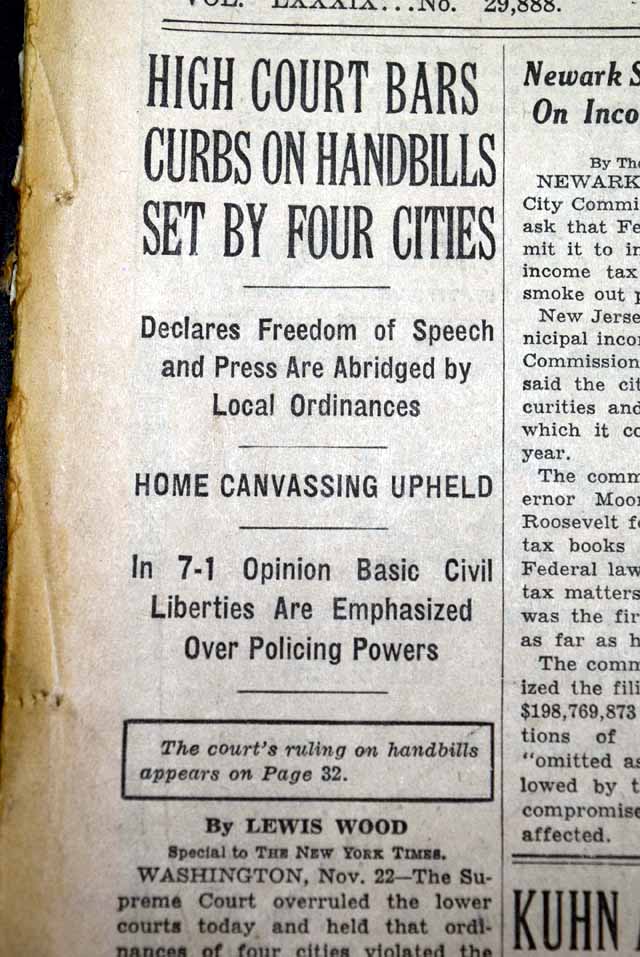
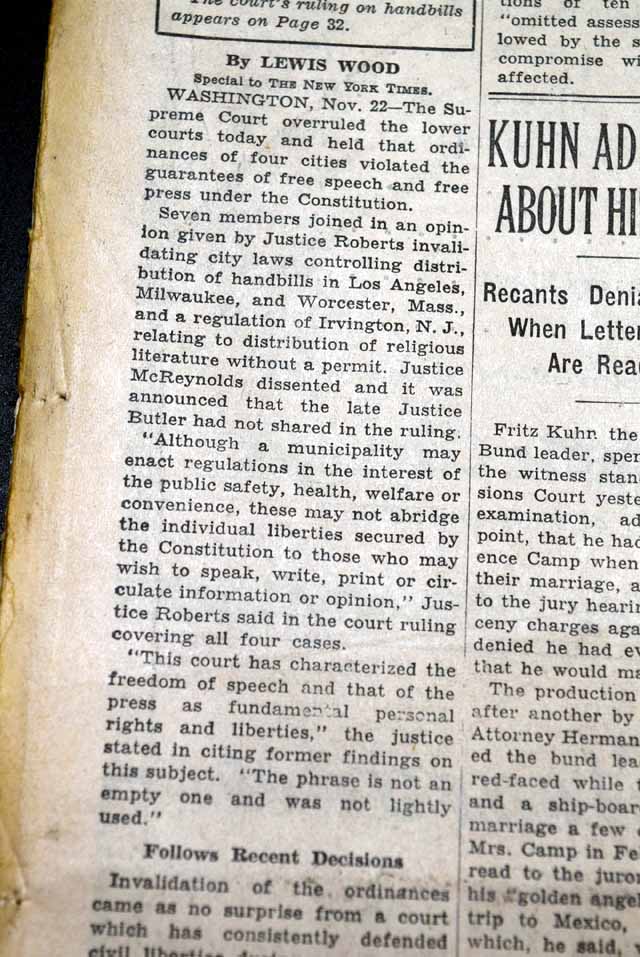
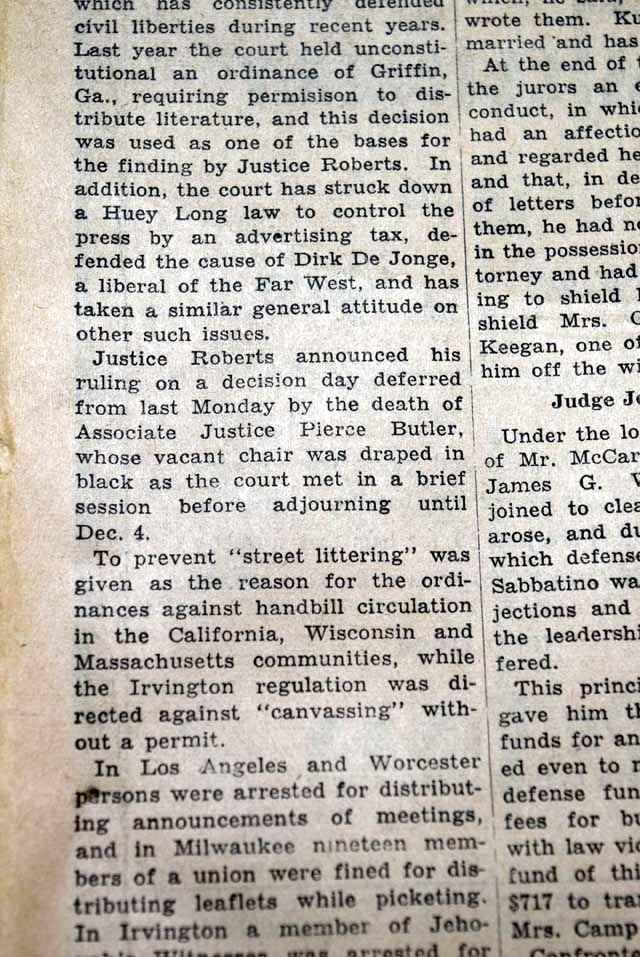
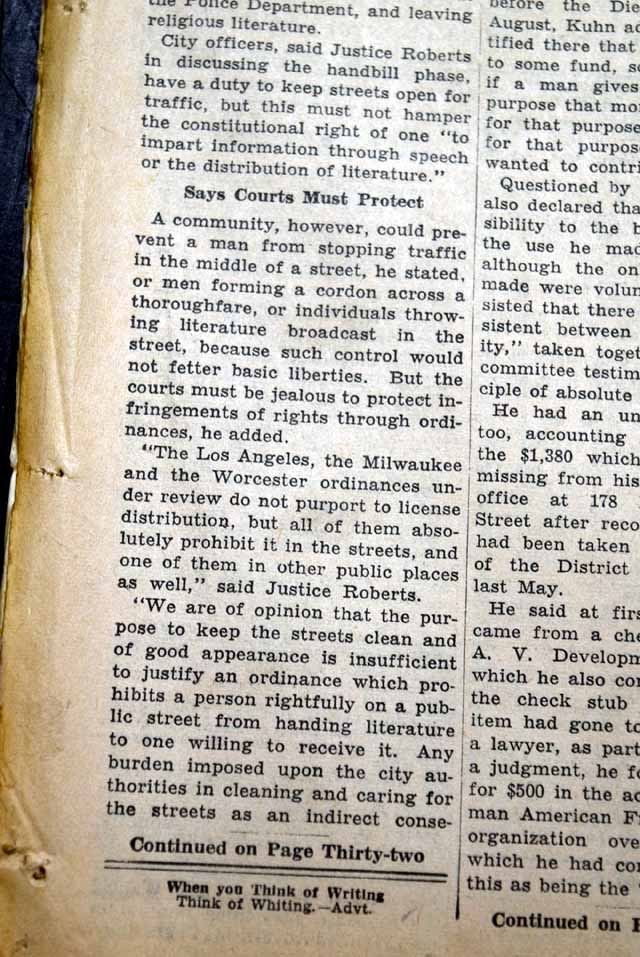
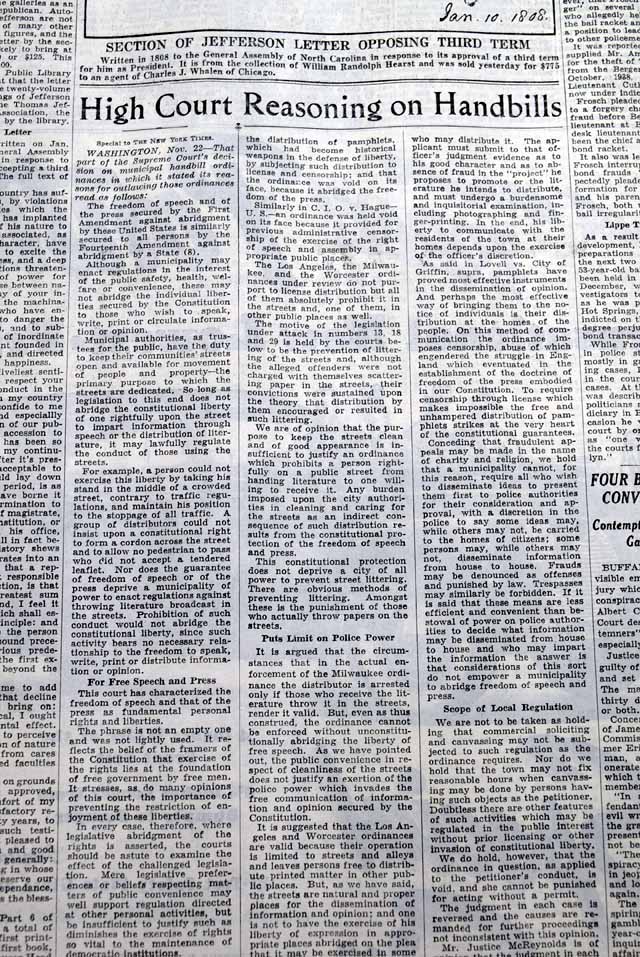
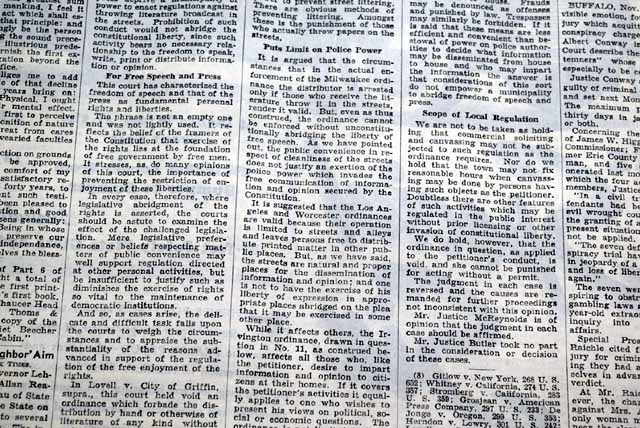
The top of the front page one column heading: "HIGH COURT BARS CURBS ON HANDBILLS SET BY FOUR CITIES" with subheads. (see images) Much more on page 32.
I suspect this to be an extremely rare item because there was really no reason to save it at the time.
Complete with 56 pages, light toning at the margins, generally very nice.
Background: On November 22, 1939, the Supreme Court of the United States delivered a watershed ruling in Schneider v. State of New Jersey (Town of Irvington), a consolidated 7–1 decision that fundamentally reshaped First Amendment jurisprudence and secured a monumental victory for the Jehovah’s Witnesses. The case arose from the arrest of Clara Schneider, a Witness prosecuted under a municipal ordinance for distributing religious literature door-to-door without a police permit, alongside three other cases involving political and labor handbill bans in California, Wisconsin, and Massachusetts. In striking down these local laws, Justice Owen J. Roberts established the enduring legal principle that a municipality's desire to prevent litter or public annoyance cannot justify the wholesale suppression of constitutional speech, famously declaring that cities must punish the litterer rather than censor the distributor. The historical significance of this event is profound: it dealt a decisive blow to municipal "prior restraint" censorship, legally validated door-to-door religious evangelism, and served as a critical stepping stone for the Jehovah's Witnesses' aggressive legal campaign—spearheaded by the Watch Tower Society—which systematically used the courts to expand civil liberties for all Americans. Furthermore, the publications Schneider distributed, such as early editions of The Watchtower and Consolation (now Awake!), hold exceptional historical rarity today. Because these fragile, newsprint pamphlets were printed in limited quantities for immediate, zealous street distribution during a period of intense public hostility and wartime patriotism, very few physical copies survived the era, transforming these ephemeral handbills into highly prized artifacts of American constitutional and religious history.
Other issues you may like
§ related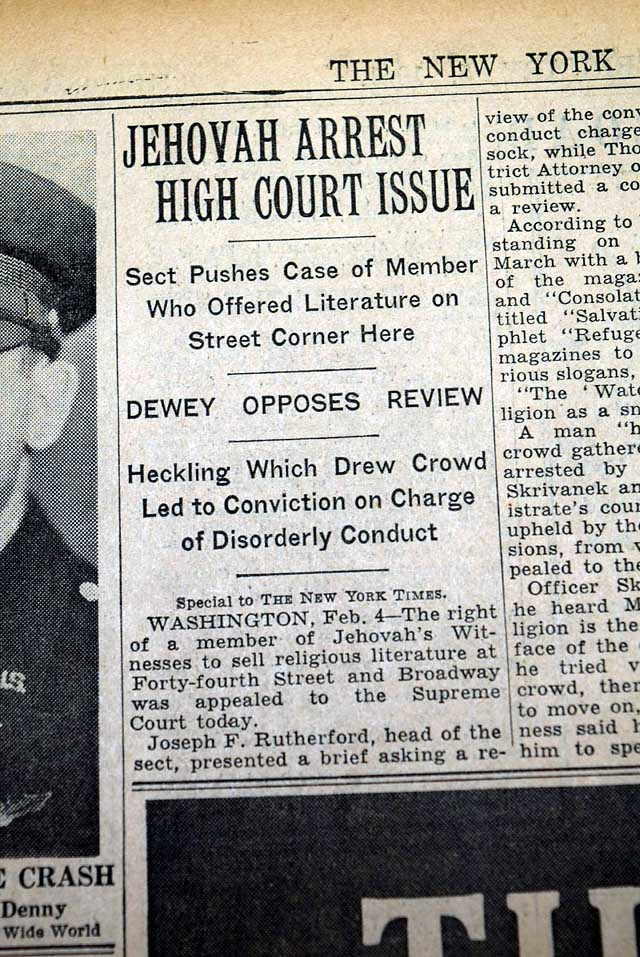
THE NEW YORK TIMES, February 5, 1941
- Charles Hussock arrest in New York City
- Distribution of literature on public streets
- Watch Tower Bible and Tract Society
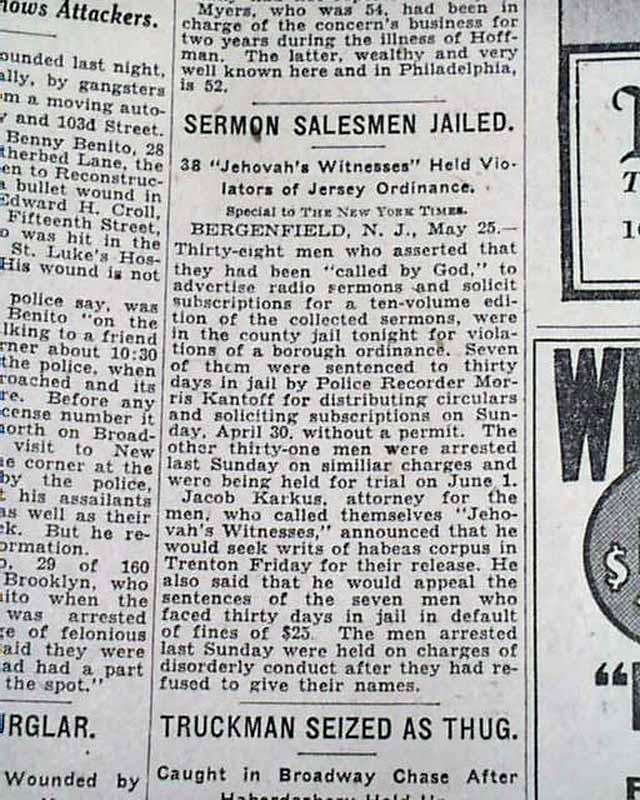
THE NEW YORK TIMES, May 26, 1932
- Bergenfield, New Jersey Jehovah's Witnesses
- Distribution of literature on public streets
- Watch Tower Bible and Tract Society
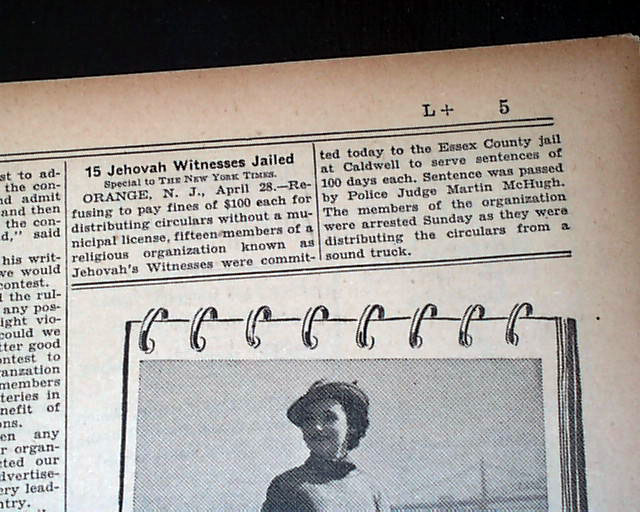
THE NEW YORK TIMES, April 29, 1936
- Jehovah's Witnesses jailed in Orange NJ
- Under Joseph Franklin Rutherford leadership
- Watch Tower Bible and Tract Society
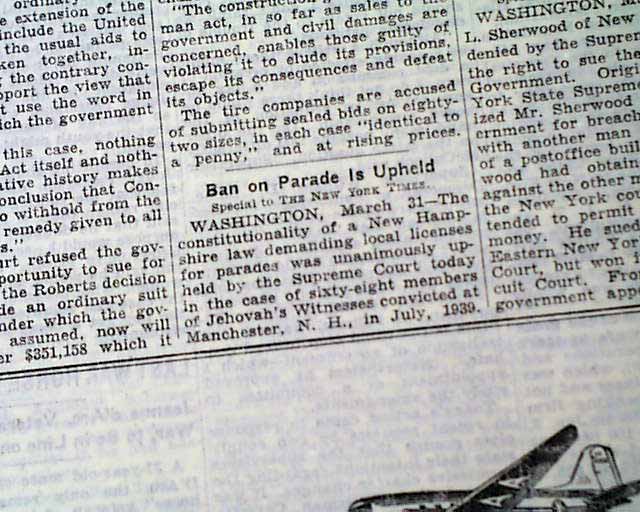
THE NEW YORK TIMES, April 1, 1941
- re. Manchester, New Hampshire parade
- Cox v. New Hampshire case upheld
- United States Supreme Court decision
- Watch Tower Bible