The hanging of Nathan Hale as a spy...
Item # 726723
·
Sorry, but this item is no longer available. Please be in touch at info@rarenewspapers.com if you would like to be placed on a want list or are interested in a potential alternate issue.
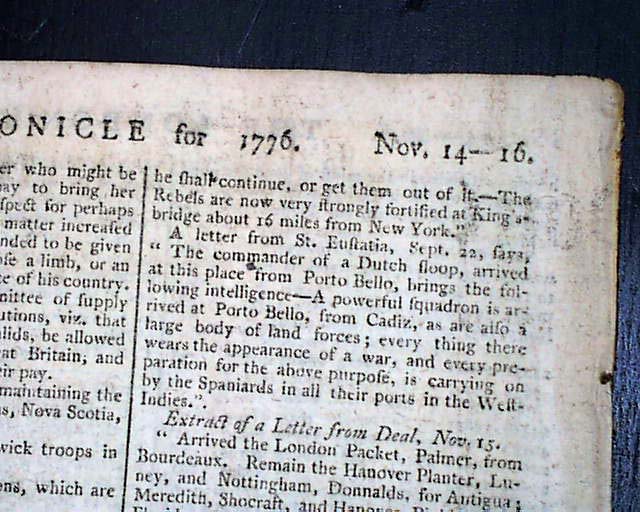
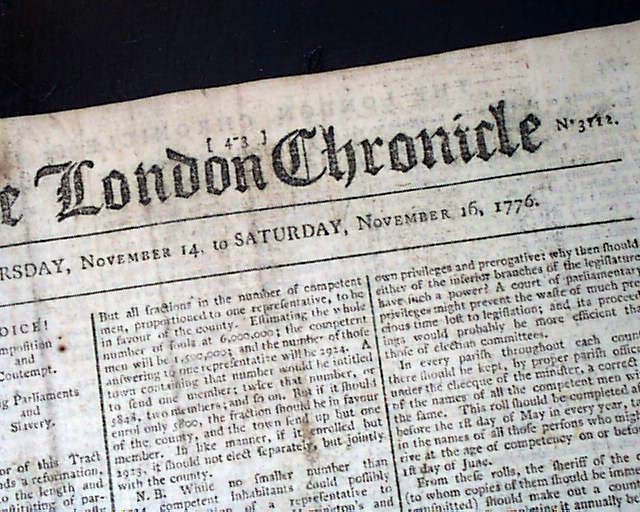
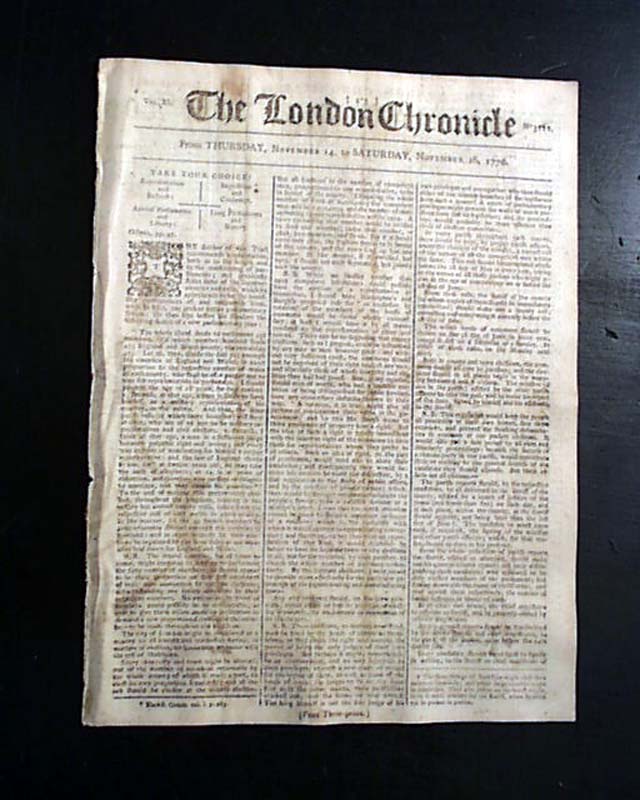
THE LONDON CHRONICLE, England, Nov. 16, 1776
* Hanging of Nathan Hale - American Revolutionary War
* "I only regret that I have but one life to give for my country" fame
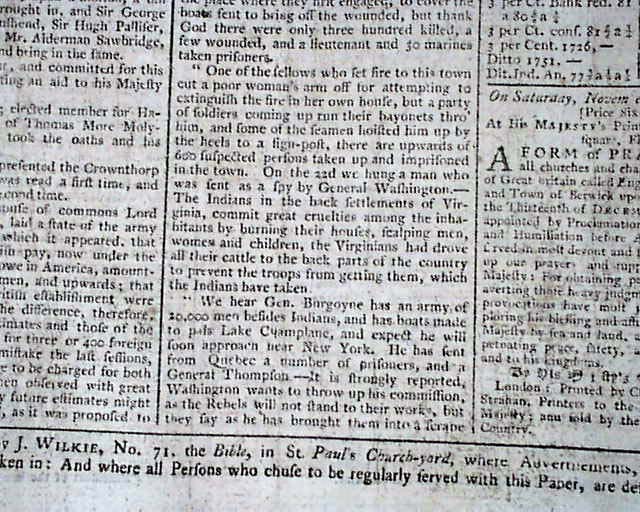
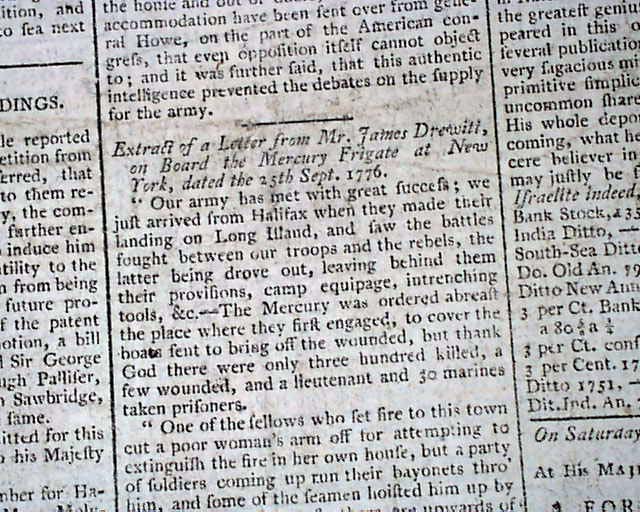
The back page has a letter from a man on board a ship at New York dated Sept. 25, 1776. It begins; "Our army has met with great success; we just arrived from Halifax when they made their landing on Long Island & saw the battles fought between our troops and the rebels..." with more detail (see). But it is a later sentence in this letter--brief as it is--which reports a incident known to every student in America: "On the 22d we hung a man who was sent as a spy by Gen. Washington." Knowing that Nathan Hale was hanged on Sept. 22 in New York, it is very obvious that this spy was Nathan Hale although not mentioned by name. Hale was, indeed, a spy for the Continental Army having volunteered for an intelligence-gathering mission in New York City before being captured by the British. He is probably best remembered for his purported last words before being hanged: "I only regret that I have but one life to lose for my country." It is our experience that any contemporary newspaper reference to the hanging of Nathan Hale is quite rare.
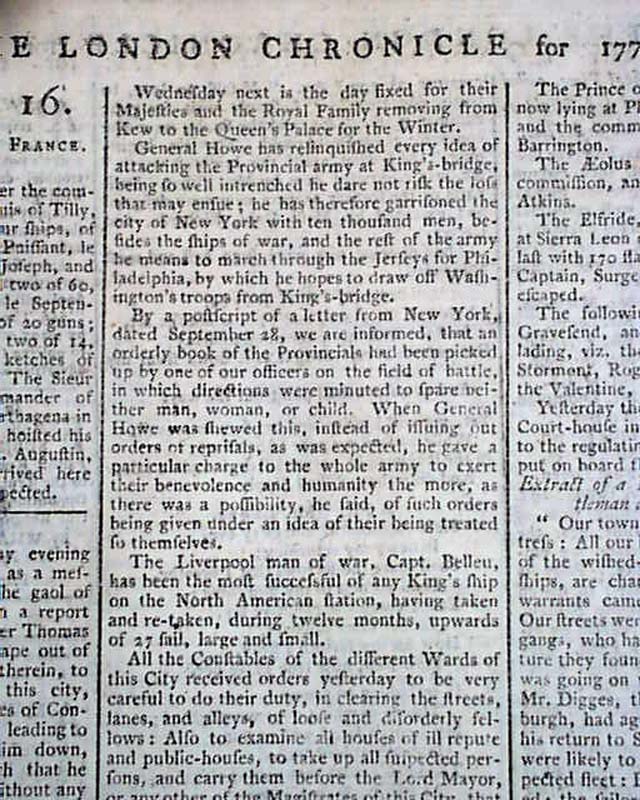
An inside page has: "General Howe has relinquished every idea of attacking the Provincial army at King's bridge, being so well entrenched he dare not risk the loss that may ensue; he has therefore garrisoned the city of New York with 10,000 men...& the rest of the army he means to march through the Jerseys for Philadelphia by which he hopes to draw off Washington's troops from King's bridge..." with more (see).
Eight pages, 8 1/2 by 11 in., some foxing, nice condition.
Background: The significance of this brief mention in The London Chronicle lies in its raw, unfiltered validation of an American founding myth, stripping away decades of romanticized nationalism to reveal the brutal reality of the Revolutionary War. For historians, contemporary British accounts of Nathan Hale’s execution are exceedingly rare, making this anonymous sailor's letter a vital piece of connective tissue between folklore and fact. By reducing a man who would become an American icon of ultimate patriotism to an unnamed "spy sent by Gen. Washington," the text illustrates the psychological warfare of the era; the British treated The significance of this brief mention in The London Chronicle lies in its raw, unfiltered validation of an American founding myth, stripping away decades of romanticized nationalism to reveal the brutal reality of the Revolutionary War. For historians, contemporary British accounts of Nathan Hale’s execution are exceedingly rare, making this anonymous sailor's letter a vital piece of connective tissue between folklore and fact. By reducing a man who would become an American icon of ultimate patriotism to an unnamed "spy sent by Gen. Washington," the text illustrates the psychological warfare of the era; the British treated Hale with calculated obscurity to prevent the rebels from gaining a martyr, inadvertently highlighting how deeply they feared the ideological resolve of Washington's forces. Ultimately, this single sentence underscores the precarious, espionage-driven nature of the conflict, proving that the legendary birth of the United States was forged not just in grand battles, but in the quiet, unceremonious sacrifices of individuals erased by the empire they dared to defy.Hale with calculated obscurity to prevent the rebels from gaining a martyr, inadvertently highlighting how deeply they feared the ideological resolve of Washington's forces. Ultimately, this single sentence underscores the precarious, espionage-driven nature of the conflict, proving that the legendary birth of the United States was forged not just in grand battles, but in the quiet, unceremonious sacrifices of individuals erased by the empire they dared to defy.
* Hanging of Nathan Hale - American Revolutionary War
* "I only regret that I have but one life to give for my country" fame
The back page has a letter from a man on board a ship at New York dated Sept. 25, 1776. It begins; "Our army has met with great success; we just arrived from Halifax when they made their landing on Long Island & saw the battles fought between our troops and the rebels..." with more detail (see). But it is a later sentence in this letter--brief as it is--which reports a incident known to every student in America: "On the 22d we hung a man who was sent as a spy by Gen. Washington." Knowing that Nathan Hale was hanged on Sept. 22 in New York, it is very obvious that this spy was Nathan Hale although not mentioned by name. Hale was, indeed, a spy for the Continental Army having volunteered for an intelligence-gathering mission in New York City before being captured by the British. He is probably best remembered for his purported last words before being hanged: "I only regret that I have but one life to lose for my country." It is our experience that any contemporary newspaper reference to the hanging of Nathan Hale is quite rare.
An inside page has: "General Howe has relinquished every idea of attacking the Provincial army at King's bridge, being so well entrenched he dare not risk the loss that may ensue; he has therefore garrisoned the city of New York with 10,000 men...& the rest of the army he means to march through the Jerseys for Philadelphia by which he hopes to draw off Washington's troops from King's bridge..." with more (see).
Eight pages, 8 1/2 by 11 in., some foxing, nice condition.
Background: The significance of this brief mention in The London Chronicle lies in its raw, unfiltered validation of an American founding myth, stripping away decades of romanticized nationalism to reveal the brutal reality of the Revolutionary War. For historians, contemporary British accounts of Nathan Hale’s execution are exceedingly rare, making this anonymous sailor's letter a vital piece of connective tissue between folklore and fact. By reducing a man who would become an American icon of ultimate patriotism to an unnamed "spy sent by Gen. Washington," the text illustrates the psychological warfare of the era; the British treated The significance of this brief mention in The London Chronicle lies in its raw, unfiltered validation of an American founding myth, stripping away decades of romanticized nationalism to reveal the brutal reality of the Revolutionary War. For historians, contemporary British accounts of Nathan Hale’s execution are exceedingly rare, making this anonymous sailor's letter a vital piece of connective tissue between folklore and fact. By reducing a man who would become an American icon of ultimate patriotism to an unnamed "spy sent by Gen. Washington," the text illustrates the psychological warfare of the era; the British treated Hale with calculated obscurity to prevent the rebels from gaining a martyr, inadvertently highlighting how deeply they feared the ideological resolve of Washington's forces. Ultimately, this single sentence underscores the precarious, espionage-driven nature of the conflict, proving that the legendary birth of the United States was forged not just in grand battles, but in the quiet, unceremonious sacrifices of individuals erased by the empire they dared to defy.Hale with calculated obscurity to prevent the rebels from gaining a martyr, inadvertently highlighting how deeply they feared the ideological resolve of Washington's forces. Ultimately, this single sentence underscores the precarious, espionage-driven nature of the conflict, proving that the legendary birth of the United States was forged not just in grand battles, but in the quiet, unceremonious sacrifices of individuals erased by the empire they dared to defy.
Categories: Revolutionary War, British
No Longer Available
100% Authentic: Original printing, never a reproduction.
Other issues you may like
§ related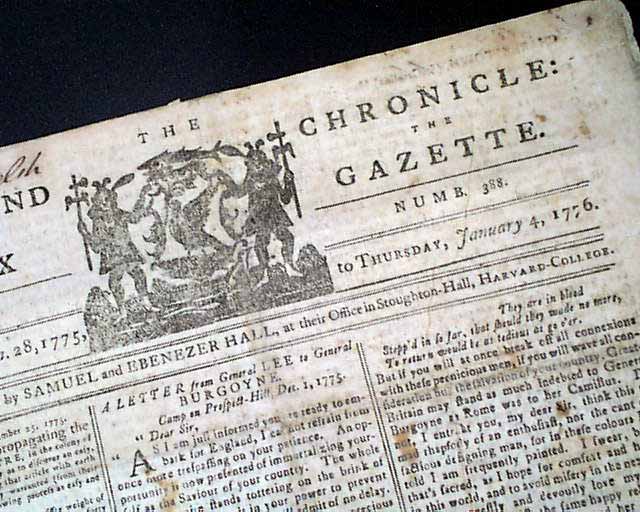
Dr. Church's traitorous letter to the British... General Lee's letter to General Burgoyne...
NEW ENGLAND CHRONICLE OR THE ESSEX GAZETTE, Cambridge, Jan. 4, 1776
* Traitor Dr. Benjamin Church
* British General Thomas Gage
* American...
* Traitor Dr. Benjamin Church
* British General Thomas Gage
* American...
Jan 1776
$895
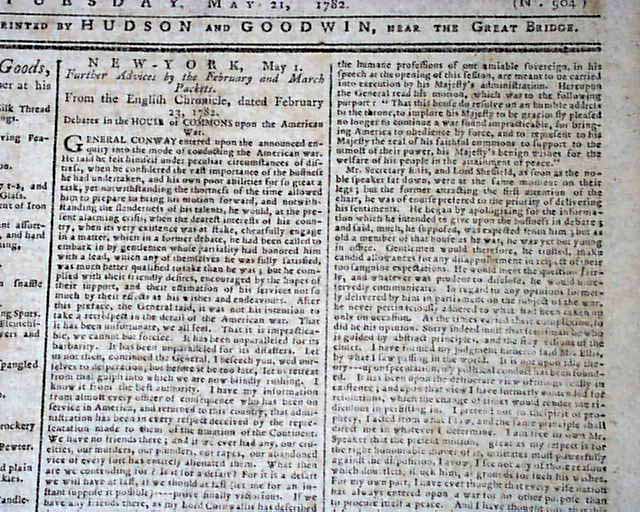
Washington's anger over the murder of Captain Huddy...
THE CONNECTICUT COURANT & WEEKLY INTELLIGENCER, Hartford, May 21, 1782
* Captain Joshua Huddy execution - hanging
* General George Washington angry...
* Captain Joshua Huddy execution - hanging
* General George Washington angry...
May 1782
$440
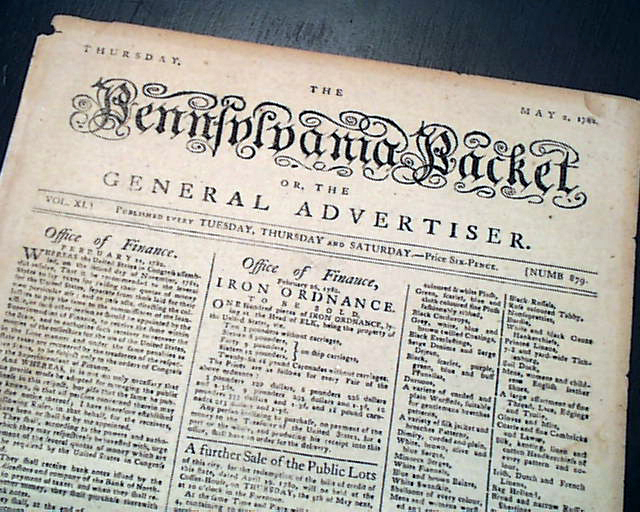
Fate of Col. Hayne... The Asgill Affair... Keep fighting, or not
THE PENNSYLVANIA PACKET OR THE GENERAL ADVERTISER, Philadelphia, May 2, 1782
* American Revolutionary War
The front page begins with a lengthy report
May 1782
$465
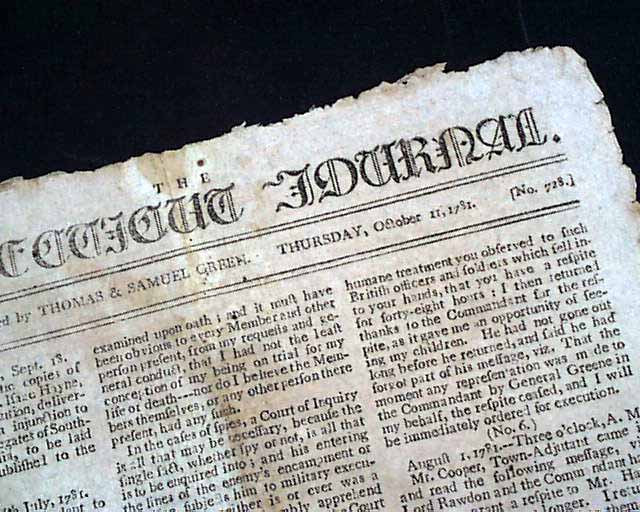
Execution of Col. Isaac Hayne, and much more...
THE CONNECTICUT JOURNAL, New Haven, October 11, 1781
* American Revolutionary War original
* American Issac Hayne's execution - hanging
Most of the front page...
* American Revolutionary War original
* American Issac Hayne's execution - hanging
Most of the front page...
Oct 1781
$478