

Edison's latest telephone in 1879...
Item # 725879
September 27, 1879
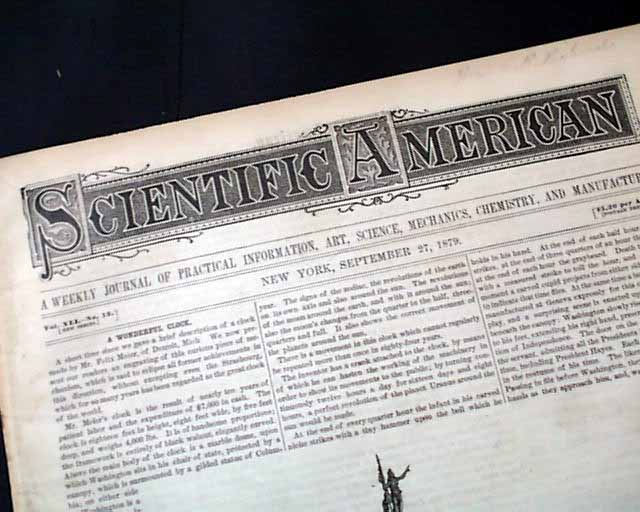
SCIENTIFIC AMERICAN, New York, September 27, 1879
* Inventor Thomas Edison telephone invention
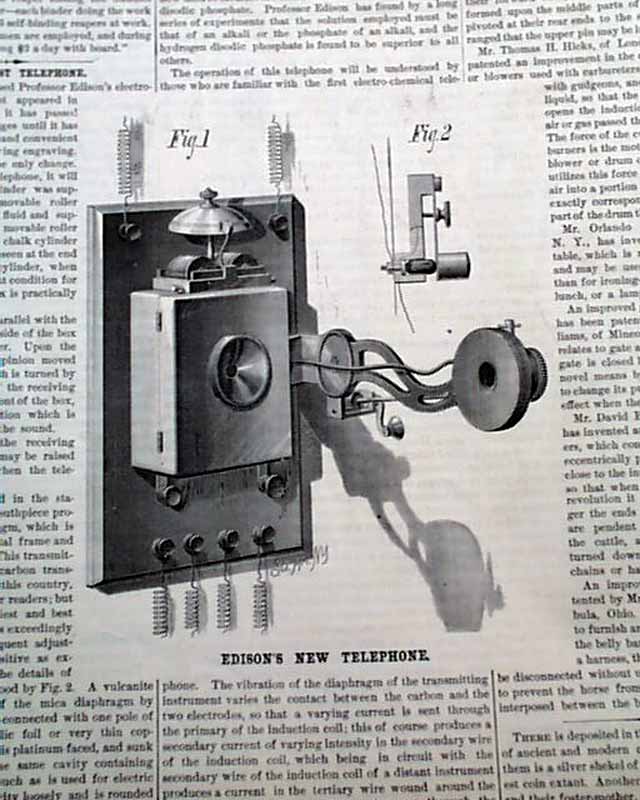
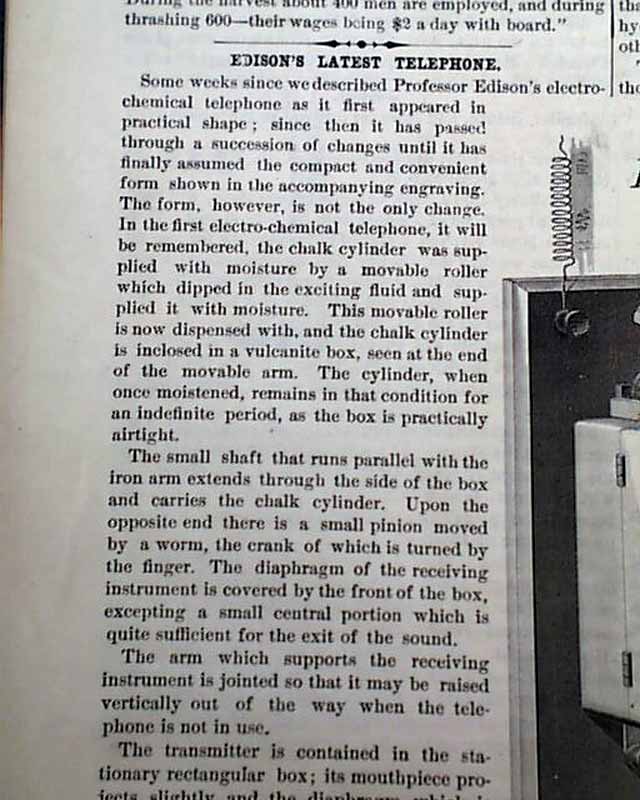
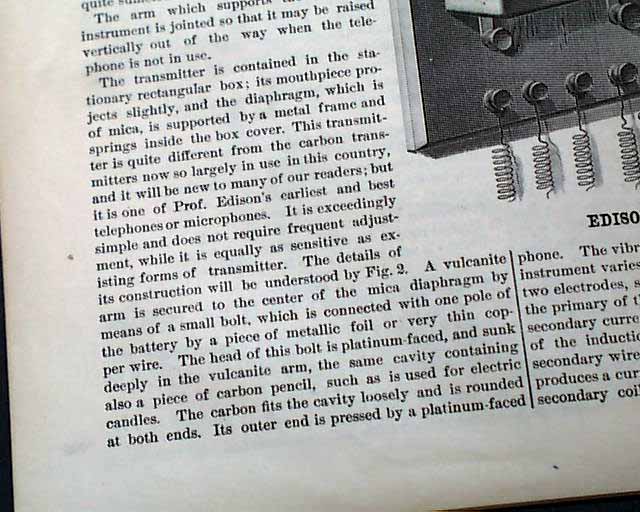
* Carbon button transmitter and 'chalk" receiver
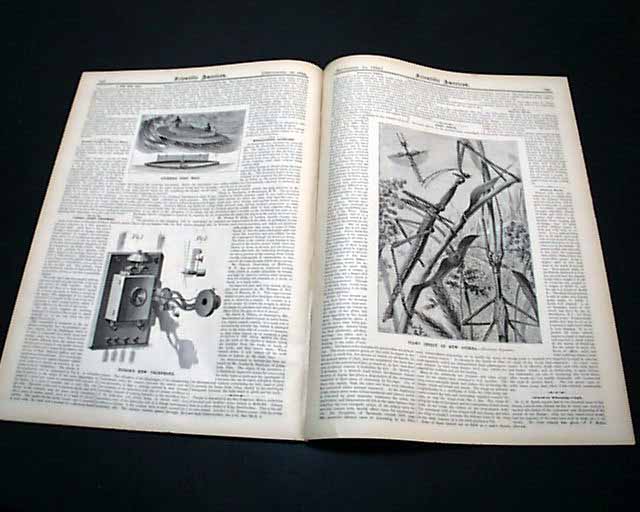
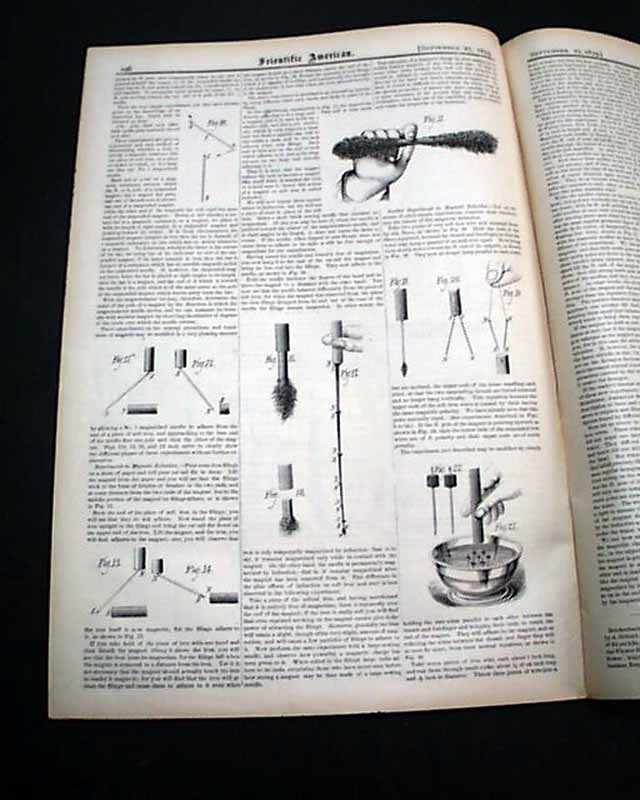
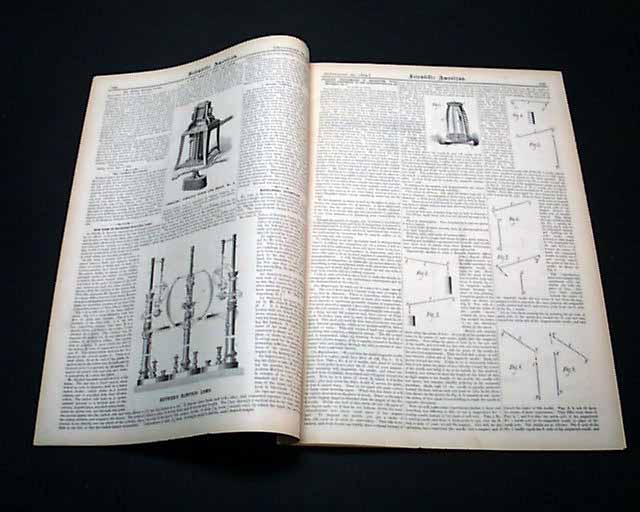
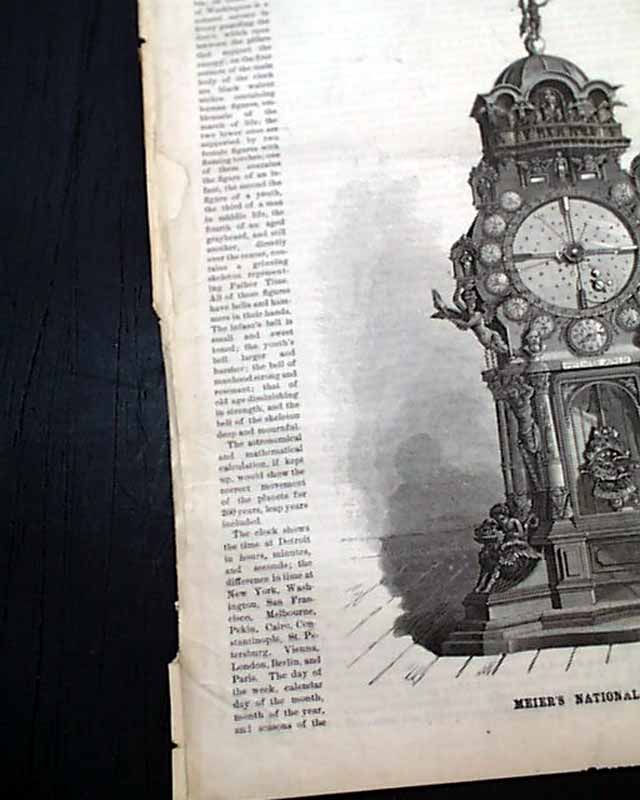
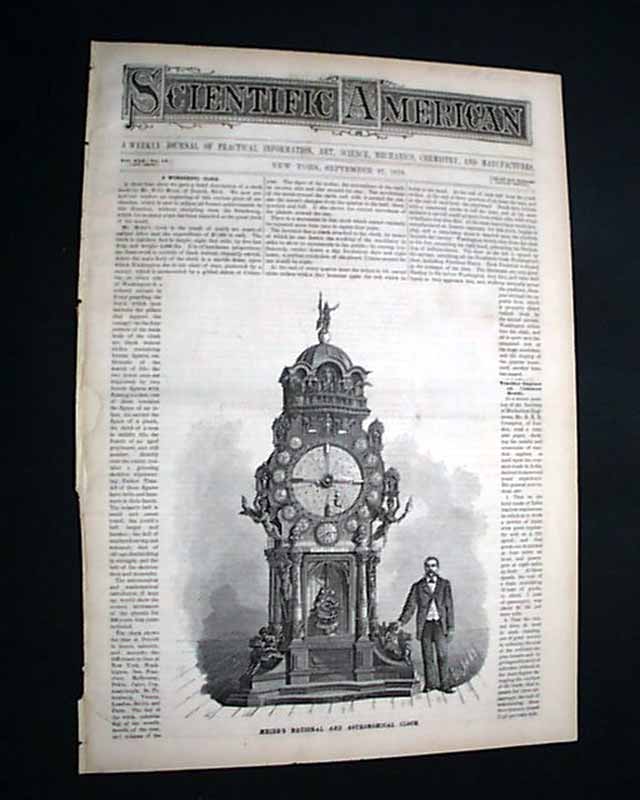
The cover features "Meier's National and Astronomical Clock". Inside the issue is "Reynier's Electric Lamp"; "Tucker's Surf Boat"; "Edison's New Telephone" with very descriptive text; "Giant Insect of New Guinea"; and other illustrations, stories and advertisements.
Complete in sixteen pages, some spine wear, otherwise good.
background: The September 27, 1879, issue of Scientific American detailed Thomas Edison’s aggressive refinement of telephonic technology, specifically highlighting his carbon button transmitter and "chalk" receiver (electromotograph), which effectively bypassed Alexander Graham Bell’s electromagnetic patents while offering superior performance. The transmitter utilized the principle of variable resistance, where sound waves exerted pressure on a disc of compressed lampblack, modulating a battery-powered current to produce a signal far more robust than Bell’s magneto-based system. Complementing this was the chalk receiver, a marvel of electrochemical engineering that replaced the traditional vibrating metal plate with a rotating cylinder of wet, chemically treated chalk. As an electrical current passed through the contact point between a metal arm and the revolving chalk, the friction varied instantaneously, causing a diaphragm to vibrate with such intensity that it could project sound across a room. This "loud-speaking" capability, powered by the mechanical energy of the rotating cylinder rather than the weak line current alone, cemented Edison’s role in making the telephone a practical tool for long-distance communication and established the carbon-based architecture that would dominate telephony for the next century.
* Inventor Thomas Edison telephone invention
* Carbon button transmitter and 'chalk" receiver
The cover features "Meier's National and Astronomical Clock". Inside the issue is "Reynier's Electric Lamp"; "Tucker's Surf Boat"; "Edison's New Telephone" with very descriptive text; "Giant Insect of New Guinea"; and other illustrations, stories and advertisements.
Complete in sixteen pages, some spine wear, otherwise good.
background: The September 27, 1879, issue of Scientific American detailed Thomas Edison’s aggressive refinement of telephonic technology, specifically highlighting his carbon button transmitter and "chalk" receiver (electromotograph), which effectively bypassed Alexander Graham Bell’s electromagnetic patents while offering superior performance. The transmitter utilized the principle of variable resistance, where sound waves exerted pressure on a disc of compressed lampblack, modulating a battery-powered current to produce a signal far more robust than Bell’s magneto-based system. Complementing this was the chalk receiver, a marvel of electrochemical engineering that replaced the traditional vibrating metal plate with a rotating cylinder of wet, chemically treated chalk. As an electrical current passed through the contact point between a metal arm and the revolving chalk, the friction varied instantaneously, causing a diaphragm to vibrate with such intensity that it could project sound across a room. This "loud-speaking" capability, powered by the mechanical energy of the rotating cylinder rather than the weak line current alone, cemented Edison’s role in making the telephone a practical tool for long-distance communication and established the carbon-based architecture that would dominate telephony for the next century.
Category: Post-Civil War


