Women & affirmative action in 1987 SCOTUS...
Item # 725658
·
LOS ANGELES TIMES, March 26, 1987
* United States Supreme Court decision
* John v. Transportation Agency - SCOTUS
* Affirmative action re. Women in the workplace
* Employers can hire based on gender over expertise
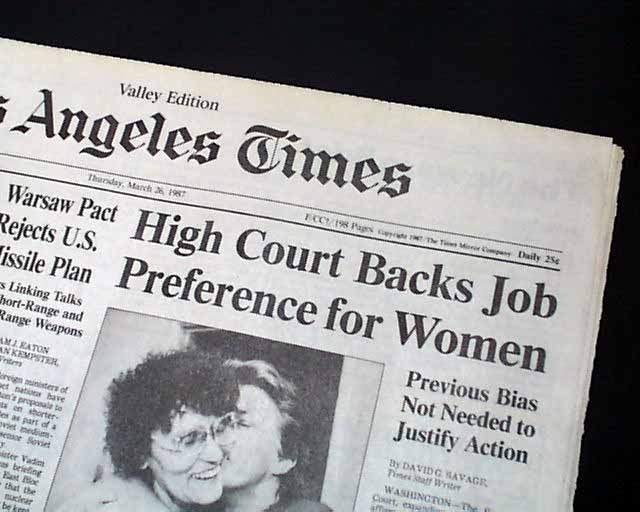
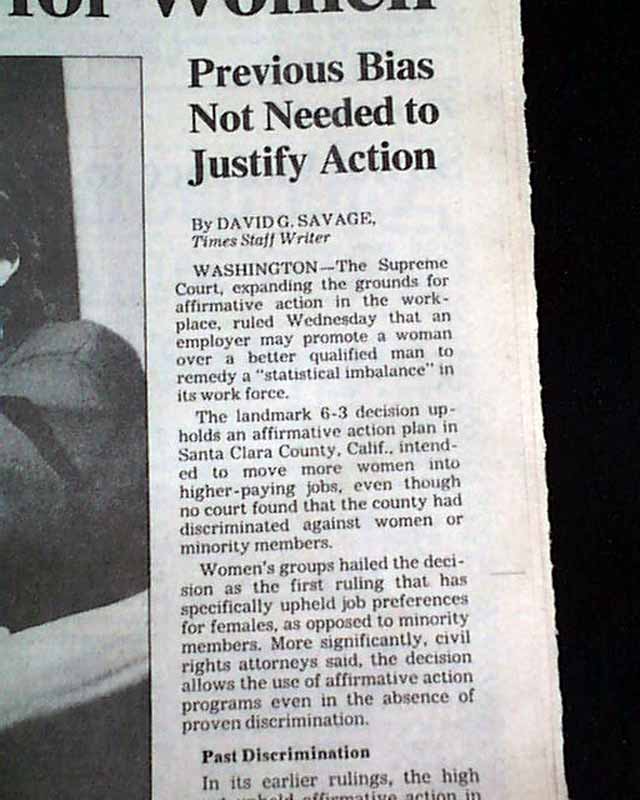
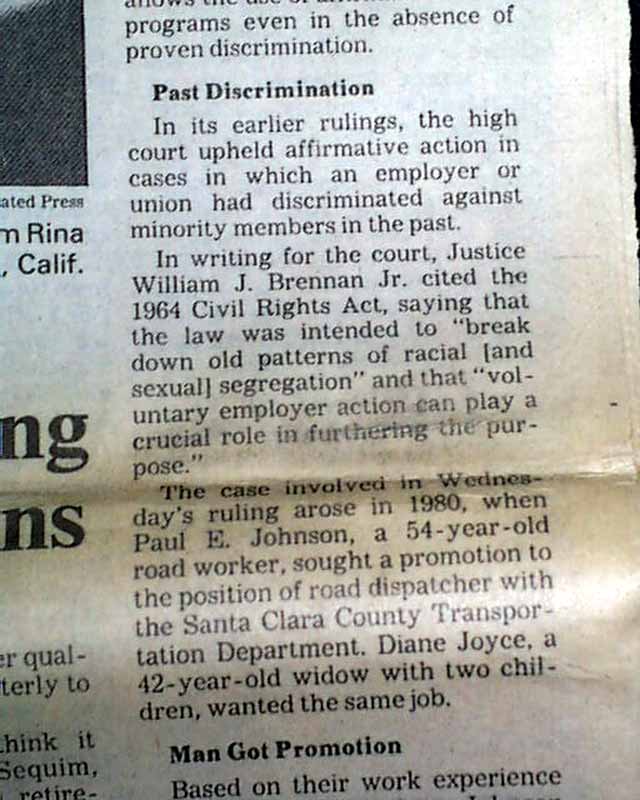
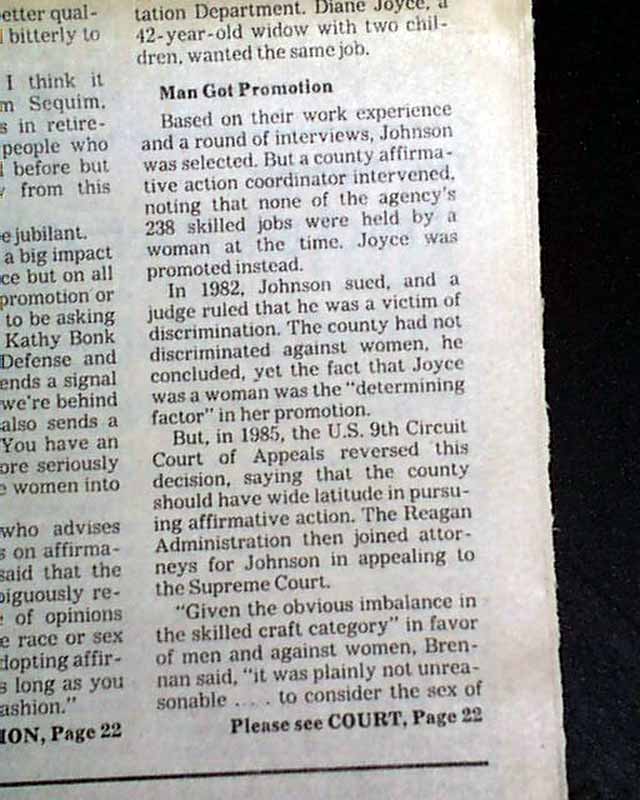
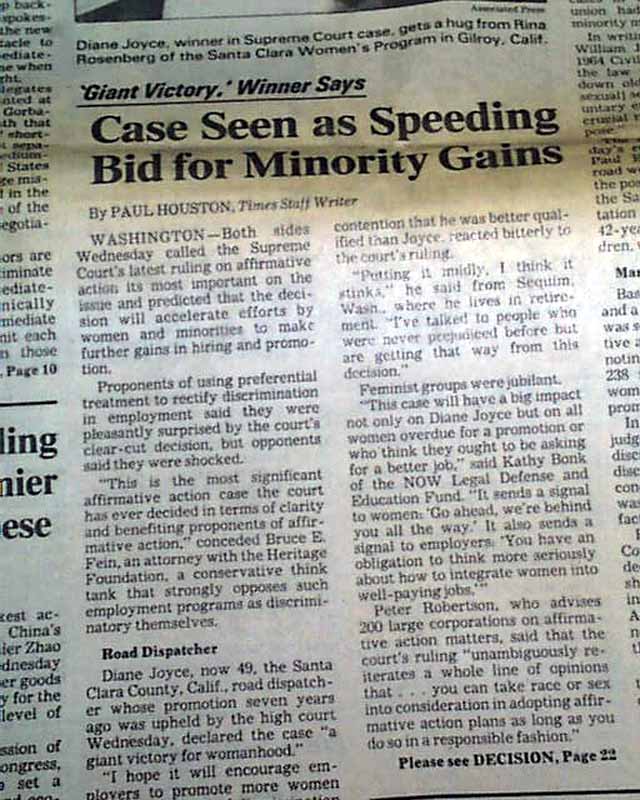
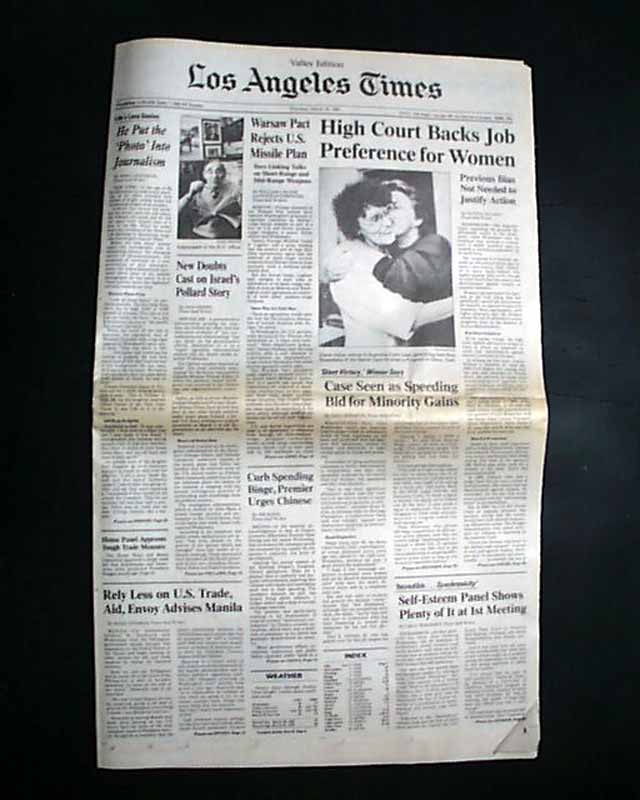
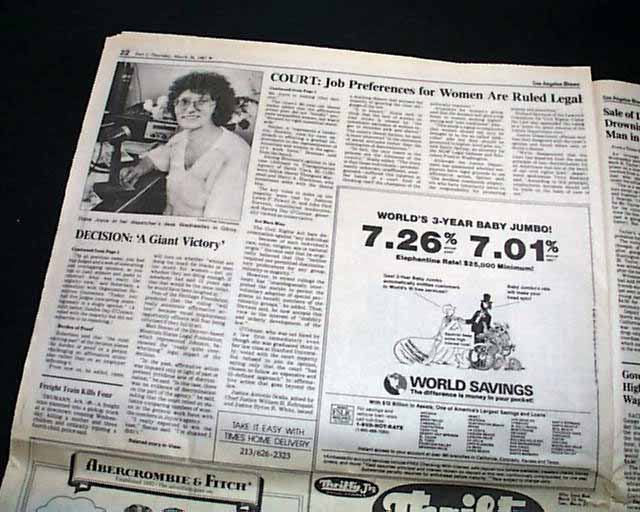
The top of the front page has a headline: "High Court Backs Job Preference for Women" with subhead and related photo. (see images) Coverage continues inside with another related photo.
Complete 1st section with all 28 pages, nice condition.
background: In the landmark 6–3 decision of Johnson v. Transportation Agency, decided on March 25, 1987, the Supreme Court fundamentally expanded the scope of affirmative action by ruling that employers could voluntarily consider gender as a "plus factor" in promotion decisions to correct a manifest imbalance in traditionally segregated job categories. The case centered on Diane Joyce, who was promoted to a road dispatcher role over Paul Johnson, despite Johnson scoring two points higher on a technical interview; the Court found this lawful under Title VII of the Civil Rights Act of 1964 because the agency’s plan was a moderate, flexible effort to address the fact that zero women occupied the 238 skilled craft positions available. By emphasizing that such plans do not require a prior finding of intentional discrimination—only a "conspicuous statistical disparity"—and that they must not unnecessarily trammel the interests of male employees by using rigid quotas, the ruling provided a critical legal framework for private and public employers to proactively integrate women into historically male-dominated industries.
* United States Supreme Court decision
* John v. Transportation Agency - SCOTUS
* Affirmative action re. Women in the workplace
* Employers can hire based on gender over expertise
The top of the front page has a headline: "High Court Backs Job Preference for Women" with subhead and related photo. (see images) Coverage continues inside with another related photo.
Complete 1st section with all 28 pages, nice condition.
background: In the landmark 6–3 decision of Johnson v. Transportation Agency, decided on March 25, 1987, the Supreme Court fundamentally expanded the scope of affirmative action by ruling that employers could voluntarily consider gender as a "plus factor" in promotion decisions to correct a manifest imbalance in traditionally segregated job categories. The case centered on Diane Joyce, who was promoted to a road dispatcher role over Paul Johnson, despite Johnson scoring two points higher on a technical interview; the Court found this lawful under Title VII of the Civil Rights Act of 1964 because the agency’s plan was a moderate, flexible effort to address the fact that zero women occupied the 238 skilled craft positions available. By emphasizing that such plans do not require a prior finding of intentional discrimination—only a "conspicuous statistical disparity"—and that they must not unnecessarily trammel the interests of male employees by using rigid quotas, the ruling provided a critical legal framework for private and public employers to proactively integrate women into historically male-dominated industries.
Category: The 20th Century
Price
$58
100% Authentic: Original printing, never a reproduction.
Other issues you may like
§ related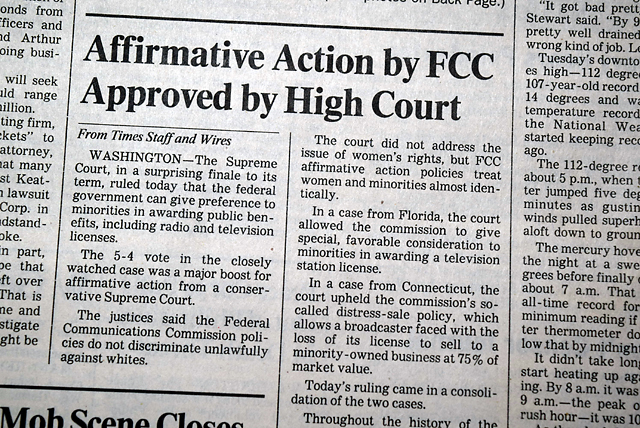
1990 "Affirmative Action" SCOTUS ruling...
LOS ANGELES TIMES, June 27, 1990
* FCC Affirmative Action case ruling
* Supreme Court of the United States
* Metro Broadcasting, Inc. v. FCC
The front page...
* FCC Affirmative Action case ruling
* Supreme Court of the United States
* Metro Broadcasting, Inc. v. FCC
The front page...
Jun 1990
$52
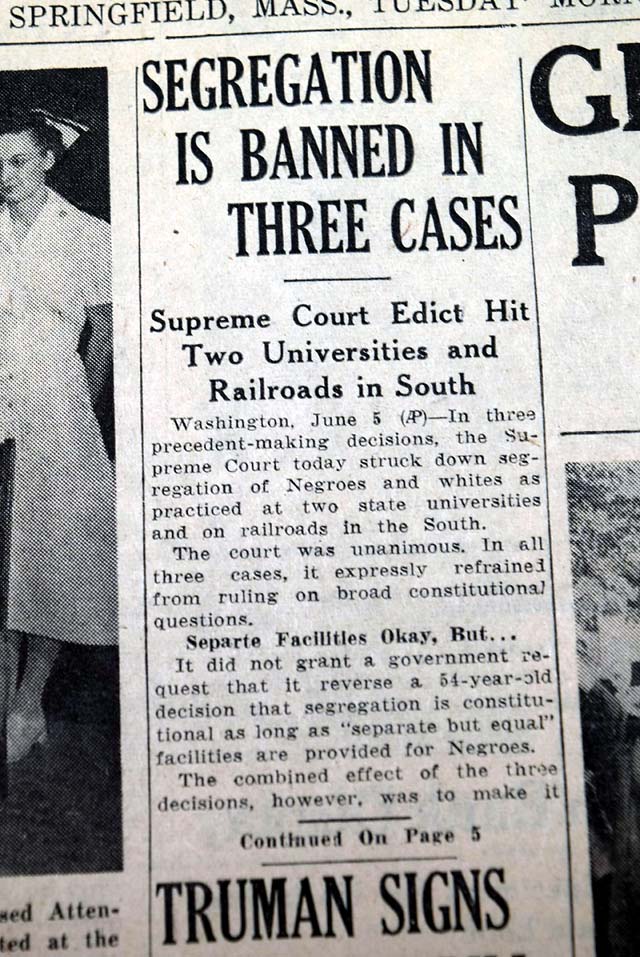
Supreme Court rules in 3 discrimination cases...
NEW YORK TIMES, June 6, 1950
* Colleges not permitted to discriminate based on race
* McLaurin vs. Oklahoma State Regents & more
* United States Supreme...
* Colleges not permitted to discriminate based on race
* McLaurin vs. Oklahoma State Regents & more
* United States Supreme...
Jun 1950
$52
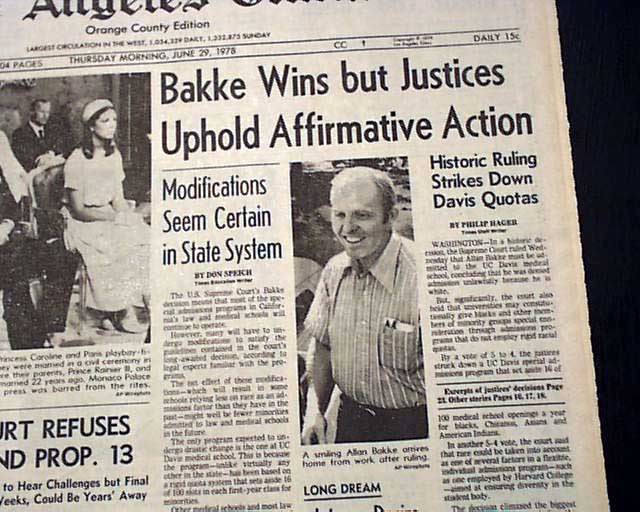
Landmark Supreme Court case on affirmative action...
LOS ANGELES TIMES, June 29, 1978
* Regents of the Univ. of California v. Bakke
* Landmark United States Supreme Court decision
* Affirmative action...
* Regents of the Univ. of California v. Bakke
* Landmark United States Supreme Court decision
* Affirmative action...
Jun 1978
$67
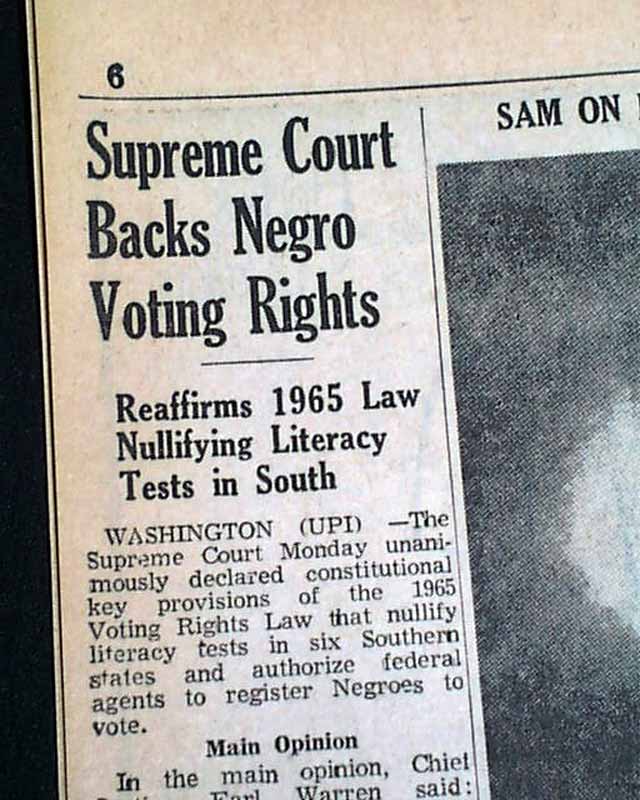
1966 civil rights movement... Voting rights...
THE SPRINGFIELD UNION, Mass. March 8, 1966
* Voting Rights Act of 1965
* Civil Rights movement in the South
* United States Supreme Court
* South Carolina...
* Voting Rights Act of 1965
* Civil Rights movement in the South
* United States Supreme Court
* South Carolina...
Mar 2026
$62