

The King is angry at the colonies for encouraging opposition...
Item # 720766
·
THE BOSTON CHRONICLE, July 18, 1768
* King of England growing impatient
* Tensions in the American Colonies
* Pre Revolutionary War original
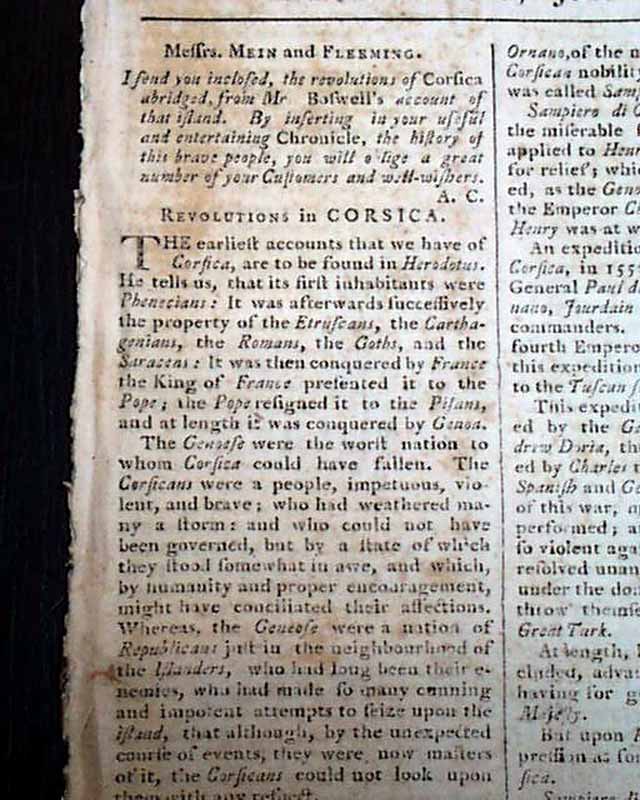
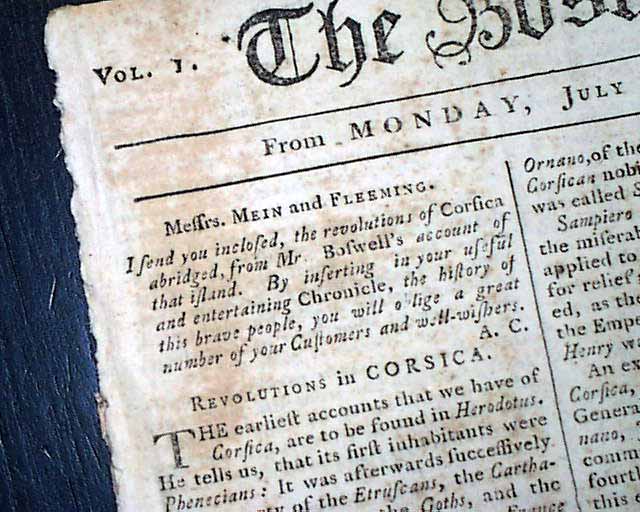
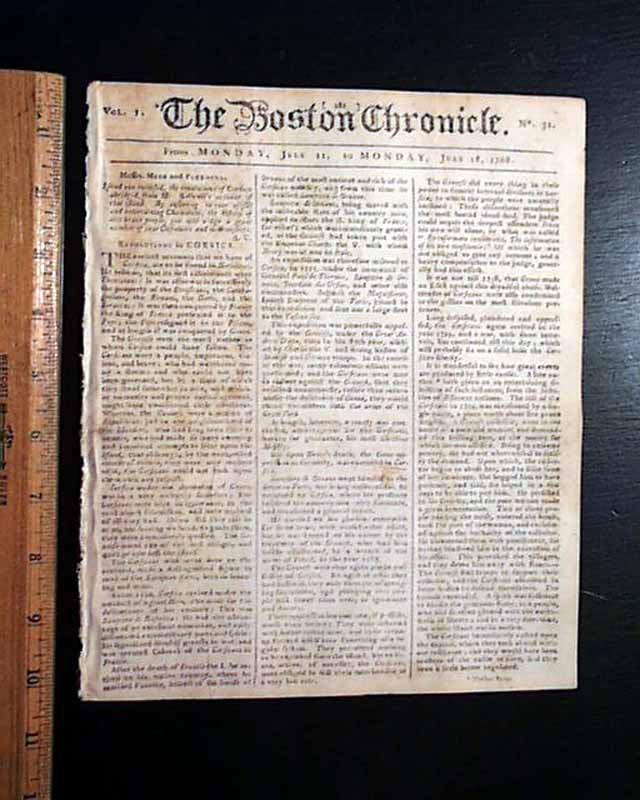
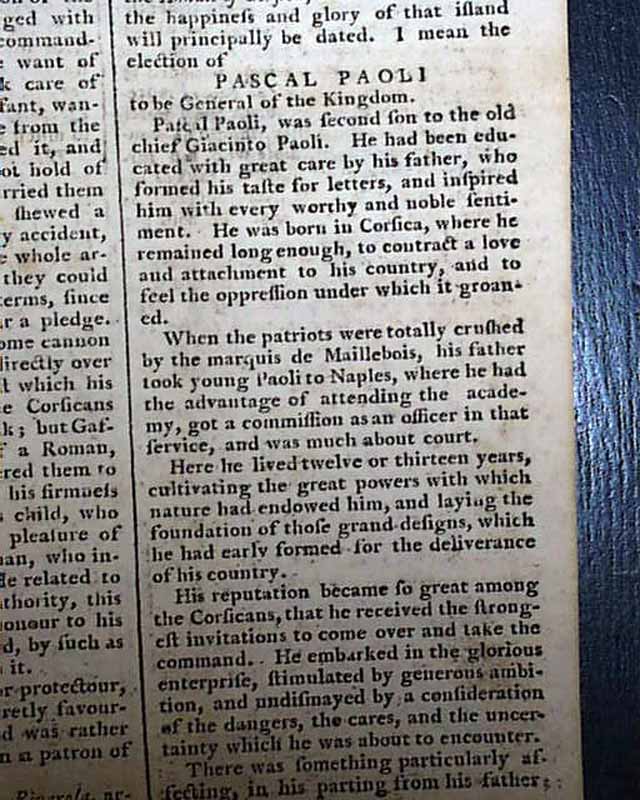
All of pages 1, 2 & 3 are taken up with a detailed report of the island of Corsica, the latter page including a biography of Pascal Paoli which carries over to take close to half of page 4.
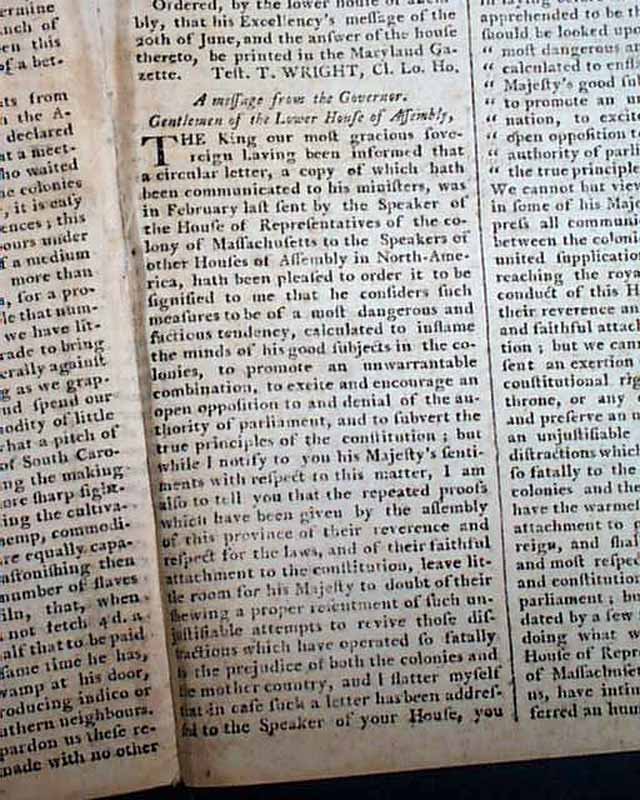
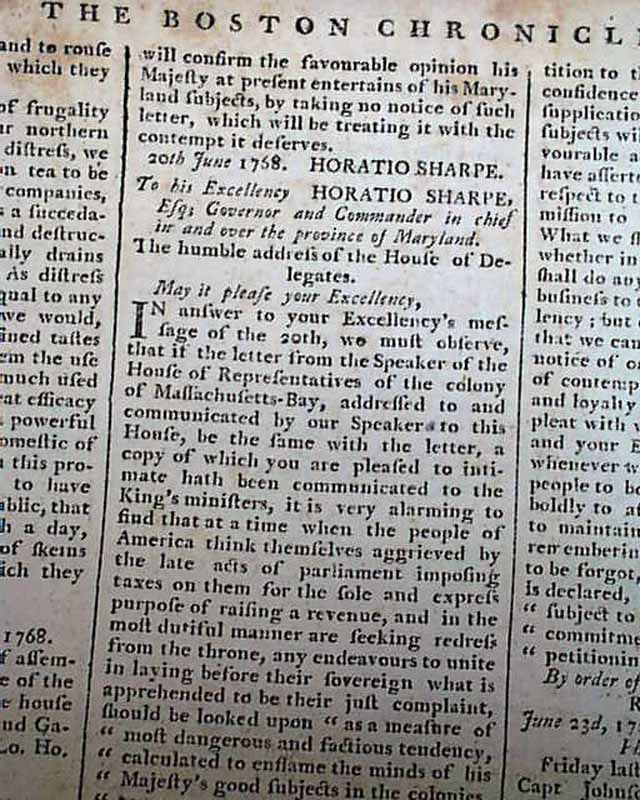
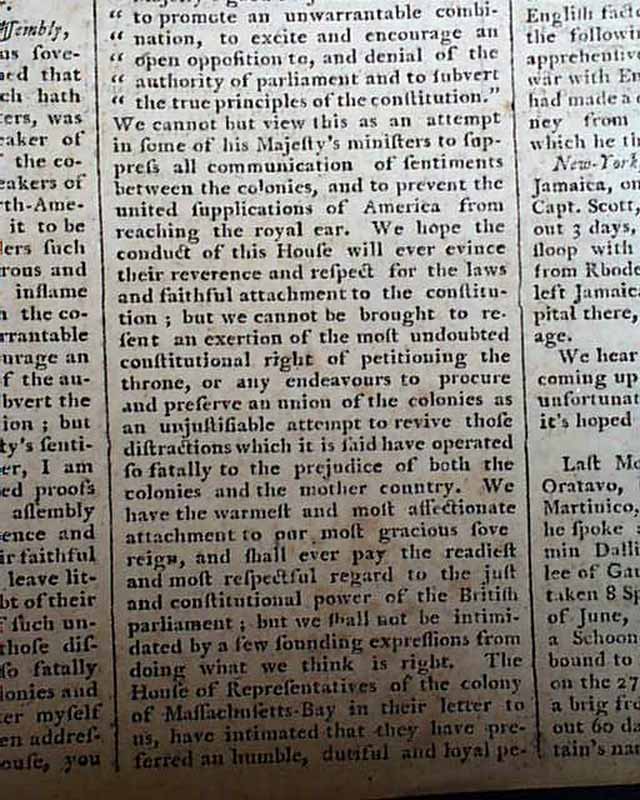
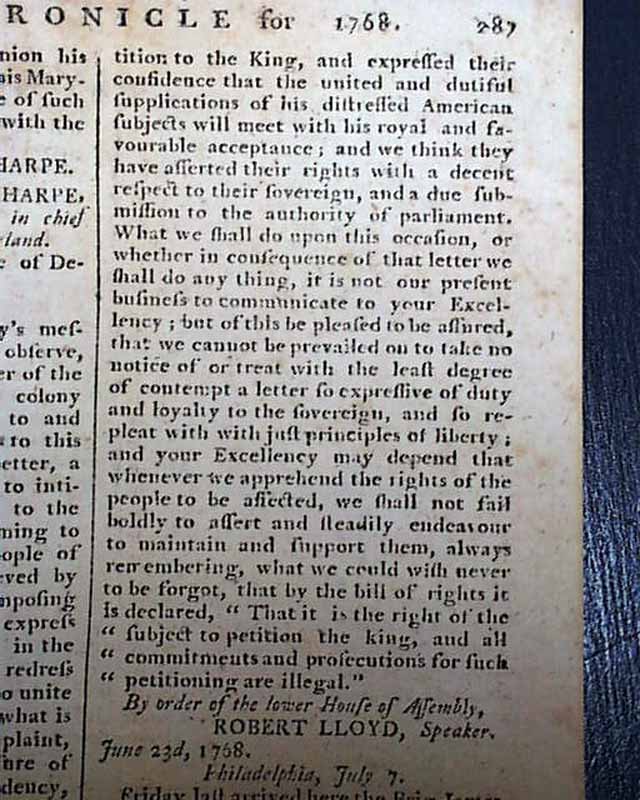
Near the back under "America" are reports from Charleston and Annapolis, as well as "A Message from the Governor" of Maryland which includes: "The King, our most gracious sovereign, having been informed that a circular letter...was in February last sent by the Speaker of the House of Rep. of the colony of Massachusetts...hath been pleased to order it to be signified to me that he considers such measures to be of a most dangerous & factious tendency, calculated to inflame the minds of his good subjects in the colonies, to promote an unwarrantable combination, to excite & encourage an open opposition to & denial of the authority of parliament, & to subvert the true principles of the constitution..." with more. This is followed by the response of the Maryland Assembly to the governor which is great reading as well.
Eight pages, 8 1/2 by 10 1/4 inches, period notations in a front page margin, very nice condition.
Background: The convergence of these reports in July 1768 highlights a critical tipping point where local colonial grievances coalesced into a unified, intercolonial resistance network, heavily fueled by global revolutionary ideals. By attempting to suppress the Massachusetts Circular Letter, the British Crown inadvertently triggered the exact "unwarrantable combination" it feared; Maryland's defiance—and the subsequent dissolution of its assembly—proved that the colonies were increasingly willing to sacrifice their own governance to stand in solidarity against taxation without representation. Meanwhile, the massive front-page coverage of Pascal Paoli’s struggle in Corsica was not mere foreign news, but a deliberate ideological mirror. It framed the American resistance not as an isolated, localized tax dispute, but as part of a grand, transatlantic crusade for human liberty, psychologically preparing the colonists to see themselves as defenders of freedom just two months before British troops arrived to occupy Boston.
This newspaper published only briefly from December 21, 1767 until 1770. The publishers, John Mein and John Fleeming, were both from Scotland. The Chronicle was a Loyalist paper in the time before the American Revolution. In its second year, Mein printed names in the paper that accused some colonial merchants of breaking a British non-importation agreement. In response, Mein's name appeared on a list of merchants who violated the trade agreement. Mein retaliated by accusing the Merchants' Committee of using the non-importation agreement for illegal profiteering. The irritated readership ransacked the offices of the Chronicle, and ultimately, it ceased operations in 1770. (credit Wikipedia)
* King of England growing impatient
* Tensions in the American Colonies
* Pre Revolutionary War original
All of pages 1, 2 & 3 are taken up with a detailed report of the island of Corsica, the latter page including a biography of Pascal Paoli which carries over to take close to half of page 4.
Near the back under "America" are reports from Charleston and Annapolis, as well as "A Message from the Governor" of Maryland which includes: "The King, our most gracious sovereign, having been informed that a circular letter...was in February last sent by the Speaker of the House of Rep. of the colony of Massachusetts...hath been pleased to order it to be signified to me that he considers such measures to be of a most dangerous & factious tendency, calculated to inflame the minds of his good subjects in the colonies, to promote an unwarrantable combination, to excite & encourage an open opposition to & denial of the authority of parliament, & to subvert the true principles of the constitution..." with more. This is followed by the response of the Maryland Assembly to the governor which is great reading as well.
Eight pages, 8 1/2 by 10 1/4 inches, period notations in a front page margin, very nice condition.
Background: The convergence of these reports in July 1768 highlights a critical tipping point where local colonial grievances coalesced into a unified, intercolonial resistance network, heavily fueled by global revolutionary ideals. By attempting to suppress the Massachusetts Circular Letter, the British Crown inadvertently triggered the exact "unwarrantable combination" it feared; Maryland's defiance—and the subsequent dissolution of its assembly—proved that the colonies were increasingly willing to sacrifice their own governance to stand in solidarity against taxation without representation. Meanwhile, the massive front-page coverage of Pascal Paoli’s struggle in Corsica was not mere foreign news, but a deliberate ideological mirror. It framed the American resistance not as an isolated, localized tax dispute, but as part of a grand, transatlantic crusade for human liberty, psychologically preparing the colonists to see themselves as defenders of freedom just two months before British troops arrived to occupy Boston.
This newspaper published only briefly from December 21, 1767 until 1770. The publishers, John Mein and John Fleeming, were both from Scotland. The Chronicle was a Loyalist paper in the time before the American Revolution. In its second year, Mein printed names in the paper that accused some colonial merchants of breaking a British non-importation agreement. In response, Mein's name appeared on a list of merchants who violated the trade agreement. Mein retaliated by accusing the Merchants' Committee of using the non-importation agreement for illegal profiteering. The irritated readership ransacked the offices of the Chronicle, and ultimately, it ceased operations in 1770. (credit Wikipedia)
Categories: The 1600's and 1700's, American
Price
$168
100% Authentic: Original printing, never a reproduction.
Other issues you may like
§ related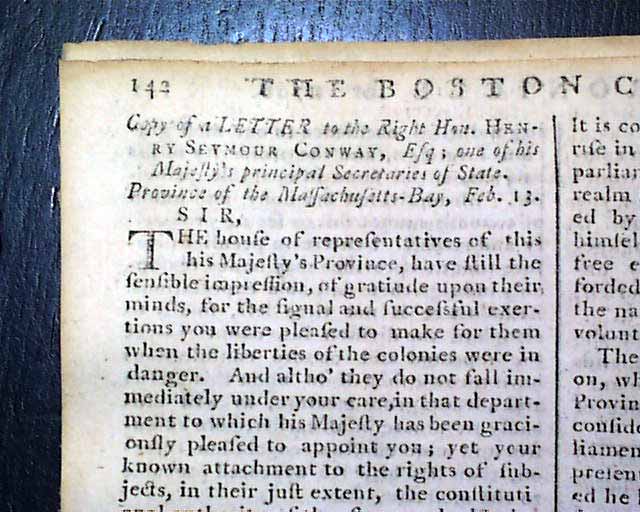
Would reject independence if offered... Regarding representation in Parliament...
THE BOSTON CHRONICLE, Massachusetts, April 4, 1768 Inside has most of a page taken up with a letter from the Speaker of the Mass. Assembly to one of the...
Apr 1768
$194
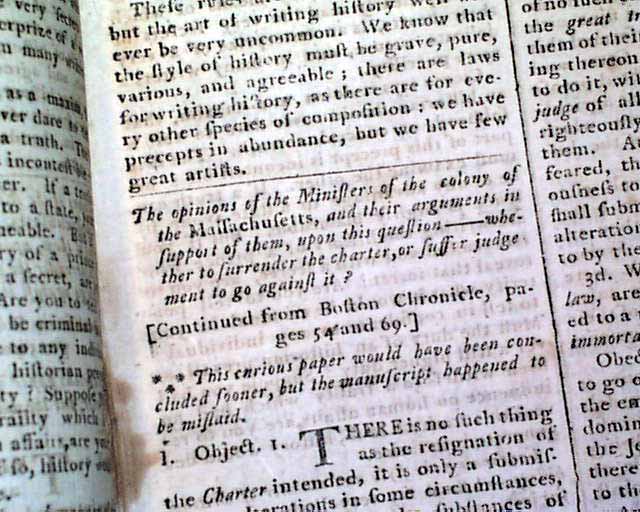
Boston newspaper with Loyalist leanings... Opinions on Massachusetts clergy re the Charter...
THE BOSTON CHRONICLE, December 26, 1768 The publisher of this newspaper had Loyalist leanings, causing its demise before the formal outbreak of the...
Dec 1768
$155
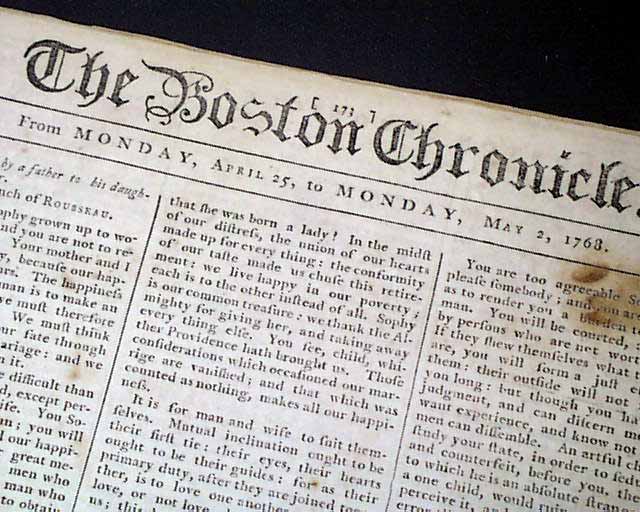
John Dickinson responds... Supplement issue also...
THE BOSTON CHRONICLE, with the "Supplement" as well, May 2, 1768
* John Dickinson
* Colonial Boston
Inside pages have various reports from colonial cities...
* John Dickinson
* Colonial Boston
Inside pages have various reports from colonial cities...
May 1768
$210
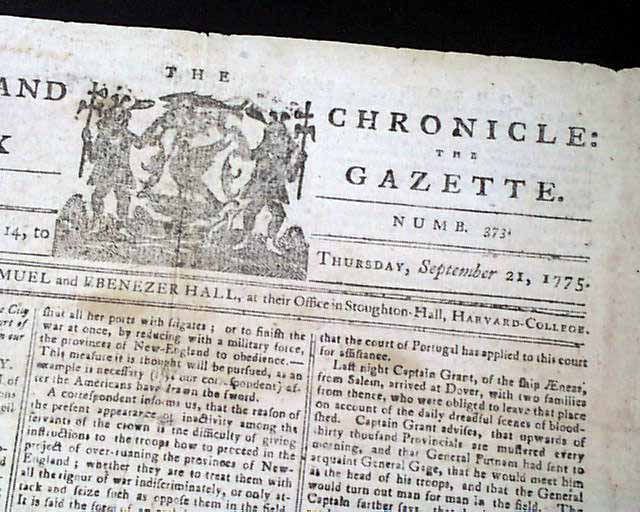
Much good, early war content...
THE NEW-ENGLAND CHRONICLE, OR THE ESSEX GAZETTE Cambridge, Sept. 21, 1775
* American Revolutionary War
This title has a rather short lifespan in Cambridge...
* American Revolutionary War
This title has a rather short lifespan in Cambridge...
Sep 1775
$575