


Angry Boston freeholders... Destroy Fort Pitt...
THE LONDON CHRONICLE, Dec. 19, 1772
- Pre-Revolutionary War America
The second page has the follow-up petition from the Freeholders of Boston expressing once again their concern about the salaries of the judges of the Superior Court, as well as a request for a special meeting of the General Assembly to discuss this important and alarming matter.
A reply from the Governor says their reasons are insufficient and they have not altered his opinion in the matter. He also denied their request for a special meeting.
Also a small item noting: "...there are positive orders to demolish Fort Pitt, the whole frontier is open to savage generosity; the people in general...have concluded to address the governor...for some troops to protect our trade & frontiers...".
Eight pages, 8 1/4 by 11 1/2 inches, nice condition.
Background: This December 19, 1772 issue of The London Chronicle captures two pivotal flashpoints in pre-Revolutionary America that illustrate the rapid unraveling of imperial authority: the Massachusetts judicial salary crisis and the British military drawdown on the western frontier. The report detailing the Boston freeholders' petition highlights the intense colonial outrage over the Crown paying Superior Court judges directly from royal customs duties, a move that stripped the local legislature of its purse-string power over the judiciary and turned judges into royal dependents. Royal Governor Thomas Hutchinson’s refusal to convene the General Assembly to address these grievances served as the direct catalyst for Samuel Adams and Boston leaders to establish the Boston Committee of Correspondence, creating the vital intercolonial communication network that organized revolutionary resistance across the colonies. Meanwhile, the item reporting orders to dismantle Fort Pitt reflects General Thomas Gage’s strategic policy of pulling troops from the interior to consolidate forces along the eastern seaboard, which left western settlers exposed to frontier conflicts, threatened the regional fur trade, and fueled deep resentments over abandoned defenses. Together, these entries provide British readers of 1772 a stark contemporary window into a dual crisis of imperial governance—the imposition of direct royal control in the East alongside the retraction of military protection in the West.
Other issues you may like
§ related
THE LONDON CHRONICLE, Dec. 19, 1772 The second page has the follow-up petition from the Freeholders of Boston expressing once again their concern about the
...
THE LONDON CHRONICLE, Dec. 19, 1772 The second page has the follow-up petition from the Freeholders of Boston expressing once again their concern about the
...
THE PENNSYLVANIA LEDGER, Philadelphia, Feb. 24, 1776
- Governor John Penn
- American Revolutionary War
- Great year to have (1776)
The front page has half a column
...
PENNSYLVANIA LEDGER, Philadelphia, Aug. 19, 1775
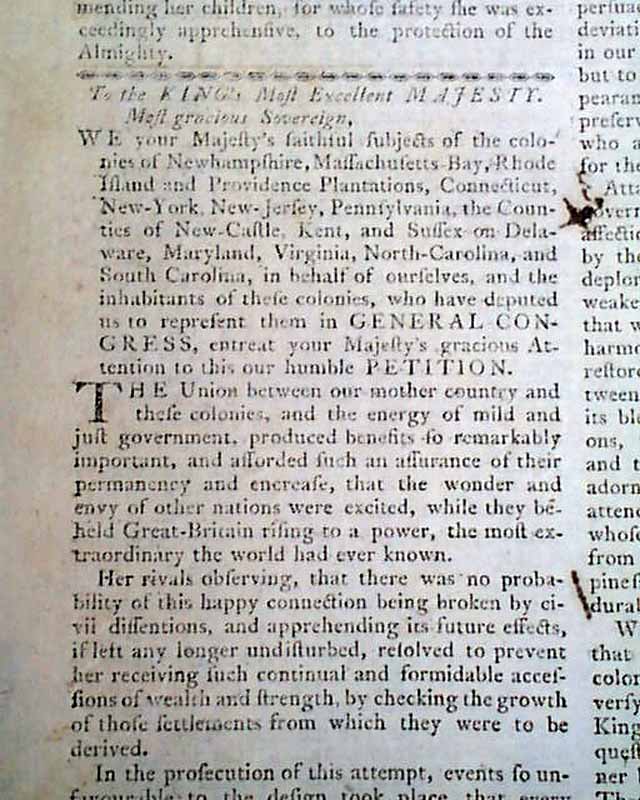
- The "Olive Branch Petition"
- Revolutionary War beginning
- Second Continental Congress
Certainly the most
...