


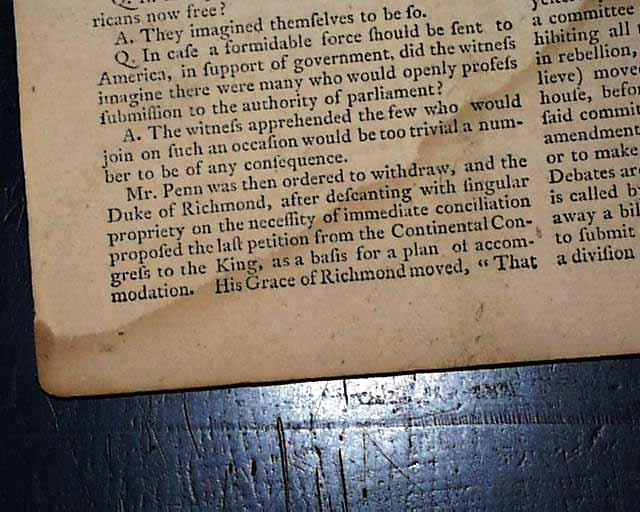

Governor Penn is cross-examined concerning America's preparedness for war...
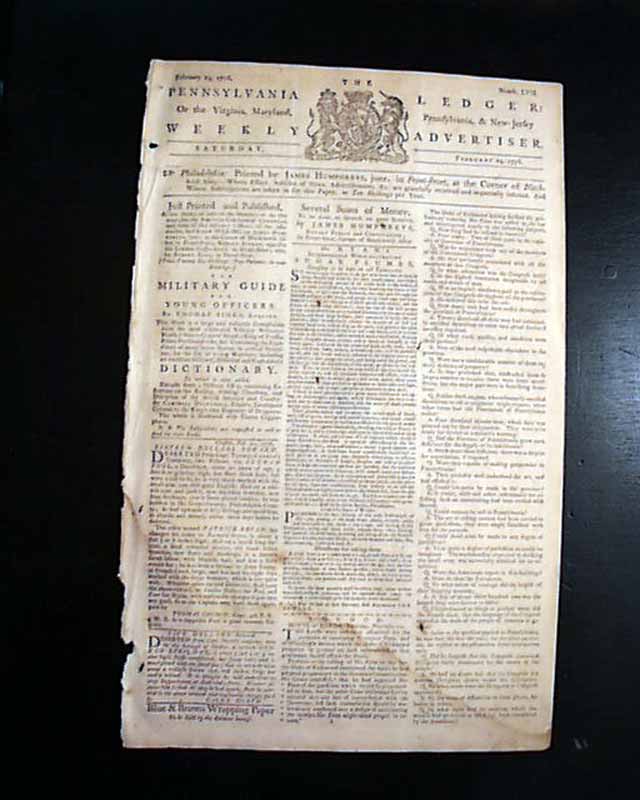
THE PENNSYLVANIA LEDGER, Philadelphia, Feb. 24, 1776
- Governor John Penn
- American Revolutionary War
- Great year to have (1776)
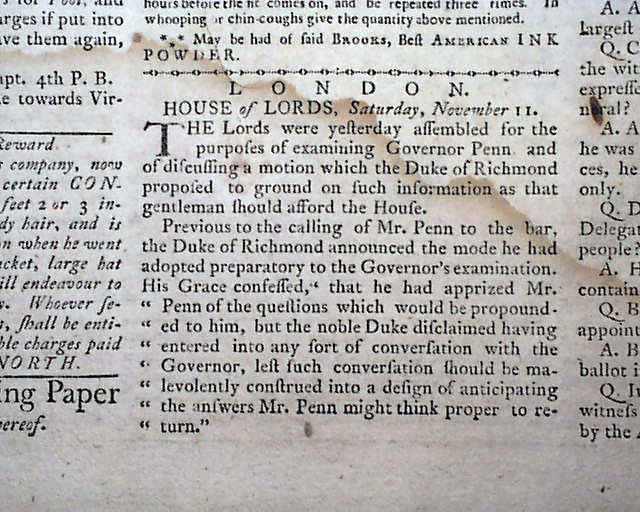
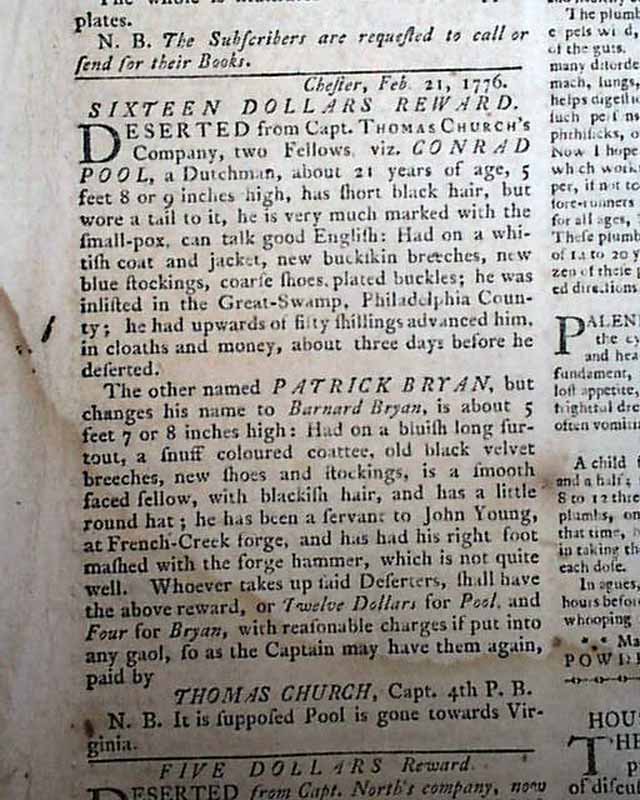
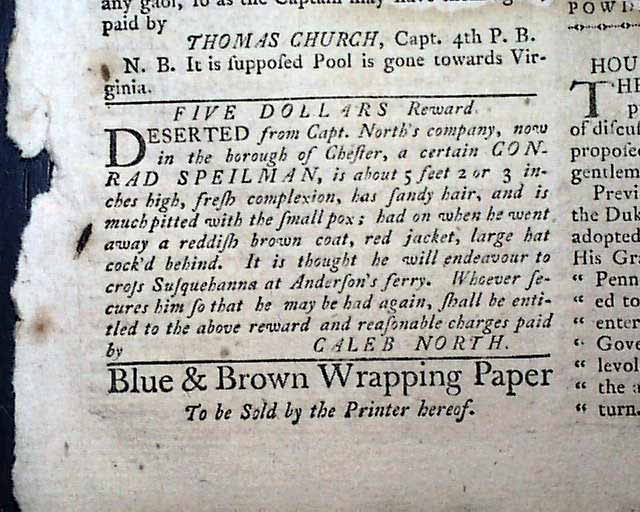
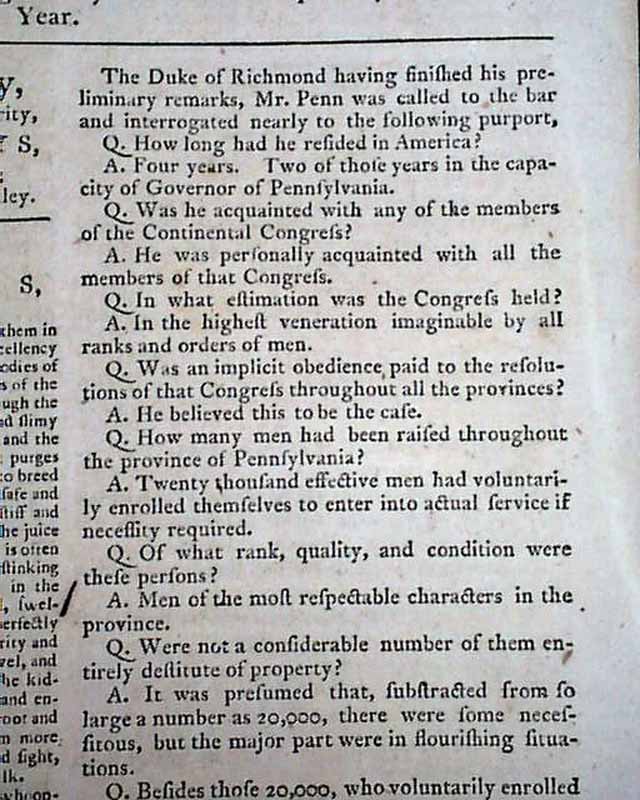
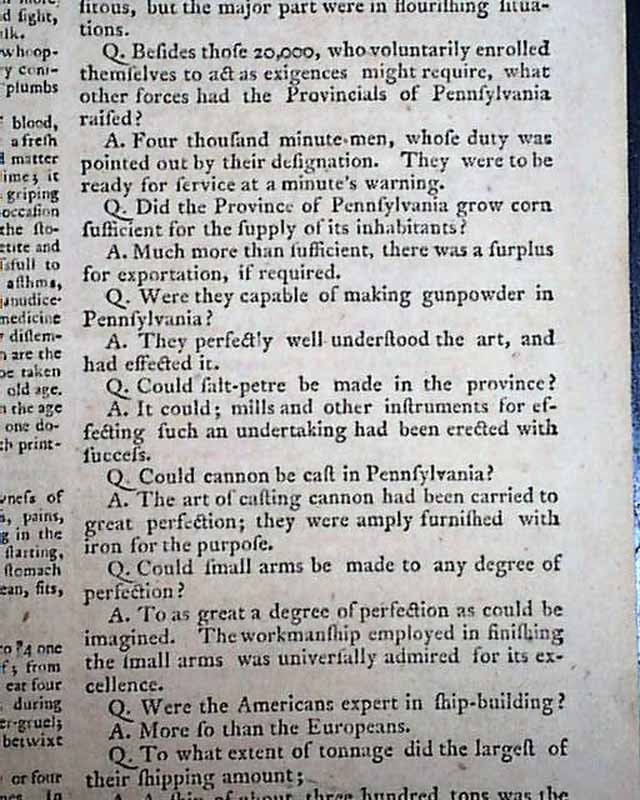
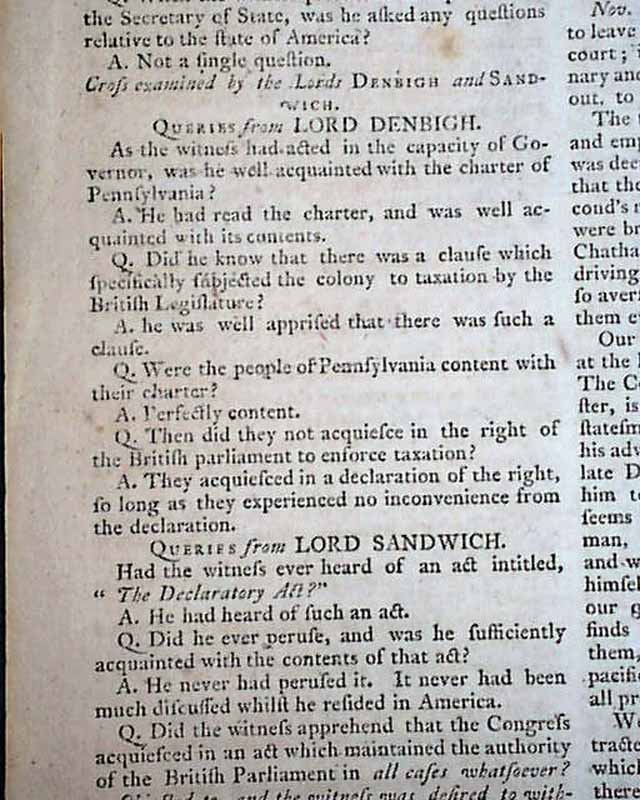
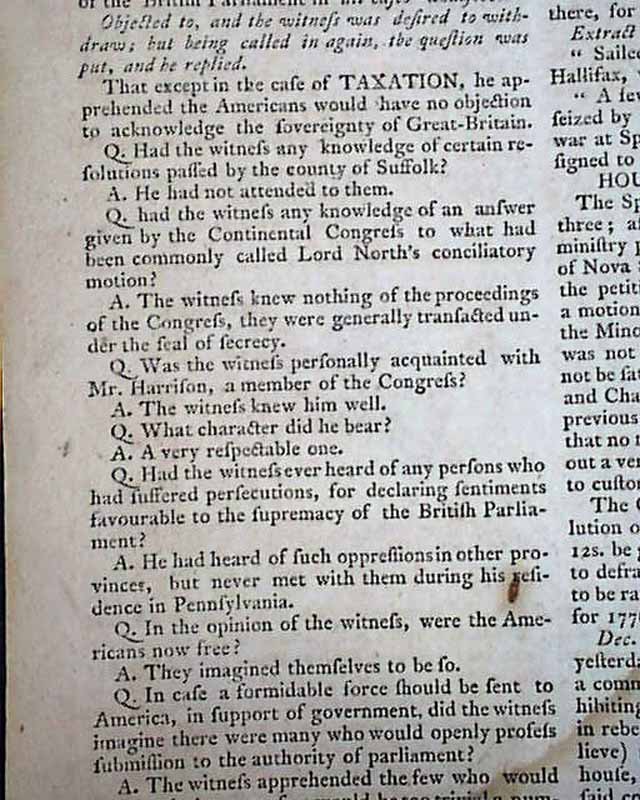
The front page has half a column taken up with 2 desertion reward ads, with much detail. Over a column is taken up with the verbatim cross-examination of Governor Penn of Pennsylvania, which carries over to take one-third of page 2. A few questions & answers include: "...Q. In what estimation was the Congress held? A. In the highest veneration imaginable by all ranks and orders of men...what other forces had the Provincials of Pennsylvania raised? A. Four thousand minute-men, whose duty was pointed out by their designation. They were to be ready for service at a minute's warning. Q. Where they capable of making gunpowder in Pennsylvania?...Q. Could small arms be made to any degree of perfection? A. To a great degree of perfection as could be imagined...Q. What did the witness recollect of the Stamp Act? A. That it caused great uneasiness throughout America...." and so much more.
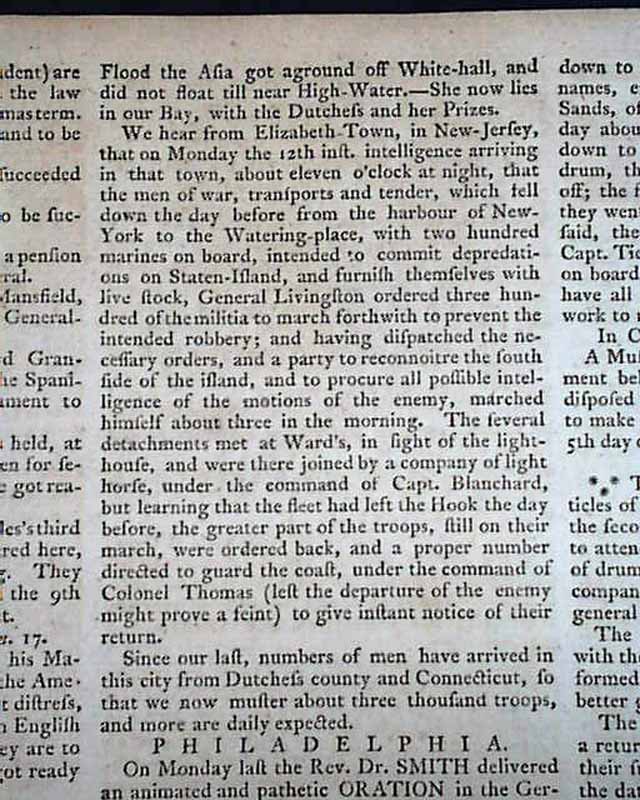
Page 3 has reports concerning the Revolutionary War. Four pages, Royal coat-of-arms in the masthead, numeric notations in margins next to ads (this was the editor's copy), damp stain near the bottom, good condition.
Background: Published in Philadelphia just five months before the Declaration of Independence, the February 24, 1776 issue of The Pennsylvania Ledger captures a critical turning point in the Revolutionary War through its verbatim transcript of Governor Richard Penn's testimony before the British House of Lords. Penn—sent to London in August 1775 to deliver the Continental Congress's Olive Branch Petition—was cross-examined on November 10, 1775, after King George III refused to receive the petition, leaving Parliament eager to gauge the colonies' actual military strength and resolve. His answers delivered a striking warning to British leadership: he affirmed that the Continental Congress was held in "the highest veneration," revealed that Pennsylvania had already raised four thousand minute-men ready at a minute's warning, and confirmed that the Americans possessed the capability to manufacture both gunpowder and small arms to a "great degree of perfection," while directly attributing the widespread colonial unrest to earlier parliamentary overreach like the Stamp Act. When this testimony crossed the Atlantic and reached the American public alongside front-page desertion reward ads—which vividly highlighted the daily strains and human realities of winter troop mobilization—it signaled to both sides that reconciliation had failed, reinforcing the momentum for total independence sweeping through Philadelphia following the recent publication of Thomas Paine's Common Sense.
Other issues you may like
§ related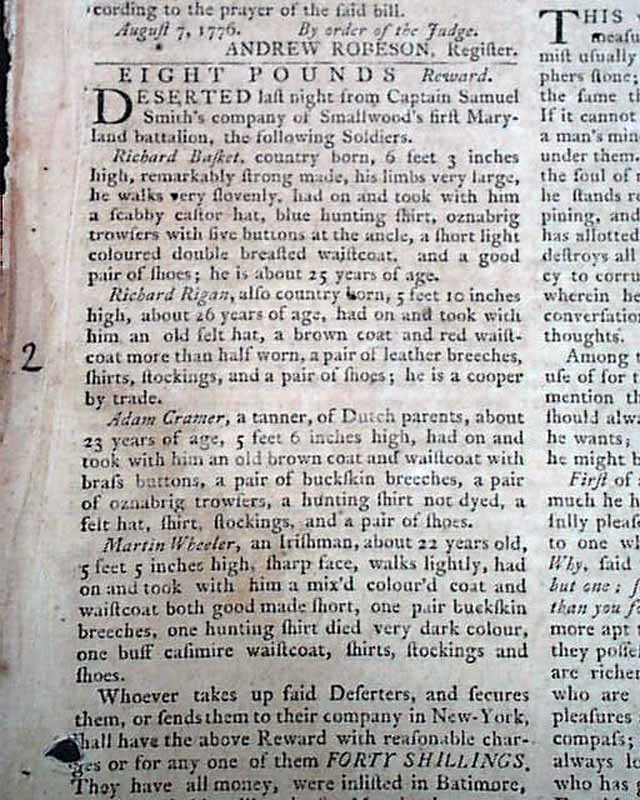
THE PENNSYLVANIA LEDGER, Philadelphia, August 17, 1776
- Post Declaration of Independence
- American Revolutionary War
This exceptional, content-rich issue was
...
PENNSYLVANIA LEDGER, Philadelphia, Aug. 19, 1775
- The "Olive Branch Petition"
- Revolutionary War beginning
- Second Continental Congress
Certainly the most
...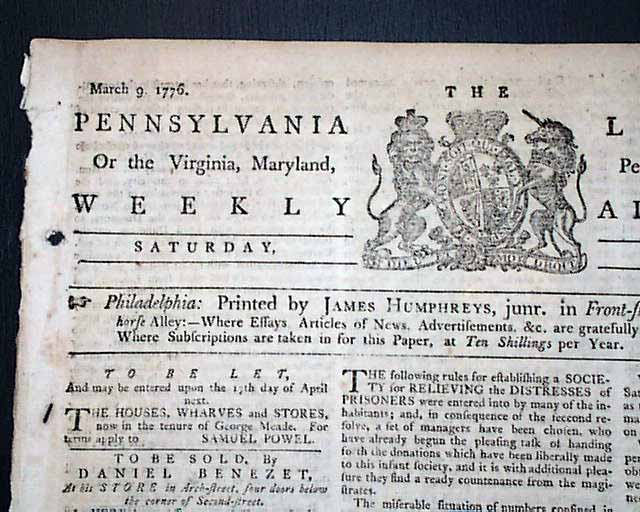
THE PENNSYLVANIA LEDGER, Philadelphia, March 9, 1776
- Rare Revolutionary War era title
- Tory issue from Pennsylvania
- Great year to have (1776)
This was a
...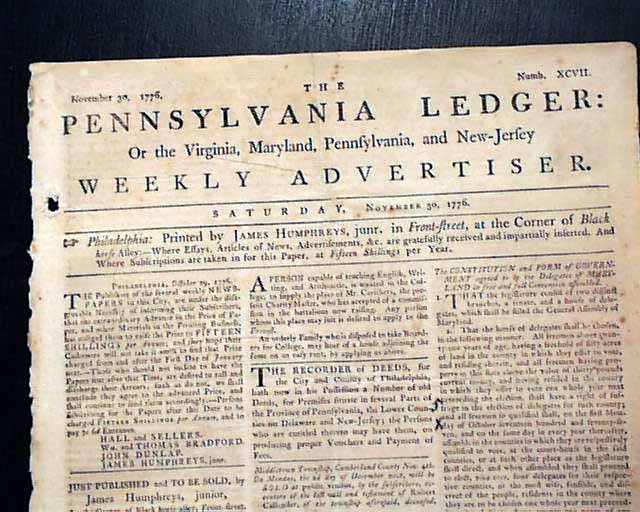
THE PENNSYLVANIA LEDGER, Philadelphia, Nov. 30, 1776
- Rare Revolutionary War era title
- Tory issue from Pennsylvania
- Great year to have (1776)
(editor's copy)
...