

First anniversary of "Juneteenth", a national holiday...
NEW YORK TIMES, June 21, 1866
- Very 1st Juneteenth anniversary observed
- Jubilee - Emancipation - Freedom Day
- Galveston, Texas celebration
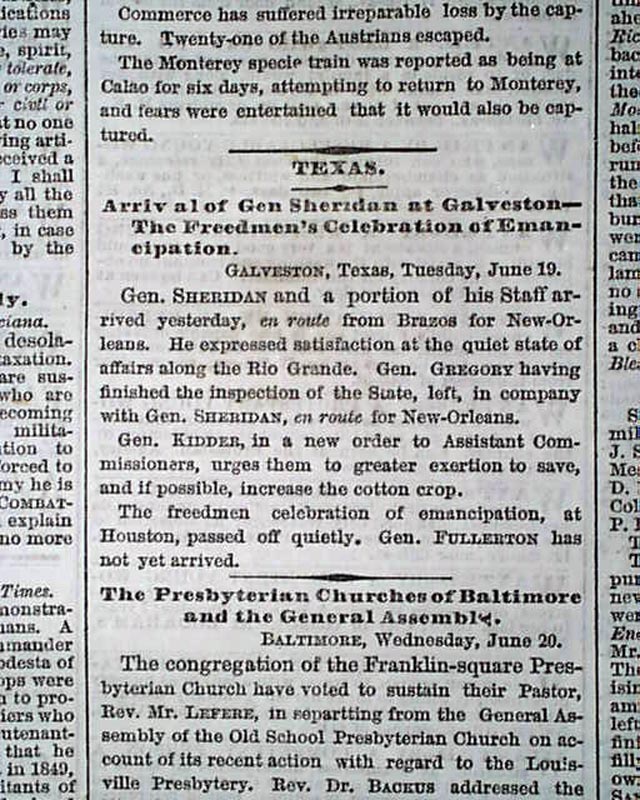
Period reports of the first "Juneteenth" event on June 19, 1865, when Union troops entered Galveston, Texas and announced to more than 250,000 enslaved blacks that they were free, are almost impossible to find.
However, we did discover a somewhat oblique mention of the first anniversary of what was then known in Texas as "Jubilee Day", which would be renamed "Juneteenth" in 1867.
Page 5 has a small report headed: "Texas - Arrival of Gen. Sheridan at Galveston--The Freedmen's Celebration of Emancipation" with a dateline from Galveston, June 19. The end of the report notes: "...The freedmen celebration of emancipation, at Houston, passed off quietly. Gen. Fullerton has not yet arrived."
A quite rare and early reference to what is now a national holiday.
Complete in 8 pages, a tear at the top of the front leaf does not impact mentioned content, otherwise very nice.
Background: This June 21, 1866, issue of The New York Times represents a remarkably rare and significant archival milestone: it contains one of the earliest known national press mentions of the very first anniversary of Juneteenth, then celebrated locally as "Jubilee Day" or "Emancipation Day." Published just one year after Major General Gordon Granger’s June 19, 1865, announcement in Galveston, Texas, that liberated more than 250,000 enslaved Black Americans, the newspaper’s brief Page 5 report highlights a freedmen’s celebration in Houston that "passed off quietly." The historical significance of this brief, somewhat obscured entry cannot be overstated; it provides undeniable, contemporary proof that despite facing an intensely hostile post-Civil War Texas environment rife with white vigilante violence and systemic oppression, newly emancipated Black communities immediately took ownership of their freedom by organizing structured, peaceful commemorations. Furthermore, because mainstream Reconstruction-era media rarely spotlighted Black cultural triumphs, this early Northern publication serves as a foundational text that validates the resilient, grassroots origins of a liberation movement that would endure for over a century before finally being recognized as a United States federal holiday.
Other issues you may like
§ related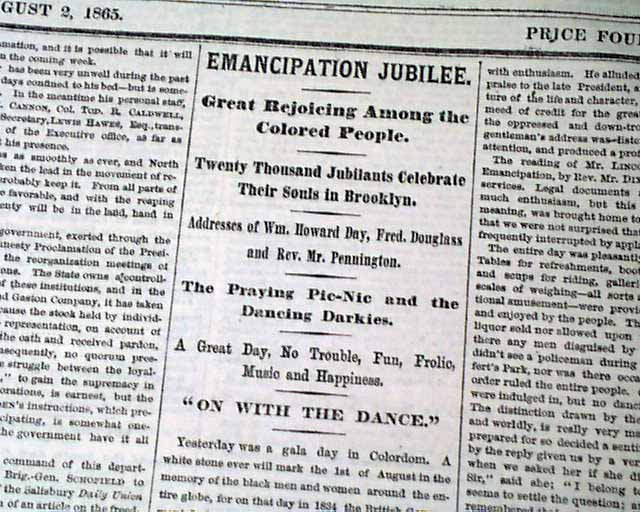
NEW YORK TIMES, Aug. 2, 1865
- Frederick Douglass speech
- Emancipation of Southern slaves
The top of the front page has: "EMANCIPATION JUBILEE" "Great Rejoicing
...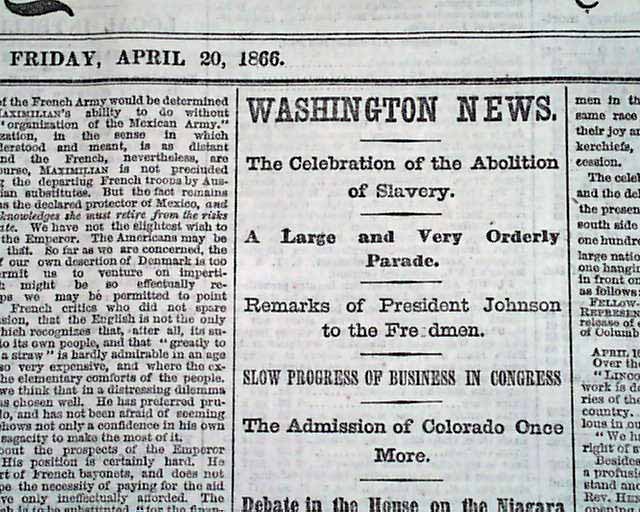
THE NEW YORK TIMES, April 20, 1866
- The 1866 celebration of the abolition of slavery within the District of Columbia
- Historically called the "Emancipation
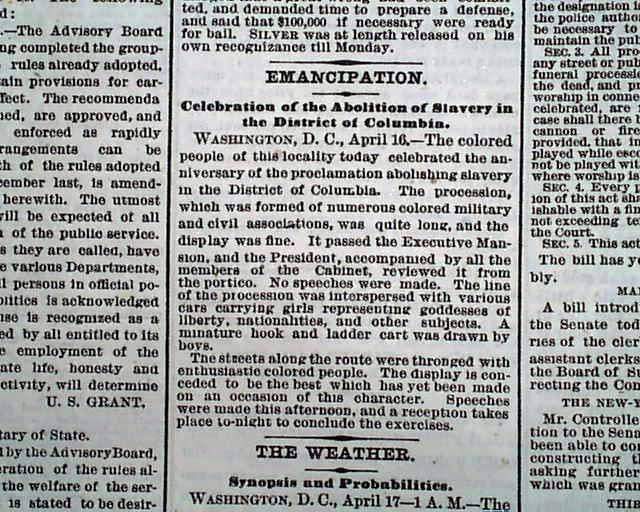
THE NEW YORK TIMES, April 17, 1872
- Emancipation of slaves
- District of Columbia
- Slavery anniversary
The front page has one column headings: "Emancipation
...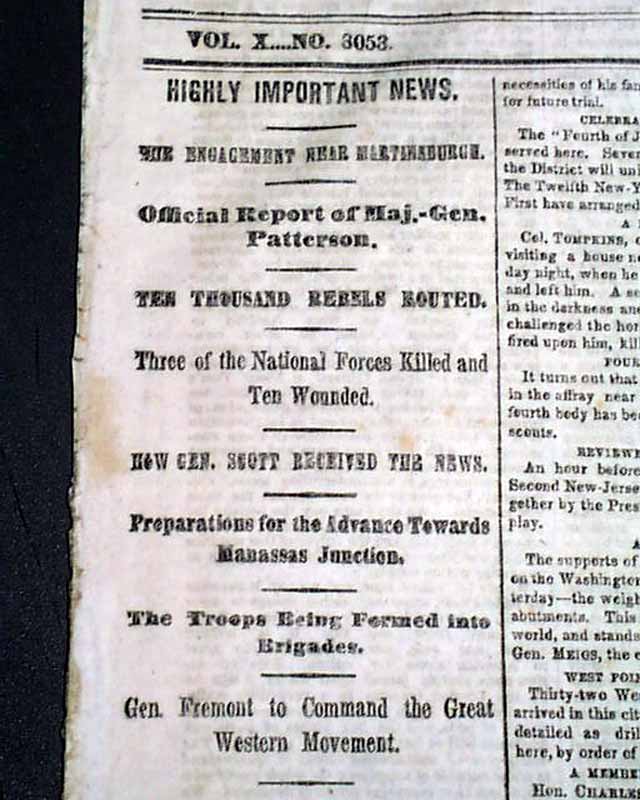
NEW YORK TIMES, July 4, 1861 Among the first column heads on the Civil War are: "The Engagement Near Martinsburgh" "Official Report of Maj.-Gen. Patterson"
...