Early on Abraham Lincoln & the slavery issue... Execution of Pirate Hicks...
Item # 712513
·
Sorry, but this item is no longer available. Please be in touch at info@rarenewspapers.com if you would like to be placed on a want list or are interested in a potential alternate issue.
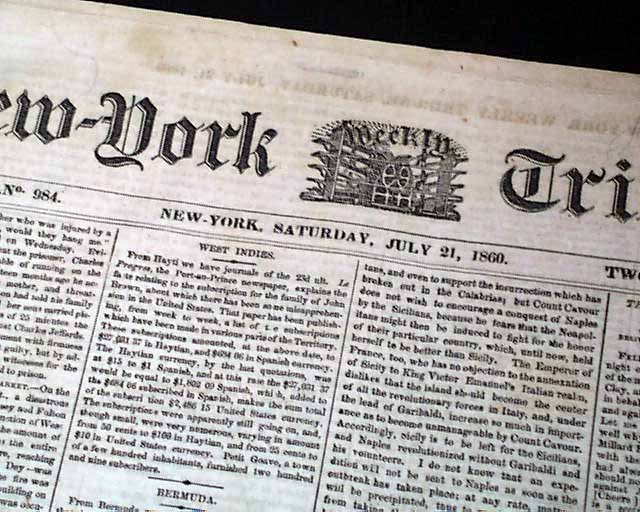
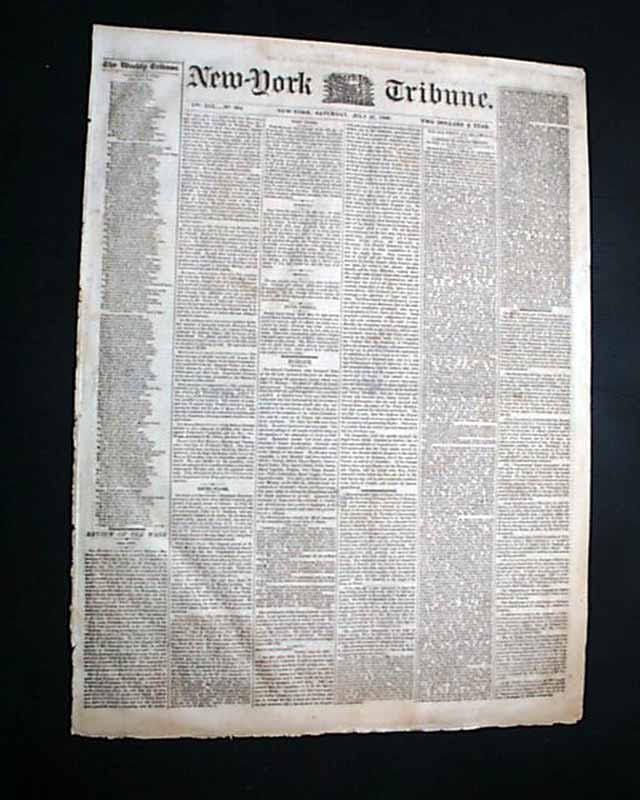
NEW YORK WEEKLY TRIBUNE, July 21, 1860
* Republican candidate Abraham Lincoln
* Anti-slavery radical ? - free slaves view ?
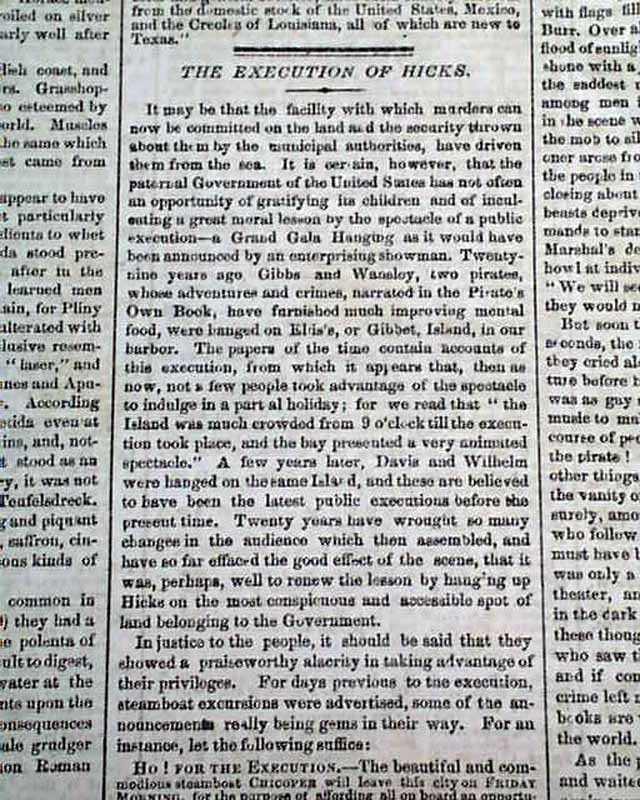
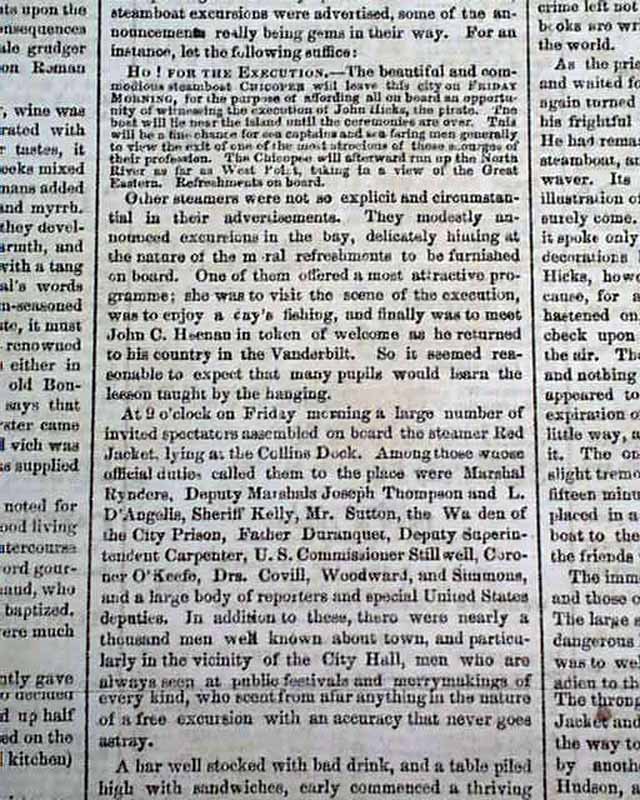
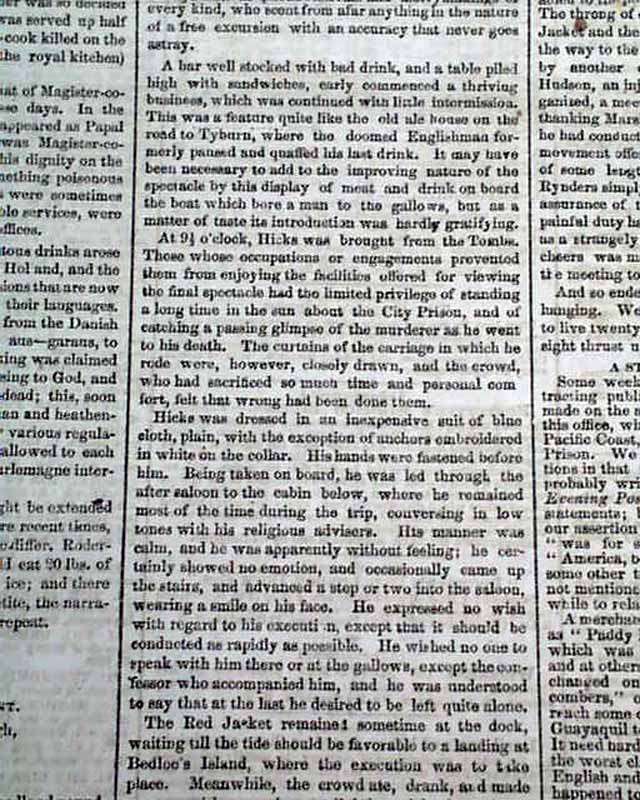
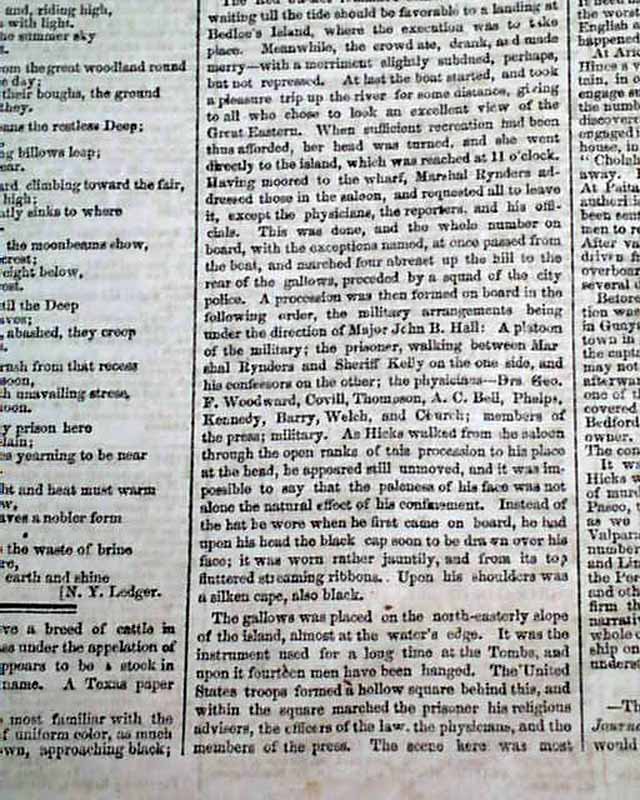
* Execution of the pirate Albert Hicks
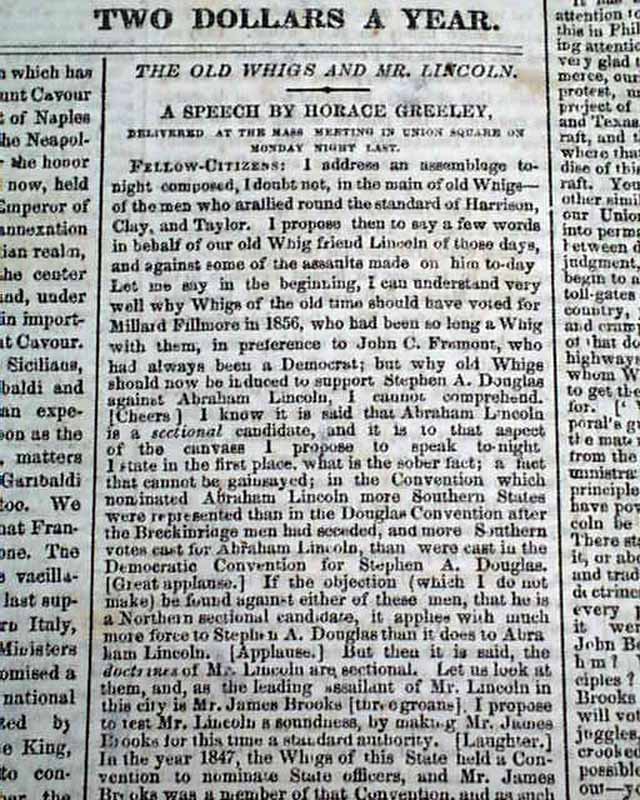
About 1 1/2 columns on the front page are taken up with a lengthy: "Speech By Horace Greeley" headed: "The Old Whigs And Mr. Lincoln", given at a recent mass meeting in Union Square.
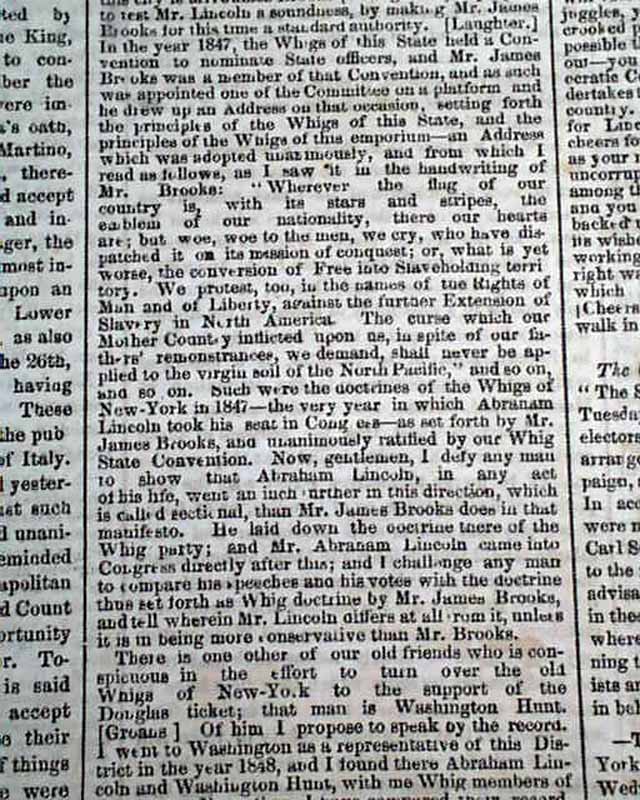
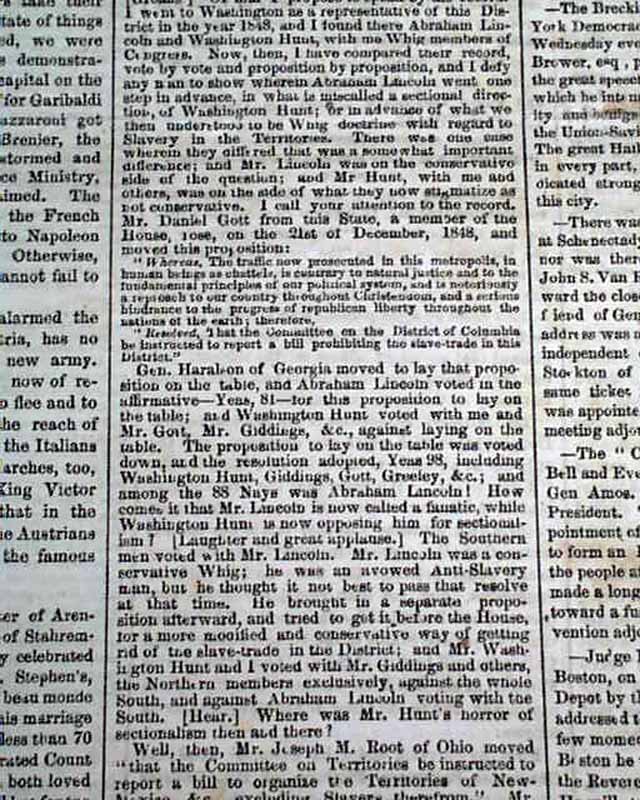
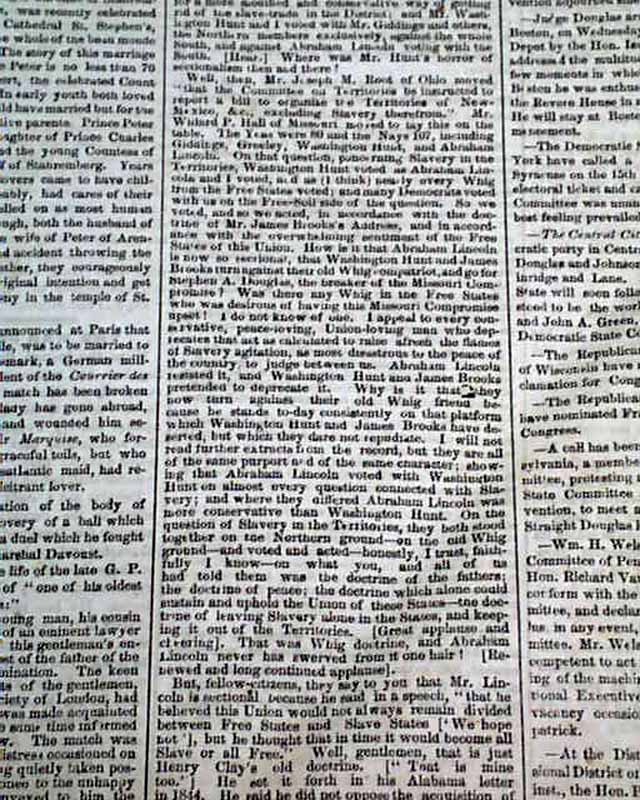
The speech has some very interesting comments concerning Abraham Lincoln, just a few including: "...I propose then to say a few words in behalf of our old Whig friend Lincoln of those days & against some of the assaults made on him to-day...Now gentlemen, I defy any man to show that Abraham Lincoln, in any act of his life, went an inch further in this direction, which is called sectional, than Mr. James Brooks does in that manifesto..." with more.
Page 7 has a lengthy article headed: "The Execution of Hicks", concerning Albert Hicks, or "Pirate Hicks", the last man executed in the United States for piracy. This article takes close to two columns and has a subhead: "A Story of Hicks, the Pirate".
Eight pages, good condition.
Background: In this prominent July 21, 1860, address delivered at a massive Republican rally in Union Square, Horace Greeley leveraged his influential media voice to directly counter political attacks accusing Abraham Lincoln of "sectionalism"—a charge designed by opponents to label Lincoln as an anti-Slavery radical who would dismantle the Union. Aiming his defense specifically at former Whigs whose votes were critical in the impending four-way presidential race, Greeley aggressively argued that Lincoln, himself a lifelong Whig before joining the Republican Party, held mainstream views on restricting the westward expansion of slavery that were no more radical than those of conservative figures like James Brooks, the prominent editor of the New York Express. By framing Lincoln’s platform within traditional Whig principles and directly confronting accusations of extremism, Greeley used the widely circulated front page of the New York Tribune as critical campaign literature to reassure conservative Northern voters, validate Lincoln's broad national appeal, and unite split political factions ahead of the November election.
* Republican candidate Abraham Lincoln
* Anti-slavery radical ? - free slaves view ?
* Execution of the pirate Albert Hicks
About 1 1/2 columns on the front page are taken up with a lengthy: "Speech By Horace Greeley" headed: "The Old Whigs And Mr. Lincoln", given at a recent mass meeting in Union Square.
The speech has some very interesting comments concerning Abraham Lincoln, just a few including: "...I propose then to say a few words in behalf of our old Whig friend Lincoln of those days & against some of the assaults made on him to-day...Now gentlemen, I defy any man to show that Abraham Lincoln, in any act of his life, went an inch further in this direction, which is called sectional, than Mr. James Brooks does in that manifesto..." with more.
Page 7 has a lengthy article headed: "The Execution of Hicks", concerning Albert Hicks, or "Pirate Hicks", the last man executed in the United States for piracy. This article takes close to two columns and has a subhead: "A Story of Hicks, the Pirate".
Eight pages, good condition.
Background: In this prominent July 21, 1860, address delivered at a massive Republican rally in Union Square, Horace Greeley leveraged his influential media voice to directly counter political attacks accusing Abraham Lincoln of "sectionalism"—a charge designed by opponents to label Lincoln as an anti-Slavery radical who would dismantle the Union. Aiming his defense specifically at former Whigs whose votes were critical in the impending four-way presidential race, Greeley aggressively argued that Lincoln, himself a lifelong Whig before joining the Republican Party, held mainstream views on restricting the westward expansion of slavery that were no more radical than those of conservative figures like James Brooks, the prominent editor of the New York Express. By framing Lincoln’s platform within traditional Whig principles and directly confronting accusations of extremism, Greeley used the widely circulated front page of the New York Tribune as critical campaign literature to reassure conservative Northern voters, validate Lincoln's broad national appeal, and unite split political factions ahead of the November election.
Item from last month's catalog - #368 - released for July, 2026
Category: Pre-Civil War
No Longer Available
100% Authentic: Original printing, never a reproduction.
Other issues you may like
§ related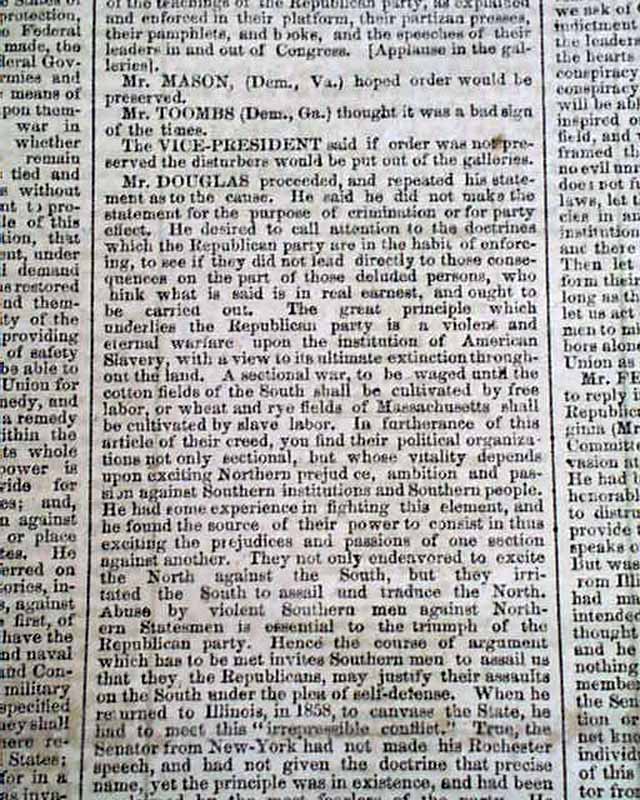
A great contemporary quote from Lincoln's famous speech - "A House divided against itself cannot stand."...
NEW YORK SEMI-WEEKLY TRIBUNE, Jan. 24, 1860
* President Abraham Lincoln
* Pre American Civil War
There is considerable reporting on the slavery issue, with a...
* President Abraham Lincoln
* Pre American Civil War
There is considerable reporting on the slavery issue, with a...
Jan 1860
$195
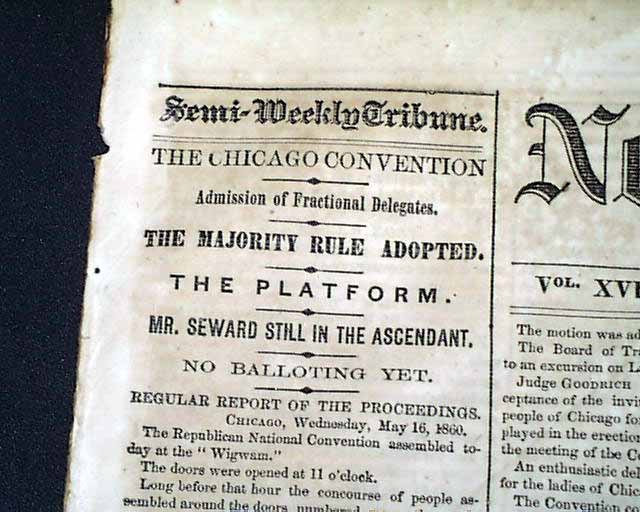
Rare mention of Lincoln, but Seward is the presumed candidate...
NEW YORK SEMI-WEEKLY TRIBUNE, May 18, 1860
* Abraham Lincoln about to make history
* Republican convention in Chicago, Illinois
A very notable...
* Abraham Lincoln about to make history
* Republican convention in Chicago, Illinois
A very notable...
May 1860
$148
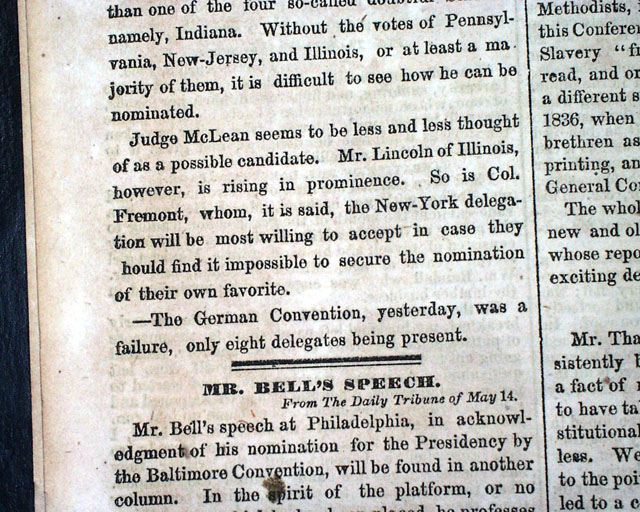
"Mr. Lincoln...is rising in prominence" says it all...
NEW YORK SEMI-WEEKLY TRIBUNE, May 15, 1860
* Abraham Lincoln gaining recognition
* At the Chicago Republican Convention
This issue is one of...
* Abraham Lincoln gaining recognition
* At the Chicago Republican Convention
This issue is one of...
May 1860
$495
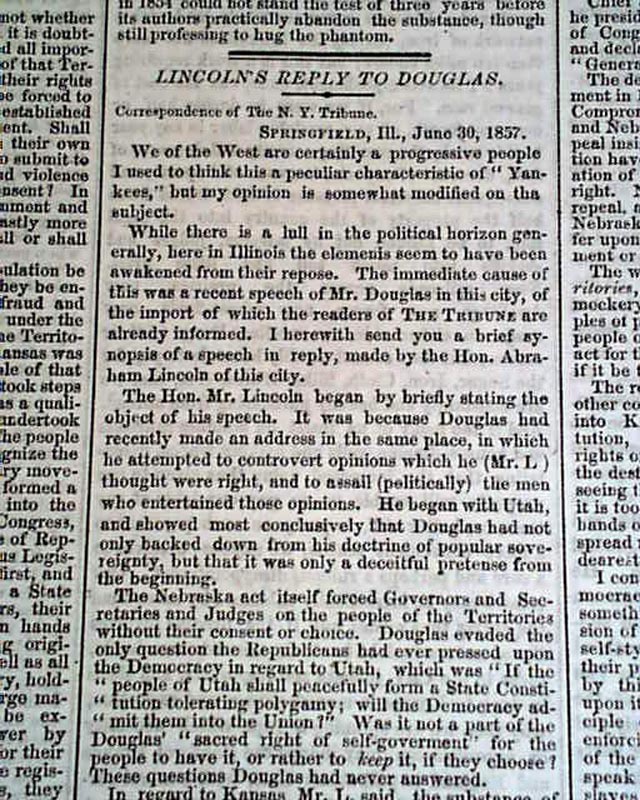
On Lincoln's seminal speech which lead to the famous Lincoln-Douglas debates...
NEW YORK TRIBUNE, July 6, 1857
* Abraham Lincoln speech
* Springfield, Illinois
* Lincoln-Douglas debates prelude
Page 3 has nearly 2 columns...
* Abraham Lincoln speech
* Springfield, Illinois
* Lincoln-Douglas debates prelude
Page 3 has nearly 2 columns...
Jul 1857
$445