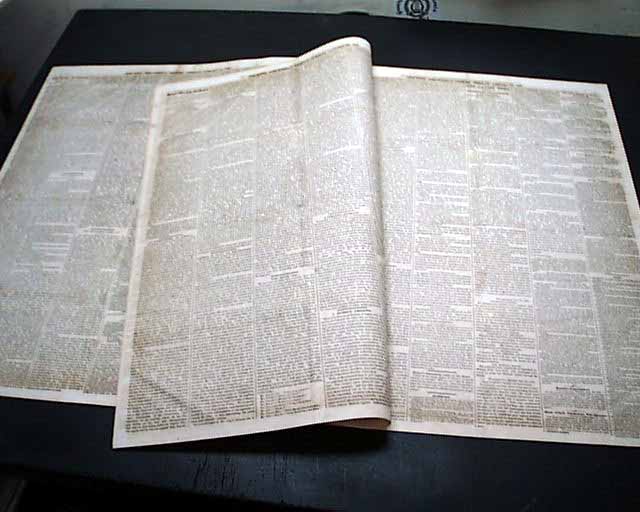
A great contemporary quote from Lincoln's famous speech - "A House divided against itself cannot stand."...
Item # 713892
·
NEW YORK SEMI-WEEKLY TRIBUNE, Jan. 24, 1860
* President Abraham Lincoln
* Pre American Civil War
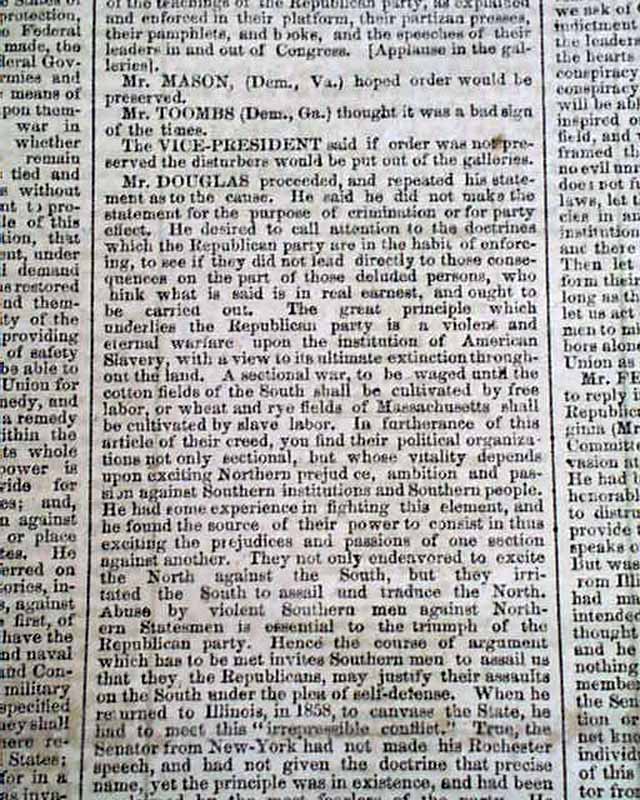
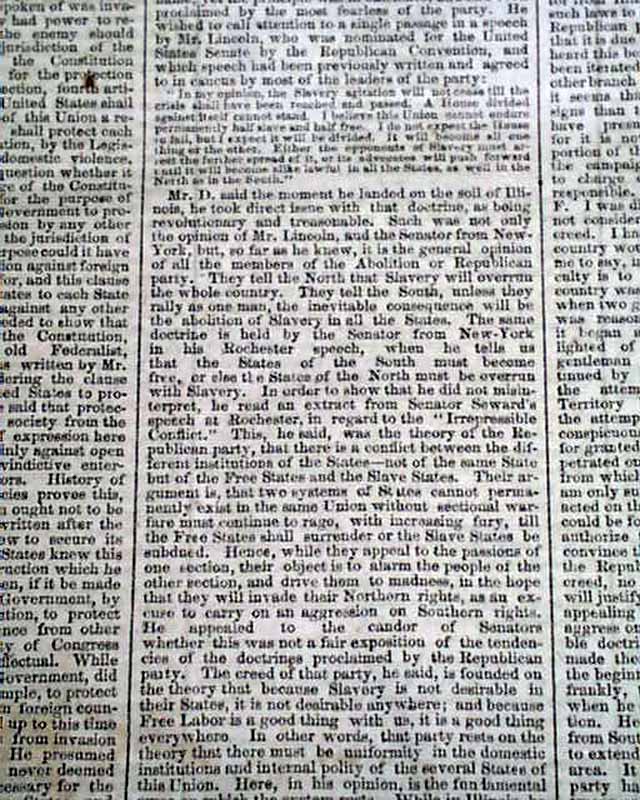
There is considerable reporting on the slavery issue, with a few mentions of Abraham Lincoln. However, of particular significance is the front page, column two re-printing of a portion of Lincoln's very famous speech in 1858 during the Lincoln-Douglas debates. During a speech on the Senate floor, Senator Douglas, speaking of Lincoln, states in part: "...When he returned to Illinois in 1858, to canvas the state, he had to meet this 'irrepressible conflict.' True, the Senator from New York had not made his Rochester speech...He wished to call attention to a single passage in a speech by Mr. Lincoln, who was nominated for the U.S. Senate by the Republican Convention, and which speech had been previously written & agreed to in caucus by most of the lasers of the party: 'In my opinion, the slavery agitation will not cease till the crisis shall have been reached and passed. A House divided against itself cannot stand. I believe this Union cannot endure permanently half slave and half free...", with a bit more on Lincoln's historic speech.
The front page is mostly taken up with great reporting from Congress, with considerable reporting on the words of Senator Stephen Douglas.
Eight pages, some scattered foxing, nice condition.
Background: This front-page excerpt from January 24, 1860, captures a pivotal moment of rhetorical warfare just months before the American Civil War, illustrating how the nation's escalating ideological divide had completely paralyzed federal governance. By weaponizing Abraham Lincoln's 1858 "House Divided" speech on the Senate floor, Northern Democrat Stephen A. Douglas sought to paint Lincoln and the nascent Republican Party as dangerous, uncompromising radicals whose belief in an "irrepressible conflict" would inevitably tear the Union apart. This debate occurred in a highly volatile, post-John Brown political atmosphere, where Southern states increasingly viewed any anti-slavery rhetoric as a direct threat to their existential survival. Ironically, while Douglas intended to disqualify Lincoln by framing his words as a partisan conspiracy hatched in a secret caucus, the nationwide reprinting of this speech in influential papers like Horace Greeley's New York Tribune actually elevated Lincoln's national profile. Instead of ruining him, this intense congressional scrutiny solidified Lincoln as a principal ideological counterweight to the expansion of slavery, setting the stage for his crucial Cooper Union address a month later and his subsequent, fracture-inducing election to the presidency.
* President Abraham Lincoln
* Pre American Civil War
There is considerable reporting on the slavery issue, with a few mentions of Abraham Lincoln. However, of particular significance is the front page, column two re-printing of a portion of Lincoln's very famous speech in 1858 during the Lincoln-Douglas debates. During a speech on the Senate floor, Senator Douglas, speaking of Lincoln, states in part: "...When he returned to Illinois in 1858, to canvas the state, he had to meet this 'irrepressible conflict.' True, the Senator from New York had not made his Rochester speech...He wished to call attention to a single passage in a speech by Mr. Lincoln, who was nominated for the U.S. Senate by the Republican Convention, and which speech had been previously written & agreed to in caucus by most of the lasers of the party: 'In my opinion, the slavery agitation will not cease till the crisis shall have been reached and passed. A House divided against itself cannot stand. I believe this Union cannot endure permanently half slave and half free...", with a bit more on Lincoln's historic speech.
The front page is mostly taken up with great reporting from Congress, with considerable reporting on the words of Senator Stephen Douglas.
Eight pages, some scattered foxing, nice condition.
Background: This front-page excerpt from January 24, 1860, captures a pivotal moment of rhetorical warfare just months before the American Civil War, illustrating how the nation's escalating ideological divide had completely paralyzed federal governance. By weaponizing Abraham Lincoln's 1858 "House Divided" speech on the Senate floor, Northern Democrat Stephen A. Douglas sought to paint Lincoln and the nascent Republican Party as dangerous, uncompromising radicals whose belief in an "irrepressible conflict" would inevitably tear the Union apart. This debate occurred in a highly volatile, post-John Brown political atmosphere, where Southern states increasingly viewed any anti-slavery rhetoric as a direct threat to their existential survival. Ironically, while Douglas intended to disqualify Lincoln by framing his words as a partisan conspiracy hatched in a secret caucus, the nationwide reprinting of this speech in influential papers like Horace Greeley's New York Tribune actually elevated Lincoln's national profile. Instead of ruining him, this intense congressional scrutiny solidified Lincoln as a principal ideological counterweight to the expansion of slavery, setting the stage for his crucial Cooper Union address a month later and his subsequent, fracture-inducing election to the presidency.
Category: Pre-Civil War
Price
$195
100% Authentic: Original printing, never a reproduction.
Other issues you may like
§ related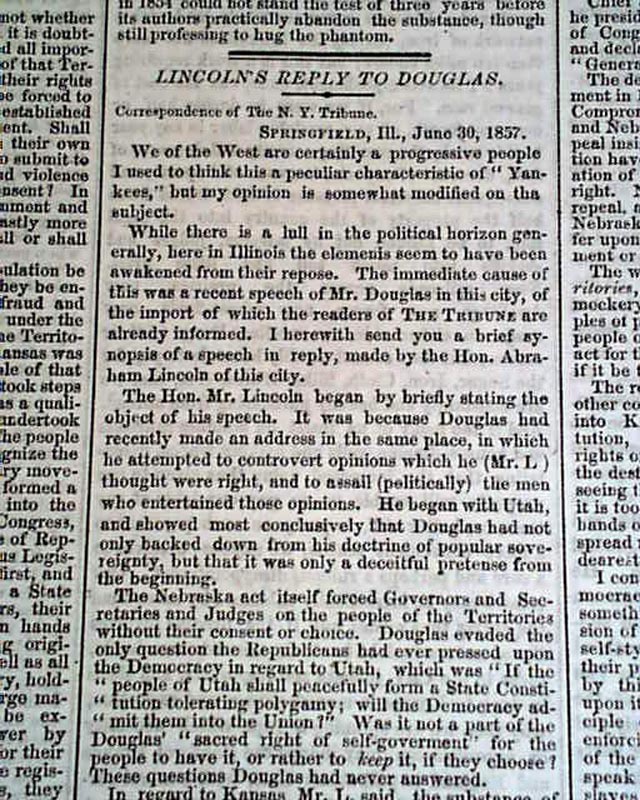
On Lincoln's seminal speech which lead to the famous Lincoln-Douglas debates...
NEW YORK TRIBUNE, July 6, 1857
* Abraham Lincoln speech
* Springfield, Illinois
* Lincoln-Douglas debates prelude
Page 3 has nearly 2 columns...
* Abraham Lincoln speech
* Springfield, Illinois
* Lincoln-Douglas debates prelude
Page 3 has nearly 2 columns...
Jul 1857
$445
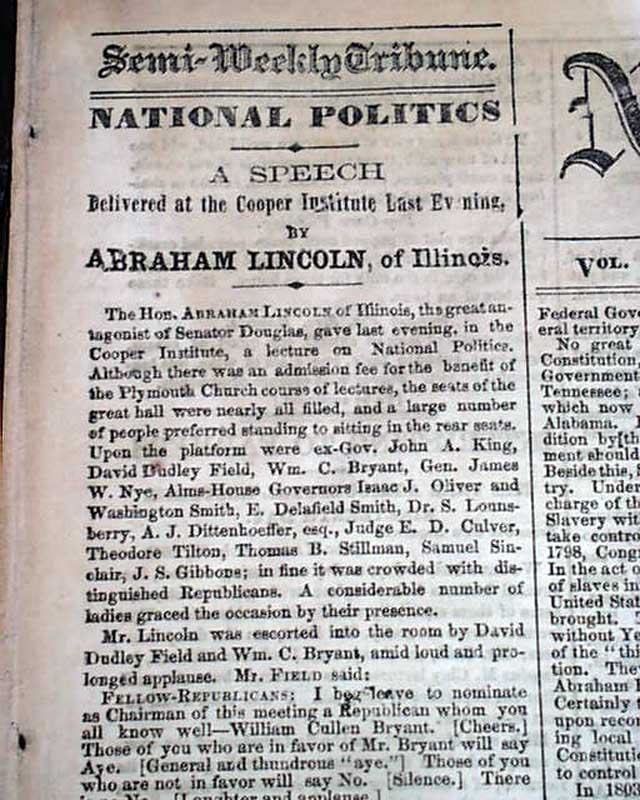
Lincoln steps upon the national stage... The Cooper Union speech...
NEW YORK SEMI-WEEKLY TRIBUNE, Feb. 28, 1860
* Historic Abraham Lincoln address
* Cooper Institute Union speech
* Launched into national prominence
The front...
* Historic Abraham Lincoln address
* Cooper Institute Union speech
* Launched into national prominence
The front...
Feb 1860
$4,125
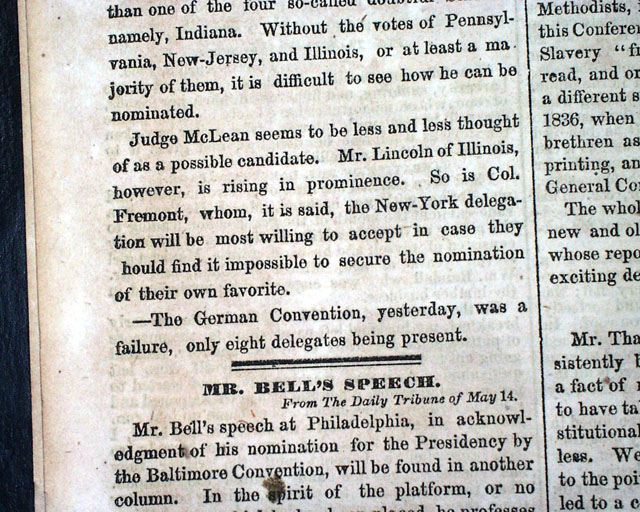
"Mr. Lincoln...is rising in prominence" says it all...
NEW YORK SEMI-WEEKLY TRIBUNE, May 15, 1860
* Abraham Lincoln gaining recognition
* At the Chicago Republican Convention
This issue is one of...
* Abraham Lincoln gaining recognition
* At the Chicago Republican Convention
This issue is one of...
May 1860
$495
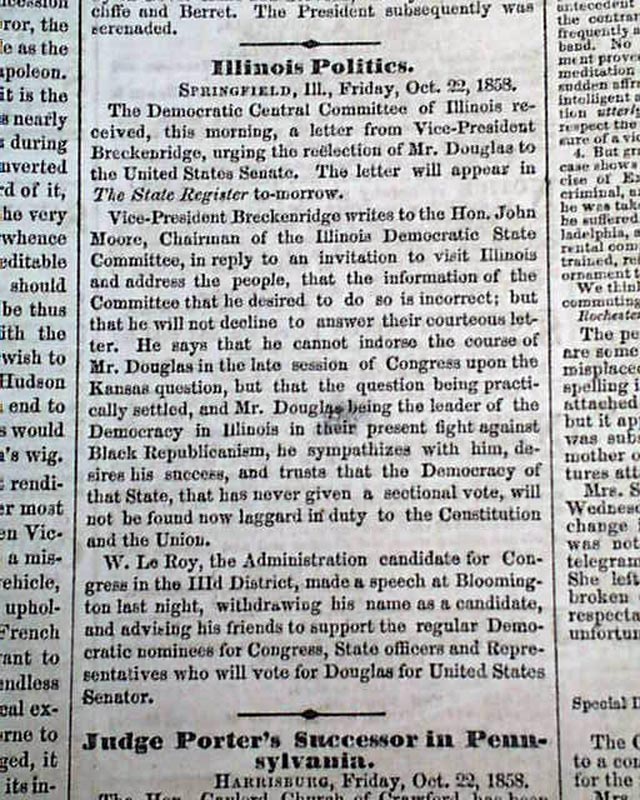
Great account of the last of the Lincoln-Douglas debates...
NEW YORK TRIBUNE, Oct. 23, 1858
* Abraham Lincoln & Stephen Douglas
* The Great Debates of 1858 (last one)
* Alton, Madison County, Illinois
...
* Abraham Lincoln & Stephen Douglas
* The Great Debates of 1858 (last one)
* Alton, Madison County, Illinois
...
Oct 1858
$725