

Plan to create a nobility for the United States...
Item # 709922Sorry, but this item is no longer available. Please be in touch at info@rarenewspapers.com if you would like to be placed on a want list or are interested in a potential alternate issue.
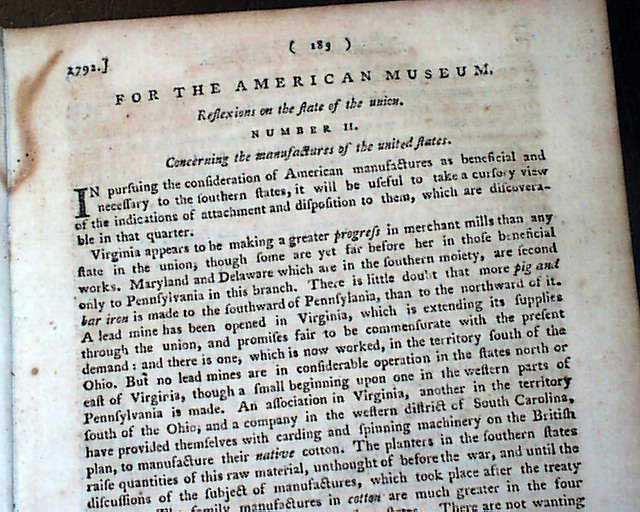
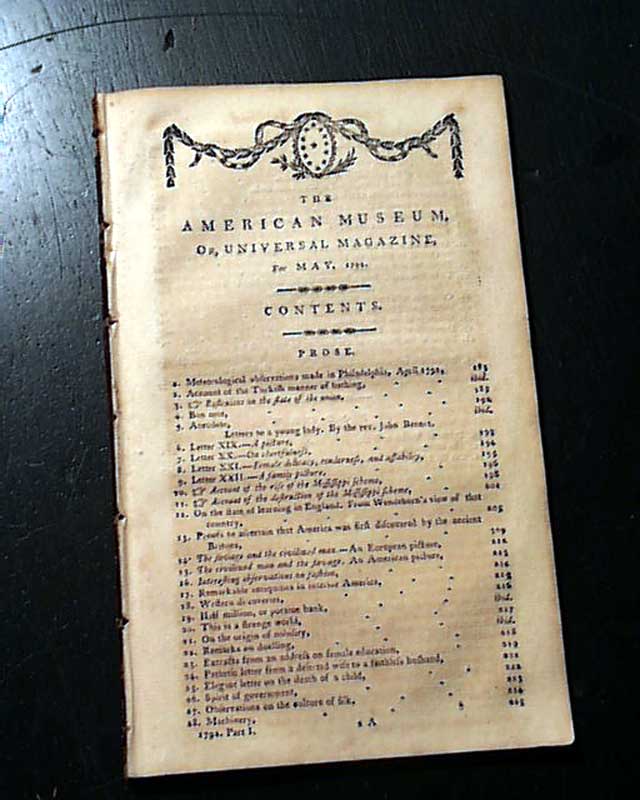
THE AMERICAN MUSEUM, Philadelphia, May, 1792 This title, along with the "Columbian Magazine", has the honor of being the first successful American magazine, both published in Philadelphia. The Museum was published by Mathew Carey and existed from January, 1787 thru the end of 1792.
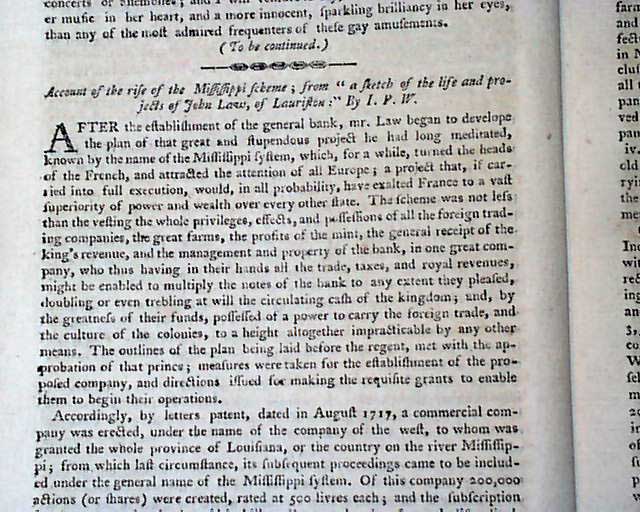
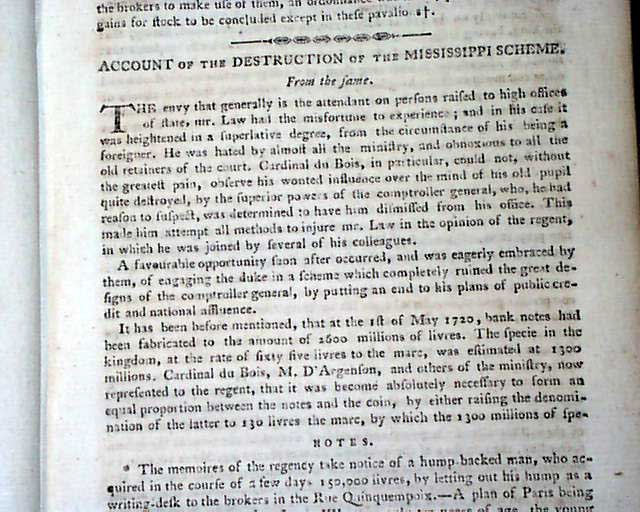
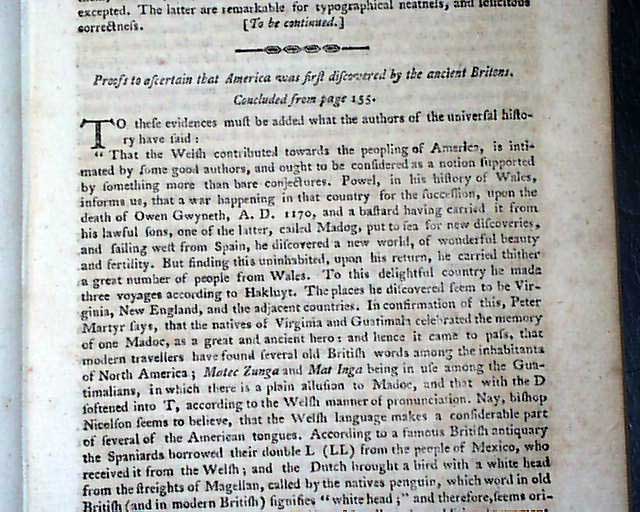
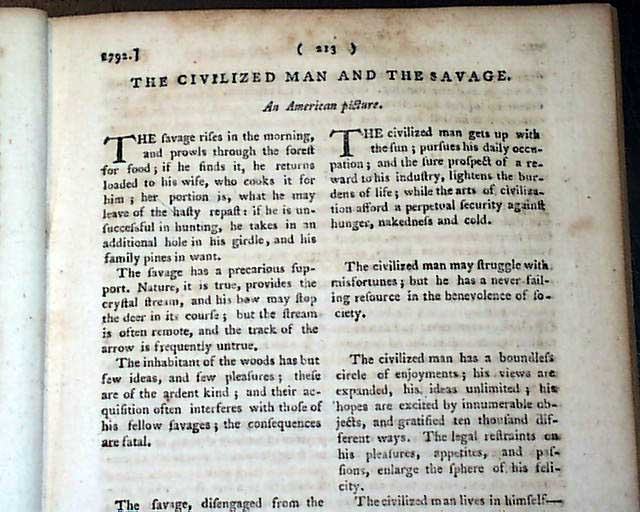
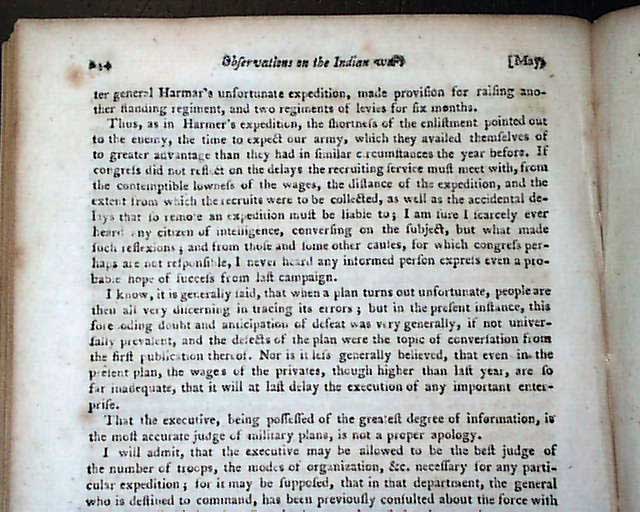
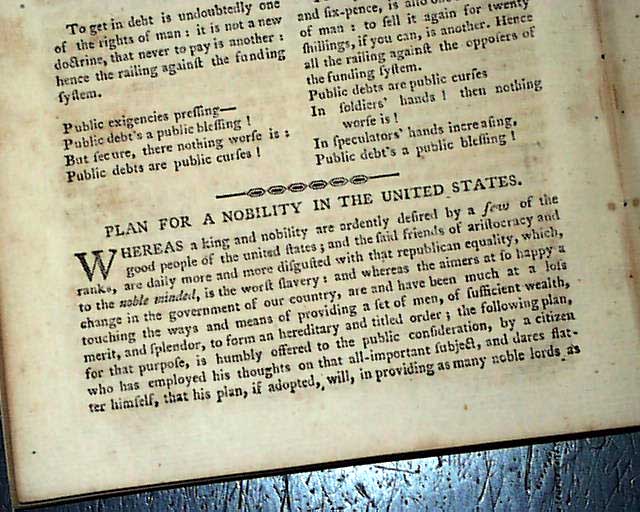
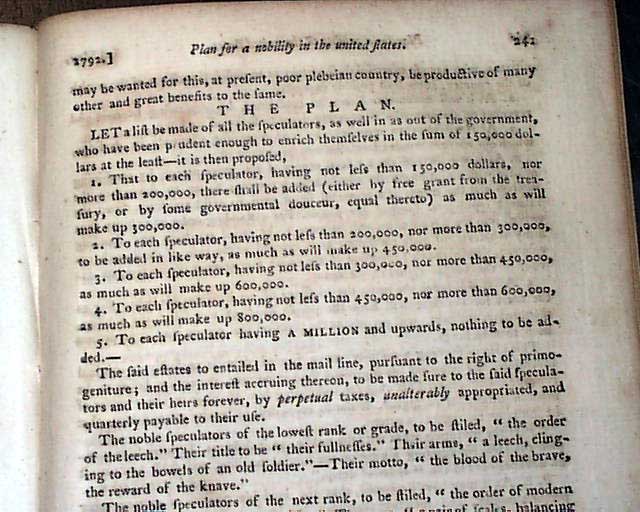
Content includes: "Account of the Rise of the Mississippi Scheme" "Account of the Destruction of the Mississippi Scheme" "Proofs to Ascertain that America was First Discovered by the Ancient Britons" "The Civilized Man & The Savage" "Remarkable Antiquities in Interior America" "Western Discoveries" "Remarks on Dueling"; a continuation of: "Account of the New Colony at Sierra Leone"; a continuation of: "Observations on the Indian War" "Discharge of the Four Nations" of Indians; and a very interesting: "Plans for a Nobility in the United States". Also present is a moving letter from a father written upon the untimely death of his child.
Complete in 68 pages, 5 by 8 inches, full title/contents page with a decorative heading, great condition. No appendices are included.
Background: The publication of the May 1792 issue of The American Museum represents a pivotal moment in the development of American national identity, as Mathew Carey’s periodical functioned as the young republic's premier intellectual clearinghouse. By curating a sophisticated blend of economic warnings (the Mississippi Scheme), social commentary (remarks on dueling), and controversial political theory (plans for an American nobility), the magazine bridged the gap between the elite Enlightenment circles and a growing literate middle class. Its historical significance is anchored in its role as a "national archive" that documented the tension between newly won democratic ideals and the lingering influences of European aristocracy, all while attempting to forge a distinct cultural history through articles on "Ancient Britons" and "Western Discoveries." Ultimately, the magazine’s existence proved that the United States could sustain a "successful" literary venture, setting the standard for the American magazine industry by providing a unified platform for the diverse political and social discourse of the 1790s.
Content includes: "Account of the Rise of the Mississippi Scheme" "Account of the Destruction of the Mississippi Scheme" "Proofs to Ascertain that America was First Discovered by the Ancient Britons" "The Civilized Man & The Savage" "Remarkable Antiquities in Interior America" "Western Discoveries" "Remarks on Dueling"; a continuation of: "Account of the New Colony at Sierra Leone"; a continuation of: "Observations on the Indian War" "Discharge of the Four Nations" of Indians; and a very interesting: "Plans for a Nobility in the United States". Also present is a moving letter from a father written upon the untimely death of his child.
Complete in 68 pages, 5 by 8 inches, full title/contents page with a decorative heading, great condition. No appendices are included.
Background: The publication of the May 1792 issue of The American Museum represents a pivotal moment in the development of American national identity, as Mathew Carey’s periodical functioned as the young republic's premier intellectual clearinghouse. By curating a sophisticated blend of economic warnings (the Mississippi Scheme), social commentary (remarks on dueling), and controversial political theory (plans for an American nobility), the magazine bridged the gap between the elite Enlightenment circles and a growing literate middle class. Its historical significance is anchored in its role as a "national archive" that documented the tension between newly won democratic ideals and the lingering influences of European aristocracy, all while attempting to forge a distinct cultural history through articles on "Ancient Britons" and "Western Discoveries." Ultimately, the magazine’s existence proved that the United States could sustain a "successful" literary venture, setting the standard for the American magazine industry by providing a unified platform for the diverse political and social discourse of the 1790s.
Category: The 1600's and 1700's


