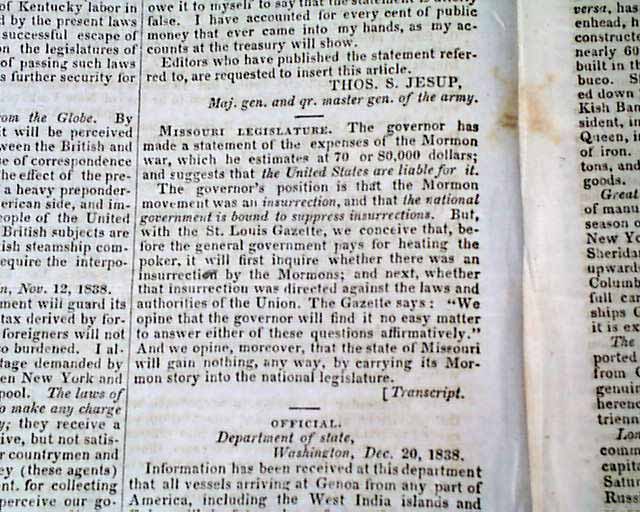
Who is to pay for the Mormon War?
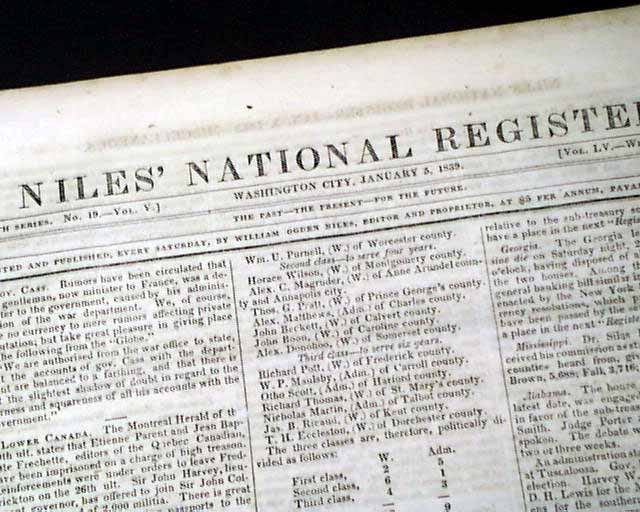
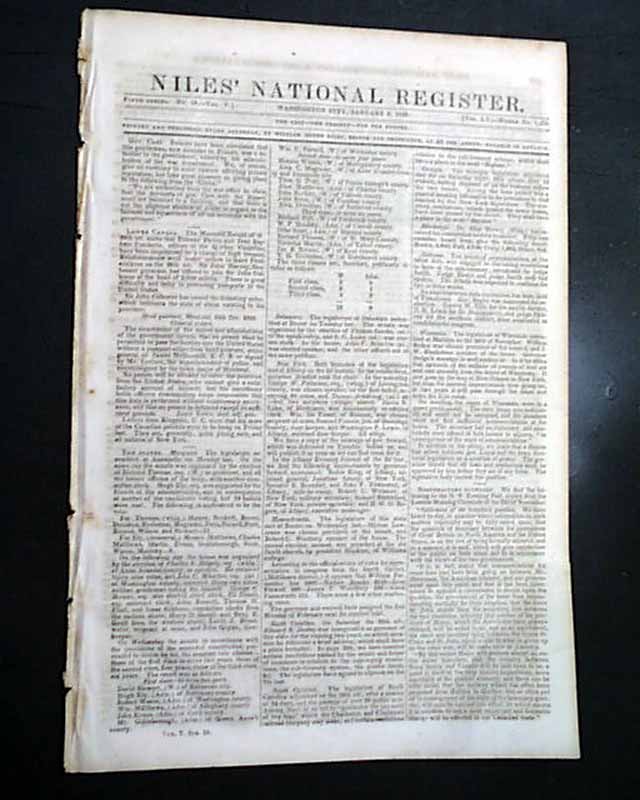
NILES' NATIONAL REGISTER, Washington City, Jan. 5, 1839
- Missouri Mormon War
- Latter-day Saints settlers
- Governor Lilburn Boggs
Page 2 has a report from the Missouri legislature which includes "...governor has made a statement of the expenses of the Mormon war...and suggests that the United States are liable for it. The governor's position is that the Mormon movement was an insurrection & that the national government is bound to suppress insurrections...." with more.
The balance of the issue is mostly taken up with congressional proceedings.
Sixteen pages 8 1/4 by 12 inches, very nice condition.
Background: The excerpt from the January 5, 1839, issue of Niles' National Register captures the immediate political and financial aftermath of the 1838 Missouri Mormon War, a conflict fueled by deep-seated religious, economic, and political tensions between Latter-day Saint settlers and old Missouri residents. Just months earlier, in October 1838, Missouri Governor Lilburn Boggs had issued his infamous "Extermination Order" (Executive Order 44), declaring that the Mormons must be treated as enemies and "exterminated or driven from the state." This order led to the capitulation of church leadership, the surrender of Far West, and the forced expulsion of over 10,000 citizens in the dead of winter. The historical significance of the report in Niles' lies in its documentation of Governor Boggs's subsequent attempt to shift the immense financial burden of mobilizing the state militia onto the federal government. By strategically framing the Mormon community’s efforts at self-defense as a treasonous "insurrection," Boggs sought to invoke the U.S. Constitution's Insurrection Clause to secure federal reimbursement. This maneuver not only highlights the massive fiscal strain the conflict placed on Missouri's treasury, but it also reflects a critical, early constitutional debate regarding state-versus-federal responsibility, the boundaries of religious freedom, and the federal government's reluctance to intervene in state-level religious persecution during the Jacksonian era.
As noted in Wikipedia, this title: "...(was) one of the most widely-circulated magazines in the United States...Devoted primarily to politics...considered an important source for the history of the period."
Other issues you may like
§ related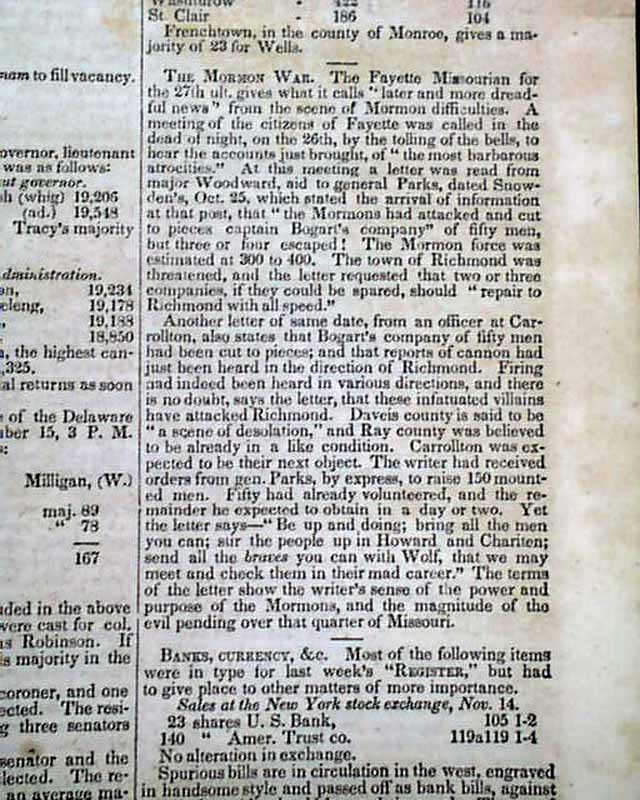
NILES' NATIONAL REGISTER, Washington City, Nov. 17, 1838
- The Mormon War
- Northwestern Missouri
The front page has a very nice item headed: "The Mormon War"
...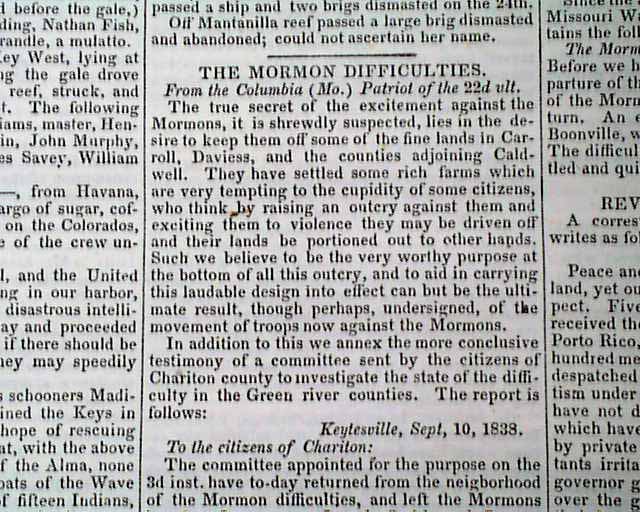
NILES' NATIONAL REGISTER, Baltimore, Oct. 13, 1838
- Early Mormons in Missouri - troubles
- Joseph Smith and Sidney Rigdon
An inside page has: "The Mormon
...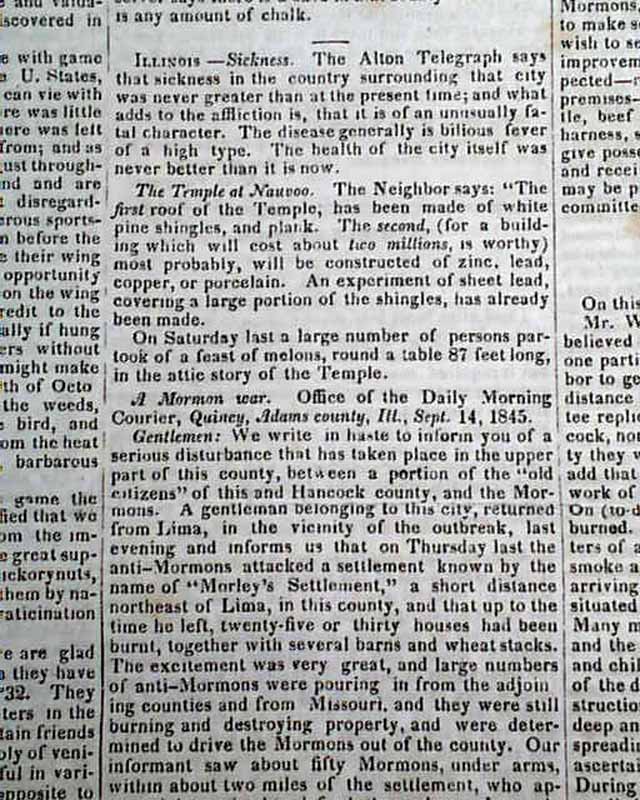
NILES' NATIONAL REGISTER, Baltimore, Sept. 27, 1845
- The Mormon War
- Hancock County, Illinois
- Nauvoo Temple construction
Inside has various reports under:
...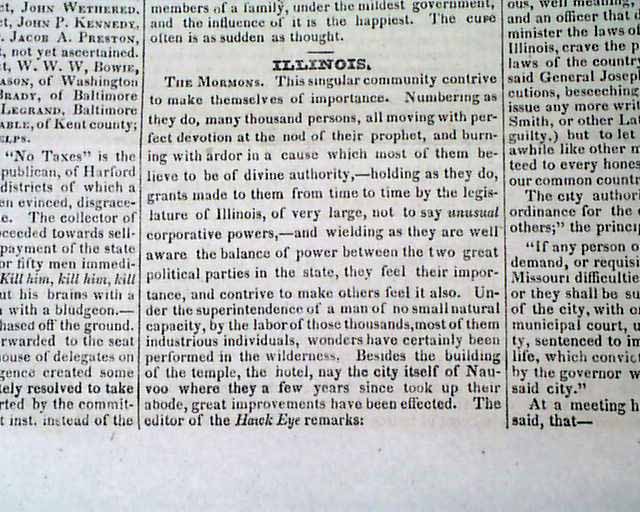
NILES' NATIONAL REGISTER, Baltimore, Feb. 3, 1844
- Mormons - Mormonism
- The Rise of Nauvoo, Illinois
- Frontier Conflict and Kidnappings
- The Calhoun-Smith Letters