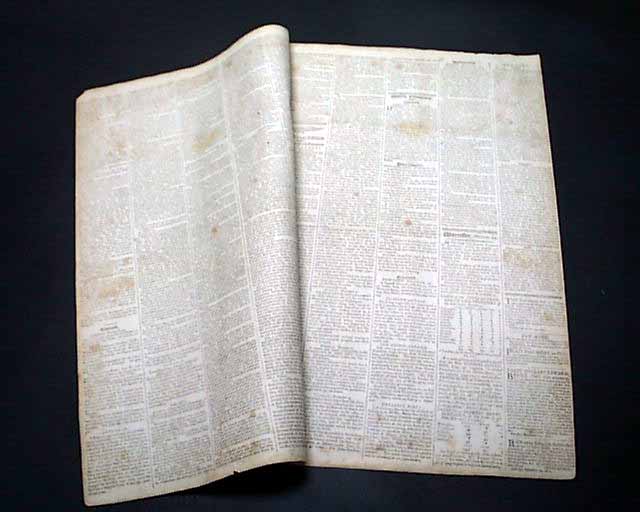
Thomas Jefferson is elected President? Not really...
Item # 708880
·
Sorry, but this item is no longer available. Please be in touch at info@rarenewspapers.com if you would like to be placed on a want list or are interested in a potential alternate issue.
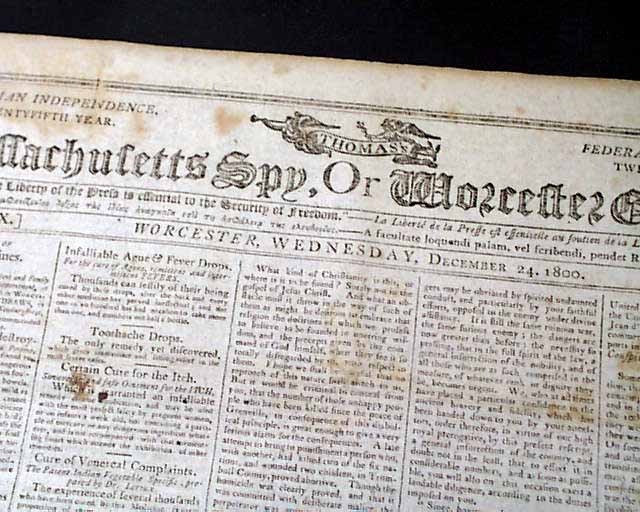
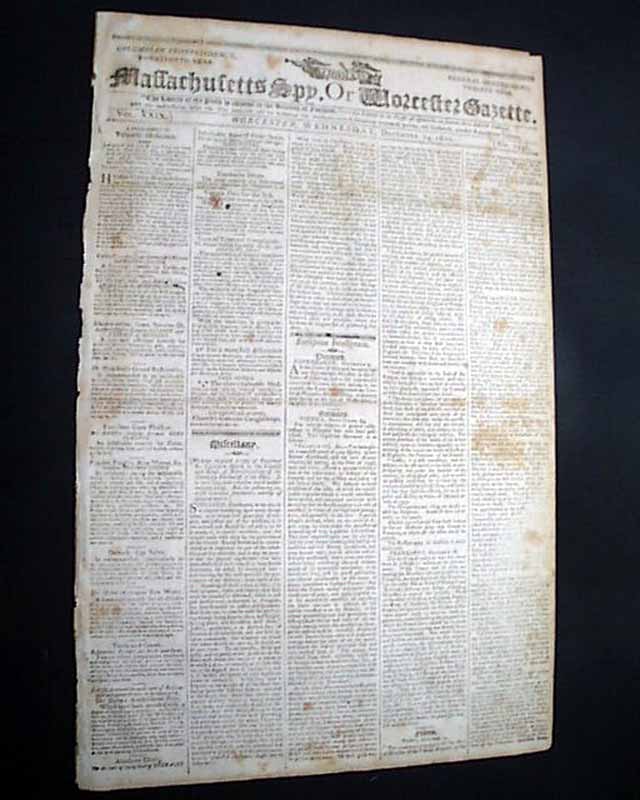
THOMAS'S MASSACHUSETTS SPY, OR WORCESTER GAZETTE, Dec. 24, 1800
* Thomas Jefferson and Aaron Burr
* The Revolution of 1800 - electoral tie
A wonderful masthead makes this a displayable issue.
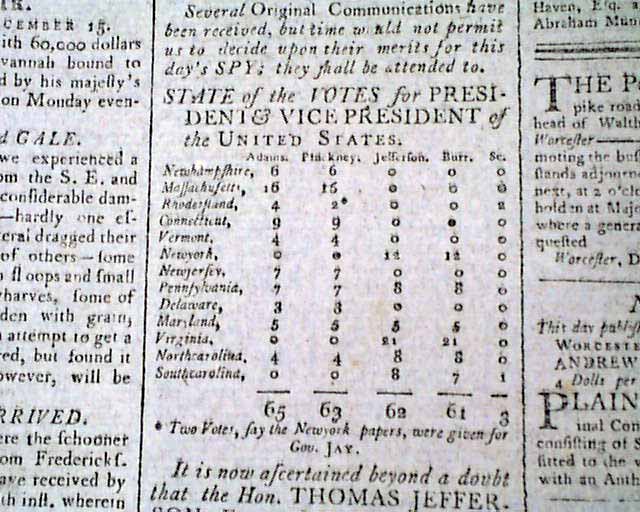
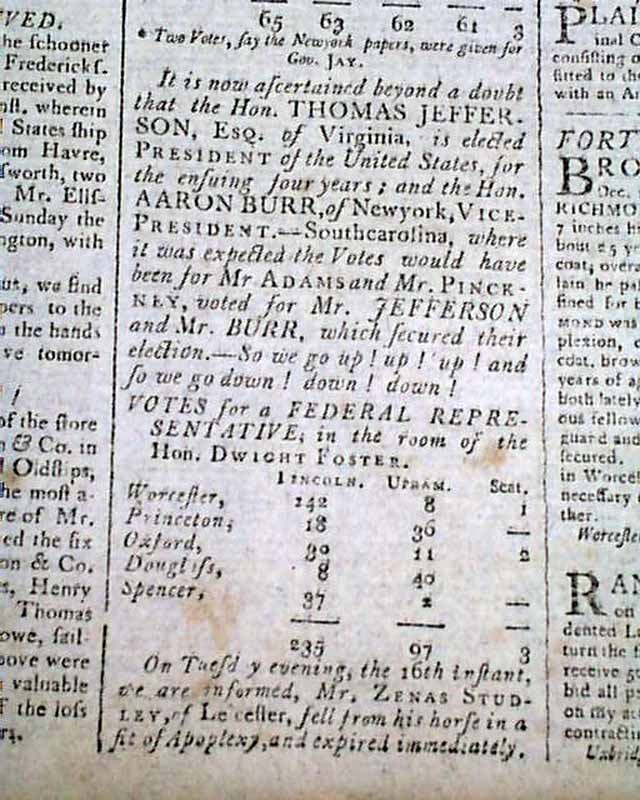
Page 3 has a report headed: "State of the Votes for President & Vice President of the United States" show votes for Adams, Pickney, Jefferson, and Burr. The report beneath the chart includes: "It is now ascertained beyond a doubtl that the Hon. THOMAS JEFFERSON, Esq. of Virginia, is elected President of the United Stares for the ensuing four years; and the Hon. AA4RON BURR, of New York, Vice President..." with more.
But that was not really true. The electoral voting rules were different in 1800 and, after 36 ballots, the decision would finally go to Jefferson on February 17.
Four pages, nice condition.
Background: The premature declaration in the December 24, 1800, issue of Thomas's Massachusetts Spy captures the frantic uncertainty of the Election of 1800—a pivotal turning point in American democracy often called the "Revolution of 1800." While the newspaper confidently announced Thomas Jefferson as President and Aaron Burr as Vice President based on the defeat of incumbent Federalist John Adams, it inadvertently ignored a massive constitutional crisis. Under the original Article II voting rules, electors cast two votes for president without distinguishing between their executive and vice-executive preferences; because the Democratic-Republican electors voted strictly along party lines, Jefferson and Burr unexpectedly tied with 73 electoral votes each. This legislative blunder effectively threw the election into the lame-duck, Federalist-controlled House of Representatives, exposing a volatile loophole that threatened a peaceful transfer of power. For over two months after this newspaper article was printed, the nation remained in a dangerous political deadlock that required 36 grueling ballots and intense backroom maneuvering—largely influenced by Alexander Hamilton’s lobbying against Burr—before Jefferson was finally secured the presidency on February 17, 1801. This historical blunder not only marks the first time political power shifted from one party to another in the United States, but it also directly catalyzed the ratification of the 12th Amendment in 1804, which forever changed American politics by mandating separate electoral ballots for President and Vice President.
* Thomas Jefferson and Aaron Burr
* The Revolution of 1800 - electoral tie
A wonderful masthead makes this a displayable issue.
Page 3 has a report headed: "State of the Votes for President & Vice President of the United States" show votes for Adams, Pickney, Jefferson, and Burr. The report beneath the chart includes: "It is now ascertained beyond a doubtl that the Hon. THOMAS JEFFERSON, Esq. of Virginia, is elected President of the United Stares for the ensuing four years; and the Hon. AA4RON BURR, of New York, Vice President..." with more.
But that was not really true. The electoral voting rules were different in 1800 and, after 36 ballots, the decision would finally go to Jefferson on February 17.
Four pages, nice condition.
Background: The premature declaration in the December 24, 1800, issue of Thomas's Massachusetts Spy captures the frantic uncertainty of the Election of 1800—a pivotal turning point in American democracy often called the "Revolution of 1800." While the newspaper confidently announced Thomas Jefferson as President and Aaron Burr as Vice President based on the defeat of incumbent Federalist John Adams, it inadvertently ignored a massive constitutional crisis. Under the original Article II voting rules, electors cast two votes for president without distinguishing between their executive and vice-executive preferences; because the Democratic-Republican electors voted strictly along party lines, Jefferson and Burr unexpectedly tied with 73 electoral votes each. This legislative blunder effectively threw the election into the lame-duck, Federalist-controlled House of Representatives, exposing a volatile loophole that threatened a peaceful transfer of power. For over two months after this newspaper article was printed, the nation remained in a dangerous political deadlock that required 36 grueling ballots and intense backroom maneuvering—largely influenced by Alexander Hamilton’s lobbying against Burr—before Jefferson was finally secured the presidency on February 17, 1801. This historical blunder not only marks the first time political power shifted from one party to another in the United States, but it also directly catalyzed the ratification of the 12th Amendment in 1804, which forever changed American politics by mandating separate electoral ballots for President and Vice President.
Category: Pre-Civil War
No Longer Available
100% Authentic: Original printing, never a reproduction.
Other issues you may like
§ related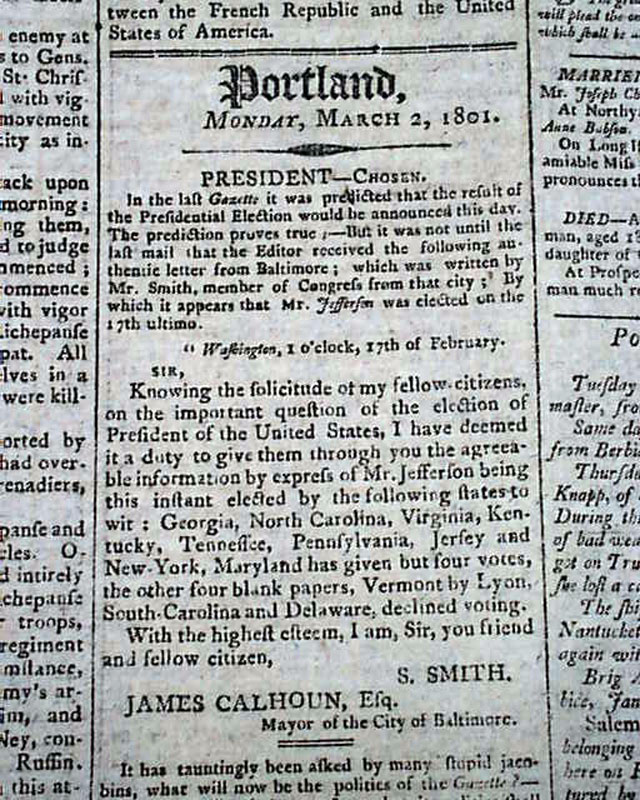
Jefferson is--finally--elected President...
JENKS' PORTLAND GAZETTE, Maine (still part of Mass. at this time), March 2, 1801
* Thomas Jefferson finally wins
* Controversial election of 1800
...
* Thomas Jefferson finally wins
* Controversial election of 1800
...
Mar 1801
$188
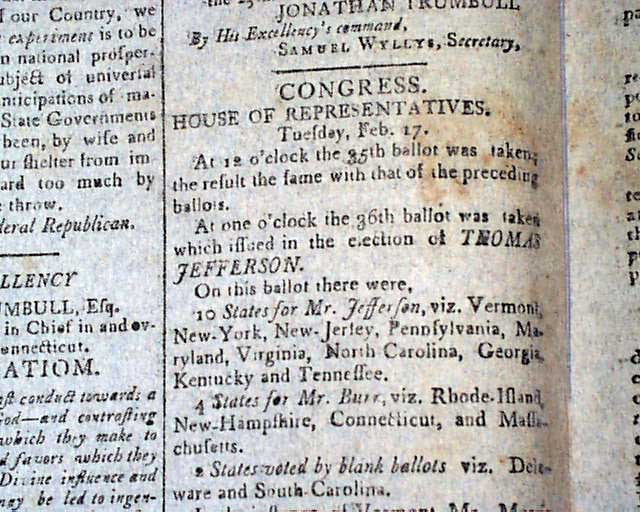
Jefferson is (finally) elected President...
MIDDLESEX GAZETTE, Middletown, Connecticut, March 13, 1801
* Thomas Jefferson finally wins
* Controversial election of 1800
Page 2 has a notable...
* Thomas Jefferson finally wins
* Controversial election of 1800
Page 2 has a notable...
Mar 1801
$185
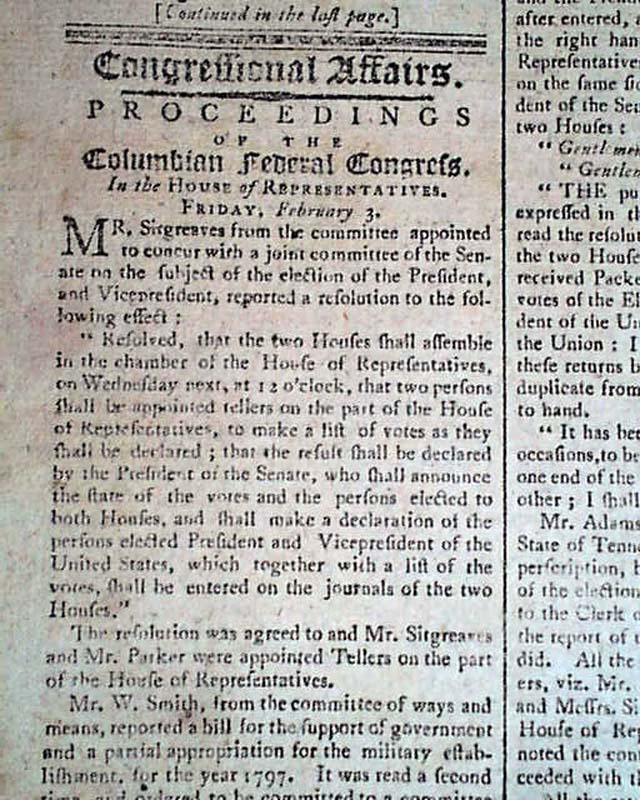
Details on the Presidential election of 1796...
THOMAS'S MASSACHUSETTS SPY OR WORCESTER GAZETTE, Feb. 22, 1797
* John Adams presidential election
* Thomas Jefferson as vice president
Page 2 has a report...
* John Adams presidential election
* Thomas Jefferson as vice president
Page 2 has a report...
Feb 1797
$238
On Adams & Jefferson assuming the Presidency and Vice Presidency...
GAZETTE OF THE UNITED STATES & PHILADELPHIA DAILY ADVERTISER, Feb. 18, 1797
* John Adams & Thomas Jefferson
* United States President and VP
Page 3...
* John Adams & Thomas Jefferson
* United States President and VP
Page 3...
Feb 1797
$62