Mormon connection to counterfeiters?
Item # 708022
·
NILES' WEEKLY REGISTER, Baltimore, May 19, 1827
* Latter Day Saints movement
* Oliver Cowdery & Joseph Smith
* Mormons - Mormonism
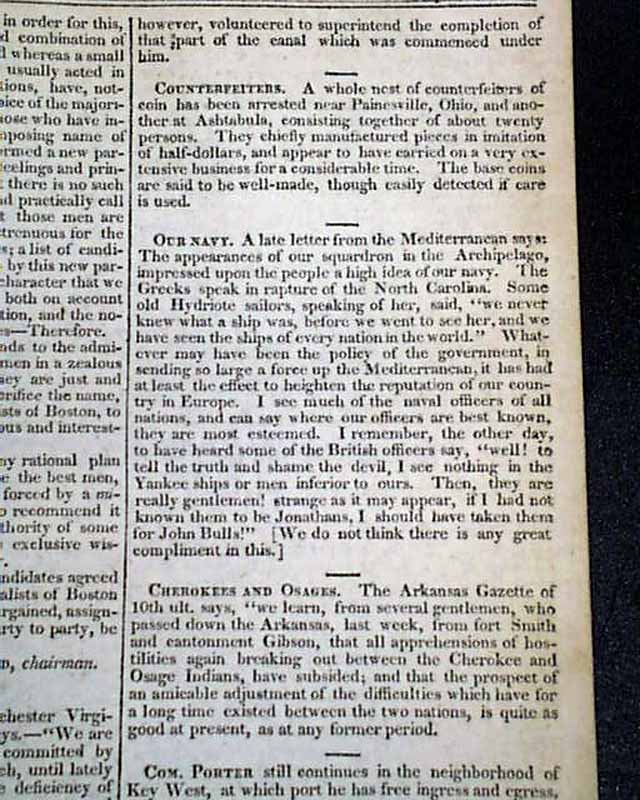
Inside has a rather brief article: "Counterfeiters" noting in part: "A whole nest of counterfeiters of coin has been arrested near Painesville, Ohio & another at Ashtabula...chiefly manufactured pieces in imitation of half-dollars..." with a bit more.
One could argue an early Mormon connection here.
Allegations were made by the top Mormon leadership against Oliver Cowdery, who along with Joseph Smith was a participant in the formative period of the Latter Day Saints. Among the reasons given for his demanded exclusion from the Latter Day Saints was that Cowdery had been associated with other "blacklegs" in the "bogus" business at Tinkers Creek in Trumbull Co., Ohio.
The "Tinkers creek coiners" presumably operated out of the swamps of what is now Tinkers Creek State Park near Hudson, Ohio. This 1830s band of bogus makers were practically (if not directly) the successors of the ring of blacklegs mentioned in this 1827 report.
Sixteen pages, 6 by 9 1/2 inches, nice condition.
Background: The May 19, 1827, report in Niles' Weekly Register exposing a "nest of counterfeiters" manufacturing fake half-dollars in Painesville and Ashtabula, Ohio, provides critical, contemporary evidence of an illicit frontier economy that later collided directly with early Mormon history. This region of the Ohio Western Reserve, particularly the swampy wilderness of Tinkers Creek, was a notorious stronghold for "blacklegs" and "bogus makers" (counterfeiters) whose operations directly preceded the arrivals of the Latter Day Saints in Kirtland in 1831. The historical significance of this specific 1827 crackdown lies in how it establishes a deeply rooted, regional culture of organized forgery years before it fractured the highest echelons of Mormon leadership; in 1838, top church authorities formally excommunicated Oliver Cowdery—the co-witness to Joseph Smith's foundational visions—partly under the explosive allegation that he had aligned with thieves and become "connected with the bogus business" at Tinkers Creek. Consequently, this brief newspaper report is not merely a record of frontier crime, but a vital piece of contextual Americana that documents the exact social and criminal landscape of northeastern Ohio that would later fuel bitter, faith-shattering accusations of counterfeiting during the formative era of the Latter Day Saint movement.
* Latter Day Saints movement
* Oliver Cowdery & Joseph Smith
* Mormons - Mormonism
Inside has a rather brief article: "Counterfeiters" noting in part: "A whole nest of counterfeiters of coin has been arrested near Painesville, Ohio & another at Ashtabula...chiefly manufactured pieces in imitation of half-dollars..." with a bit more.
One could argue an early Mormon connection here.
Allegations were made by the top Mormon leadership against Oliver Cowdery, who along with Joseph Smith was a participant in the formative period of the Latter Day Saints. Among the reasons given for his demanded exclusion from the Latter Day Saints was that Cowdery had been associated with other "blacklegs" in the "bogus" business at Tinkers Creek in Trumbull Co., Ohio.
The "Tinkers creek coiners" presumably operated out of the swamps of what is now Tinkers Creek State Park near Hudson, Ohio. This 1830s band of bogus makers were practically (if not directly) the successors of the ring of blacklegs mentioned in this 1827 report.
Sixteen pages, 6 by 9 1/2 inches, nice condition.
Background: The May 19, 1827, report in Niles' Weekly Register exposing a "nest of counterfeiters" manufacturing fake half-dollars in Painesville and Ashtabula, Ohio, provides critical, contemporary evidence of an illicit frontier economy that later collided directly with early Mormon history. This region of the Ohio Western Reserve, particularly the swampy wilderness of Tinkers Creek, was a notorious stronghold for "blacklegs" and "bogus makers" (counterfeiters) whose operations directly preceded the arrivals of the Latter Day Saints in Kirtland in 1831. The historical significance of this specific 1827 crackdown lies in how it establishes a deeply rooted, regional culture of organized forgery years before it fractured the highest echelons of Mormon leadership; in 1838, top church authorities formally excommunicated Oliver Cowdery—the co-witness to Joseph Smith's foundational visions—partly under the explosive allegation that he had aligned with thieves and become "connected with the bogus business" at Tinkers Creek. Consequently, this brief newspaper report is not merely a record of frontier crime, but a vital piece of contextual Americana that documents the exact social and criminal landscape of northeastern Ohio that would later fuel bitter, faith-shattering accusations of counterfeiting during the formative era of the Latter Day Saint movement.
Category: Pre-Civil War
Price
$44
100% Authentic: Original printing, never a reproduction.
Other issues you may like
§ related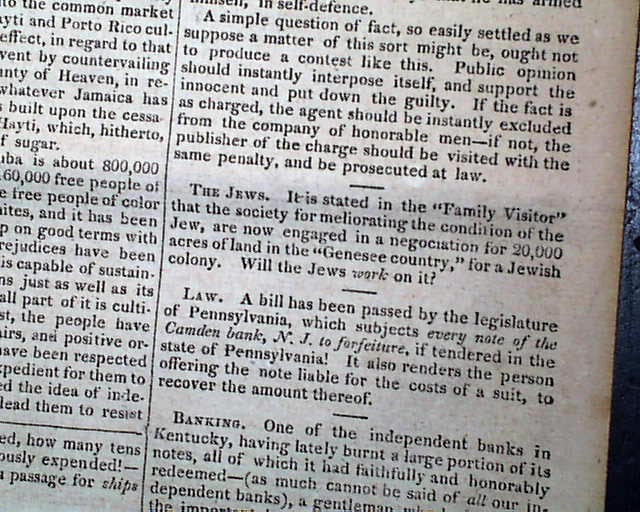
A possible Mormon connection? Two influencing events?
NILES' WEEKLY REGISTER Baltimore, April 5, 1823
* Jews and Mormons ?
An inside page has a brief report noting: "...that the society for meliorating...
* Jews and Mormons ?
An inside page has a brief report noting: "...that the society for meliorating...
Apr 1823
$63
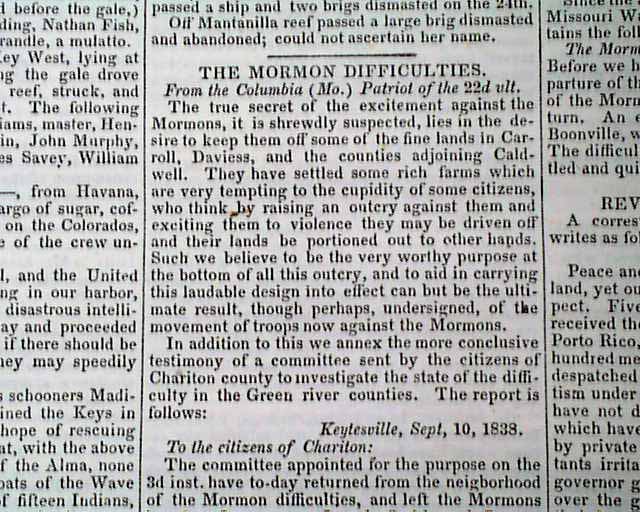
More on "Mormon difficulties"...
NILES' NATIONAL REGISTER, Baltimore, Oct. 13, 1838
* Early Mormons in Missouri - troubles
* Joseph Smith and Sidney Rigdon
An inside page has: "The Mormon...
* Early Mormons in Missouri - troubles
* Joseph Smith and Sidney Rigdon
An inside page has: "The Mormon...
Oct 1838
$84
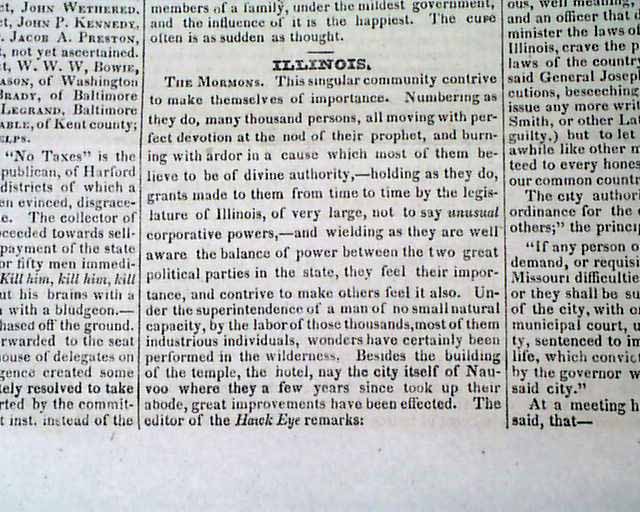
Much on the Mormons at Nauvoo...
NILES' NATIONAL REGISTER, Baltimore, Feb. 3, 1844
* Mormons - Mormonism
* The Rise of Nauvoo, Illinois
* Frontier Conflict and Kidnappings
* The...
* Mormons - Mormonism
* The Rise of Nauvoo, Illinois
* Frontier Conflict and Kidnappings
* The...
Feb 1844
$85
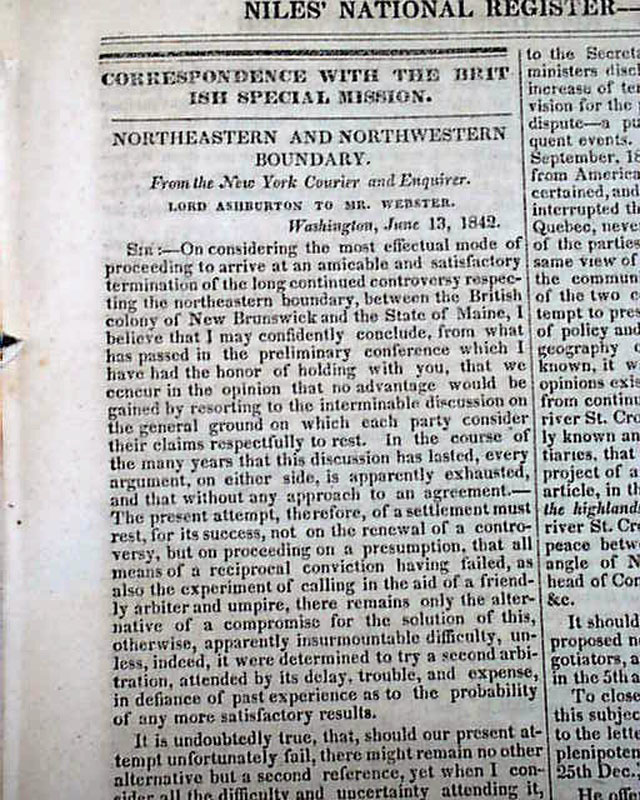
Mormon content: report on Joe Smith...
NILES' NATIONAL REGISTER, Baltimore, Sept. 17, 1842
The back page has a brief yet rather rare report with a mini-head: "Joe Smith" stating: "This...
The back page has a brief yet rather rare report with a mini-head: "Joe Smith" stating: "This...
Sep 1842
$65