


Number three on the "top ten" list of Supreme Court decisions...
NILES' WEEKLY REGISTER, Baltimore, March 20, 1819
- McCulloch vs. Maryland Supreme Court decision
Close to eight pages are taken up with what one website lists as number 3 of "The Ten Most Significant Supreme Court Decisions Of All Time" (#2 is Roe vs. Wade; #1 is the Dred Scott Decision).
This is the case of McCulloch vs. the state Maryland, the text headed: "Bank of the United States - In the Supreme Court of the United States", with the lengthy text containing the Chief Justice's opinion, he being John Marshall. This landmark decision concerns the right of Maryland to tax a branch of the federal bank operating within its borders.
This fundamental case established the following two principles: 1) that the Constitution grants to Congress implied powers for implementing the Constitution's express powers in order to create a functional national government and: 2) that state action may not impede valid constitutional exercises of power by the federal government.
Nice to have this report in a newspaper so close to Washington, D.C.
Sixteen pages, 6 1/4 by 9 1/2 inches, very nice condition.
Background: This March 20, 1819 issue of Niles’ Weekly Register holds extraordinary historical and legal significance because it contains the immediate, full-text publication of Chief Justice John Marshall’s opinion in McCulloch v. Maryland—rendered just two weeks prior on March 6, 1819—which fundamentally reshaped the balance of power in the United States. Originating from a dispute over Maryland's attempt to tax the Baltimore branch of the Second Bank of the United States, Marshall’s landmark ruling established two bedrock tenets of American constitutional law: first, using a broad interpretation of the "Necessary and Proper" Clause, it affirmed that Congress possesses implied powers beyond those explicitly enumerated in Article I to create a functional national government; second, invoked alongside Marshall’s famous declaration that "the power to tax involves the power to destroy," it affirmed federal supremacy under Article VI by ruling that state actions cannot impede or control valid constitutional operations of the federal government. Published by Hezekiah Niles’ highly respected, nationally distributed news weekly—the preeminent archival publication of the antebellum era—this 16-page issue captured one of the top Supreme Court rulings of all time while the ink was still wet, serving as an invaluable primary document of early American constitutional governance.
As noted in Wikipedia, this title: "...(was) one of the most widely-circulated magazines in the United States...Devoted primarily to politics...considered an important source for the history of the period."
Other issues you may like
§ related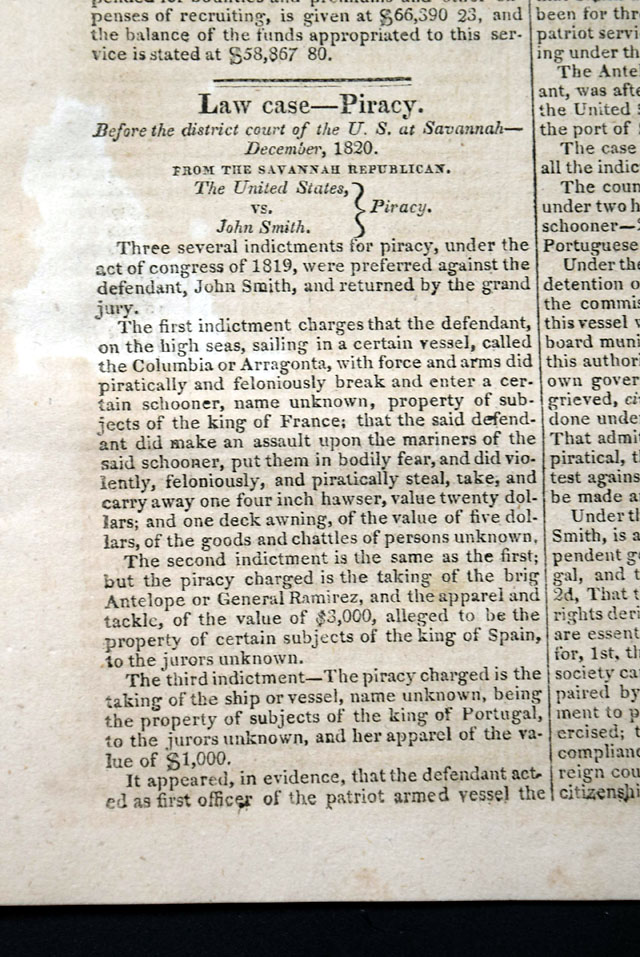
NILES' WEEKLY REGISTER, Baltimore, Jan. 15, 1821 Inside has over a full page taken up with: "Law Case--Piracy" "Before the District Court of the U.S. at
...
NEW YORK TRIBUNE, March 9, 1857
- Historic Dred Scott Decision
- Famous former slave case
Page 5 has nearly 2 1/2 columns taken up with a report on the historic
...
NILES' WEEKLY REGISTER, Baltimore, a pair of consecutive issues dated Oct. 3 and 10, 1818
- Constitution of the State of Illinois
Inside has: "Naval Court"
...
NILES' WEEKLY REGISTER, Baltimore, Feb. 20, 1813
- USS Constitution - William Bainbridge
- HMS Java - Henry Lambert
The prime feature would be the nice account
...