Encounters with a pirate & his crew on the Atlantic coast...
Item # 696307
·
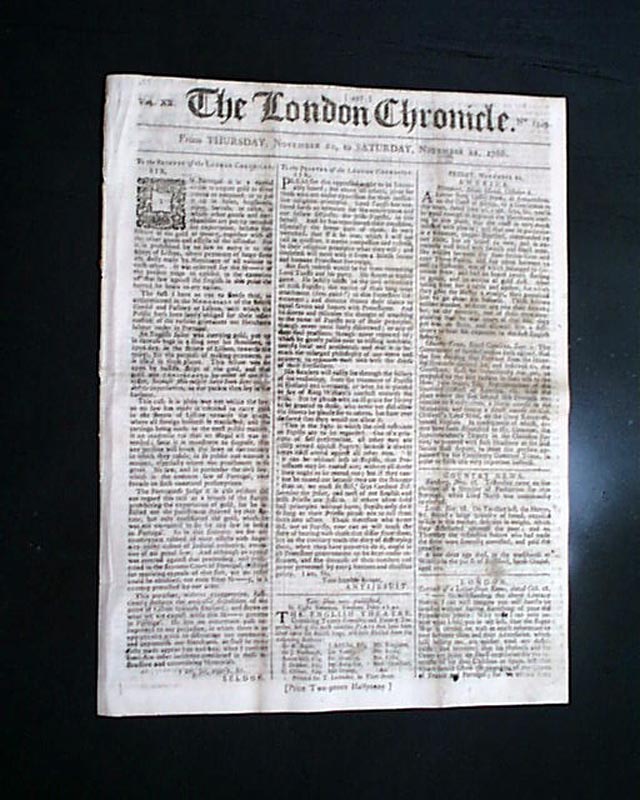
THE LONDON CHRONICLE, England, Nov. 22, 1766
* 18th century pirates - piracy
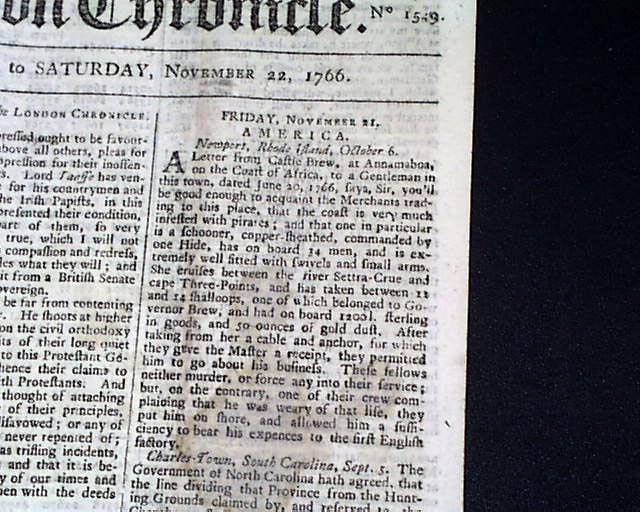
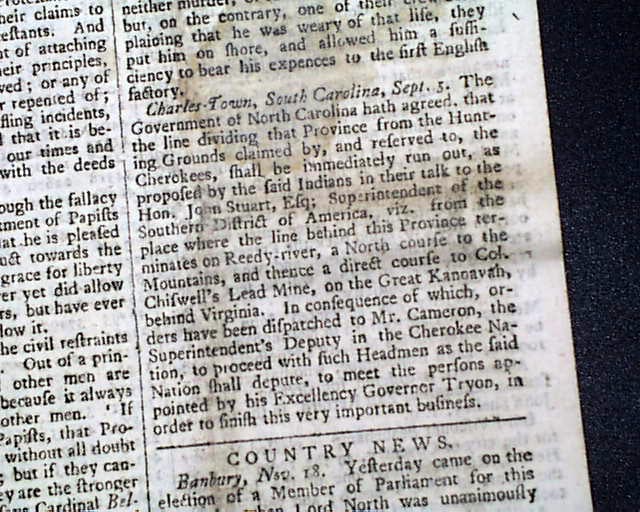
The front page has over half a column of news headed: "America" which includes problems with pirates: "...to acquaint the merchants trading to this place that the coast is very much infested with pirates; and that one in particular is a schooner, copper-sheathed, commanded by one Hide, has on board 34 men...She cruises between the river Settra-Crue and cape Three Points and has taken between 12 and 14 shalloops, [shallops: vessels used for sailing in shallow waters, especially a two-masted, gaff-rigged vessel of the 17th and 18th centuries] one of which belonged to Governor Brew..." with more.
Eight pages, 8 1/4 by 7 3/4 inches, some foxing to the front page, nice condition.
Background:In 1766 the stretch of the Atlantic Coast around Cape Three Points—on the Gold Coast in West Africa—was still a haven for small-scale maritime raiders who operated in the shallows, lagoons, and river mouths rather than on the open sea. Contemporary European records rarely mention large, organized pirate bands there by mid-century, but they do describe “canoe robbers” and coastal freebooters who struck at merchant launches and fishing craft moving between British, Danish, and Dutch forts. The “river Settra-Crue” (often rendered Sestre, Settra, or the Cess River in later maps of Liberia) lay farther west along the Grain Coast, and eighteenth-century traders complained that the winding mangrove channels inland provided perfect hiding places for raiders who ambushed small trading vessels and then disappeared upriver. While this was not the era of grand Caribbean-style piracy, 1760s European factors along both coasts consistently warned that certain riverine communities near Settra/Cess and the exposed waters off Cape Three Points supported opportunistic groups who seized goods, ransomed captured crewmen, and disrupted coastal trade whenever European naval patrols thinned or local political tensions flared.
* 18th century pirates - piracy
The front page has over half a column of news headed: "America" which includes problems with pirates: "...to acquaint the merchants trading to this place that the coast is very much infested with pirates; and that one in particular is a schooner, copper-sheathed, commanded by one Hide, has on board 34 men...She cruises between the river Settra-Crue and cape Three Points and has taken between 12 and 14 shalloops, [shallops: vessels used for sailing in shallow waters, especially a two-masted, gaff-rigged vessel of the 17th and 18th centuries] one of which belonged to Governor Brew..." with more.
Eight pages, 8 1/4 by 7 3/4 inches, some foxing to the front page, nice condition.
Background:In 1766 the stretch of the Atlantic Coast around Cape Three Points—on the Gold Coast in West Africa—was still a haven for small-scale maritime raiders who operated in the shallows, lagoons, and river mouths rather than on the open sea. Contemporary European records rarely mention large, organized pirate bands there by mid-century, but they do describe “canoe robbers” and coastal freebooters who struck at merchant launches and fishing craft moving between British, Danish, and Dutch forts. The “river Settra-Crue” (often rendered Sestre, Settra, or the Cess River in later maps of Liberia) lay farther west along the Grain Coast, and eighteenth-century traders complained that the winding mangrove channels inland provided perfect hiding places for raiders who ambushed small trading vessels and then disappeared upriver. While this was not the era of grand Caribbean-style piracy, 1760s European factors along both coasts consistently warned that certain riverine communities near Settra/Cess and the exposed waters off Cape Three Points supported opportunistic groups who seized goods, ransomed captured crewmen, and disrupted coastal trade whenever European naval patrols thinned or local political tensions flared.
Categories: The 1600's and 1700's, British
Price
$60
100% Authentic: Original printing, never a reproduction.
Other issues you may like
§ related
Dealing with a pirate ship...
THE LONDON CHRONICLE, England, March 7, 1771 Page 2 has: "America" with a report from Charleston concerning a fire at the wharf. Another page has a report...
Mar 1771
$24
Pirate troubles in the Caribbean...
THE GENTLEMAN'S MAGAZINE, London, October, 1737 Among the articles noted in the table of contents are: "Some regular Troops necessary in a free Government...
$68
Pirates in the Caribbean... The Carnival of Venice...
THE LONDON GAZETTE, England, Feb. 28, 1686
* Real Pirates of the Caribbean - buccaneers
* Laurens Cornelis Boudewijn de Graaf (Laurence)
The front page has a...
* Real Pirates of the Caribbean - buccaneers
* Laurens Cornelis Boudewijn de Graaf (Laurence)
The front page has a...
Feb 1686
$72
Pirates in the Caribbean... U.S. coins... Banking...
NILES' WEEKLY REGISTER, Baltimore, June 12, 1819 Much on "Banks and Banking" and over 4 pages on: "Regulation of Coins - Important Report".
The back page...
The back page...
Jun 1819
$32