


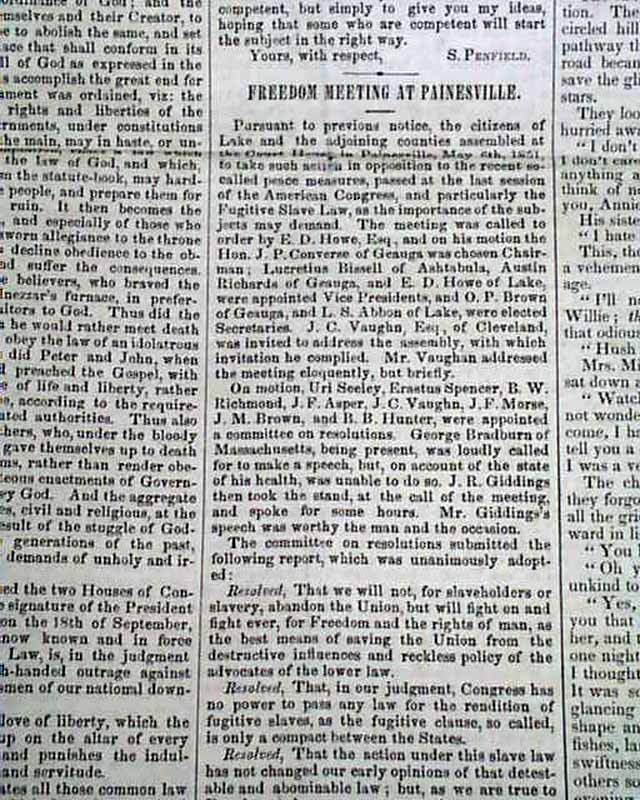
Very famous anti-slavery newspaper... Fugitive slave case in California...
Item # 695939
May 22, 1851
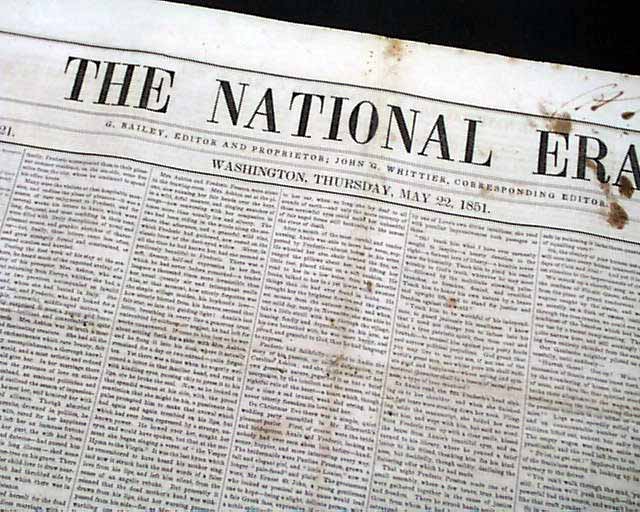
THE NATIONAL ERA, Washington, D.C., May 22, 1851
* Harriet Beecher Stowe
* Rare Anti-slavery publication
* Pre-American Civil War era
An anti-slavery newspaper which is best known for its link to the best-selling novel of the 19th century, "Uncle Tom's Cabin" by Harriet Beecher Stowe. This historic work first appeared as a 41-week serial in The National Era, starting on June 5, 1851.
* Harriet Beecher Stowe
* Rare Anti-slavery publication
* Pre-American Civil War era
An anti-slavery newspaper which is best known for its link to the best-selling novel of the 19th century, "Uncle Tom's Cabin" by Harriet Beecher Stowe. This historic work first appeared as a 41-week serial in The National Era, starting on June 5, 1851.
The complete serialization appeared almost entirely in the National Era before the book was published, with an overlap of just ten days.
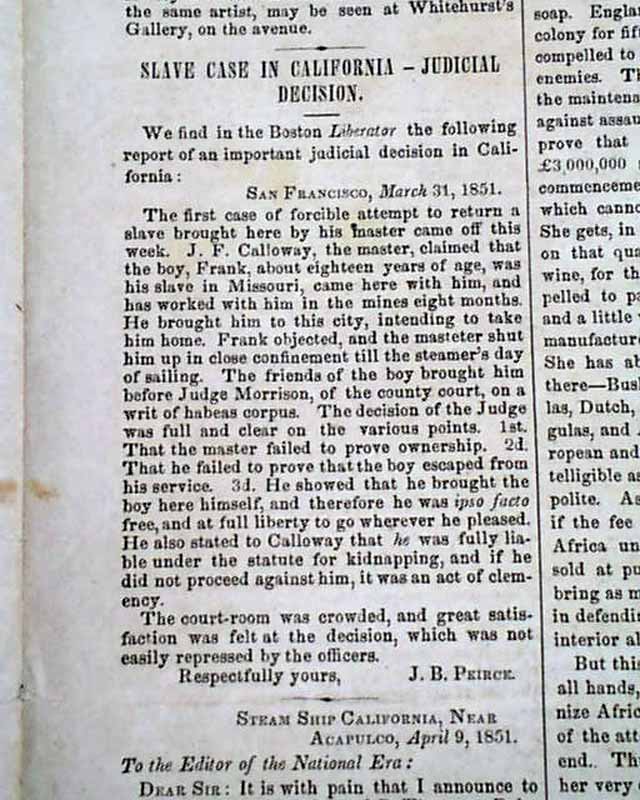
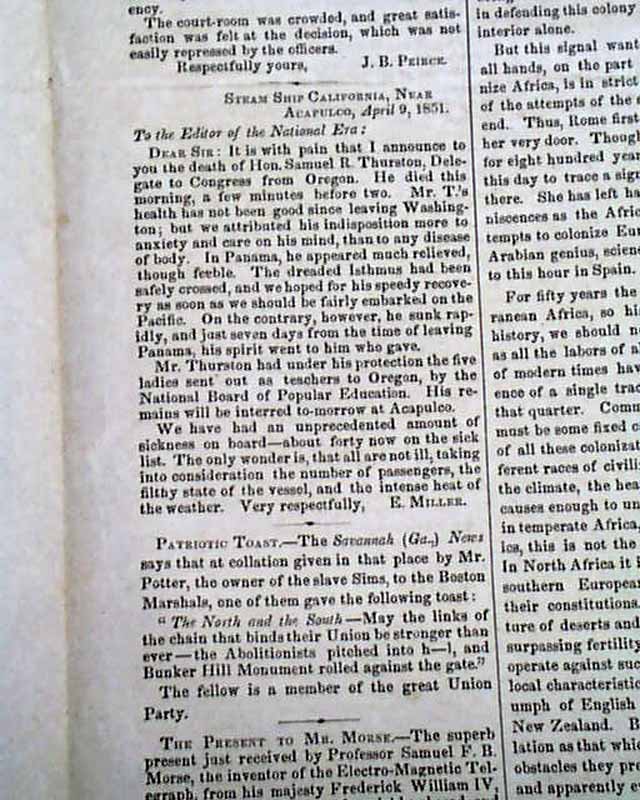
Page 3 has a report: "Slave Case In California - Judicial Decision" which is a letter from San Francisco. It includes: "The first case of forcible attempt to return a slave brought here by his master came off this week...the master claimed that the boy...was his slave in Missouri, came here with him & has worked with him in the mines..." with more.
Page 3 has a report: "Slave Case In California - Judicial Decision" which is a letter from San Francisco. It includes: "The first case of forcible attempt to return a slave brought here by his master came off this week...the master claimed that the boy...was his slave in Missouri, came here with him & has worked with him in the mines..." with more.
Four pages, great to have in never-bound condition just as sold on the streets, subscriber's name penned above the masthead, a few discrete archival mends, nice condition. Folder size noted is for the issue folded in half.
background: This specific issue of The National Era, dated May 22, 1851, serves as a poignant "prologue" to the most influential literary event of the 19th century, appearing just fourteen days before Harriet Beecher Stowe began her 41-week serialization of Uncle Tom’s Cabin. As a premier organ of the Liberty Party based in Washington, D.C., the paper operated in the volatile heart of American politics, bridging the gap between radical abolitionism and mainstream legislative debate. The inclusion of the "Slave Case In California" report on page 3 is historically invaluable, as it documents the immediate, messy legal consequences of the Compromise of 1850; it highlights the "Free State" of California’s struggle to reconcile its constitution with the reality of enslaved laborers brought to the gold mines. By capturing the final moments of the pre-Stowe era alongside the burgeoning legal battles over the Fugitive Slave Act, this four-page artifact encapsulates the rising national tension that would eventually lead to the American Civil War.
background: This specific issue of The National Era, dated May 22, 1851, serves as a poignant "prologue" to the most influential literary event of the 19th century, appearing just fourteen days before Harriet Beecher Stowe began her 41-week serialization of Uncle Tom’s Cabin. As a premier organ of the Liberty Party based in Washington, D.C., the paper operated in the volatile heart of American politics, bridging the gap between radical abolitionism and mainstream legislative debate. The inclusion of the "Slave Case In California" report on page 3 is historically invaluable, as it documents the immediate, messy legal consequences of the Compromise of 1850; it highlights the "Free State" of California’s struggle to reconcile its constitution with the reality of enslaved laborers brought to the gold mines. By capturing the final moments of the pre-Stowe era alongside the burgeoning legal battles over the Fugitive Slave Act, this four-page artifact encapsulates the rising national tension that would eventually lead to the American Civil War.
Category: Pre-Civil War


