

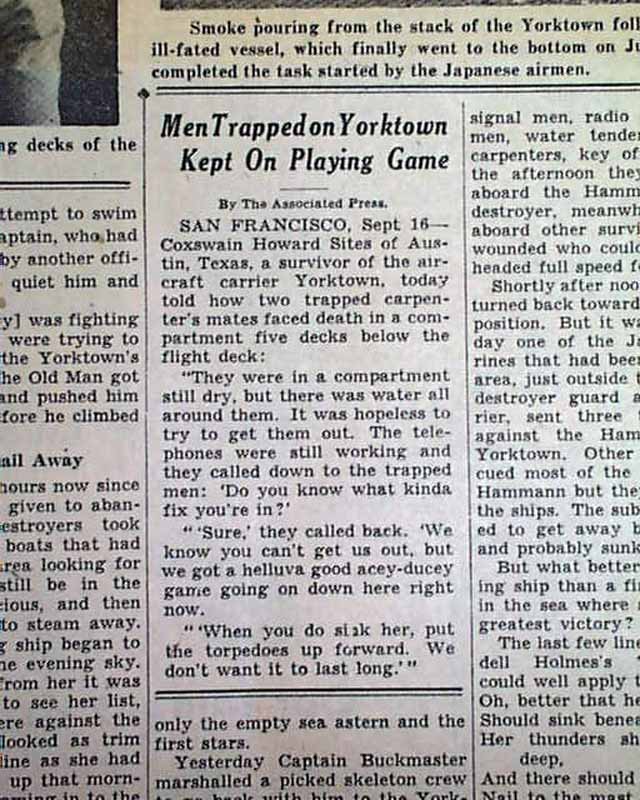
USS Yorktown Midway sinking....
Item # 598855Sorry, but this item is no longer available. Please be in touch at info@rarenewspapers.com if you would like to be placed on a want list or are interested in a potential alternate issue.
September 17, 1942
THE NEW YORK TIMES, September 17, 1942
* USS Aircraft Carrier Yorktown sinking
* Battle of Midway
* World War II - WWII
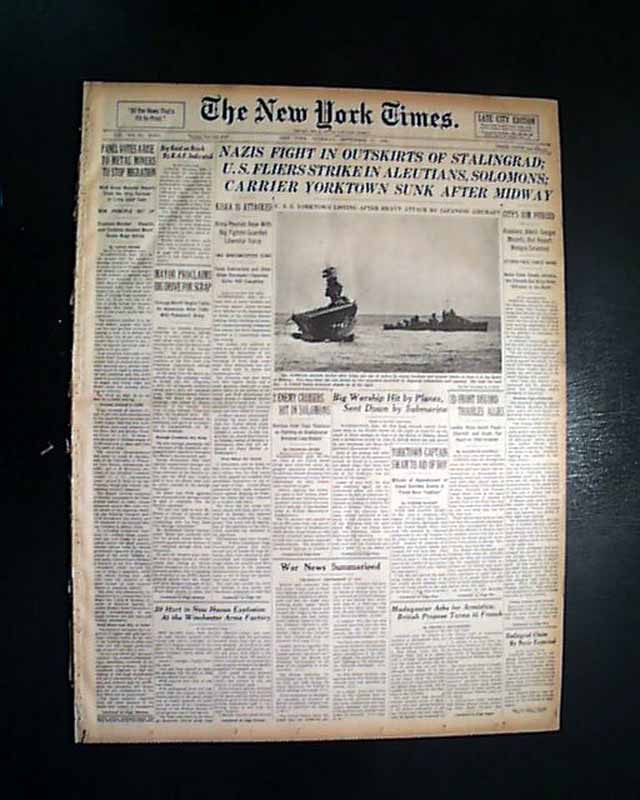
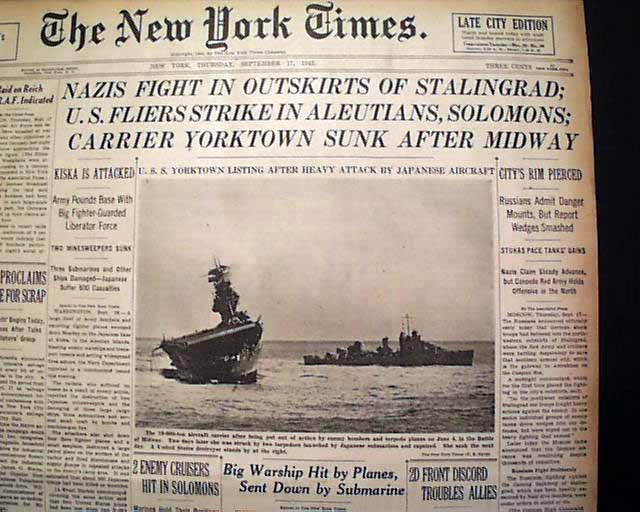
The front page has a six column headline:
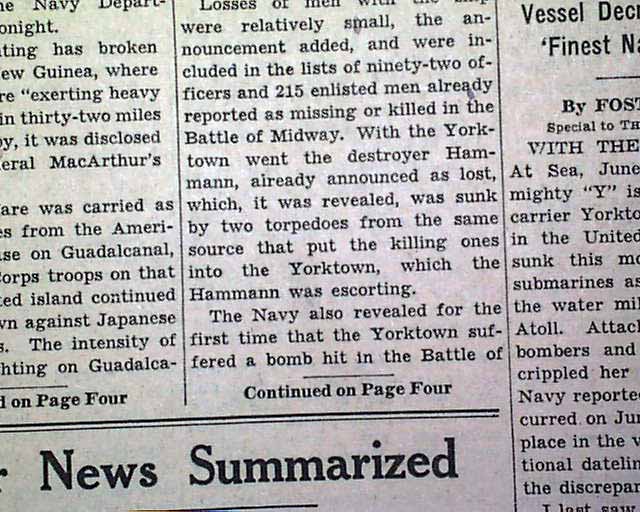
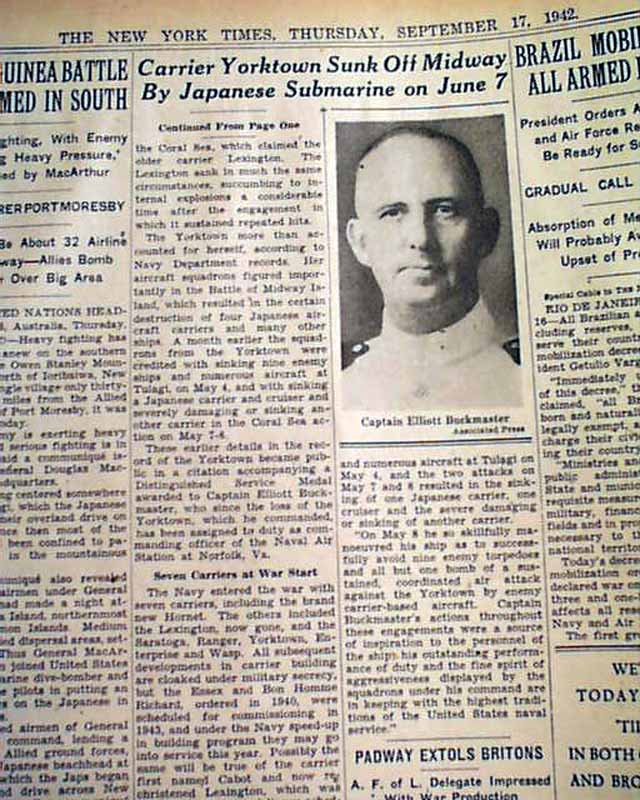
"CARRIER YORKTOWN SUNK AFTER MIDWAY"
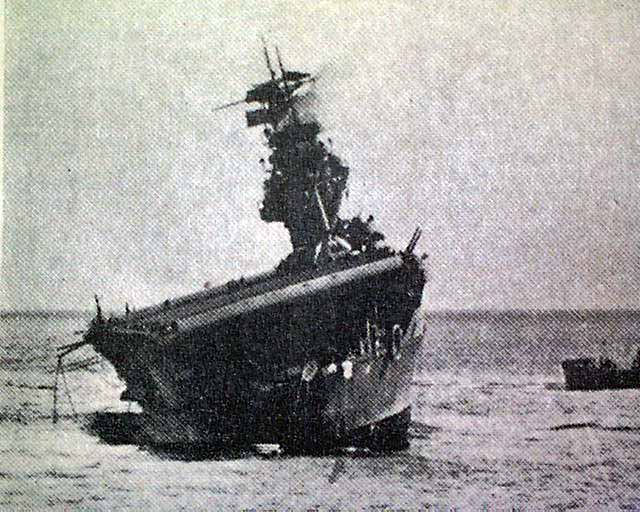
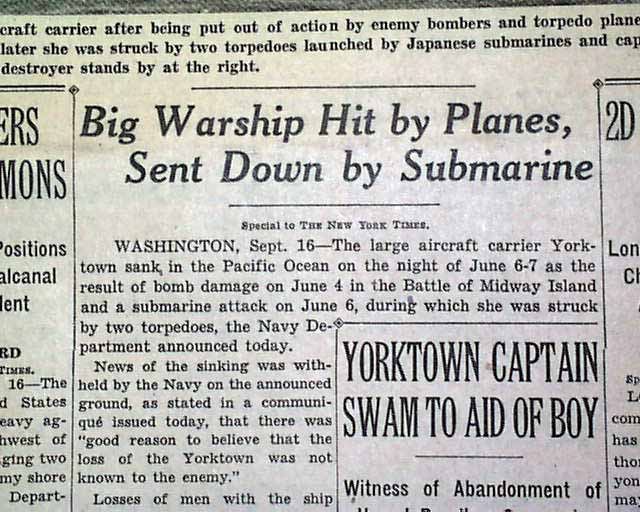
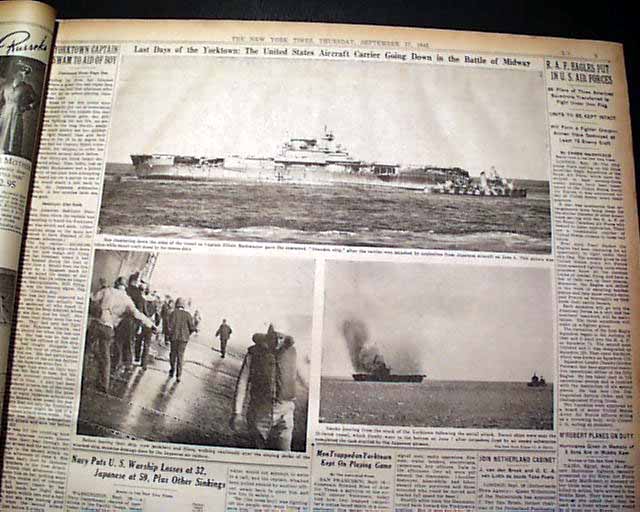
with subhead: "Big Warship Hit by Planes, Sent Down by Submarine" and a ftpg. photo of the floundering carrier. Much more on page 3 & 4 with more photos. (see)
This sinking actually happened a few months earlier but this was when it was 1st made public making it still a first report.
Other news, sports and advertisements of the day with much on WWII. Complete in 46 pages, very minor margin wear, nice condition.
wikipedia notes: Armed with this intelligence Admiral Nimitz began methodically planning Midway's defense, rushing all possible reinforcement in the way of men, planes and guns to Midway. In addition, he began gathering his naval forces - comparatively meager as they were - to meet the enemy at sea. As part of those preparations, he recalled TF16, Enterprise and Hornet (CV-8), to Pearl Harbor for a quick replenishment.
Yorktown, too, received orders to return to Hawaii; and she arrived at Pearl Harbor on 27 May. Performing a seeming miracle, yard workers there - laboring around the clock - made enough repairs to enable the ship to put to sea. The repairs were made in such a short time that the Japanese Naval Commanders thought they had mistaken Yorktown for another vessel as they thought she had been sunk after the previous battle, yet she had returned to fight another day. Her air group - for the most part experienced but weary - was augmented by planes and crews from USS Saratoga (CV-3) which was then headed for Hawaiian waters after her modernization on the West Coast. Ready for battle, Yorktown sailed as the core of TF17 on 30 May.
Northeast of Midway, Yorktown, flying Rear Admiral Fletcher's flag, rendezvoused with TF16 under Rear Admiral Raymond A. Spruance and maintained a position 10 miles (16 km) to the northward of him.
Patrols, both from Midway itself and from the carriers, proceeded apace during those days in early June. On the morning of the 4th as dawn began to streak the eastern sky, Yorktown launched a 10-plane group of Dauntlesses from VB-5 which searched a northern semicircle for a distance of 100 miles (160 km) out but found nothing.
Meanwhile, PBYs flying from Midway had sighted the approaching Japanese and broadcast the alarm for the American forces defending the key atoll. Admiral Fletcher, in tactical command, ordered Admiral Spruance's TF16 to locate the enemy carrier force and strike them as soon as they were found.
Yorktown's search group returned at 0830, landing soon after the last of the six-plane CAP had left the deck. When the last of the Dauntlesses were recovered, the deck was hastily respotted for the launch of the ship's attack group - 17 Dauntlesses from VB-3; 12 Devastators from VT-3, and six Wildcats from "Fighting Three." Enterprise and Hornet, meanwhile, launched their attack groups.
The torpedo planes from the three American carriers located the Japanese striking force, but met disaster. Of the 41 planes from VT-8, VT-6, and VT-3, only six returned to Enterprise and Yorktown, collectively. None made it back to Hornet.
The destruction of the torpedo planes, however, had served a purpose. The Japanese CAP had broken off their high-altitude cover for their carriers and had concentrated on the Devastators, flying "on the deck." The skies above were thus left open for Dauntlesses arriving from Yorktown and Enterprise.
Virtually unopposed, Yorktown's dive-bombers pummeled Japanese aircraft carrier Sōryū, making three lethal hits with 1,000 pound bombs, turning her into an inferno.[2] Enterprise's planes, meanwhile, hit Japanese aircraft carrier Akagi and Japanese aircraft carrier Kaga - turning them, too into wrecks in short order. The bombs from the Dauntlesses caught all of the Japanese carriers in the midst of refueling and rearming operations, and the combination of bombs and gasoline proved explosive and disastrous to the Japanese.
Three Japanese carriers had been lost. A fourth however, still roamed at large - Japanese aircraft carrier Hiryū. Separated from her sisters, she launched a striking force of 18 "Vals" and soon located Yorktown.
Smoke pours from Yorktown after being hit in the boilers by Japanese dive bombers at Midway.
As soon as the attackers had been picked up on Yorktown's radar at about 1329, she discontinued fueling her CAP fighters on deck and swiftly cleared for action. Her returning dive bombers were moved from the landing circle to open the area for antiaircraft fire. The Dauntlesses were ordered aloft to form a CAP. An auxiliary gasoline tank - of 800 gallons capacity - was pushed over the carrier's fantail, eliminating one fire hazard. The crew drained fuel lines and closed and secured all compartments.
All of Yorktown's fighters were vectored out to intercept the oncoming Japanese aircraft, and did so some 15 to 20 miles (32 km) out. The Wildcats attacked vigorously, breaking up what appeared to be an organized attack by some 18 "Vals" and 18 "Zeroes." "Planes were flying in every direction", wrote Captain Buckmaster after the action, "and many were falling in flames." The leader of the "Vals", Lieutenant Joichi Tomonaga, was probably shot down by the VF-3's commanding officer, Lieutenant Commander John S. Thach.
Despite an intensive barrage and evasive maneuvering, three "Vals" scored hits. Two of them were shot down soon after releasing their bomb loads; the third went out of control just as his bomb left the rack. It tumbled in flight and hit just abaft number two elevator on the starboard side, exploding on contact and blasting a hole about 10 feet (3 m) square in the flight deck. Splinters from the exploding bomb decimated the crews of the two 1.1-inch (28 mm) gun mounts aft of the island and on the flight deck below. Fragments piercing the flight deck hit three planes on the hangar deck, starting fires. One of the aircraft, a Yorktown Dauntless, was fully fueled and carrying a 1,000 pound bomb. Prompt action by Lt. A. C. Emerson, the hangar deck officer, prevented a serious conflagration by activating the sprinkler system and quickly extinguishing the fire.
The second bomb to hit the ship came from the port side, pierced the flight deck, and exploded in the lower part of the funnel. It ruptured the uptakes for three boilers, disabled two boilers themselves, and extinguished the fires in five boilers. Smoke and gases began filling the firerooms of six boilers. The men at number one boiler, however, remained at their post despite their danger and discomfort and kept its fire going, maintaining enough steam pressure to allow the auxiliary steam systems to function.
A third bomb hit the carrier from the starboard side, pierced the side of number one elevator and exploded on the fourth deck, starting a persistent fire in the rag storage space, adjacent to the forward gasoline stowage and the magazines. The prior precaution of smothering the gasoline system with carbon dioxide undoubtedly prevented the gasoline from igniting.
While the ship recovered from the damage inflicted by the dive-bombing attack, her speed dropped to six knots; and then at 14:40, about 20 minutes after the bomb hit that had shut down most of the boilers, Yorktown slowed to a stop, dead in the water.
At about 15:40, Yorktown prepared to get steaming again; and, at 1550, the engine room force reported that they were ready to make 20 knots (23 mph; 37 km/h) or better. The ship was not yet out of the fight.
Simultaneously, with the fires controlled sufficiently to warrant the resumption of fueling, Yorktown began refueling the fighters then on deck; just then the ship's radar picked up an incoming air group at a distance of 33 miles (53 km). While the ship prepared for battle - again smothering gasoline systems and stopping the fueling of the planes on her flight deck - she vectored four of the six fighters of the CAP in the air to intercept the raiders. Of the 10 fighters on board, eight had as little as 23 gallons of fuel in their tanks. They were launched as the remaining pair of fighters of the CAP headed out to intercept the Japanese planes.
Yorktown is hit on the port side, amidships, by a Japanese Type 91 aerial torpedo during the mid-afternoon attack by planes from the carrier Hiryu.
At 16:00, maneuvering Yorktown churned forward, making 20 knots (23 mph; 37 km/h). The fighters she had launched and vectored out to intercept had meanwhile made contact with the enemy. Yorktown received reports that the planes were "Kates." The Wildcats shot down at least three, but the rest began their approach while the carrier and her escorts mounted a heavy antiaircraft barrage.
Yorktown maneuvered radically, avoiding at least two torpedoes before another two struck the port side within minutes of each other, the first at 16:20. The carrier had been mortally wounded; she lost power and went dead in the water with a jammed rudder and an increasing list to port.
As the list progressed Commander C. E. Aldrich, the damage control officer, reported from central station that, without power, controlling the flooding looked impossible. The engineering officer, Lt. Cdr. J. F. Delaney, soon reported that all fires were out, but all power was lost and it was impossible to correct the list. Buckmaster ordered Aldrich, Delaney, and their men to secure and lay up on deck to put on life jackets.
The list, meanwhile, continued to increase. When it reached 26 degrees, Buckmaster and Aldrich agreed that capsizing was imminent. "In order to save as many of the ship's company as possible", the captain wrote later, he "ordered the ship to be abandoned."
Over the next few minutes the crew lowered the wounded into life rafts and struck out for the nearby destroyers and cruisers to be picked up by their boats, abandoning ship in good order. After the evacuation of all wounded, the executive officer, Commander I. D. Wiltsie, left the ship down a line on the starboard side. Buckmaster, meanwhile, toured the ship one last time, to see if any men remained. After finding no "live personnel", Buckmaster lowered himself into the water by means of a line over the stern, by which time water was lapping the port side of the hangar deck.
* USS Aircraft Carrier Yorktown sinking
* Battle of Midway
* World War II - WWII
The front page has a six column headline:
"CARRIER YORKTOWN SUNK AFTER MIDWAY"
with subhead: "Big Warship Hit by Planes, Sent Down by Submarine" and a ftpg. photo of the floundering carrier. Much more on page 3 & 4 with more photos. (see)
This sinking actually happened a few months earlier but this was when it was 1st made public making it still a first report.
Other news, sports and advertisements of the day with much on WWII. Complete in 46 pages, very minor margin wear, nice condition.
wikipedia notes: Armed with this intelligence Admiral Nimitz began methodically planning Midway's defense, rushing all possible reinforcement in the way of men, planes and guns to Midway. In addition, he began gathering his naval forces - comparatively meager as they were - to meet the enemy at sea. As part of those preparations, he recalled TF16, Enterprise and Hornet (CV-8), to Pearl Harbor for a quick replenishment.
Yorktown, too, received orders to return to Hawaii; and she arrived at Pearl Harbor on 27 May. Performing a seeming miracle, yard workers there - laboring around the clock - made enough repairs to enable the ship to put to sea. The repairs were made in such a short time that the Japanese Naval Commanders thought they had mistaken Yorktown for another vessel as they thought she had been sunk after the previous battle, yet she had returned to fight another day. Her air group - for the most part experienced but weary - was augmented by planes and crews from USS Saratoga (CV-3) which was then headed for Hawaiian waters after her modernization on the West Coast. Ready for battle, Yorktown sailed as the core of TF17 on 30 May.
Northeast of Midway, Yorktown, flying Rear Admiral Fletcher's flag, rendezvoused with TF16 under Rear Admiral Raymond A. Spruance and maintained a position 10 miles (16 km) to the northward of him.
Patrols, both from Midway itself and from the carriers, proceeded apace during those days in early June. On the morning of the 4th as dawn began to streak the eastern sky, Yorktown launched a 10-plane group of Dauntlesses from VB-5 which searched a northern semicircle for a distance of 100 miles (160 km) out but found nothing.
Meanwhile, PBYs flying from Midway had sighted the approaching Japanese and broadcast the alarm for the American forces defending the key atoll. Admiral Fletcher, in tactical command, ordered Admiral Spruance's TF16 to locate the enemy carrier force and strike them as soon as they were found.
Yorktown's search group returned at 0830, landing soon after the last of the six-plane CAP had left the deck. When the last of the Dauntlesses were recovered, the deck was hastily respotted for the launch of the ship's attack group - 17 Dauntlesses from VB-3; 12 Devastators from VT-3, and six Wildcats from "Fighting Three." Enterprise and Hornet, meanwhile, launched their attack groups.
The torpedo planes from the three American carriers located the Japanese striking force, but met disaster. Of the 41 planes from VT-8, VT-6, and VT-3, only six returned to Enterprise and Yorktown, collectively. None made it back to Hornet.
The destruction of the torpedo planes, however, had served a purpose. The Japanese CAP had broken off their high-altitude cover for their carriers and had concentrated on the Devastators, flying "on the deck." The skies above were thus left open for Dauntlesses arriving from Yorktown and Enterprise.
Virtually unopposed, Yorktown's dive-bombers pummeled Japanese aircraft carrier Sōryū, making three lethal hits with 1,000 pound bombs, turning her into an inferno.[2] Enterprise's planes, meanwhile, hit Japanese aircraft carrier Akagi and Japanese aircraft carrier Kaga - turning them, too into wrecks in short order. The bombs from the Dauntlesses caught all of the Japanese carriers in the midst of refueling and rearming operations, and the combination of bombs and gasoline proved explosive and disastrous to the Japanese.
Three Japanese carriers had been lost. A fourth however, still roamed at large - Japanese aircraft carrier Hiryū. Separated from her sisters, she launched a striking force of 18 "Vals" and soon located Yorktown.
Smoke pours from Yorktown after being hit in the boilers by Japanese dive bombers at Midway.
As soon as the attackers had been picked up on Yorktown's radar at about 1329, she discontinued fueling her CAP fighters on deck and swiftly cleared for action. Her returning dive bombers were moved from the landing circle to open the area for antiaircraft fire. The Dauntlesses were ordered aloft to form a CAP. An auxiliary gasoline tank - of 800 gallons capacity - was pushed over the carrier's fantail, eliminating one fire hazard. The crew drained fuel lines and closed and secured all compartments.
All of Yorktown's fighters were vectored out to intercept the oncoming Japanese aircraft, and did so some 15 to 20 miles (32 km) out. The Wildcats attacked vigorously, breaking up what appeared to be an organized attack by some 18 "Vals" and 18 "Zeroes." "Planes were flying in every direction", wrote Captain Buckmaster after the action, "and many were falling in flames." The leader of the "Vals", Lieutenant Joichi Tomonaga, was probably shot down by the VF-3's commanding officer, Lieutenant Commander John S. Thach.
Despite an intensive barrage and evasive maneuvering, three "Vals" scored hits. Two of them were shot down soon after releasing their bomb loads; the third went out of control just as his bomb left the rack. It tumbled in flight and hit just abaft number two elevator on the starboard side, exploding on contact and blasting a hole about 10 feet (3 m) square in the flight deck. Splinters from the exploding bomb decimated the crews of the two 1.1-inch (28 mm) gun mounts aft of the island and on the flight deck below. Fragments piercing the flight deck hit three planes on the hangar deck, starting fires. One of the aircraft, a Yorktown Dauntless, was fully fueled and carrying a 1,000 pound bomb. Prompt action by Lt. A. C. Emerson, the hangar deck officer, prevented a serious conflagration by activating the sprinkler system and quickly extinguishing the fire.
The second bomb to hit the ship came from the port side, pierced the flight deck, and exploded in the lower part of the funnel. It ruptured the uptakes for three boilers, disabled two boilers themselves, and extinguished the fires in five boilers. Smoke and gases began filling the firerooms of six boilers. The men at number one boiler, however, remained at their post despite their danger and discomfort and kept its fire going, maintaining enough steam pressure to allow the auxiliary steam systems to function.
A third bomb hit the carrier from the starboard side, pierced the side of number one elevator and exploded on the fourth deck, starting a persistent fire in the rag storage space, adjacent to the forward gasoline stowage and the magazines. The prior precaution of smothering the gasoline system with carbon dioxide undoubtedly prevented the gasoline from igniting.
While the ship recovered from the damage inflicted by the dive-bombing attack, her speed dropped to six knots; and then at 14:40, about 20 minutes after the bomb hit that had shut down most of the boilers, Yorktown slowed to a stop, dead in the water.
At about 15:40, Yorktown prepared to get steaming again; and, at 1550, the engine room force reported that they were ready to make 20 knots (23 mph; 37 km/h) or better. The ship was not yet out of the fight.
Simultaneously, with the fires controlled sufficiently to warrant the resumption of fueling, Yorktown began refueling the fighters then on deck; just then the ship's radar picked up an incoming air group at a distance of 33 miles (53 km). While the ship prepared for battle - again smothering gasoline systems and stopping the fueling of the planes on her flight deck - she vectored four of the six fighters of the CAP in the air to intercept the raiders. Of the 10 fighters on board, eight had as little as 23 gallons of fuel in their tanks. They were launched as the remaining pair of fighters of the CAP headed out to intercept the Japanese planes.
Yorktown is hit on the port side, amidships, by a Japanese Type 91 aerial torpedo during the mid-afternoon attack by planes from the carrier Hiryu.
At 16:00, maneuvering Yorktown churned forward, making 20 knots (23 mph; 37 km/h). The fighters she had launched and vectored out to intercept had meanwhile made contact with the enemy. Yorktown received reports that the planes were "Kates." The Wildcats shot down at least three, but the rest began their approach while the carrier and her escorts mounted a heavy antiaircraft barrage.
Yorktown maneuvered radically, avoiding at least two torpedoes before another two struck the port side within minutes of each other, the first at 16:20. The carrier had been mortally wounded; she lost power and went dead in the water with a jammed rudder and an increasing list to port.
As the list progressed Commander C. E. Aldrich, the damage control officer, reported from central station that, without power, controlling the flooding looked impossible. The engineering officer, Lt. Cdr. J. F. Delaney, soon reported that all fires were out, but all power was lost and it was impossible to correct the list. Buckmaster ordered Aldrich, Delaney, and their men to secure and lay up on deck to put on life jackets.
The list, meanwhile, continued to increase. When it reached 26 degrees, Buckmaster and Aldrich agreed that capsizing was imminent. "In order to save as many of the ship's company as possible", the captain wrote later, he "ordered the ship to be abandoned."
Over the next few minutes the crew lowered the wounded into life rafts and struck out for the nearby destroyers and cruisers to be picked up by their boats, abandoning ship in good order. After the evacuation of all wounded, the executive officer, Commander I. D. Wiltsie, left the ship down a line on the starboard side. Buckmaster, meanwhile, toured the ship one last time, to see if any men remained. After finding no "live personnel", Buckmaster lowered himself into the water by means of a line over the stern, by which time water was lapping the port side of the hangar deck.
Category: The 20th Century


