

St. Valentine's Day Massacre...
Item # 563948Sorry, but this item is no longer available. Please be in touch at info@rarenewspapers.com if you would like to be placed on a want list or are interested in a potential alternate issue.
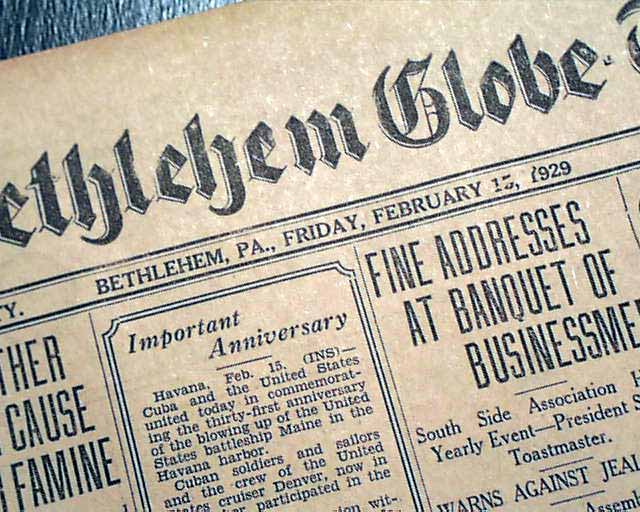
February 15, 1929
THE BETHLEHEM GLOBE TIMES, Albany, New York, February 15, 1929
* St. Valentine's Day Massacre
* Al Capone & George 'Bug's' Moran
* Rare photo showing
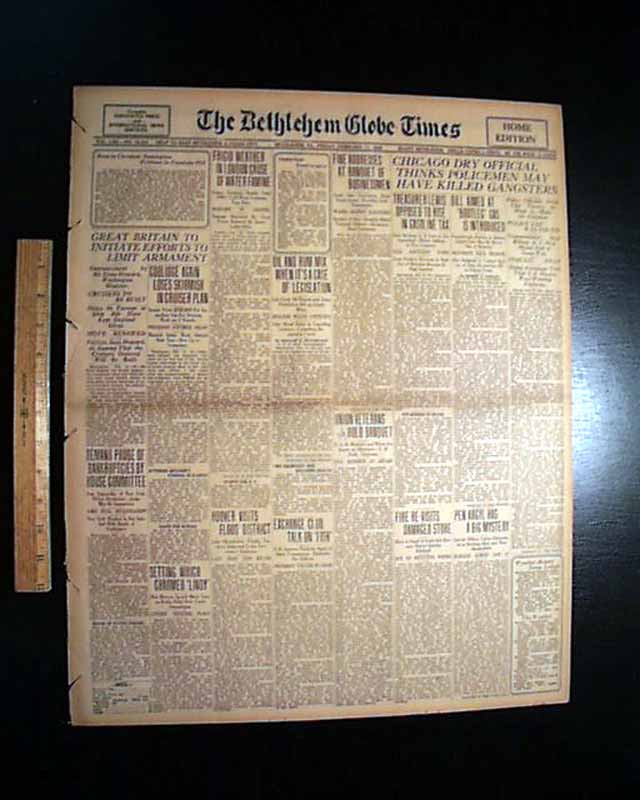
This 32 page newspaper has a three column headline on the front page:
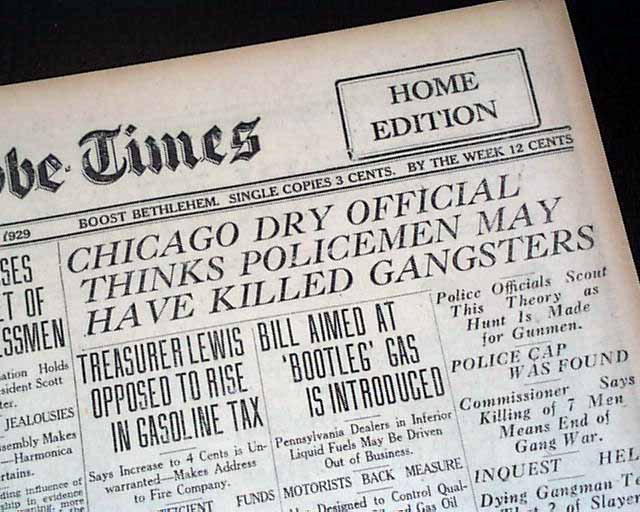
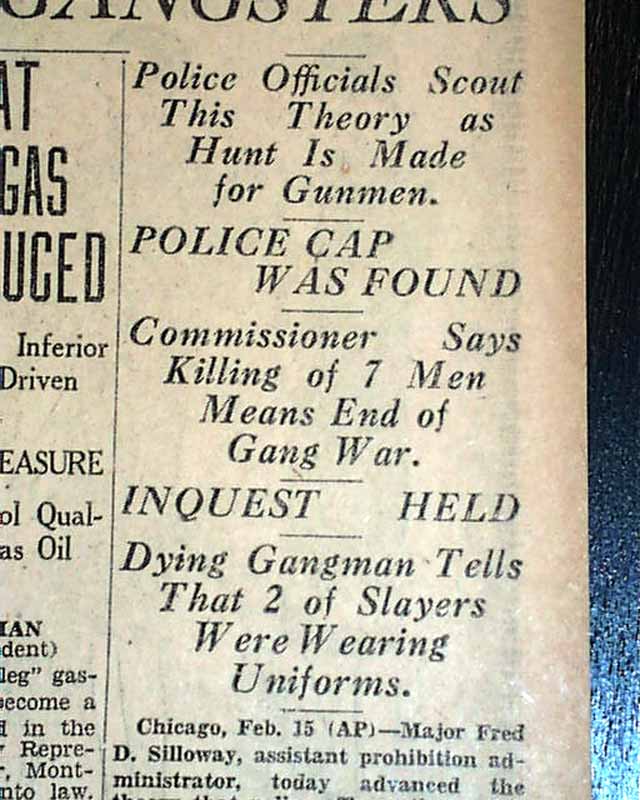
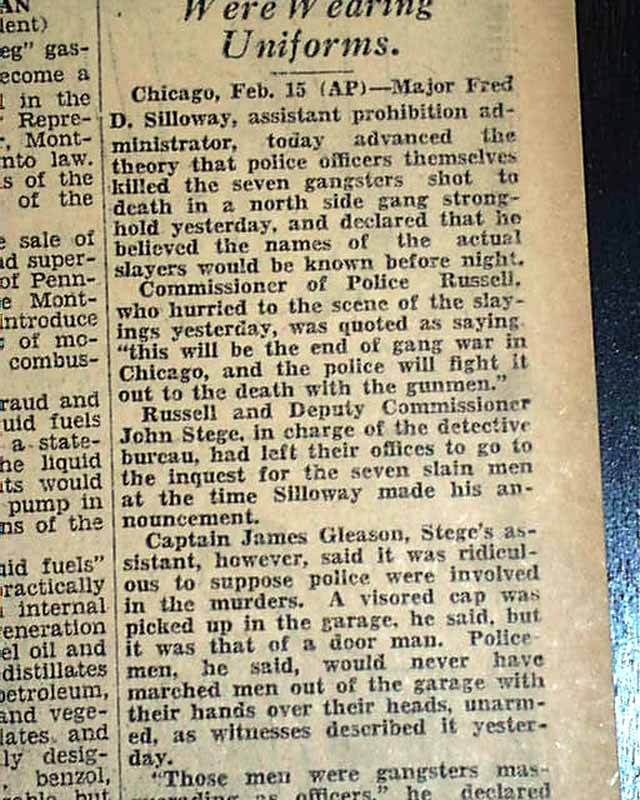
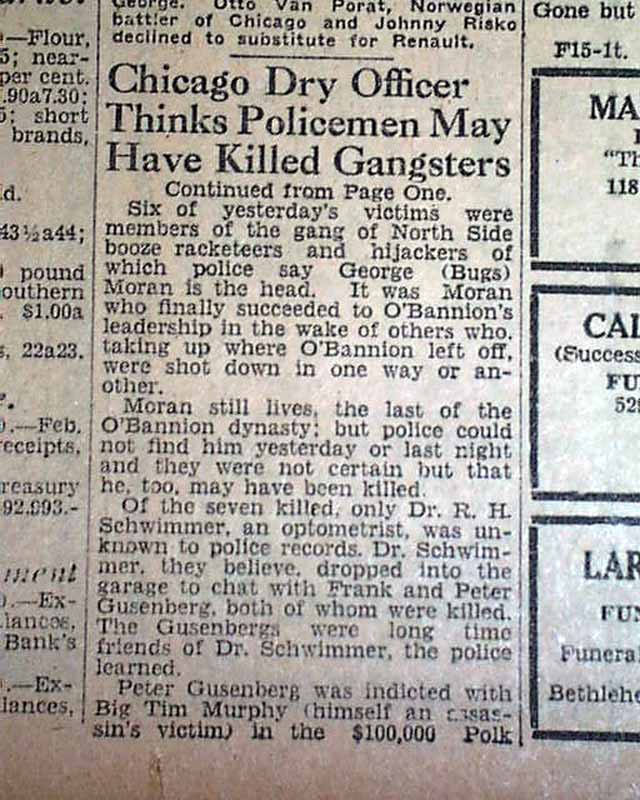
* CHICAGO DRY OFFICIAL THINKS POLICEMEN MAY HAVE KILLED GANGSTERS
with subheads that include: "Police Officials Scout This Theory as Hunt IS Made for Gunmen" "POLICE CAP WAS FOUND" "Dying Gangman Tells That 2 of Slayers Were Wearing Uniforms" and more. (see)
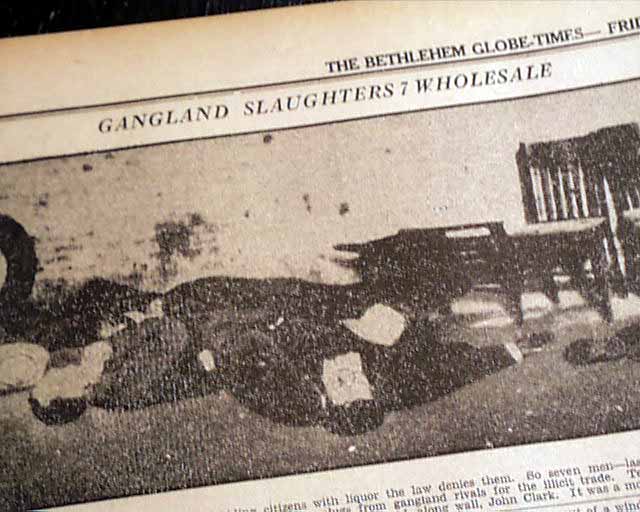
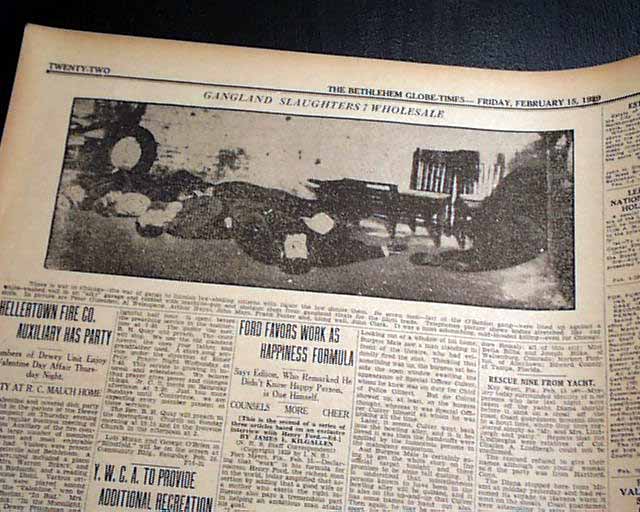
Also a five column photo of the crime scene on page 22 which shows the Moran gang dead on the ground. Photos such as this were rarely shown in newspapers. Photo is somewhat blurred due to poor picture quality.
Other news of the day throughout. Light browning with some binding slits along the spine, otherwise good.
wikipedia notes: The Saint Valentine's Day Massacre is the name given to the murder of seven people as part of a Prohibition Era conflict between two powerful criminal gangs in Chicago, Illinois, in 1929: the South Side Italian gang led by Al Capone and the North Side Irish gang led by Bugs Moran. Former members of the Egan's Rats gang were also suspected to have played a large role in the St. Valentine's Day massacre, assisting Capone.
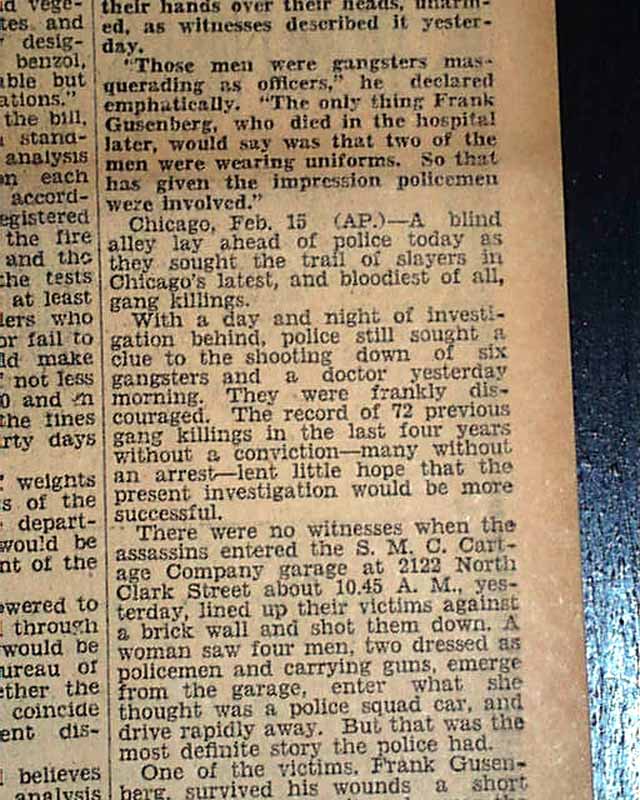
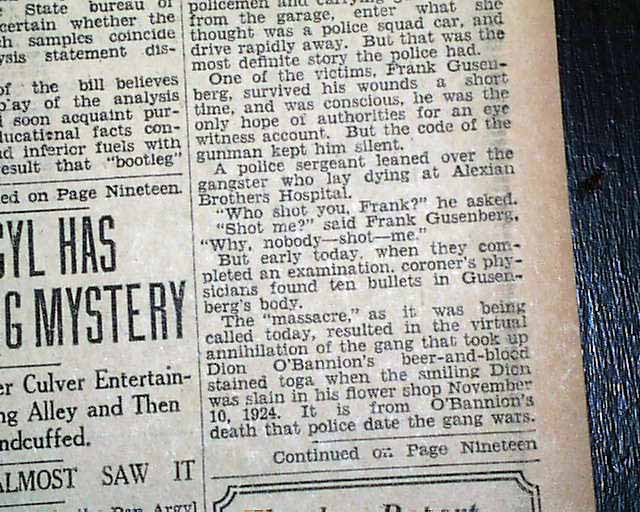
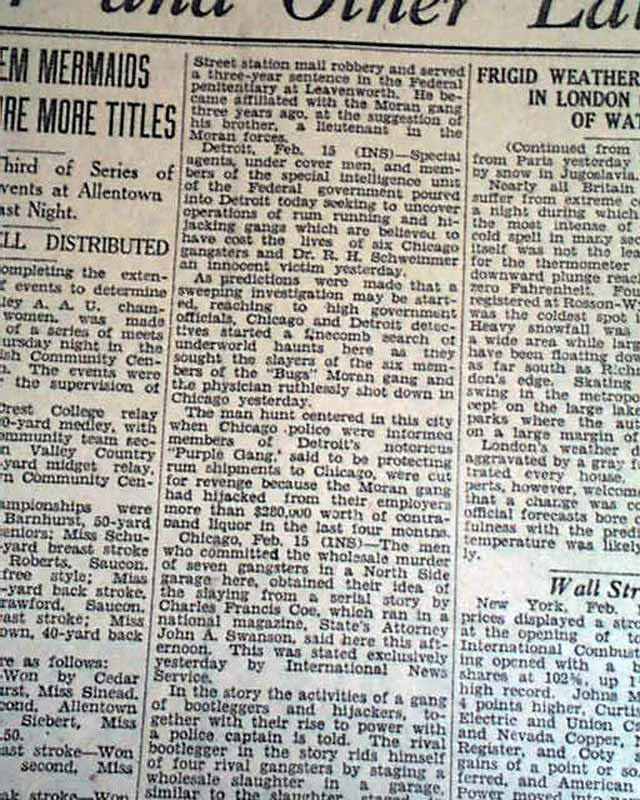
On the morning of Thursday, February 14, 1929, St. Valentine's Day, six members of the "Bugs" Moran gang and Reinhardt H. Schwimmer were lined up against the rear inside wall of the garage of the SMC Cartage Company (2122 North Clark Street) in the Lincoln Park neighborhood of Chicago's North Side. They were then shot and killed, possibly by members of Al Capone's gang, possibly by "outside talent" (that is, gangsters from outside the city who would not be known to their victims), most likely by a combination of both. Two of the men were dressed as Chicago police officers, and the others were dressed in long trenchcoats, according to witnesses who saw the "police" leading the other men at gunpoint out of the garage (part of the plan). When one of the dying men, Frank Gusenberg, was asked who shot him, he replied, "I'm not gonna talk - nobody shot me" despite having 22 bullet wounds. Capone himself had arranged to be on vacation in Florida. The St. Valentine's Massacre resulted from a plan devised by a member or members of the Capone gang to eliminate the Polish-Irish Bugs Moran, the boss of the North Side Gang, formerly headed up by Dion O'Banion who was murdered nearly five years earlier. Jack McGurn is the person most frequently cited by researchers as a suspected planner. The massacre was planned by the Capone mob for a number of reasons: in retaliation for an unsuccessful attempt by Frank and his brother Peter Gusenberg to murder Jack McGurn earlier in the year, the North Side Gang's complicity in the murder of Pasqualino "Patsy" Lolordo as well as Antonio "The Scourge" Lombardo, and Bugs Moran's muscling in on a Capone-run dog track in the Chicago suburbs. Also, the rivalry between Moran and Capone for control of the lucrative Chicago bootlegging business led Capone to plan the hits and the O'Banion's gang demise.
The plan was to lure Bugs Moran and his men to the SMC Cartage warehouse on North Clark Street. It is assumed usually that the North Side Gang was lured to the garage with the promise of a cut-rate shipment of bootleg whiskey, supplied by Detroit's Purple Gang. However, some recent studies dispute this. All seven victims (with the exception of John May) were dressed in their best clothes, hardly suitable for unloading a large shipment of whiskey crates and driving it away. The real reason for the North Siders gathering in the garage may never be known for certain.
A four-man team would then enter the building, two disguised as police officers, and kill Moran and his men. Before Moran and his men arrived, Capone stationed lookouts in the apartments across the street from the warehouse. Wishing to keep the lookouts inconspicuous, Capone had hired two unrecognizable thugs to stand watch in rented rooms across the street from the garage.
At around 10:30 a.m. on St. Valentine's Day, four men arrived at the warehouse in two cars: a Cadillac sedan and a Peerless, both outfitted to look like detective sedans. Two men were dressed in police uniforms and two in street clothes. The Moran gang had already arrived at the warehouse. However, Moran himself was not inside. One account states that Moran was supposedly approaching the warehouse, spotted the police car, and fled the scene to a nearby coffee shop. Another account was that Moran was simply late getting there.
The lookouts allegedly confused one of Moran's men (most likely Albert Weinshank, who was the same height, build and even physically resembled Moran) for Moran himself: he then signaled for the gunmen to enter the warehouse. The two phony police, carrying shotguns, exited the Peerless and entered the warehouse through the two rear doors. Inside they found members of Moran's gang, a sixth man named Reinhart Schwimmer, who was not actually a gangster but more of a gang "hanger-on" or "groupie", and a seventh man, John May, who was a mechanic fixing one of the cars, and technically not a member of the gang but an occasionally hired mechanic. The killers told the seven men to line up facing the back wall. There was apparently not any resistance, as the Moran men thought their captors were real police, and it was likely a "show" bust merely to garner good press for the police department.
Then the two "police officers" let in two men through the front door facing Clark Street. This pair, riding in the Cadillac, were dressed in civilian clothes. Two of the killers started shooting with Thompson sub-machine guns, one containing a 20-round magazine and the other a 50-round drum. All seven men were killed in a volley of seventy machine-gun bullets and two shotgun blasts according to the coroner's report.
To show bystanders that everything was under control, the men in street clothes came out with their hands up, prodded by the two uniformed cops. The only survivors in the warehouse were John May's German shepherd, Highball, and Frank Gusenberg who, despite fourteen bullet wounds, was still clinging to life. When the real police arrived, they first heard the dog howling. On entering the warehouse, they found the dog trapped under a beer truck and the floor covered with blood, shell casings, and corpses.
Photographs of the scene were taken immediately after the shooting by Jun Fujita and published in the Chicago Daily News.
* St. Valentine's Day Massacre
* Al Capone & George 'Bug's' Moran
* Rare photo showing
This 32 page newspaper has a three column headline on the front page:
* CHICAGO DRY OFFICIAL THINKS POLICEMEN MAY HAVE KILLED GANGSTERS
with subheads that include: "Police Officials Scout This Theory as Hunt IS Made for Gunmen" "POLICE CAP WAS FOUND" "Dying Gangman Tells That 2 of Slayers Were Wearing Uniforms" and more. (see)
Also a five column photo of the crime scene on page 22 which shows the Moran gang dead on the ground. Photos such as this were rarely shown in newspapers. Photo is somewhat blurred due to poor picture quality.
Other news of the day throughout. Light browning with some binding slits along the spine, otherwise good.
wikipedia notes: The Saint Valentine's Day Massacre is the name given to the murder of seven people as part of a Prohibition Era conflict between two powerful criminal gangs in Chicago, Illinois, in 1929: the South Side Italian gang led by Al Capone and the North Side Irish gang led by Bugs Moran. Former members of the Egan's Rats gang were also suspected to have played a large role in the St. Valentine's Day massacre, assisting Capone.
On the morning of Thursday, February 14, 1929, St. Valentine's Day, six members of the "Bugs" Moran gang and Reinhardt H. Schwimmer were lined up against the rear inside wall of the garage of the SMC Cartage Company (2122 North Clark Street) in the Lincoln Park neighborhood of Chicago's North Side. They were then shot and killed, possibly by members of Al Capone's gang, possibly by "outside talent" (that is, gangsters from outside the city who would not be known to their victims), most likely by a combination of both. Two of the men were dressed as Chicago police officers, and the others were dressed in long trenchcoats, according to witnesses who saw the "police" leading the other men at gunpoint out of the garage (part of the plan). When one of the dying men, Frank Gusenberg, was asked who shot him, he replied, "I'm not gonna talk - nobody shot me" despite having 22 bullet wounds. Capone himself had arranged to be on vacation in Florida. The St. Valentine's Massacre resulted from a plan devised by a member or members of the Capone gang to eliminate the Polish-Irish Bugs Moran, the boss of the North Side Gang, formerly headed up by Dion O'Banion who was murdered nearly five years earlier. Jack McGurn is the person most frequently cited by researchers as a suspected planner. The massacre was planned by the Capone mob for a number of reasons: in retaliation for an unsuccessful attempt by Frank and his brother Peter Gusenberg to murder Jack McGurn earlier in the year, the North Side Gang's complicity in the murder of Pasqualino "Patsy" Lolordo as well as Antonio "The Scourge" Lombardo, and Bugs Moran's muscling in on a Capone-run dog track in the Chicago suburbs. Also, the rivalry between Moran and Capone for control of the lucrative Chicago bootlegging business led Capone to plan the hits and the O'Banion's gang demise.
The plan was to lure Bugs Moran and his men to the SMC Cartage warehouse on North Clark Street. It is assumed usually that the North Side Gang was lured to the garage with the promise of a cut-rate shipment of bootleg whiskey, supplied by Detroit's Purple Gang. However, some recent studies dispute this. All seven victims (with the exception of John May) were dressed in their best clothes, hardly suitable for unloading a large shipment of whiskey crates and driving it away. The real reason for the North Siders gathering in the garage may never be known for certain.
A four-man team would then enter the building, two disguised as police officers, and kill Moran and his men. Before Moran and his men arrived, Capone stationed lookouts in the apartments across the street from the warehouse. Wishing to keep the lookouts inconspicuous, Capone had hired two unrecognizable thugs to stand watch in rented rooms across the street from the garage.
At around 10:30 a.m. on St. Valentine's Day, four men arrived at the warehouse in two cars: a Cadillac sedan and a Peerless, both outfitted to look like detective sedans. Two men were dressed in police uniforms and two in street clothes. The Moran gang had already arrived at the warehouse. However, Moran himself was not inside. One account states that Moran was supposedly approaching the warehouse, spotted the police car, and fled the scene to a nearby coffee shop. Another account was that Moran was simply late getting there.
The lookouts allegedly confused one of Moran's men (most likely Albert Weinshank, who was the same height, build and even physically resembled Moran) for Moran himself: he then signaled for the gunmen to enter the warehouse. The two phony police, carrying shotguns, exited the Peerless and entered the warehouse through the two rear doors. Inside they found members of Moran's gang, a sixth man named Reinhart Schwimmer, who was not actually a gangster but more of a gang "hanger-on" or "groupie", and a seventh man, John May, who was a mechanic fixing one of the cars, and technically not a member of the gang but an occasionally hired mechanic. The killers told the seven men to line up facing the back wall. There was apparently not any resistance, as the Moran men thought their captors were real police, and it was likely a "show" bust merely to garner good press for the police department.
Then the two "police officers" let in two men through the front door facing Clark Street. This pair, riding in the Cadillac, were dressed in civilian clothes. Two of the killers started shooting with Thompson sub-machine guns, one containing a 20-round magazine and the other a 50-round drum. All seven men were killed in a volley of seventy machine-gun bullets and two shotgun blasts according to the coroner's report.
To show bystanders that everything was under control, the men in street clothes came out with their hands up, prodded by the two uniformed cops. The only survivors in the warehouse were John May's German shepherd, Highball, and Frank Gusenberg who, despite fourteen bullet wounds, was still clinging to life. When the real police arrived, they first heard the dog howling. On entering the warehouse, they found the dog trapped under a beer truck and the floor covered with blood, shell casings, and corpses.
Photographs of the scene were taken immediately after the shooting by Jun Fujita and published in the Chicago Daily News.
Category: The 20th Century


