

Dan Mendoza... Dr. Priestly...
Item # 542879Sorry, but this item is no longer available. Please be in touch at info@rarenewspapers.com if you would like to be placed on a want list or are interested in a potential alternate issue.
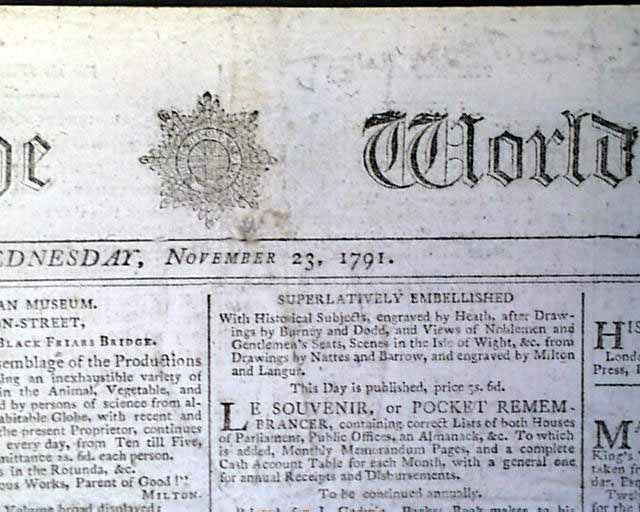
November 23, 1791
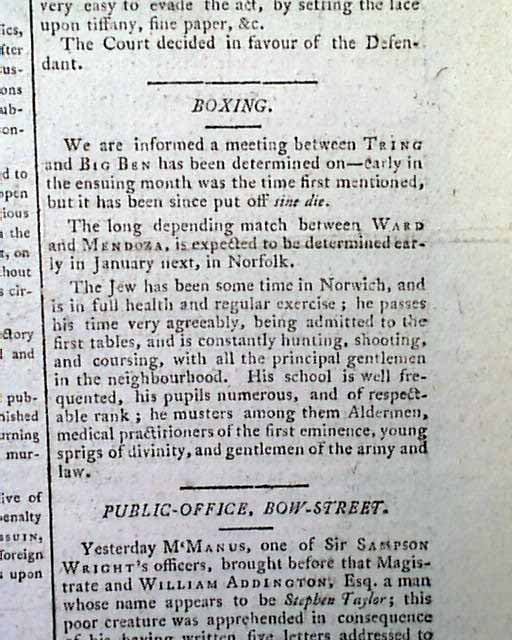
THE WORLD, London, England, dated November 23, 1791. Page three, column four of this issue features an article concerning a boxing match between Ward and Mendoza, which reads in part: "The long depending match between WARD and MENDOZA, is expected to be determined early in January next, in Norfolk. The Jew has been some time in Norwich, and is in full health..."
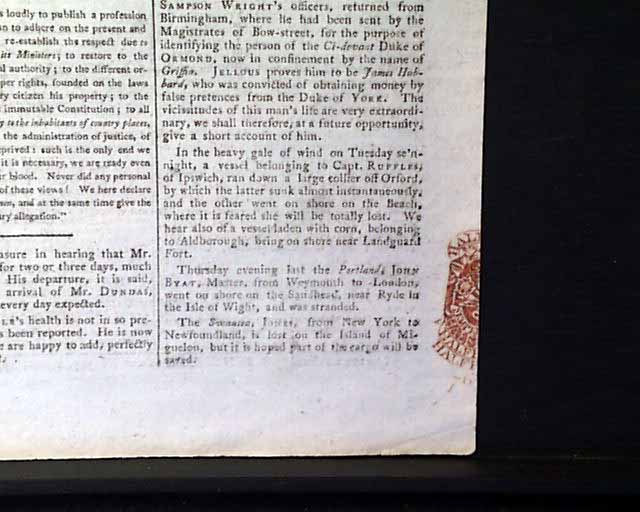
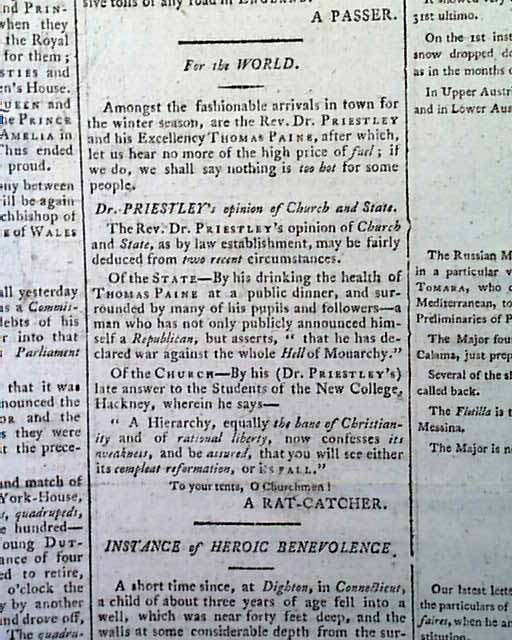
Page two contains an article that is directed to Dr. Priestley and his views on Church and State (see photo).
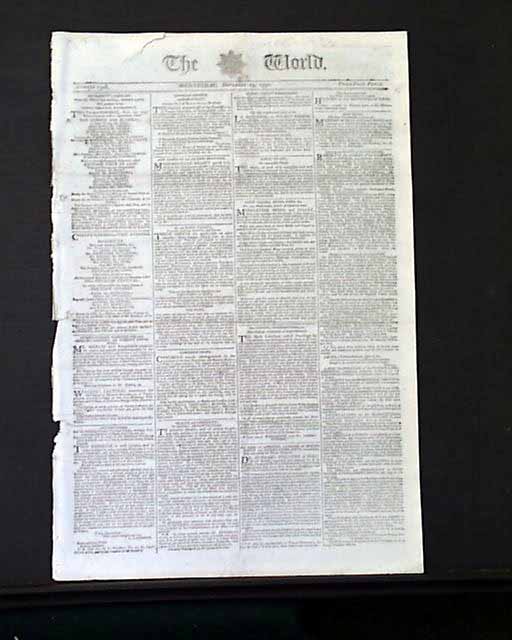
This issue is in good condition; although, several minor edge tears can be found, none of which effect the content. This is complete in four-pages.
Background Information: Daniel Mendoza (5 July 1764 – 3 September 1836) (often known as Dan Mendoza) was an English prizefighter, who was boxing champion of England 1792-95. He is sometimes called the father of scientific boxing.
Mendoza's style consisted of more than simply battering opponents into submission, his "scientific style" included much movement. His ability to overcome much heavier adversaries was a consequence of this. In 1789 he published The Art of Boxing.
Mendoza was so popular that the London press reported news of one of his bouts ahead of the storming of the Bastille which marked the start of the French Revolution. He transformed the English stereotype of a Jew from a weak, indefensible person into someone deserving of respect. He is said to have been the first Jew to talk to the King, George III.
His early boxing career was defined by three bouts with his former mentor Richard Humphries between 1788 and 1790. The first of these was lost due to Humphries’s second (the former Champion, Tom Johnson) blocking a blow. The second two bouts were won by Mendoza. The third bout was the first time spectators were charged an entry payment to a sporting event. The fights were hyped by a series of combative letters in the press between Humphries and Mendoza.
In 1795 Mendoza fought "Gentleman" John Jackson for the Championship at Hornchurch in Essex. Jackson was five years younger, 4 inches taller, and 42 lbs. heavier. The bigger man won in nine rounds, paving the way to victory by seizing Mendoza by his long hair and holding him with one hand while he pounded his head with the other. Mendoza was pummelled into submission in around ten minutes. Since this date boxers have worn their hair short.
Mendoza made and spent a fortune. His Memoirs (written in 1808 but not published until 1816) report that he tried a number of ventures, including touring the British Isles giving boxing demonstrations; appeared in a pantomime entitled Robinson Crusoe or Friday Turned Boxer; opening a boxing academy at the Lyceum in the Strand; working as a recruiting sergeant for the army; printing his own paper money; and being a pub landlord.
Mendoza made his last public appearance as a boxer in 1820 at Banstead Downs in a grudge match against Tom Owen; he was defeated after 12 rounds.
Intelligent, charismatic but chaotic, he died leaving his family in poverty. source: wikipedia
Page two contains an article that is directed to Dr. Priestley and his views on Church and State (see photo).
This issue is in good condition; although, several minor edge tears can be found, none of which effect the content. This is complete in four-pages.
Background Information: Daniel Mendoza (5 July 1764 – 3 September 1836) (often known as Dan Mendoza) was an English prizefighter, who was boxing champion of England 1792-95. He is sometimes called the father of scientific boxing.
Mendoza's style consisted of more than simply battering opponents into submission, his "scientific style" included much movement. His ability to overcome much heavier adversaries was a consequence of this. In 1789 he published The Art of Boxing.
Mendoza was so popular that the London press reported news of one of his bouts ahead of the storming of the Bastille which marked the start of the French Revolution. He transformed the English stereotype of a Jew from a weak, indefensible person into someone deserving of respect. He is said to have been the first Jew to talk to the King, George III.
His early boxing career was defined by three bouts with his former mentor Richard Humphries between 1788 and 1790. The first of these was lost due to Humphries’s second (the former Champion, Tom Johnson) blocking a blow. The second two bouts were won by Mendoza. The third bout was the first time spectators were charged an entry payment to a sporting event. The fights were hyped by a series of combative letters in the press between Humphries and Mendoza.
In 1795 Mendoza fought "Gentleman" John Jackson for the Championship at Hornchurch in Essex. Jackson was five years younger, 4 inches taller, and 42 lbs. heavier. The bigger man won in nine rounds, paving the way to victory by seizing Mendoza by his long hair and holding him with one hand while he pounded his head with the other. Mendoza was pummelled into submission in around ten minutes. Since this date boxers have worn their hair short.
Mendoza made and spent a fortune. His Memoirs (written in 1808 but not published until 1816) report that he tried a number of ventures, including touring the British Isles giving boxing demonstrations; appeared in a pantomime entitled Robinson Crusoe or Friday Turned Boxer; opening a boxing academy at the Lyceum in the Strand; working as a recruiting sergeant for the army; printing his own paper money; and being a pub landlord.
Mendoza made his last public appearance as a boxer in 1820 at Banstead Downs in a grudge match against Tom Owen; he was defeated after 12 rounds.
Intelligent, charismatic but chaotic, he died leaving his family in poverty. source: wikipedia
Category: The 1600's and 1700's


