Operation fantasia... spirit foxes... WWII...
SPRINGFIELD SUNDAY REPUBLICAN, Mass. Aug. 18, 1946
- Operation Fantasia - psychological warfare scheme
- Kitsune - Japanese supernatural folklore - fox spirit
- Pacific theater plan during World War II made public
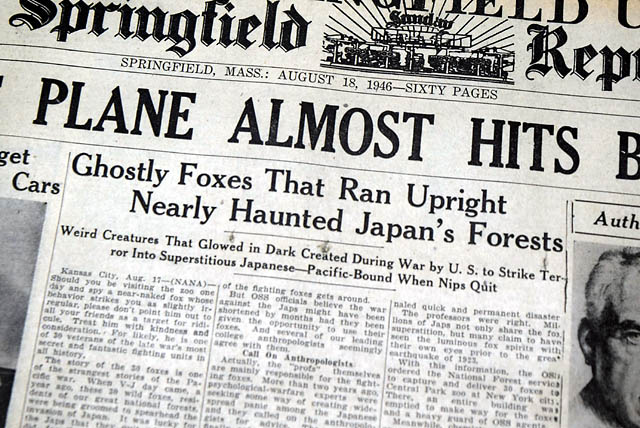
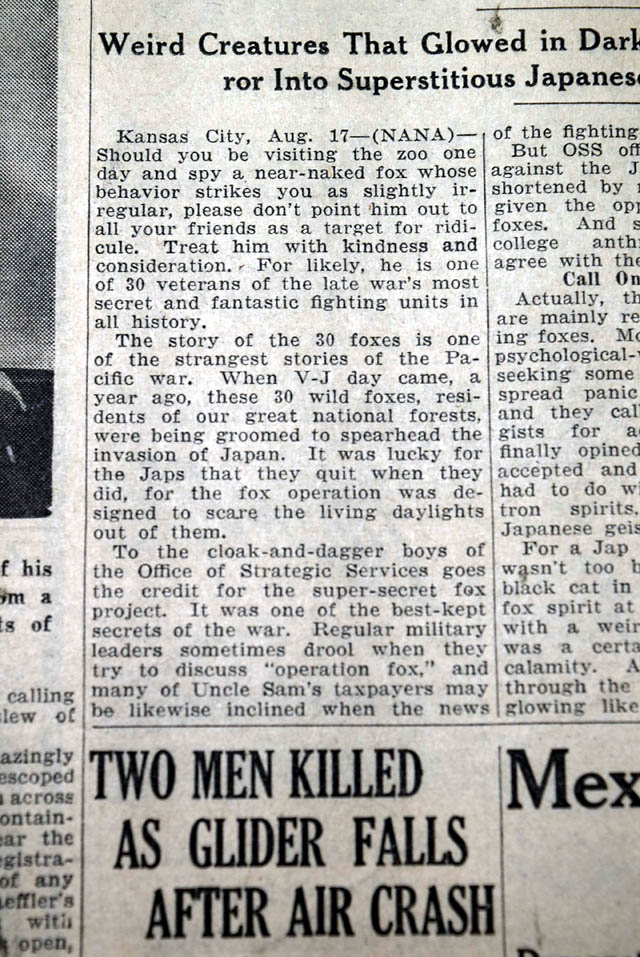
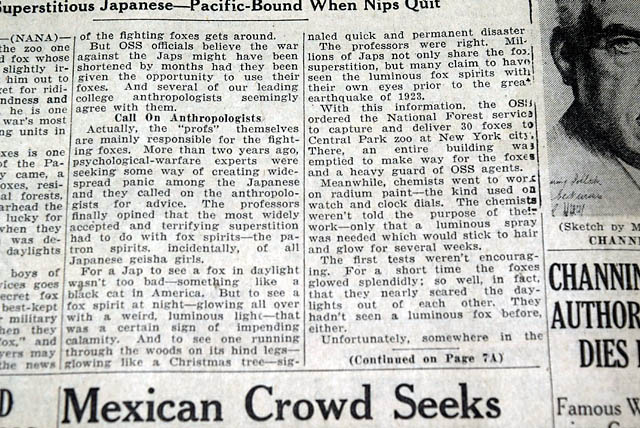
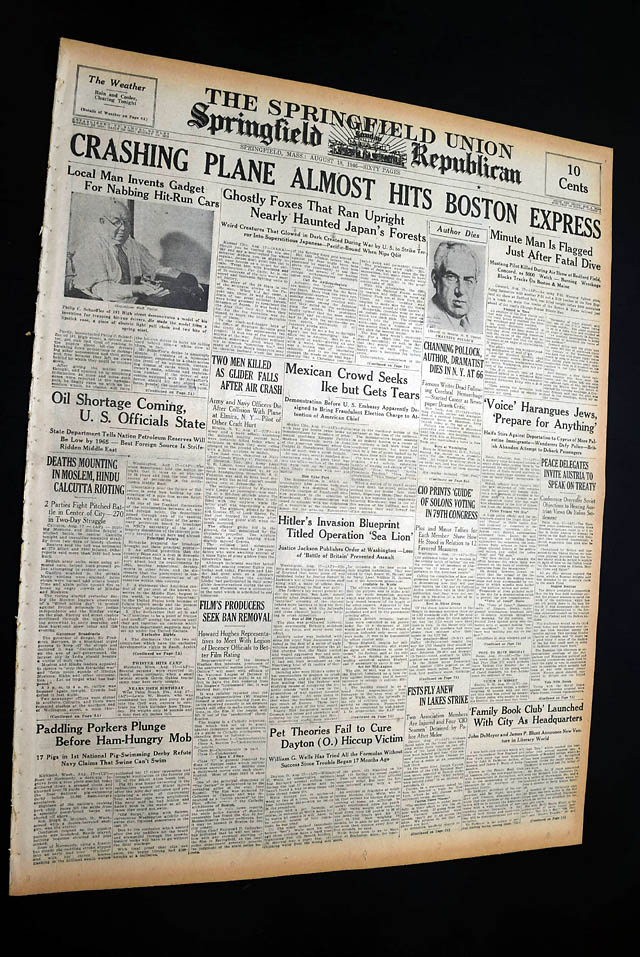
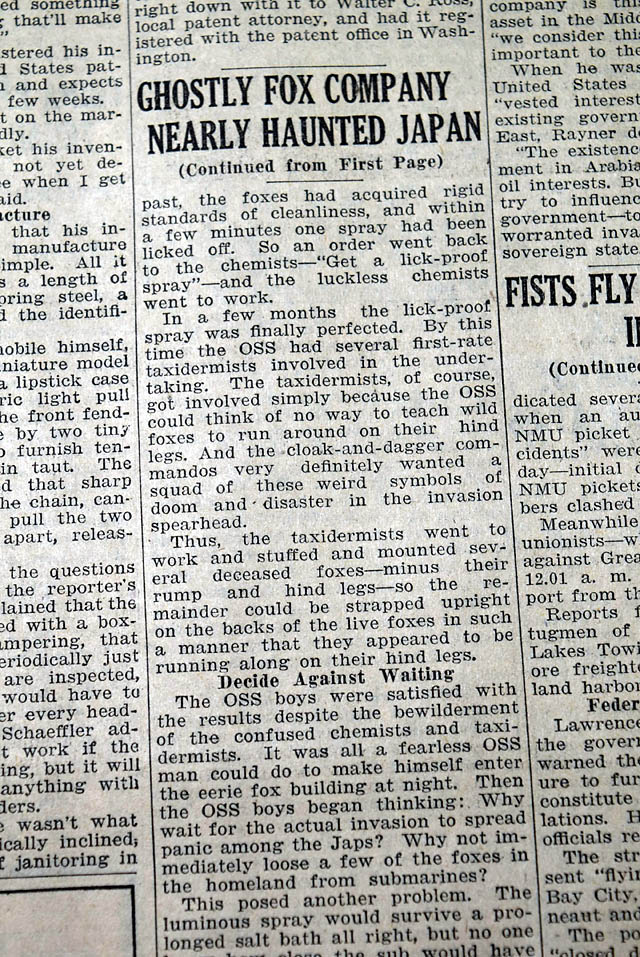
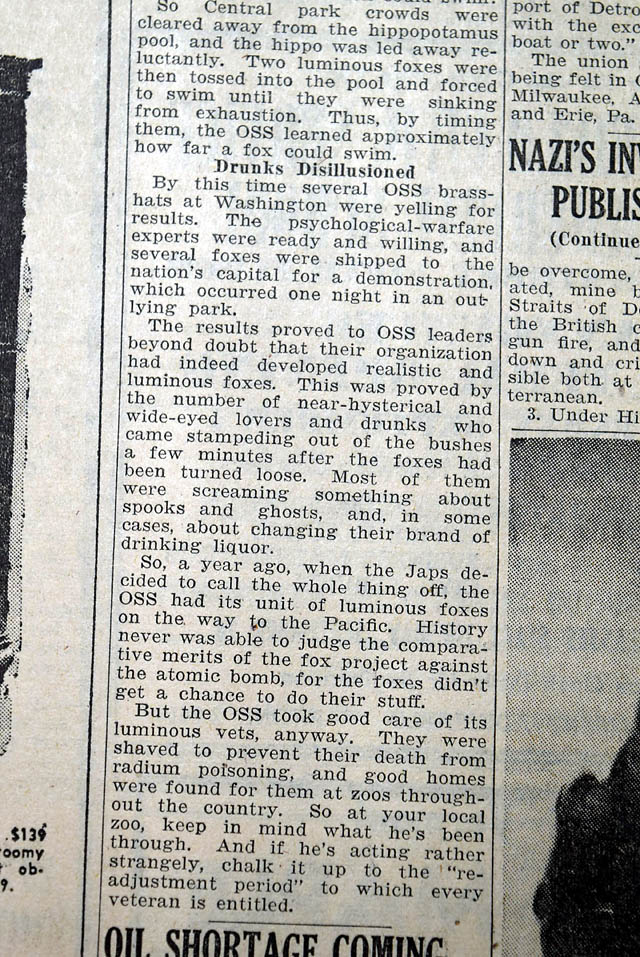
The front page has a three column heading: "Ghostly Foxes That Ran Upright Nearly Haunted Japan's Forests" with subhead. (see images) This was one the strangest and largely unknown operations during World War II. See below for more details.
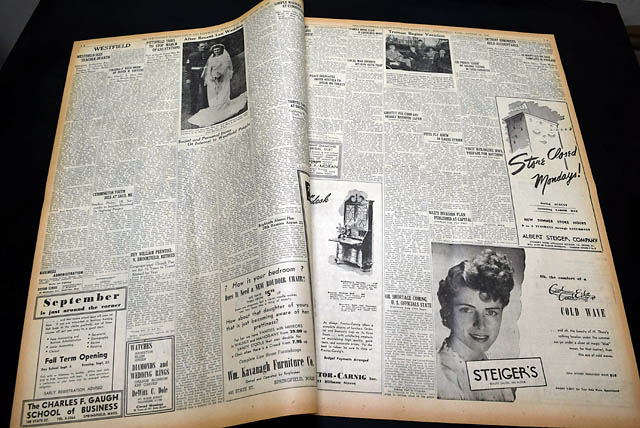
Complete 1st section only with all 16 pages, light toning and minor wear at the margins, generally in nice condition.
Background: Conceived in 1943 by Strategy Specialist Ed Salinger of the Office of Strategic Services (OSS), Operation Fantasia was an eccentric psychological warfare scheme designed to demoralize Japanese military forces and civilians by exploiting traditional folklore surrounding the kitsune—supernatural, shape-shifting foxes associated with ominous spirits and possession. Salinger theorized that unleashing glowing foxes near villages and military bases would trigger deep superstitious panic. To test the visual impact, the OSS used luminous, radium-based paint supplied by the United States Radium Corporation (the same manufacturer infamous for the "Radium Girls" workplace exposure). After verifying paint durability on a raccoon at the Central Park Zoo, agents painted 30 foxes and released them in Washington, D.C.’s Rock Creek Park, startling late-night visitors and triggering alarmed calls to local police. The agency brainstormed several bizarre companion tactics to amplify the terror, including fox-shaped balloons, artificial musk scents, specialized whistles mimicking fox calls, painted coyotes, and even a stuffed fox attached to a human skull flown from a kite.
Despite the elaborate field tests, the OSS ultimately never went through with the operation, canceling it in late 1943 before a single fox or weapon ever reached Japanese territory. The project unraveled due to severe practical failures, most notably during amphibious deployment trials in the Chesapeake Bay where officers discovered that ocean water instantly washed off the paint as the foxes swam ashore, and the animals licked away whatever chemical residue remained. Furthermore, handlers had no reliable way to control where wild foxes roamed once released on land, rendering targeted releases impossible. High-ranking military officials also voiced intense internal opposition; Stanley Lovell, head of the OSS Research and Development branch, heavily criticized the idea as absurd, unworkable, and dependent on flawed, offensive cultural assumptions about Japanese psychology. Stymied by insurmountable biological logistics and skepticism from leadership, Operation Fantasia was quietly scrapped and relegated to the archives of wartime oddities.
Other issues you may like
§ related
SAN FRANCISCO CHRONICLE, Feb. 25, 1942
- Battle of Los Angeles - Air Raid
- Japanese airplane attack ? UFO's ?
The front page has a two column headline: "War in
...
STARS & STRIPES, Paris Edition, May 26, 1945 This was the: "Daily Newspaper of U.S. Armed Forces in the European Theater of Operations" as noted in the
...
THE BOSTON POST, Sept. 15, 1942
- Lookout Air Raids - Brookings, Oregon
- Incendiary bombs from a Yokosuka E14Y
- Japanese naval aviator Nobuo Fujita
The top of the
...
STARS & STRIPES, London Edition, July 12, 1945
- Island of Kyushu, Japan
- Attack on Kamikazes airdromes
- Operation Iceberg - Okinawa campaign
This was the: "Daily
...