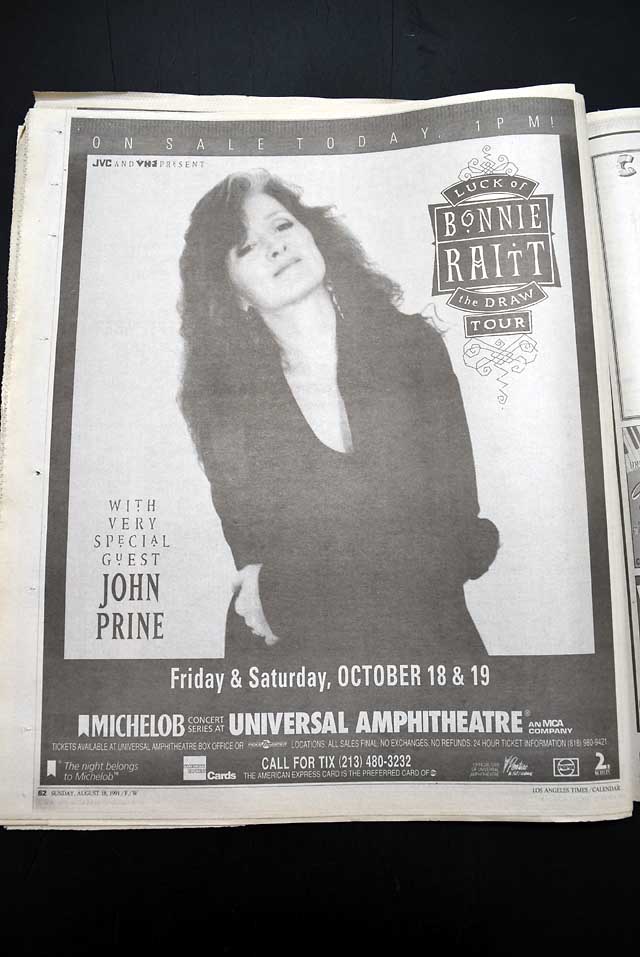
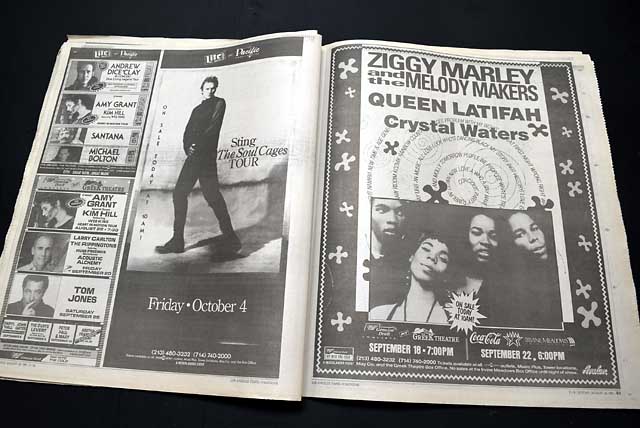
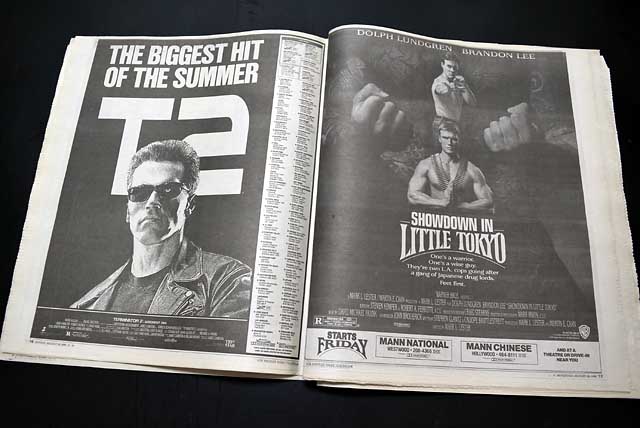
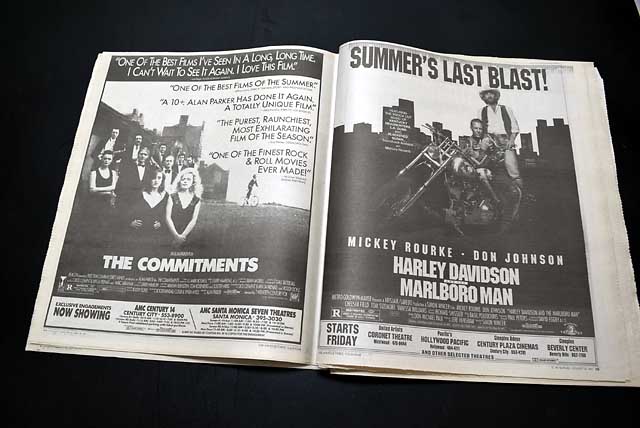
1st weekend of "Terminator 2: Judgment Day", in a Los Angeles newspaper...
Item # 728721
·
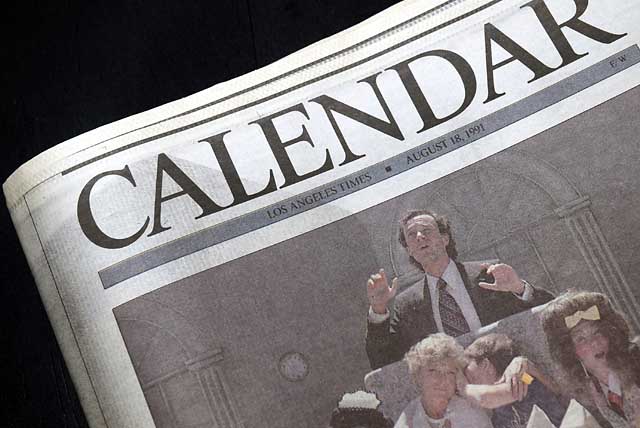
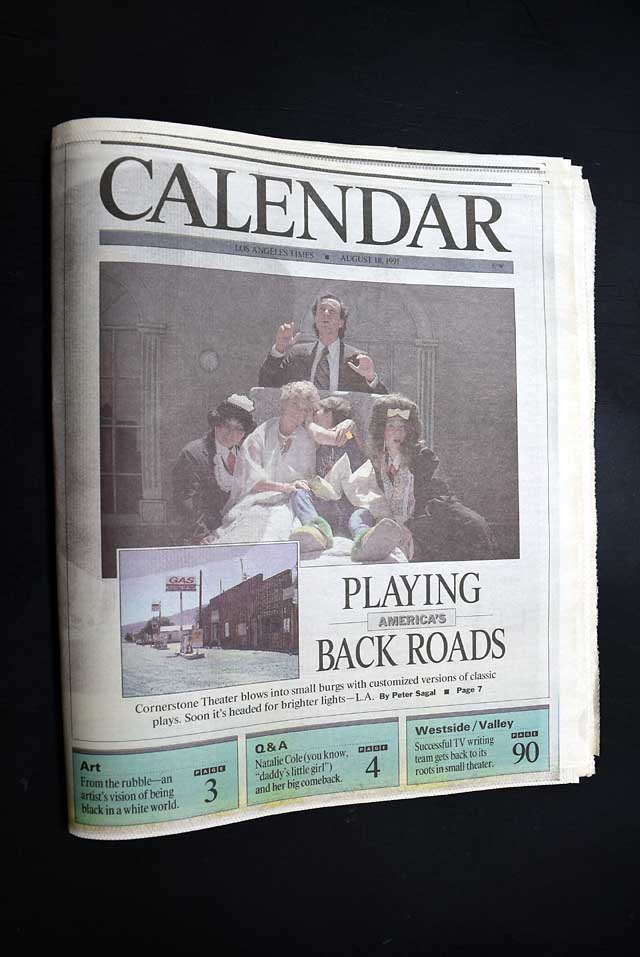
Sunday CALENDAR SECTION only of the Los Angeles Times, Aug. 18, 1991
* African American artist David Hammons
Often revered as the undisputed "bible" of Hollywood, the Sunday Calendar section occupied a rare space in journalism where a single publication could simultaneously dictate global entertainment trends and govern the inner workings of show business. Today, physical copies are an absolute rarity, largely because they were printed on standard, ephemeral newsprint designed to be devoured and promptly discarded at the end of the week.
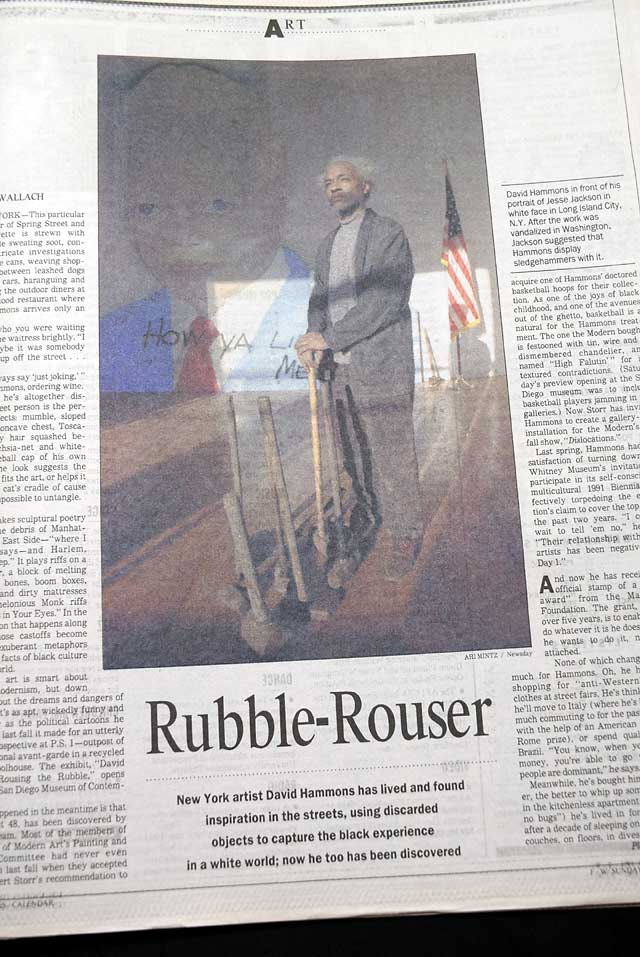
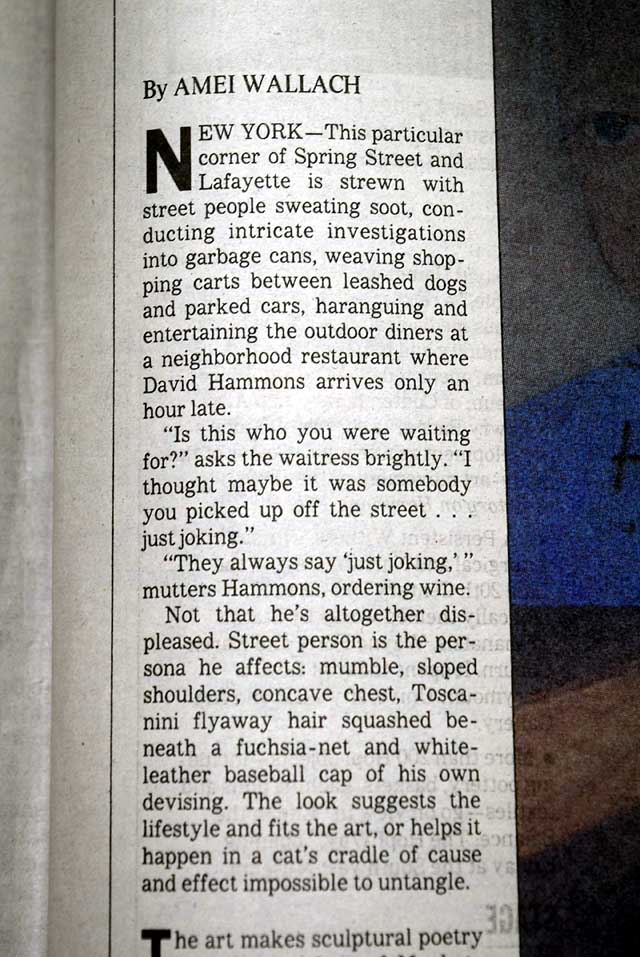
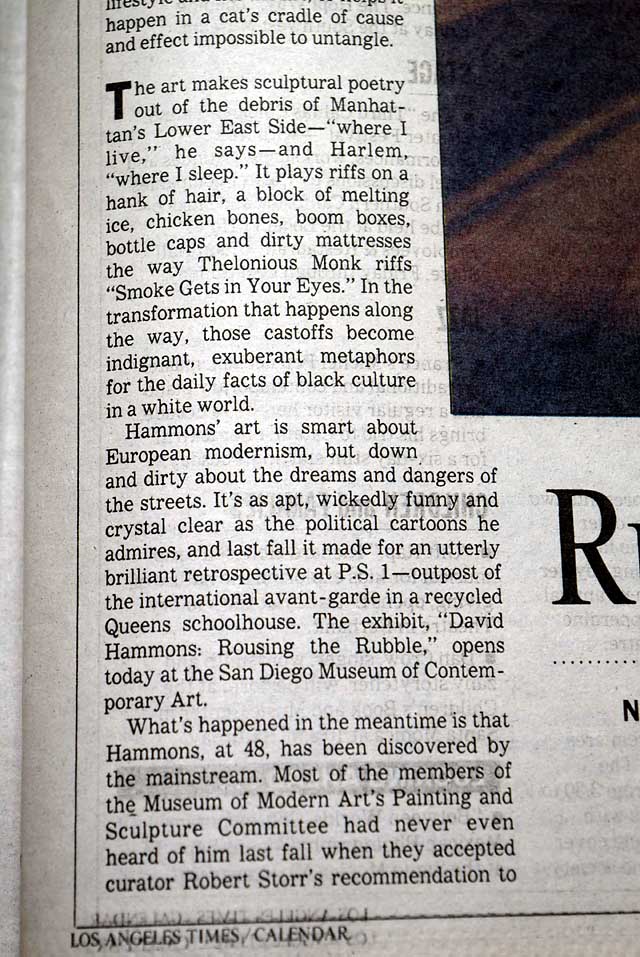
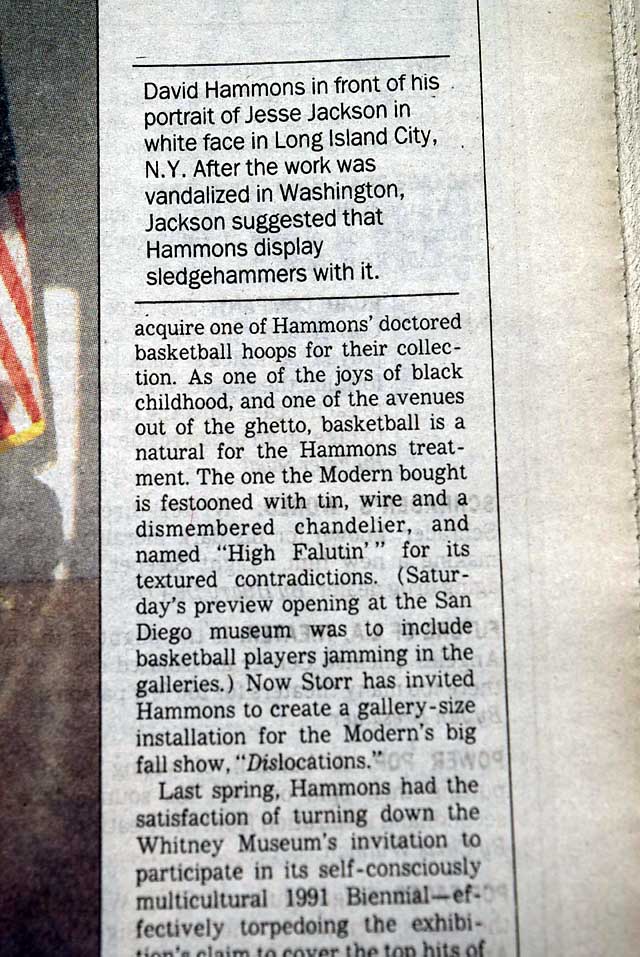
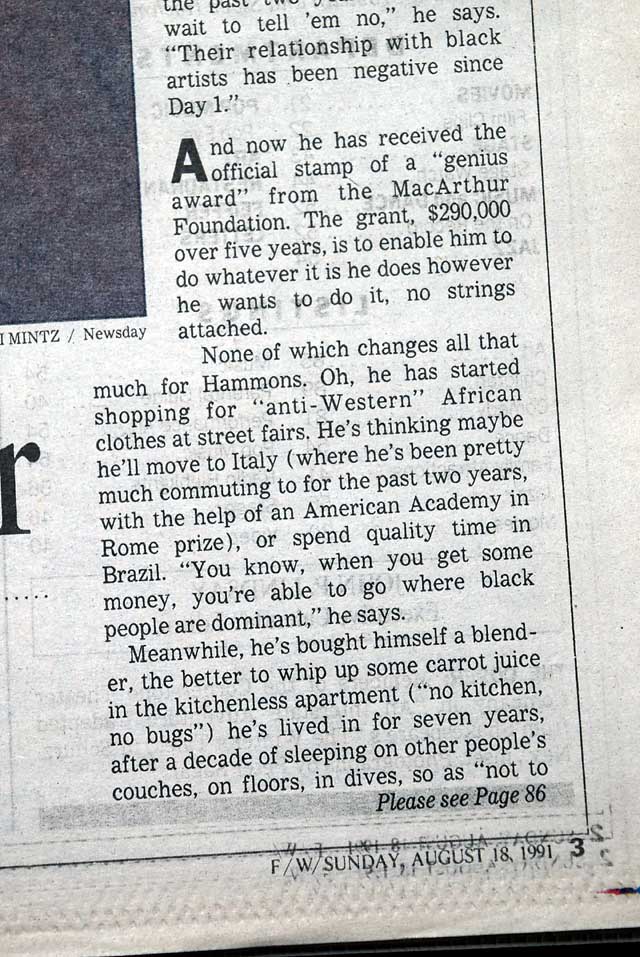
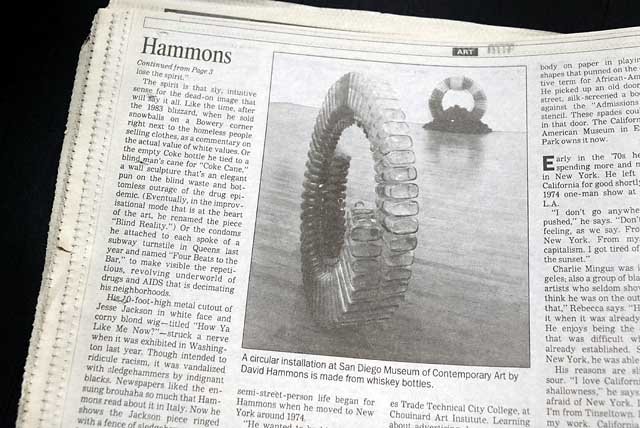
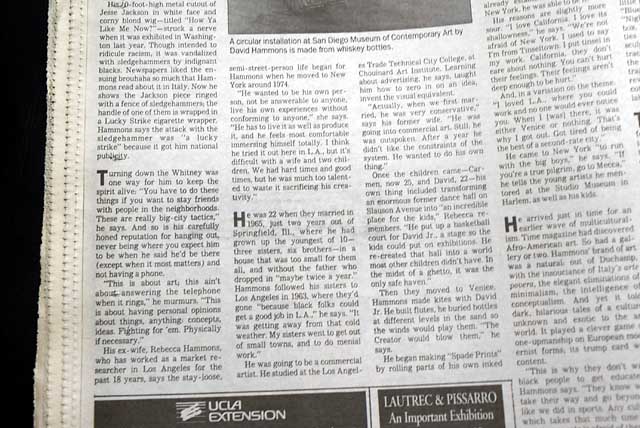
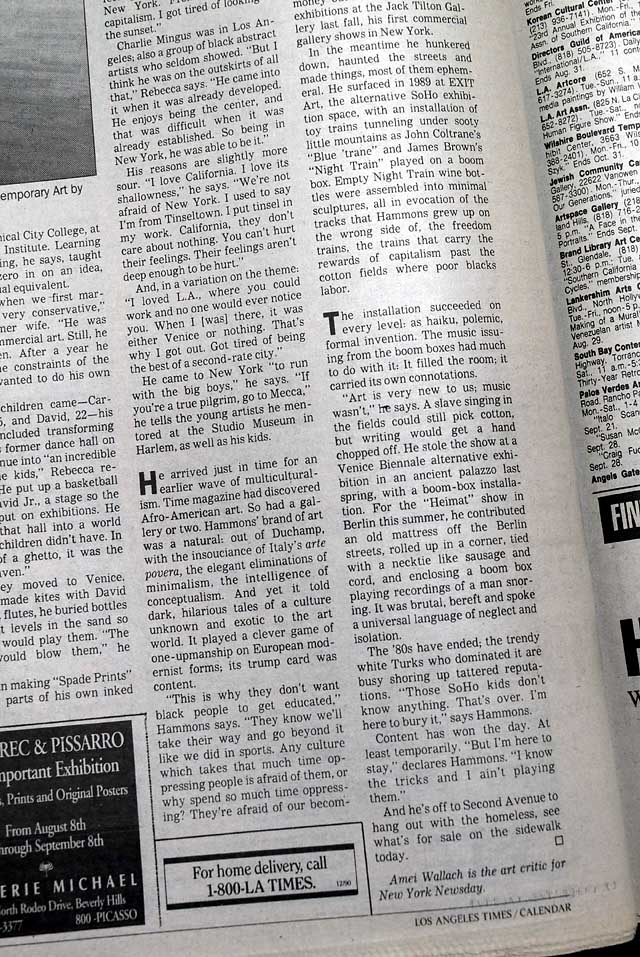
Page 3 has a piece by Amei Wallach on African American artist David Hammons with photo and heading: "Rubble-Rouser". (see images)
Provenance note: This issue comes from The Los Angeles Times own archives, part of their in-house collection used to create their digital archive. Rare as such.
I suspect this to be an extremely rare item because their was really no reason to save it at the time.
Complete Calendar section only with all 100 pages, tabloid size, great condition.
Background: Amei Wallach’s profile "Rubble-Rouser," published in the August 18, 1991 issue of the Los Angeles Times "Calendar" section, captures a monumental watershed moment in contemporary art history as conceptual pioneer David Hammons transitioned from an elusive, underground figure to an internationally acclaimed power. Marking a year defined by his career-defining retrospective Rousing the Rubble at P.S.1, his first solo commercial show at the Jack Tilton Gallery, and receiving a prestigious MacArthur "Genius" Grant, the piece documents Hammons at the exact apex of his mainstream institutional breakthrough. However, the profile’s true cultural significance lies in how Hammons weaponized this moment to critique the white-dominated art market and its historic exclusion of Black artists, most notably by discussing his decision to deliberately reject an invitation to the 1991 Whitney Biennial. By highlighting his sharp anti-art ethos, signature assemblage aesthetic—utilizing found street materials like bottle caps and hair—and candid quotes reflecting on his shift "from mysticism to capitalism," Wallach’s profile serves as an invaluable archival document of a radical artist refusing commodification while fundamentally reshaping the boundaries of American conceptual art.
* African American artist David Hammons
Often revered as the undisputed "bible" of Hollywood, the Sunday Calendar section occupied a rare space in journalism where a single publication could simultaneously dictate global entertainment trends and govern the inner workings of show business. Today, physical copies are an absolute rarity, largely because they were printed on standard, ephemeral newsprint designed to be devoured and promptly discarded at the end of the week.
Page 3 has a piece by Amei Wallach on African American artist David Hammons with photo and heading: "Rubble-Rouser". (see images)
Provenance note: This issue comes from The Los Angeles Times own archives, part of their in-house collection used to create their digital archive. Rare as such.
I suspect this to be an extremely rare item because their was really no reason to save it at the time.
Complete Calendar section only with all 100 pages, tabloid size, great condition.
Background: Amei Wallach’s profile "Rubble-Rouser," published in the August 18, 1991 issue of the Los Angeles Times "Calendar" section, captures a monumental watershed moment in contemporary art history as conceptual pioneer David Hammons transitioned from an elusive, underground figure to an internationally acclaimed power. Marking a year defined by his career-defining retrospective Rousing the Rubble at P.S.1, his first solo commercial show at the Jack Tilton Gallery, and receiving a prestigious MacArthur "Genius" Grant, the piece documents Hammons at the exact apex of his mainstream institutional breakthrough. However, the profile’s true cultural significance lies in how Hammons weaponized this moment to critique the white-dominated art market and its historic exclusion of Black artists, most notably by discussing his decision to deliberately reject an invitation to the 1991 Whitney Biennial. By highlighting his sharp anti-art ethos, signature assemblage aesthetic—utilizing found street materials like bottle caps and hair—and candid quotes reflecting on his shift "from mysticism to capitalism," Wallach’s profile serves as an invaluable archival document of a radical artist refusing commodification while fundamentally reshaping the boundaries of American conceptual art.
Category: The 20th Century
Price
$68
100% Authentic: Original printing, never a reproduction.
Other issues you may like
§ related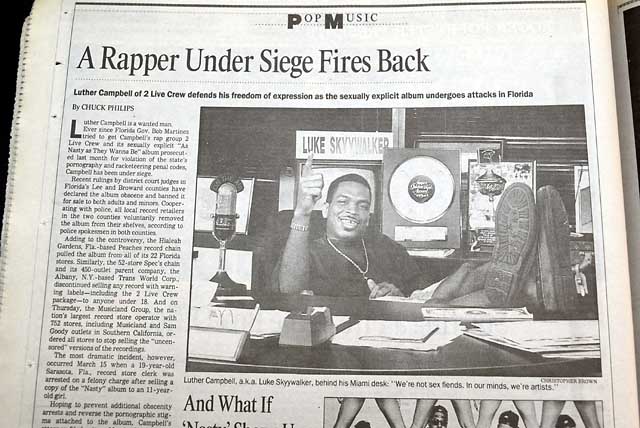
1990 ""2 Live Crew" hip hop album controversary...
Sunday CALENDAR SECTION only of the Los Angeles Times, March 25, 1990
* Hip Hop group "2 Live Crew" rap music
* "As Nasty As They Wanna Be" album
* Luther...
* Hip Hop group "2 Live Crew" rap music
* "As Nasty As They Wanna Be" album
* Luther...
Mar 1990
$58
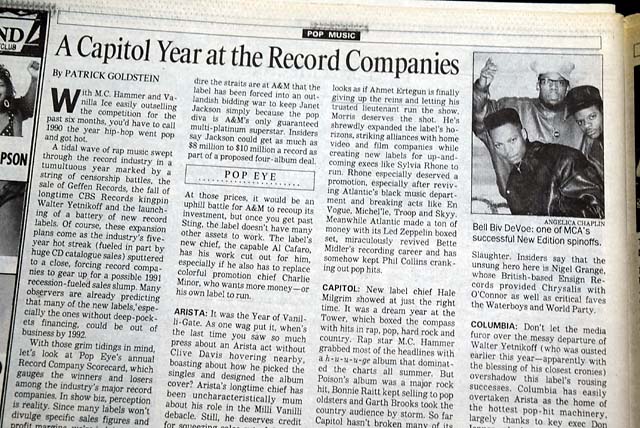
1990 hip hop rap music expands...
Sunday edition CALENDAR SECTION only of the Los Angeles Times, Dec. 30, 1990
* West Coast hip-hop gangsta rap music
* M.C. Hammer - Vanilla Ice and more
Ofte...
* West Coast hip-hop gangsta rap music
* M.C. Hammer - Vanilla Ice and more
Ofte...
Dec 1990
$48
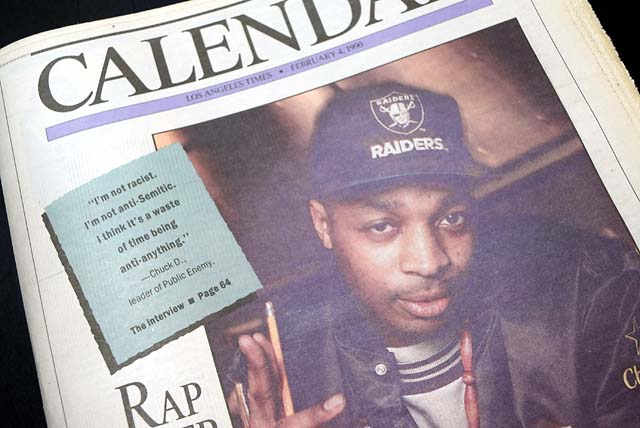
1990 "Public Enemy" & "N.W.A." gangsta rappers...
Sunday CALENDAR SECTION only of the Los Angeles Times, Feb. 4, 1990
* The birth of West Coast "gangsta rap"
* "Public Enemy" hip hop group
* Interview w/...
* The birth of West Coast "gangsta rap"
* "Public Enemy" hip hop group
* Interview w/...
Feb 1990
$98
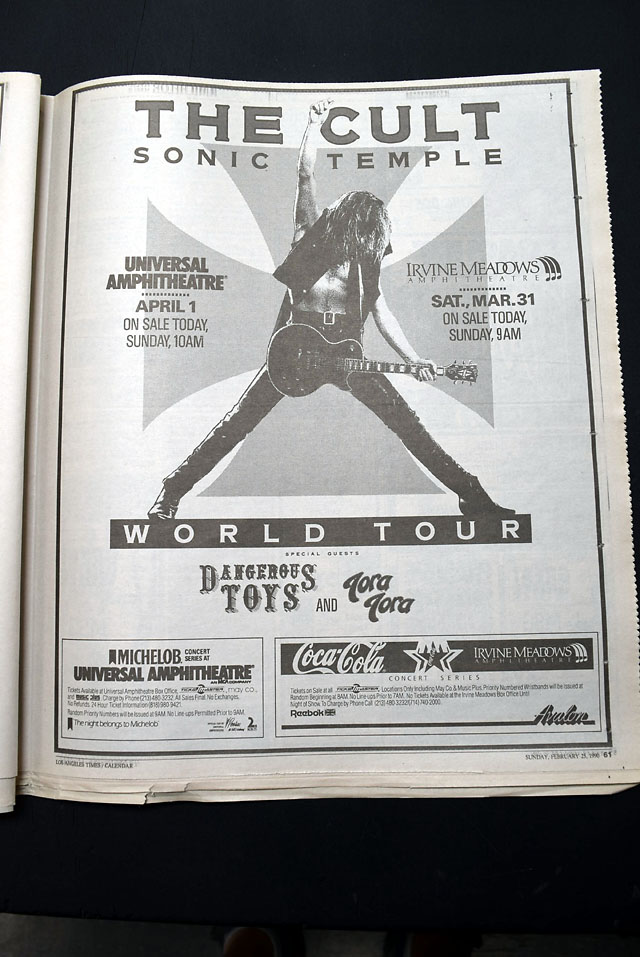
1990 "Sonic Temple" "The Cult" & "Public Enemy"...
Sunday CALENDAR SECTION only of the Los Angeles Times, Feb. 25, 1990
* "Public Enemy" hip hop group
* West Coast "gangsta rap" fame
* Rappers Chuck D and...
* "Public Enemy" hip hop group
* West Coast "gangsta rap" fame
* Rappers Chuck D and...
Feb 1990
$58