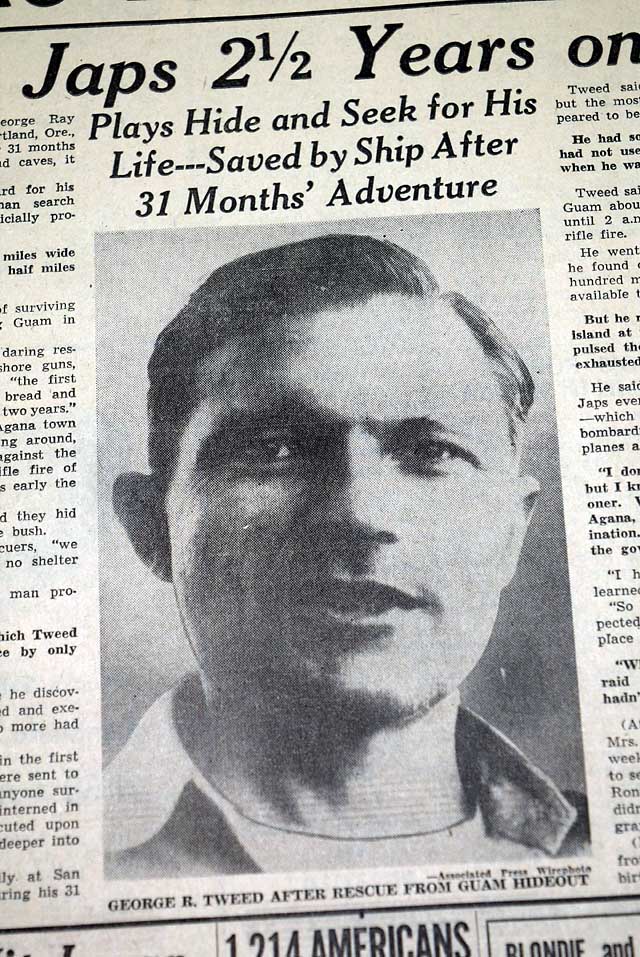
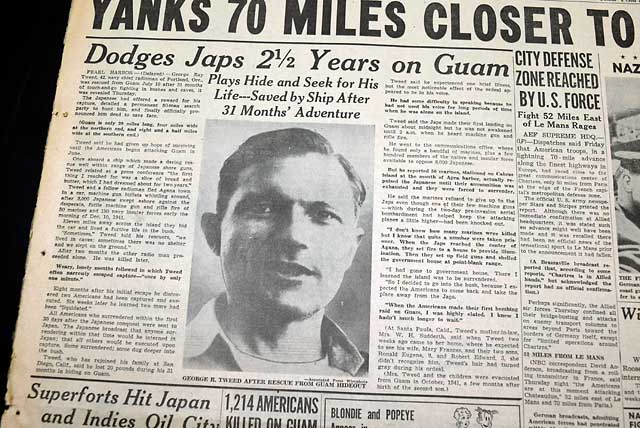
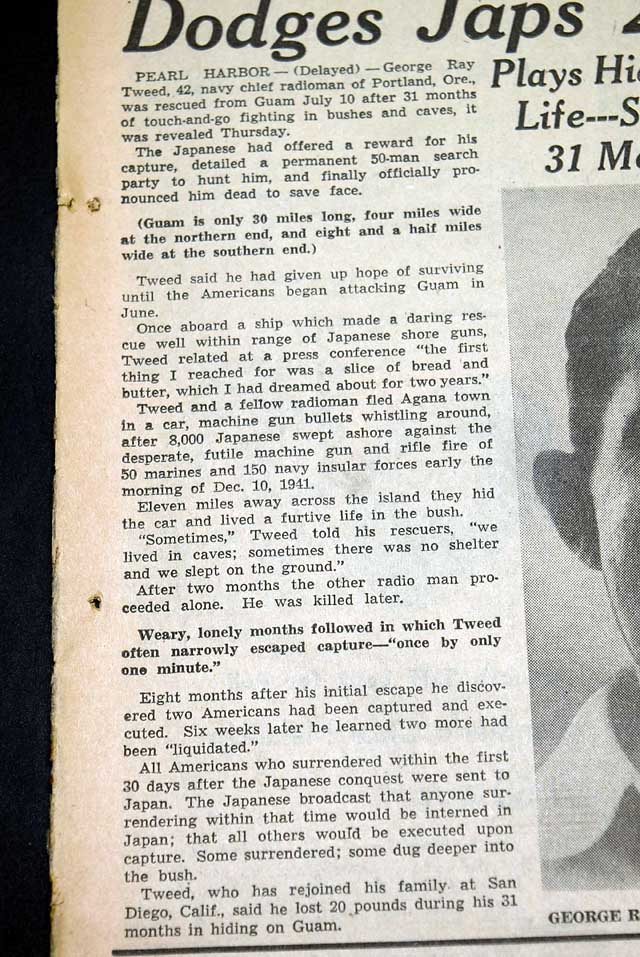
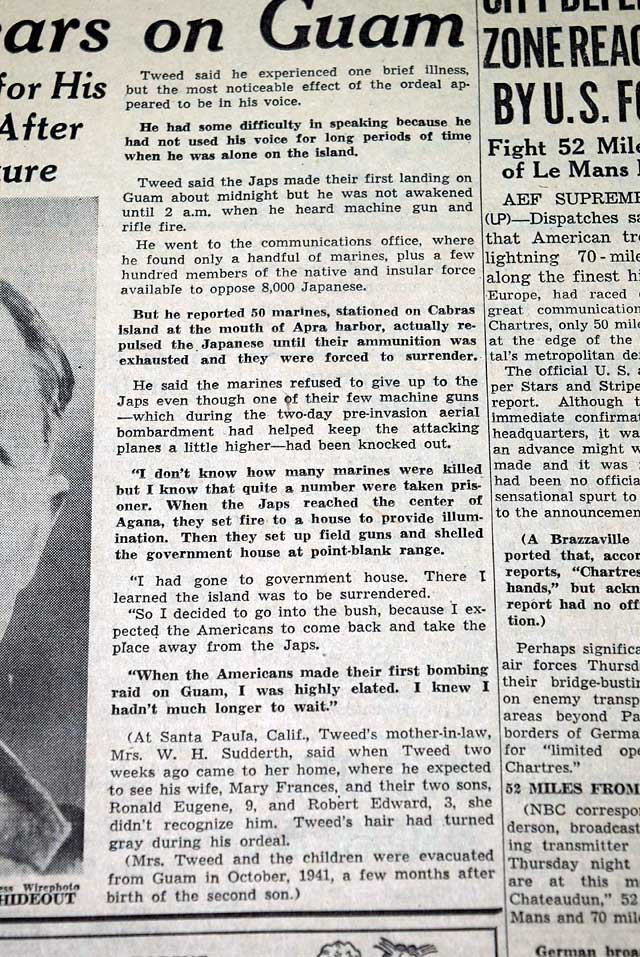
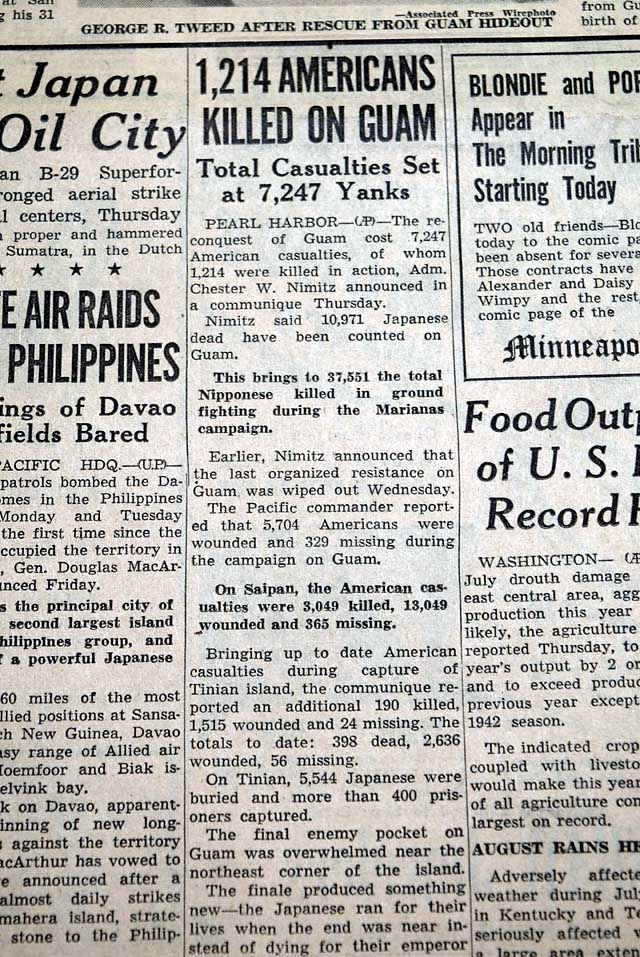
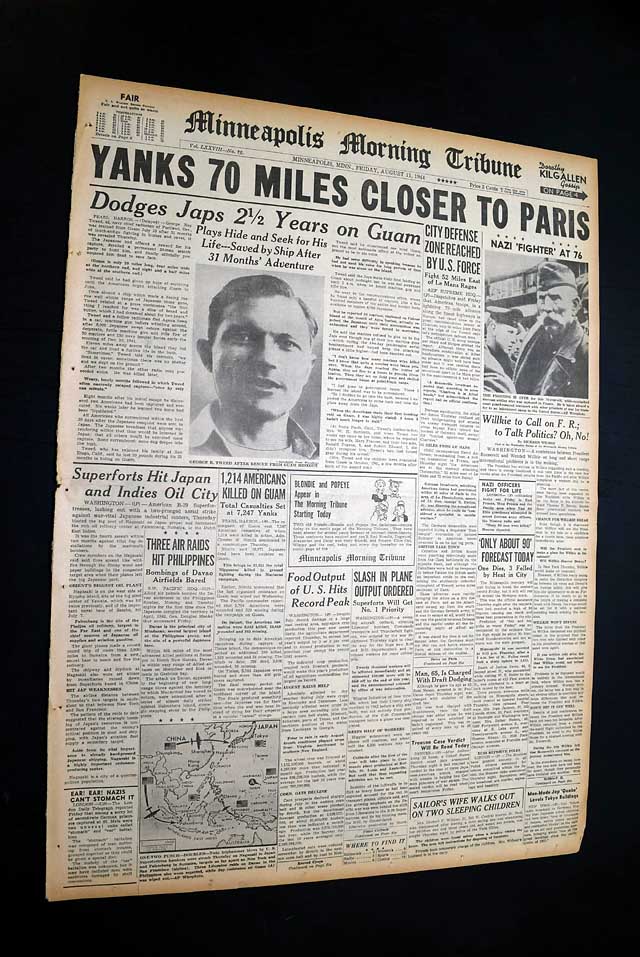
"Ghost of Guam" rescued in 1944...
MINNEAPOLIS MORNING TRIBUNE, Aug. 11, 1944
- U.S. Navy radioman George Ray Tweed
- "Ghost of Guam" evades Japanese for 2 1/2 years
- World War II serviceman hid in the jungles
The front page has a five column heading: "Dodges Japs 2 1/2 Years on Guam" with subhead and photo of Tweed. (see images)
Complete with all 18 pages, light toning and minor wear at the margins, some ink notation on inside pages, generally nice.
Background: By August 1944, the incredible story of George Ray Tweed, a U.S. Navy radioman who spent 31 months in hiding to become the sole American survivor of the Japanese occupation of Guam, emerged as a symbol of both military resilience and profound local sacrifice. Following his daring rescue on July 10, 1944—when he used a mirror and flags to signal the destroyer USS McCall from a northern cliffside hideout—the news embargo broke in August, catapulting Tweed to fame in national outlets like Life magazine as the "Ghost of Guam". Tweed’s survival held immense tactical and emotional significance: prior to his escape, he provided critical target intelligence on Japanese coastal artillery at Adelup Point, and during his evasion, he published the secret underground Guam Eagle newspaper to sustain morale. To many, Tweed stood as a living symbol of hope that American forces would return. However, his evasion carried a dark controversy, as indigenous CHamoru families endured severe torture, collective punishment, and executions—most notably Father Jesús Baza Duenas—by Japanese forces intent on locating Tweed. Assisted by brave protectors like Antonio Artero, Tweed's story Ultimately framed a complex historical legacy: a narrative of extreme evasion and strategic intelligence-gathering, heavily overshadowed by the devastating physical sacrifices made by the local CHamoru population to protect him.
Other issues you may like
§ related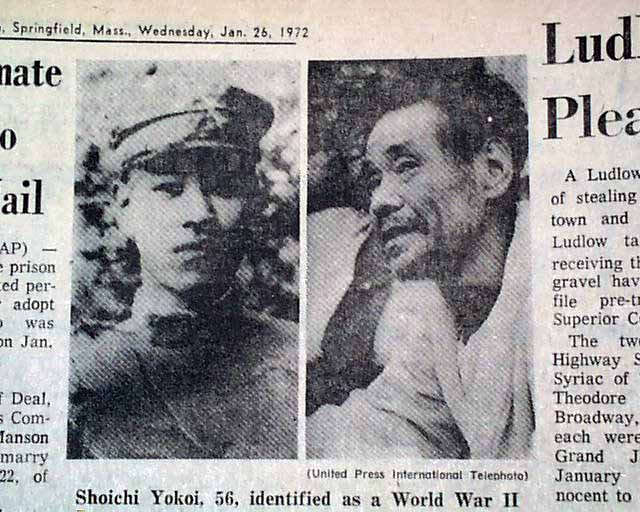
THE SPRINGFIELD UNION, January 26, 1972
- World War II Japanese Soldier Found in Hiding
- Shoichi Yokoi
This 42 page newspaper has a two line, two column
...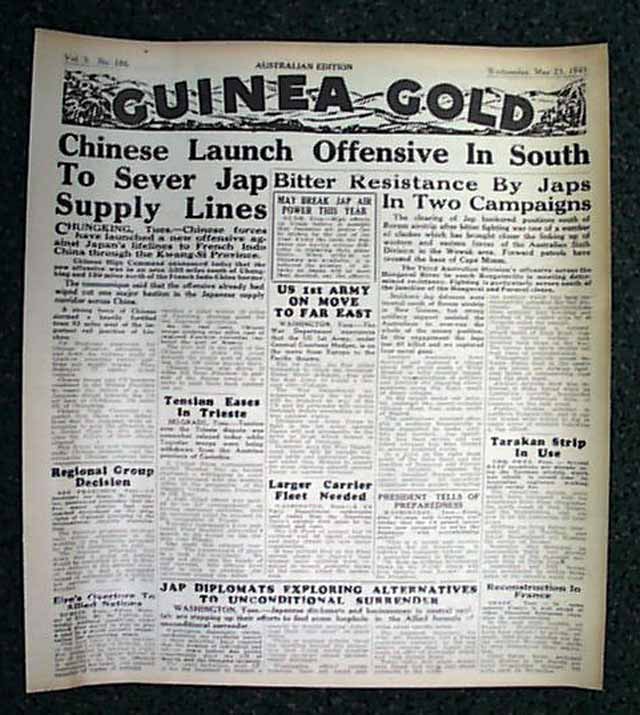
GUINEA GOLD, "Australian Edition", May 23, 1945 The front page banner headline reads: "Chinese Launch Offensive In South To Sever Jap Supply Lines" with
...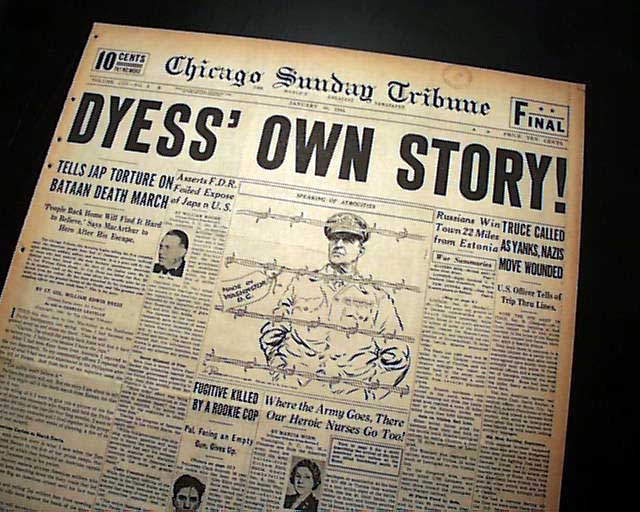
CHICAGO SUNDAY TRIBUNE, Jan. 30, 1944
- Battle of Bataan Death March
- Imperial Japanese Army atrocities
- Made public for the first time
- William E. Dyess eyewitness
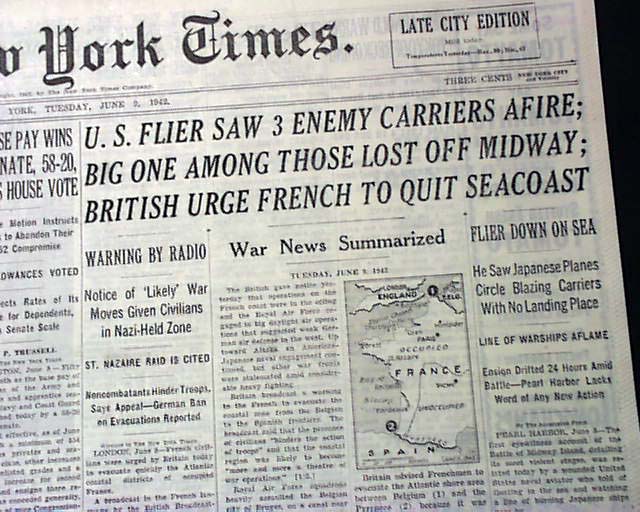
THE NEW YORK TIMES, June 9, 1942
- Battle Of Midway ends w/ win
- Japanese vs. American Navy
- Great eyewitness account - George H. Gay Jr.
The top of the front
...