
1963 miracle on Mount Everest...
Item # 727087
·
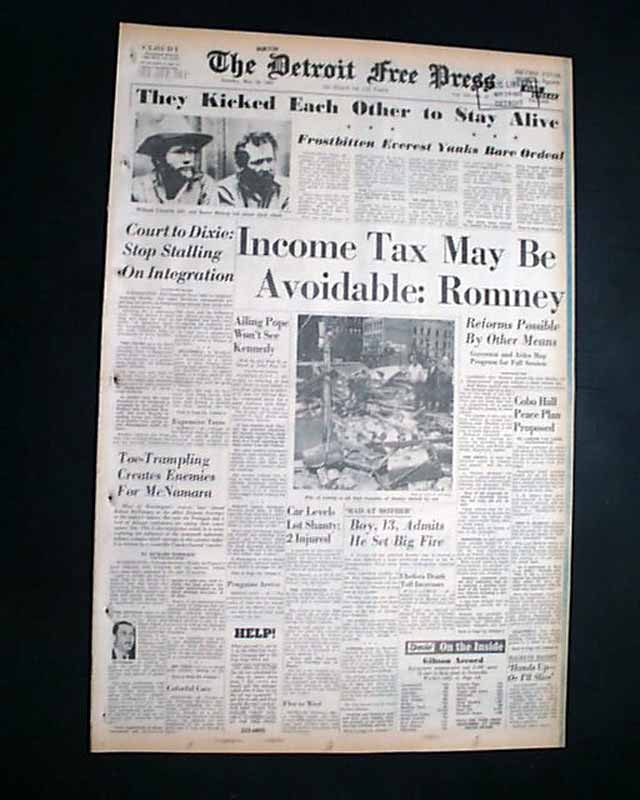
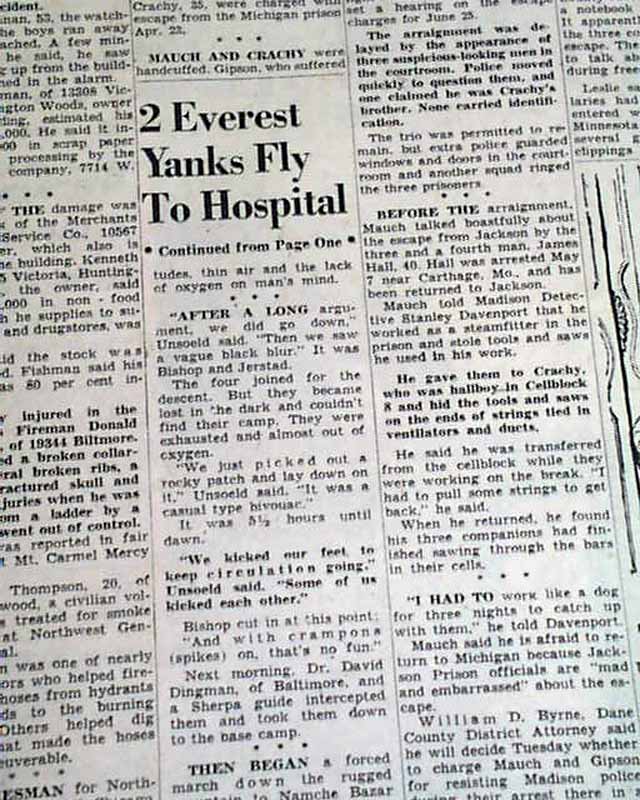
THE DETROIT FREE PRESS, May 28, 1963
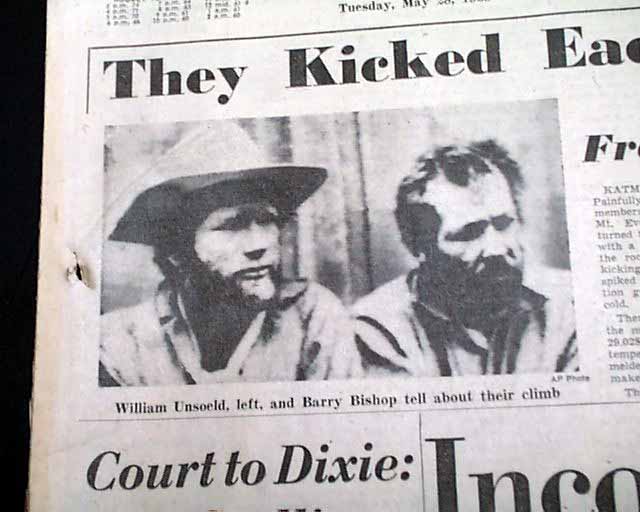
* Willi Unsoeld and Barry Bishop
* Mountaineers - Mount Everest Expedition
* First American team to reach the summit
* Extreme hardships on the ascent (frostbite toes)
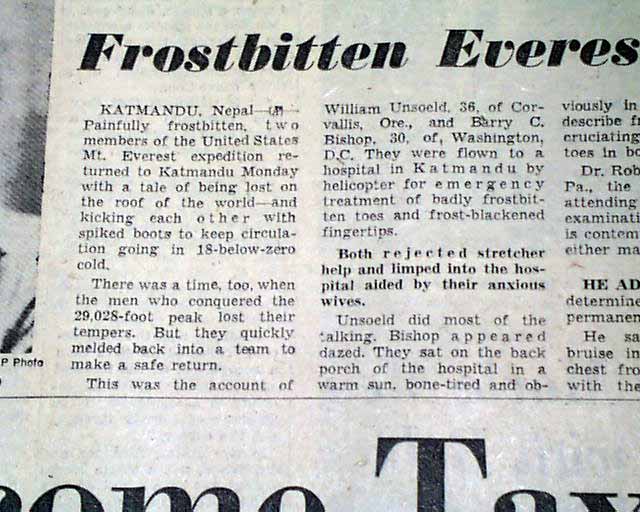
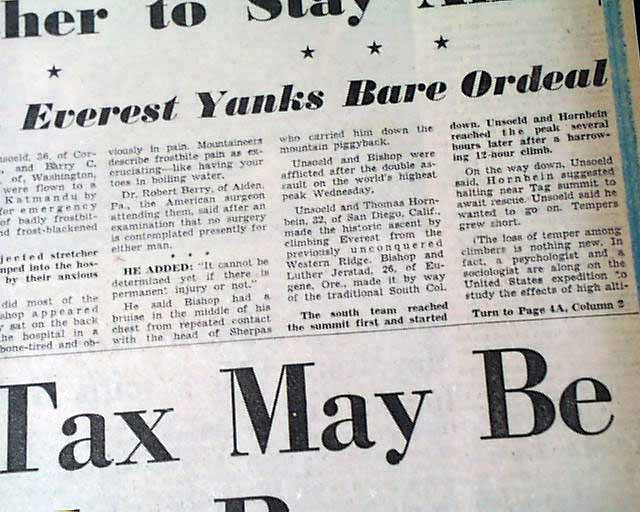
The front page has a banner heading: "They Kicked Each Other to Stay Alive" with subhead and photo. (see images)
Complete with all 40+ pages, library stamp just above the heading, small binding holes along the spine, generally very nice.
Background: The historic 1963 traverse and subsequent high-altitude survival of Willi Unsoeld and Barry Bishop fundamentally redefined the boundaries of human endurance and reshaped the philosophy of modern mountaineering. By executing the first-ever traverse of an 8,000-meter peak via the uncharted, highly technical West Ridge, the American expedition shattered the traditional, militaristic "siege-style" approach to climbing that had previously focused solely on reaching the summit by the easiest established path. Their survival of a night spent at 28,200 feet without tents, sleeping bags, or supplemental oxygen disproved the contemporary medical consensus that a night spent unprotected in the "Death Zone" was invariably fatal. This monumental feat of survival not only catalyzed a paradigm shift toward more audacious, alpine-style route-finding on the world's highest peaks, but it also served as a profound symbol of Cold War-era American grit and technological capability, earning the team the Hubbard Medal from President John F. Kennedy and elevating mountaineering to a pinnacle of national achievement.
* Willi Unsoeld and Barry Bishop
* Mountaineers - Mount Everest Expedition
* First American team to reach the summit
* Extreme hardships on the ascent (frostbite toes)
The front page has a banner heading: "They Kicked Each Other to Stay Alive" with subhead and photo. (see images)
Complete with all 40+ pages, library stamp just above the heading, small binding holes along the spine, generally very nice.
Background: The historic 1963 traverse and subsequent high-altitude survival of Willi Unsoeld and Barry Bishop fundamentally redefined the boundaries of human endurance and reshaped the philosophy of modern mountaineering. By executing the first-ever traverse of an 8,000-meter peak via the uncharted, highly technical West Ridge, the American expedition shattered the traditional, militaristic "siege-style" approach to climbing that had previously focused solely on reaching the summit by the easiest established path. Their survival of a night spent at 28,200 feet without tents, sleeping bags, or supplemental oxygen disproved the contemporary medical consensus that a night spent unprotected in the "Death Zone" was invariably fatal. This monumental feat of survival not only catalyzed a paradigm shift toward more audacious, alpine-style route-finding on the world's highest peaks, but it also served as a profound symbol of Cold War-era American grit and technological capability, earning the team the Hubbard Medal from President John F. Kennedy and elevating mountaineering to a pinnacle of national achievement.
Category: The 20th Century
Price
$57
100% Authentic: Original printing, never a reproduction.
Other issues you may like
§ related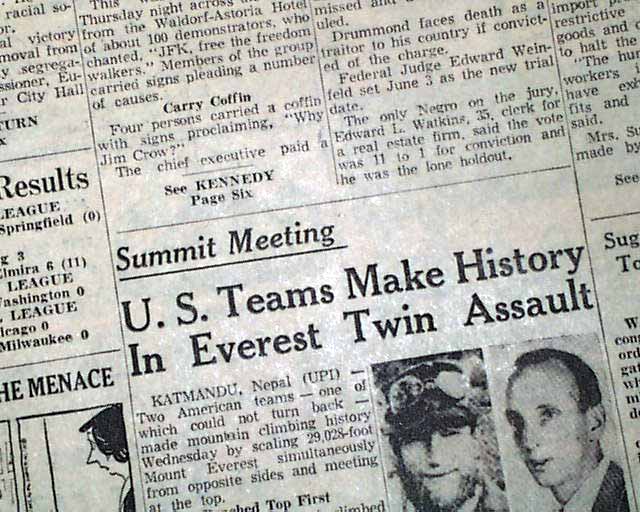
1963 Mount Everest record...
THE SPRINGFIELD UNION, Massachusetts, May 24, 1963
* Mount Everest climbing 1st
* Nepal
This 52 page newspaper has a two column heading at the...
* Mount Everest climbing 1st
* Nepal
This 52 page newspaper has a two column heading at the...
May 1963
$36
Edmund Hillary conquers Mt. Everest...
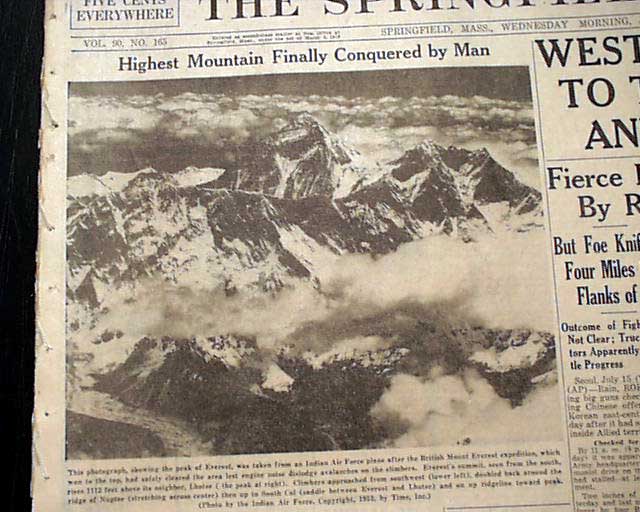
THE SPRINGFIELD UNION, Mass., July 15, 1953
* Sir Edmund Percival Hillary & Tenzing Norgay
* Own accounts of the mountain conquerors
* re. Mount...
* Sir Edmund Percival Hillary & Tenzing Norgay
* Own accounts of the mountain conquerors
* re. Mount...
Jul 1953
$52
Sir Edmund Hillary...
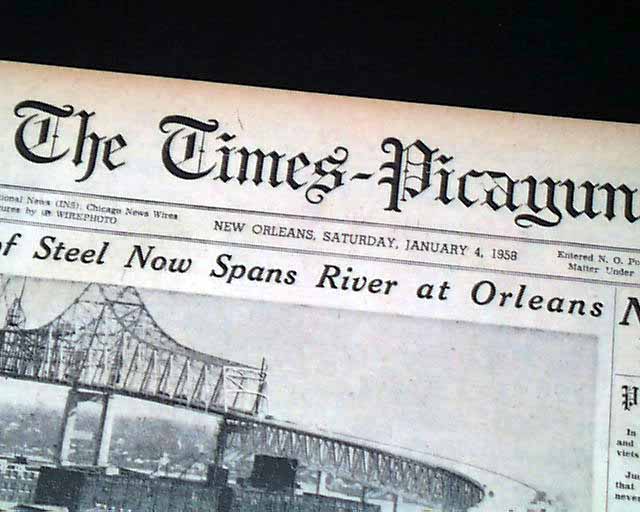
THE TIMES PICAYUNE, New Orleans, Louisiana, January 4, 1958
* Sir Edmund Hillary
* Reaches Antarctica by land
This 34 page newspaper has a two...
* Sir Edmund Hillary
* Reaches Antarctica by land
This 34 page newspaper has a two...
Jan 1958
$27
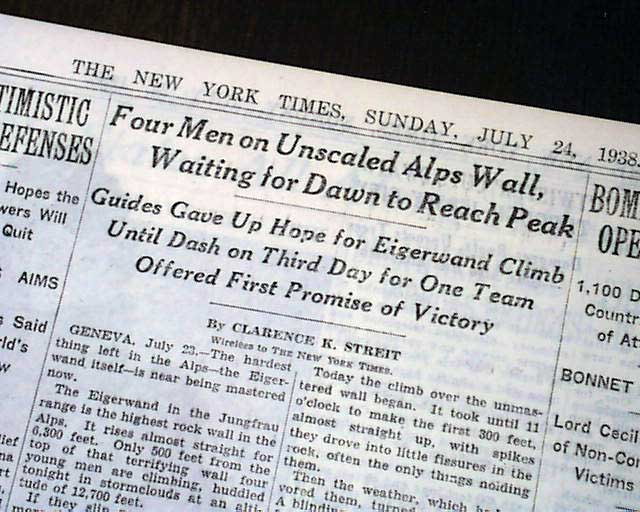
North face of Eiger Mountain scaled 1st time....
THE NEW YORK TIMES, July 24, 1938
* North face of Eiger Mountain
* Bernese Alps - mountain range
* Climbed for the very 1st time
The top of page 23...
* North face of Eiger Mountain
* Bernese Alps - mountain range
* Climbed for the very 1st time
The top of page 23...
Jul 1938
$37