
Displayable Act of Parliament...
Item # 726685
·
ACT OF PARLIAMENT, London, England, 1759
* 18th century original document
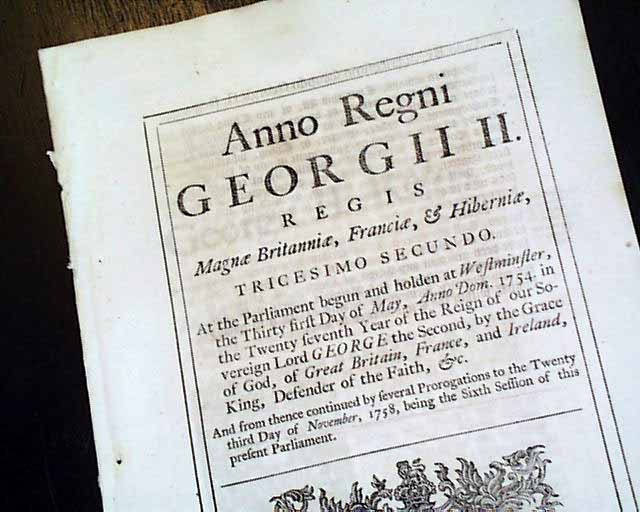
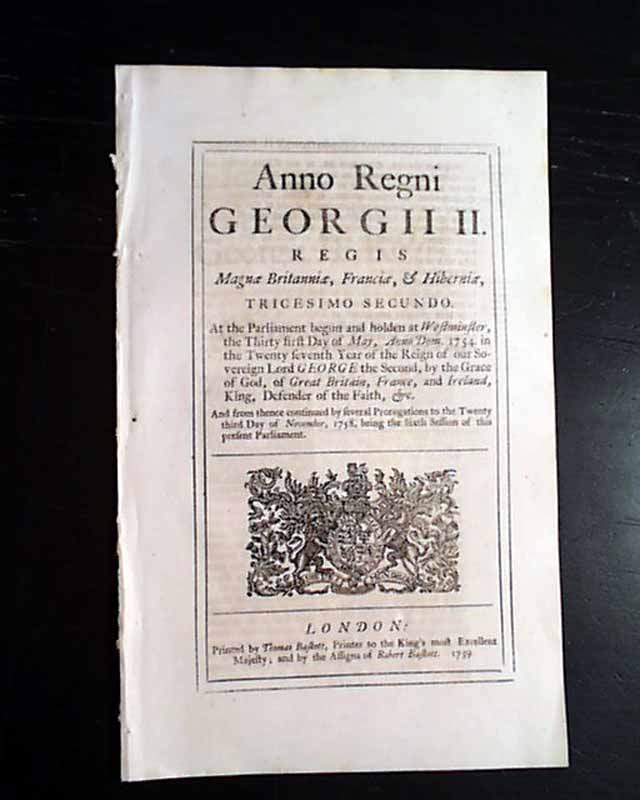
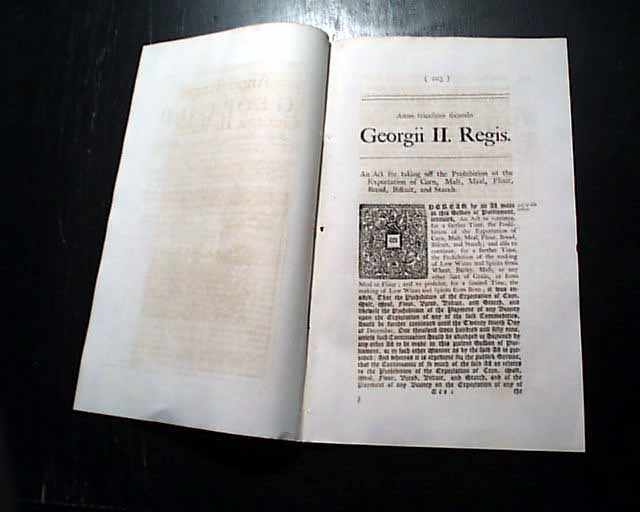
Nice full title page has an engraving of the Royal coat-of-arms. Inside has an act: "...for taking off the prohibition of the exportation of corn, malt, meal, flour, bread, biscuit, and starch."
A decorative document given the displayable title page.
Four pages, 11 by 7 1/4 inches, nice condition.
Background: The passing of this act in 1759 was a critical economic lever pulled by the British government to navigate the high-stakes financial pressures of the Seven Years' War (1756–1763). By lifting the wartime embargo on vital food staples like corn, flour, and bread, Parliament signaled that domestic agricultural yields had stabilized enough to risk exporting food during a global conflict. This policy shift served a dual strategic purpose: it revitalized the domestic agrarian economy by allowing British merchants and landowners to cash in on lucrative foreign markets, while simultaneously generating vital tax and customs revenues to fund Great Britain's massive global military campaigns against France. Ultimately, the document captures a precise moment where British trade policy and imperial warfare intersected, demonstrating how food supply was weaponized and managed as a tool of 18th-century statecraft.
* 18th century original document
Nice full title page has an engraving of the Royal coat-of-arms. Inside has an act: "...for taking off the prohibition of the exportation of corn, malt, meal, flour, bread, biscuit, and starch."
A decorative document given the displayable title page.
Four pages, 11 by 7 1/4 inches, nice condition.
Background: The passing of this act in 1759 was a critical economic lever pulled by the British government to navigate the high-stakes financial pressures of the Seven Years' War (1756–1763). By lifting the wartime embargo on vital food staples like corn, flour, and bread, Parliament signaled that domestic agricultural yields had stabilized enough to risk exporting food during a global conflict. This policy shift served a dual strategic purpose: it revitalized the domestic agrarian economy by allowing British merchants and landowners to cash in on lucrative foreign markets, while simultaneously generating vital tax and customs revenues to fund Great Britain's massive global military campaigns against France. Ultimately, the document captures a precise moment where British trade policy and imperial warfare intersected, demonstrating how food supply was weaponized and managed as a tool of 18th-century statecraft.
Price
$39
100% Authentic: Original printing, never a reproduction.
Other issues you may like
§ related
Side effects of the Revenue Acts...
THE LONDON CHRONICLE, England, Oct. 19, 1769 The back page has a letter from Philadelphia which includes: "It is with much pleasure I acquaint you the Act...
Oct 1769
$52
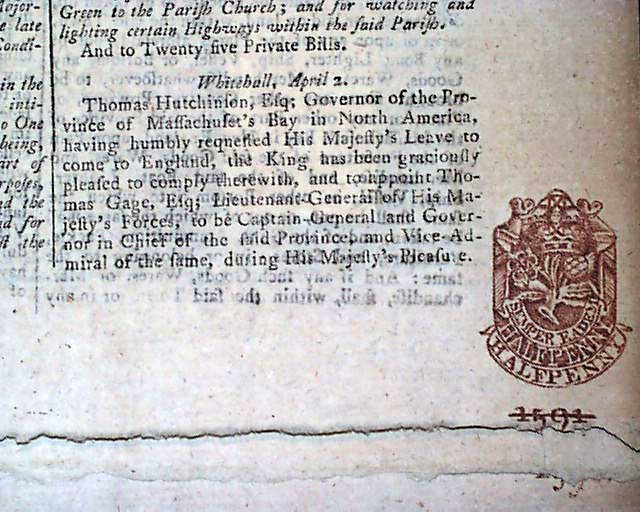
The Boston Port Act, in a London newspaper...
THE LONDON GAZETTE, England, April 2, 1774
* Boston Port Act passed in a British publication
* Boston Tea Party colonists punishment for destroyed...
* Boston Port Act passed in a British publication
* Boston Tea Party colonists punishment for destroyed...
Apr 1774
$3,650
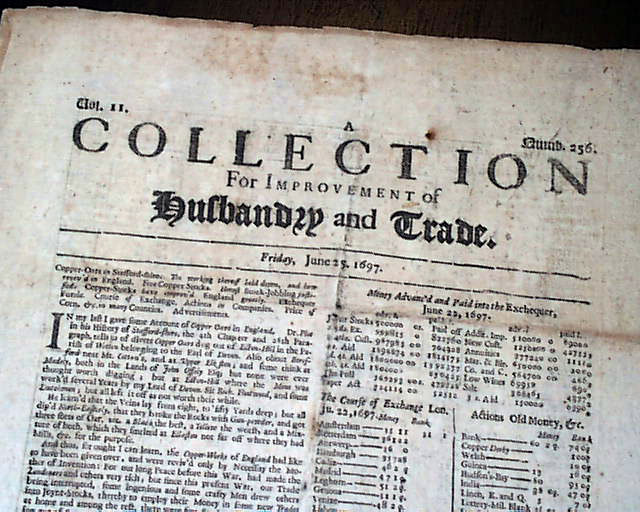
Rare title from the 1600's...
A COLLECTION FOR IMPROVEMENT OF HUSBANDRY AND TRADE, London, June 25, 1697
* Very rare 17th century publication
This is one of the more uncommon titles from...
* Very rare 17th century publication
This is one of the more uncommon titles from...
Jun 1697
$137
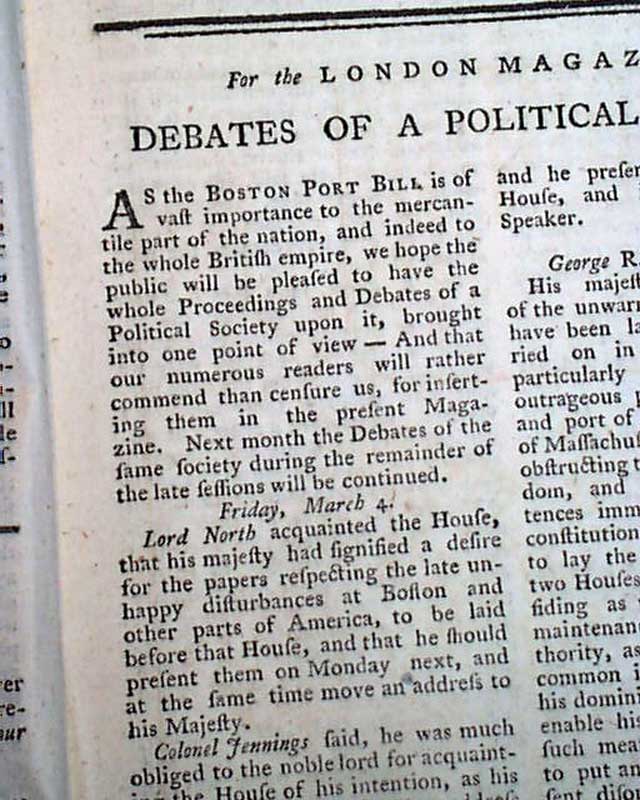
Great & rare political cartoon on the Boston Port Bill... Twenty pages discussing the Boston Port Bill...
THE LONDON MAGAZINE, England, April, 1774
* Boston Port Act of 1774 - Act
* Very rare illustration - print
* Pre Revolutionary War tensions
Over 20 pages
$1,855