
Zaro Agha has died. Was he 160 years old. ?..
CHICAGO DAILY TRIBUNE, June 29, 1934
- Zaro Agha Aga death (1st report)
- 160 years old ? - Instanbul, Turkey
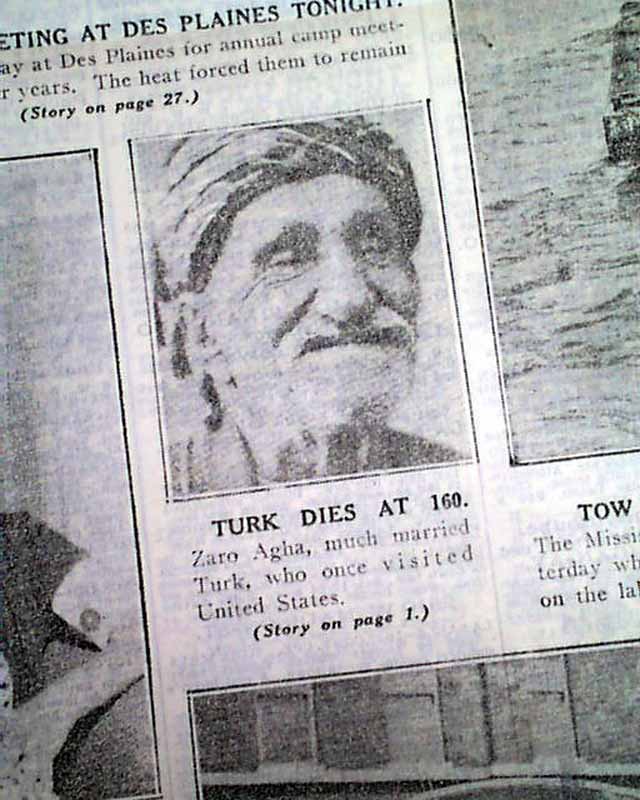
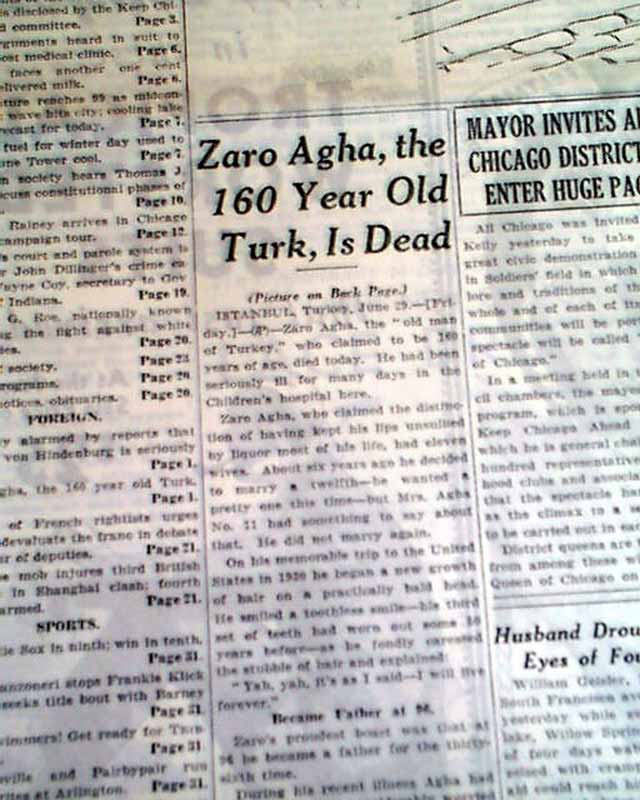
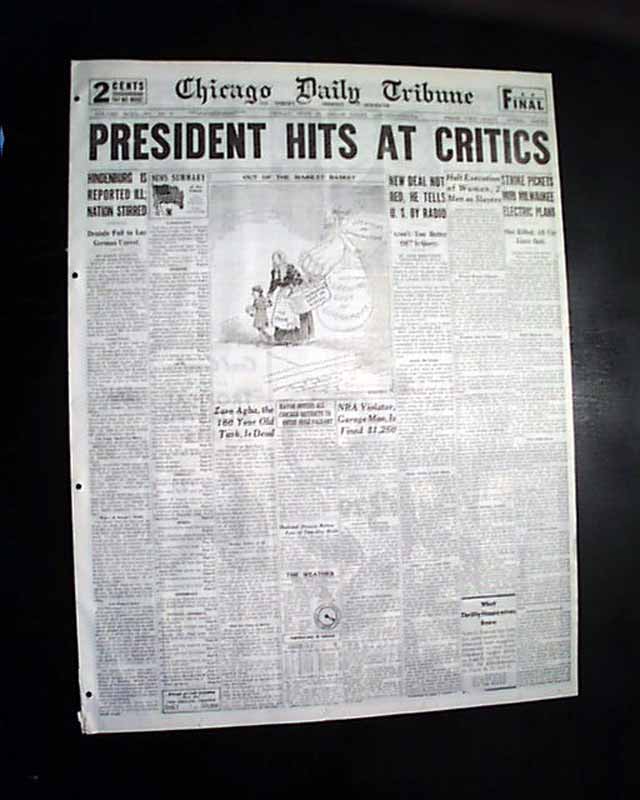
The front page has a one-column head: "Zaro Agha, the 160 Year Old Turk, Is Dead". A small photo of Agha is on the front page.
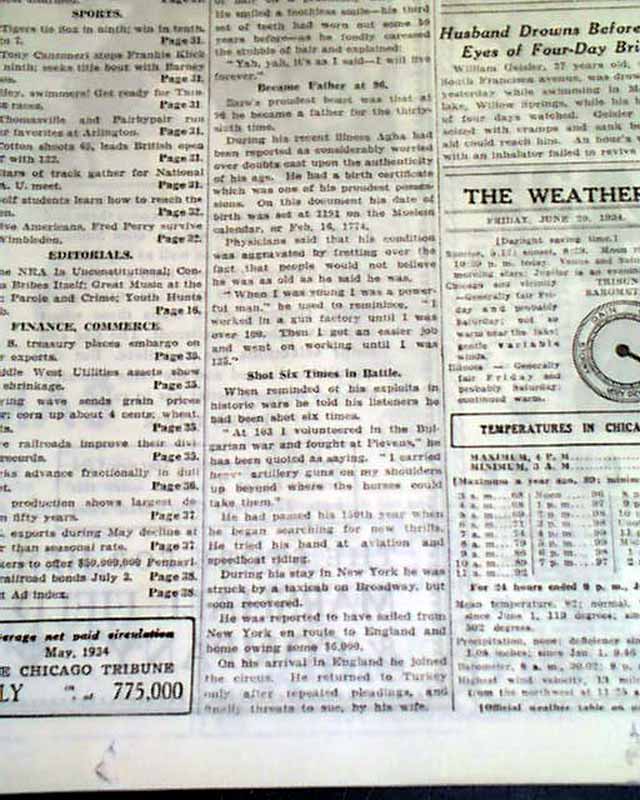
Zaro Aga was a Kurdish man who claimed to be one of the longest-living persons ever. He claimed he was born on February 16, 1774 and died on June 29, 1934 in Istanbul, Turkey. He was allegedly 160 years old when he died, and thus claimed to be one of the longest-living persons ever.
There is an ongoing debate as to his actual age. According to the death certificate provided by his Turkish doctor, Zaro Aga's age was 157. He died in Istanbul, although some confusion about the place of death exists, likely due to the fact that the body was sent to the U.S. right after his death. However, an investigative report published by Walter Bowerman in 1939 indicated that Zaro Aga was around 97, not 157.
Complete in 42 pages, this is the "rag edition" printed on high-quality newsprint meant for institutional holdings, 4 small binding holes at the blank spine, in great condition.
Background: The historical significance of Zaro Agha’s death and its front-page coverage in 1934 lies at the intersection of early 20th-century media sensationalism, the emergence of gerontology (the study of aging), and the geopolitical transformation of Turkey. As a global celebrity who toured the West as "The World's Oldest Man," Agha's alleged 160-year lifespan captivated a public fascinated by longevity and exoticized "Eastern" secrets to a long life, reflecting the era's appetite for human-interest spectacles during the Great Depression. However, the immediate scientific skepticism surrounding his age—evidenced by the post-mortem shipping of his organs to the United States for research and subsequent investigations like Walter Bowerman’s 1939 report—marked a pivotal moment in modern medicine. It highlighted a transition away from unverified oral tradition toward rigorous, evidence-based demographic and anatomical validation. Furthermore, because this specific report is preserved in a rare "rag edition" intended for long-term institutional archives, it serves as a deliberate artifact of how mainstream Western journalism documented the transition of the collapsing Ottoman Empire into a modernized Turkish Republic, through the lens of a single man who claimed to have outlived ten Sultans.
Other issues you may like
§ related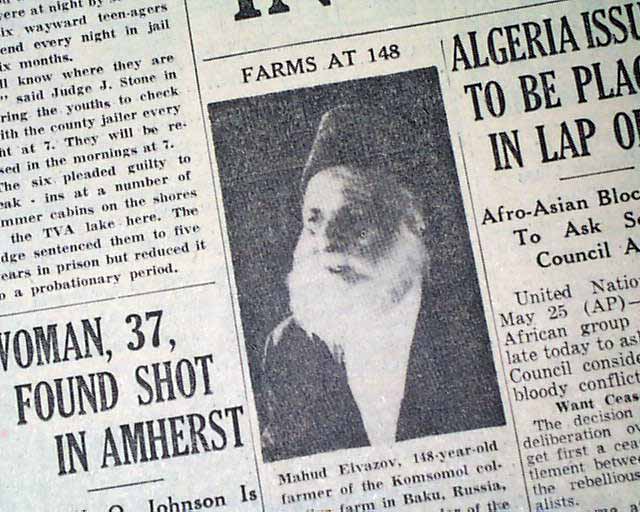
THE SPRINGFIELD UNION, Mass. May 26, 1956
- 148 year old "Mahmud Eyvazov" ?
- Republic of Azerbaijan farmer
The front page has a one column photo with heading:
...
LEOMINSTER DAILY ENTERPRISE, Massachusetts, July 11, 1957
- Aga Khan III death (Early 1st report)
- Sultan Mahommed Shah
This 12 page newspaper has a one column
...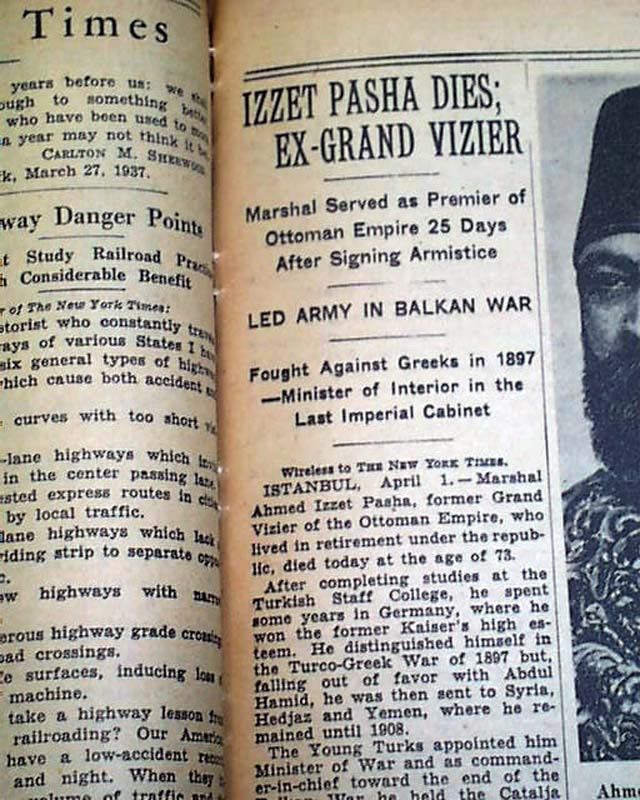
THE NEW YORK TIMES, April 2, 1937
- Ahmed Izzet Pasha death
- World War I general
- Ottoman Empire Grand Vizier
The top of page 23 has a one column heading: "IZZET
...
THE ATLANTA CONSTITUTION, Atlanta, Georgia, July 5, 1918
- Mehmed V death
- Ottoman Sultan
- Turkey - Turkish
This 12 page newspaper has one column headlines on the
...