



John Paul Jones dies in poverty...
THE UNIVERSAL ASYLUM & COLUMBIAN MAGAZINE, Philadelphia, September, 1792
- John Paul Jones death - pirate ?
- Revolutionary War naval commander
- "Father of the American Navy
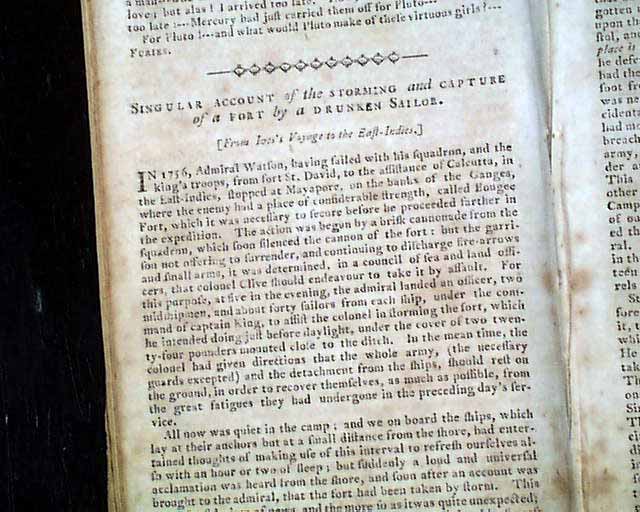
This issue begins with a letter from Benjamin Rush concerning the academy at Bordentown, New Jersey, with a lengthy response. Also inside is the continued: "History Of the American Revolution" which takes 7 pages; "Capture of a Fort by a Drunken Sailor" "On The Indian War" & more.
There are 12 pages taken up with much detail on: "Proceedings of Congress" . There two letters each signed in type by La Fayette.
Near the back is "The Chronicle" which has the latest news of the day. Included is: "The celebrated Paul Jones died in Paris about the middle of July, in the utmost poverty. A colonel Blackden, it is said, was obliged to raise a small sum of money by way of subscription in order to bury him." Also a report of the building of canals to connect the Delaware, Schuylkill and Susquehanna rivers. Mention of the army of the United States at Pittsburgh, and a report of the situation with the Creek Indians in Georgia.
Complete in 72 pages, 5 by 8 inches, full title/contents page, nice condition.
Background: John Paul Jones, the famed naval commander of the American Revolutionary War, died on July 18, 1792, in Paris at the age of 45, likely from interstitial nephritis, a kidney-related illness that had progressively weakened his health. Though once celebrated for his daring naval victories against the British—most famously the battle aboard the Bonhomme Richard, where he reportedly declared, “I have not yet begun to fight!”—Jones died in relative obscurity while living in France, having struggled to find a stable role after his service in Russia under Empress Catherine the Great ended contentiously. He was buried in a forgotten grave in the Saint Louis Cemetery for Protestants in Paris, his contributions largely overlooked for more than a century. In 1905, after an extensive search funded by the U.S. government and led by Ambassador Horace Porter, his remains were rediscovered, identified through forensic evidence, and ceremoniously returned to the United States. Jones was reinterred in 1913 with full military honors in a marble sarcophagus at the U.S. Naval Academy Chapel in Annapolis, Maryland, cementing his legacy as a foundational figure in American naval history.
This title has the honor of being the first successful American magazine, having begun in September, 1786 and lasting until December, 1792. Although many titles existed earlier, none enjoyed the success of lasting beyond a few issues or a couple of years.
Other issues you may like
§ related
ARIS'S BIRMINGHAM GAZETTE, England, April 16, 1781 Page 2 has mention of the noted John Paul Jones, with: "Paul Jones arrived at Philadelphia the first of
...
THE LONDON CHRONICLE, England, June 10, 1780 Inside has a brief item concerning John Paul Jones, with a dateline of Paris and mentioning: "The celebrated
...
NILES' NATIONAL REGISTER, Baltimore, December 31, 1842 The back page has an item: "The Last of The Crew of Paul Jones" which concern the death of Thomas
...
THE LONDON CHRONICLE, England, March 27, 1781 Page 2 has an item referencing the famous naval battle involving John Paul Jones, with: "...Displeasures of
...