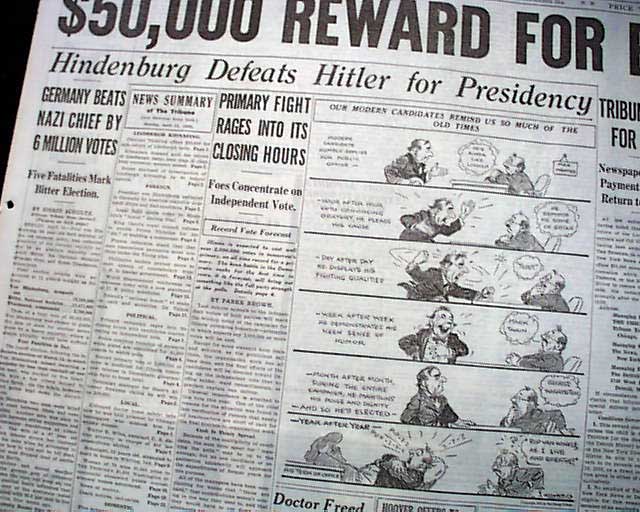


Adolf Hitler loses in the 1932 election...
CHICAGO DAILY TRIBUNE, April 11, 1932
- Adolf Hitler vs. Paul Von Hindenburg
- Last major setback before rise to power (Hitler)
- Germany presidential election
The front page has a six column head: "Hindenburg Defeats Hitler for Presidency" with subheads. A few related photos are on the back page.
This report covers the German election of President Paul Von Hindenburg over Adolf Hitler. Hitler's rise to power would be right around the corner. Also nice reporting on the Lindbergh baby kidnapping case with a nice banner headline and a few photos.
Complete in 34 pages, this is the "rag edition" printed on high-quality newsprint meant for institutional holdings. Nice condition, a few small binding holes along the spine.
Background: The April 1932 German presidential election was a pivotal watershed in the collapse of the Weimar Republic, serving as both a last-ditch defense of republican democracy and a dramatic demonstration of the Nazi Party’s rapid electoral surge. Held during the height of the Great Depression—which had left over six million Germans unemployed—the runoff election on April 10 pitted the 84-year-old monarchist incumbent Field Marshal Paul von Hindenburg against Nazi leader Adolf Hitler and Communist chief Ernst Thälmann. In a striking political paradox, moderate and pro-democratic forces, including the Social Democrats and the Center Party, rallied behind the conservative Hindenburg as the "lesser evil" to block a fascist takeover, securing his reelection with 53.0% of the vote (19.3 million votes) over Hitler’s 36.8% (13.4 million votes). However, the election's true historical significance lay in Hitler's explosive momentum, as he gained over two million votes between the two rounds through aggressive, modern campaigning techniques like statewide airplane tours, establishing the NSDAP as Germany's dominant political force and revealing the deep erosion of faith in parliamentary democracy. Although Hindenburg successfully prevented Hitler from winning the presidency directly through the popular vote, the severe political instability and reliance on executive emergency decrees that followed ultimately led Hindenburg's conservative advisers to persuade the President to appoint Hitler as Chancellor just nine months later, on January 30, 1933.
Other issues you may like
§ related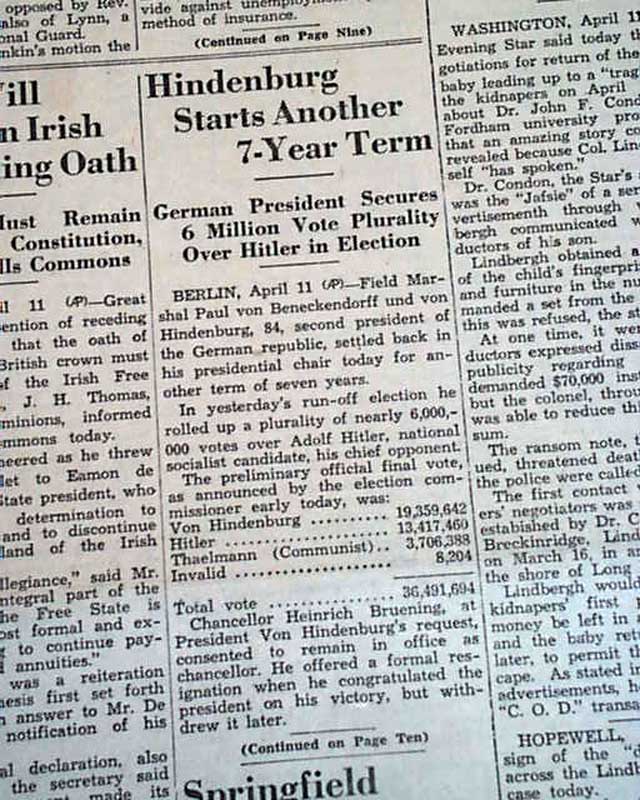
FITCHBURG SENTINEL, Massachusetts, April 11, 1932
- Adolf Hitler vs. Paul Von Hindenburg
- Last major setback before rise to power (Hitler)
- Germany presidential
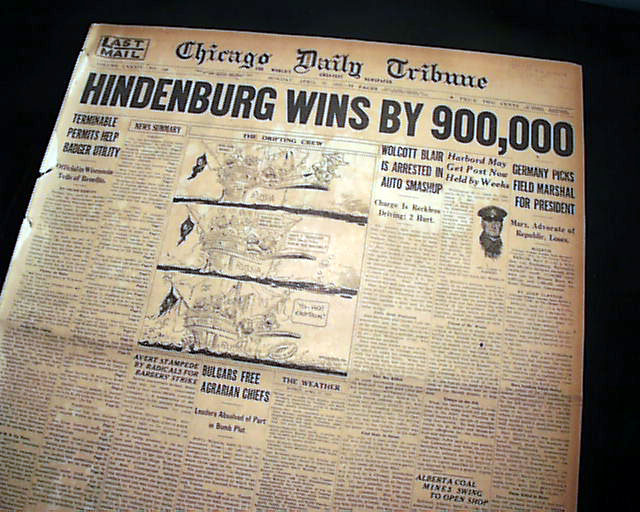
CHICAGO DAILY TRIBUNE, April 27, 1925
- Paul von Hindenburg
- 1st election as president of Germany
- 1st report w/ photos
The top of the front page has a nice
...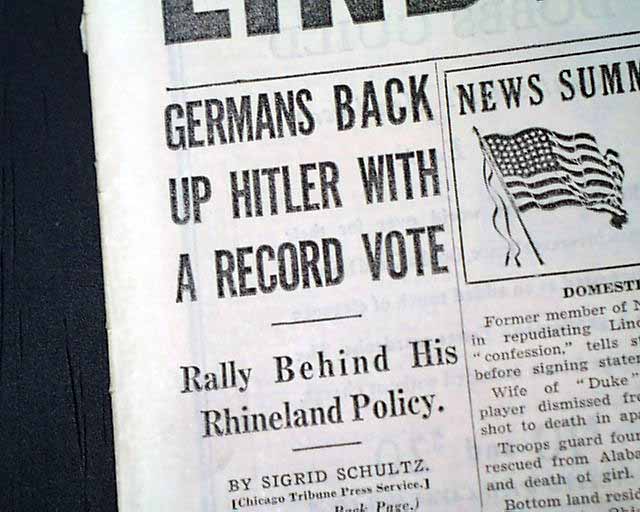
CHICAGO DAILY TRIBUNE, March 30, 1936
- German Reichstag election and referendum, 1936
- Adolf Hitler's dictatorship - plebiscitary vote
- re. remilitarization of
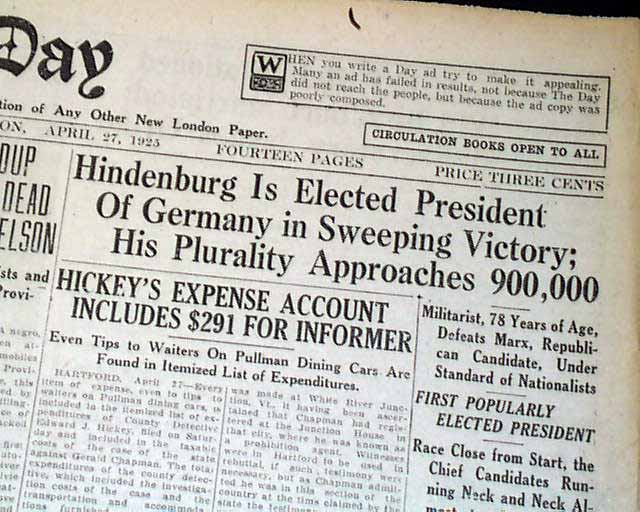
THE DAY, New London, Connecticut, April 27, 1925
- Paul von Hindenburg
- 1st election as president of Germany
This 14 page newspaper has a three column headline
...