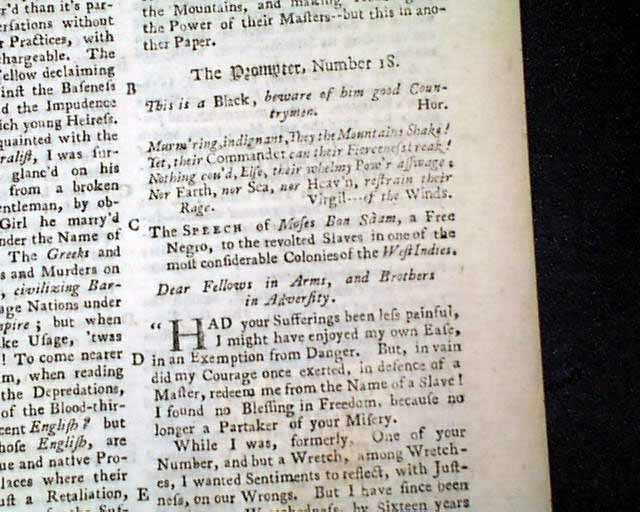
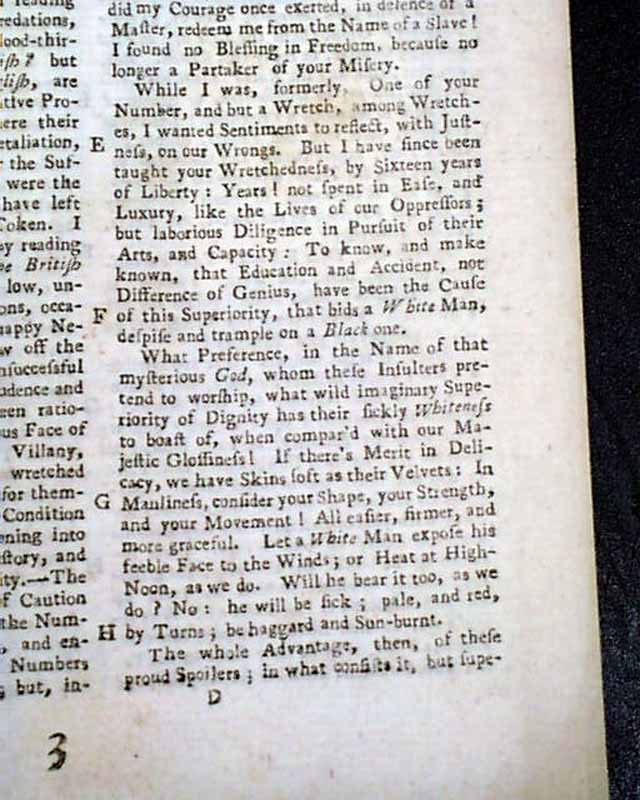
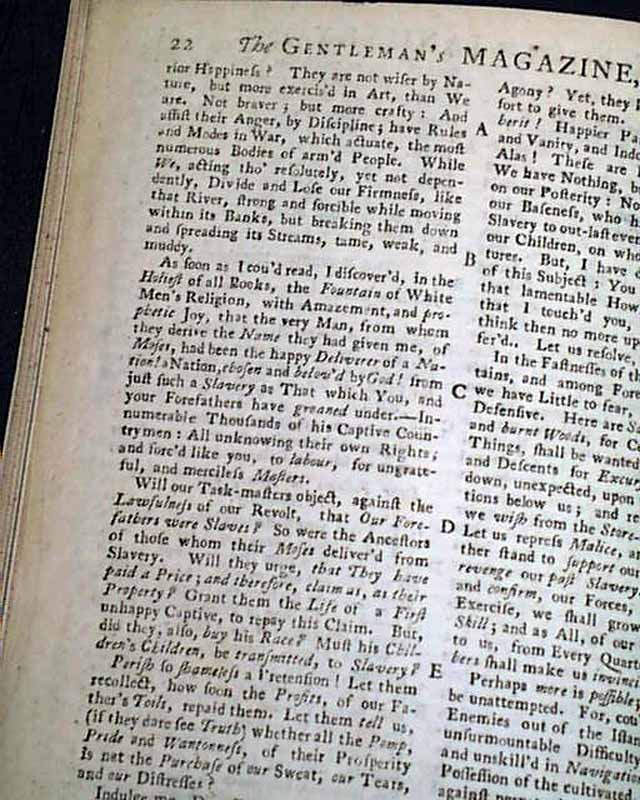
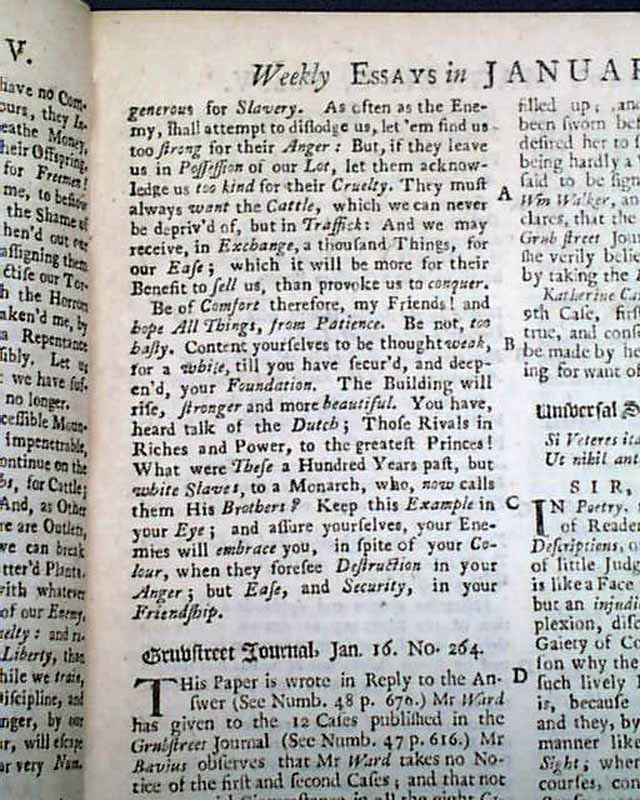
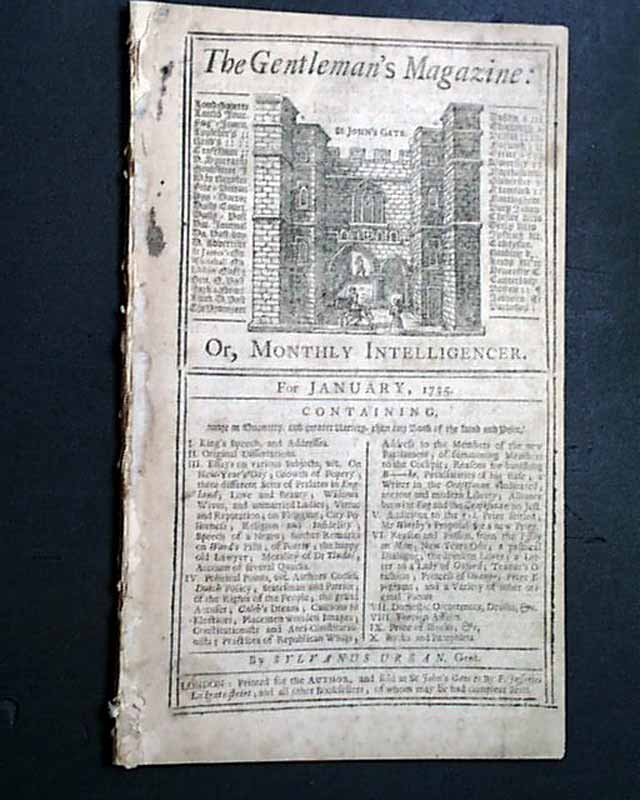
The speech of Moses Bon Saam, a free negro...
THE GENTLEMAN'S MAGAZINE, London, January, 1735
- The speech of a free negro - Moses Bon Saam
Without question the most noteworthy item is the speech by Moses Bon Saam, a free negro from Jamaica, which takes about 3 columns.
Bon Saam wrote this speech to his followers, runaway slaves planning to organize their own independent society in the interior of Jamaica. Affirmations of racial pride & a rudimentary theory of Black Power are found in this speech. It remains curiously relevant nearly 300 years later. More can be discovered regarding this speech on the web.
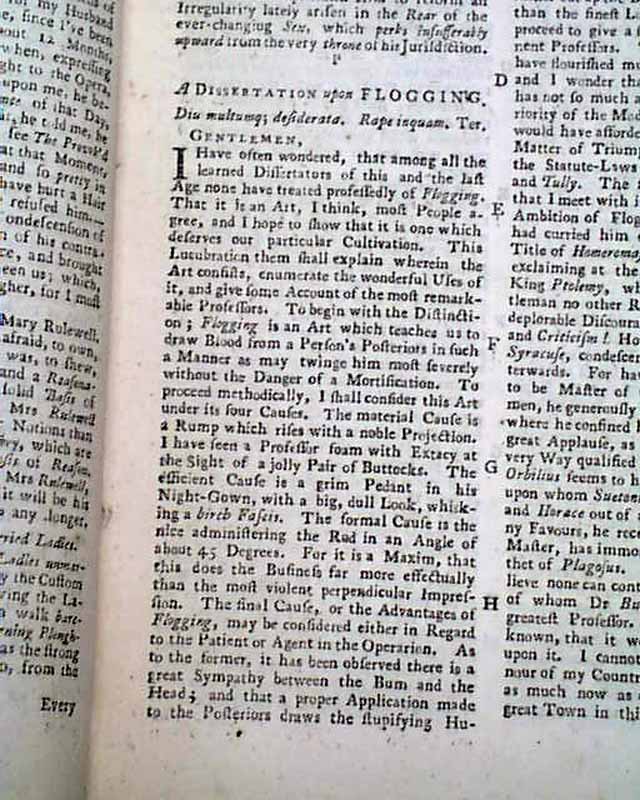
A quite comical article is on the benefits of flogging: "A New Dissertation on Flogging" taking nearly two columns.
Other articles within include: "Dissertation on New Year's Day" "Of the Growth of Popery" "Cooks & Authors Compared" "Dutch, their Policy" "Of the Fair Sex, Love & Beauty" "Religion & Infidelity" & more. Near the back is the: "Monthly Intelligencer" with news reports from various parts of England & Europe.
No maps or plates were called for in this issue.
Complete in 56 pages, full title/contents page featuring an engraving of St. John's Gate, 5 by 8 1/4 inches, light dirtiness to the front leaf and a minor front leaf margin steak, interiorly nice.
Background: The January 1735 publication of Moses Bon Saàm’s speech in The Gentleman’s Magazine marks a watershed moment in the history of Atlantic abolitionist literature and media, framing an early intellectual battleground over racial equality and colonial resistance during the height of the First Maroon War in Jamaica. Though composed as a work of political fiction by English essayist Aaron Hill, the text was presented to the British public as an authentic manifesto of a free Black leader rallying escaped slaves to establish an independent, sovereign society in the Jamaican interior. Its inclusion in London's premier periodical forced metropolitan readers to confront a radical, highly articulate defense of natural liberty, self-defense, and racial pride—concepts that anticipated modern Black Power philosophy by nearly three centuries—while directly challenging the moral and economic foundations of the British slave trade. By humanizing the Maroon insurgents not as mere rebels, but as a disciplined people justly fighting for their independence, this specific issue of the magazine stands as a rare, early counter-narrative to colonial propaganda, illustrating how 18th-century print culture inadvertently amplified the voices of resistance that threatened the very empire it documented.
A very nice pre-Revolutionary War magazine from the "mother country" with a wide range of varied content. This was the first periodical to use the word "magazine" in its title, having begun in 1731 and lasting until 1907.
Other issues you may like
§ related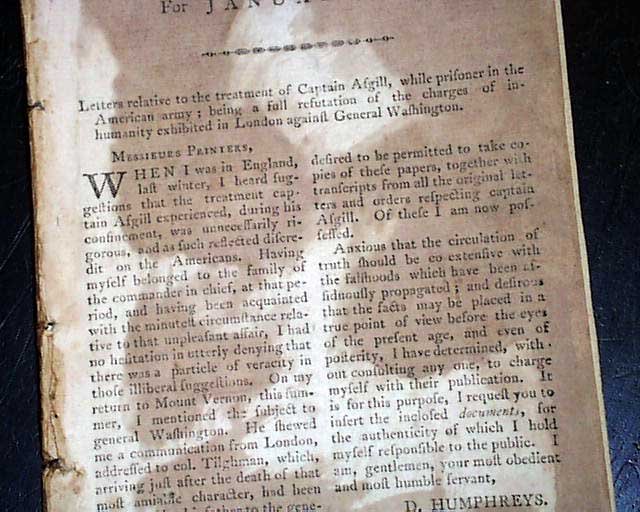
THE COLUMBIAN MAGAZINE, Philadelphia, January, 1787 One of the more intriguing articles is: "Letters Relative to the Treatment of Capt. Asgill, while
...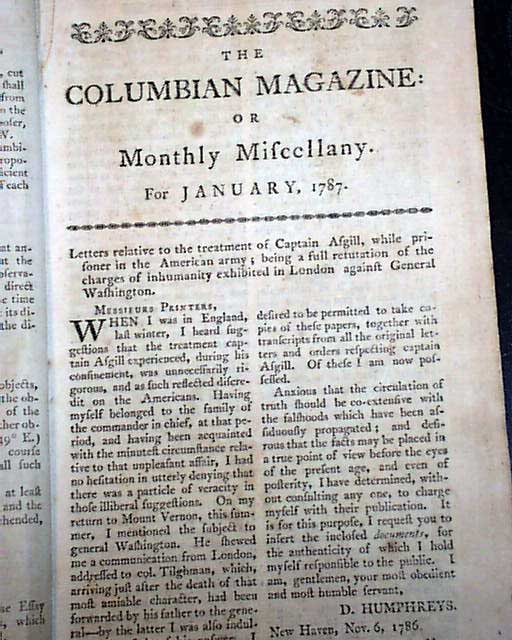
THE COLUMBIAN MAGAZINE, Philadelphia, January, 1787 One of the more intriguing articles is: "Letters Relative to the Treatment of Capt. Asgill, while
...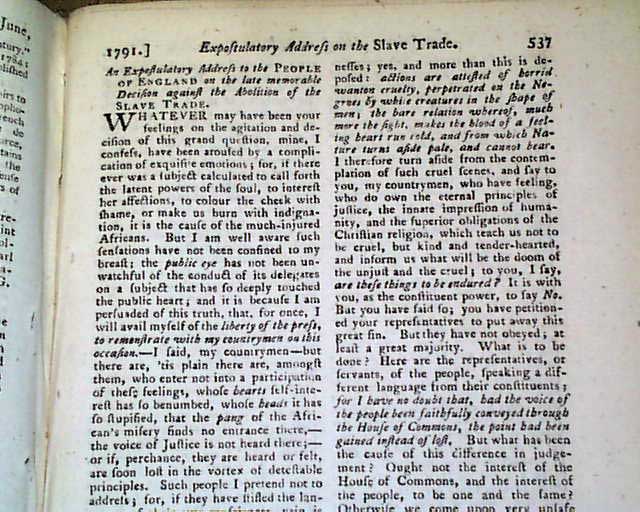
GENTLEMAN'S MAGAZINE, London, June, 1791 Taking nearly 2 pages is: "An Expository Address to the People of England on the Late Memorable Decision Against
...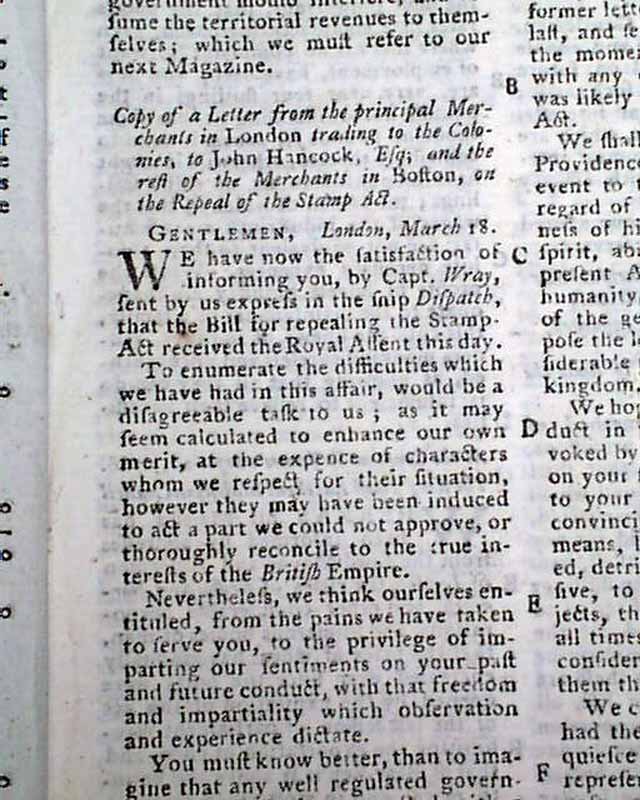
THE GENTLEMAN'S MAGAZINE, London, September, 1766 One of the better items is a letter: "...from the Principal Merchants in London trading to the Colonies,
...