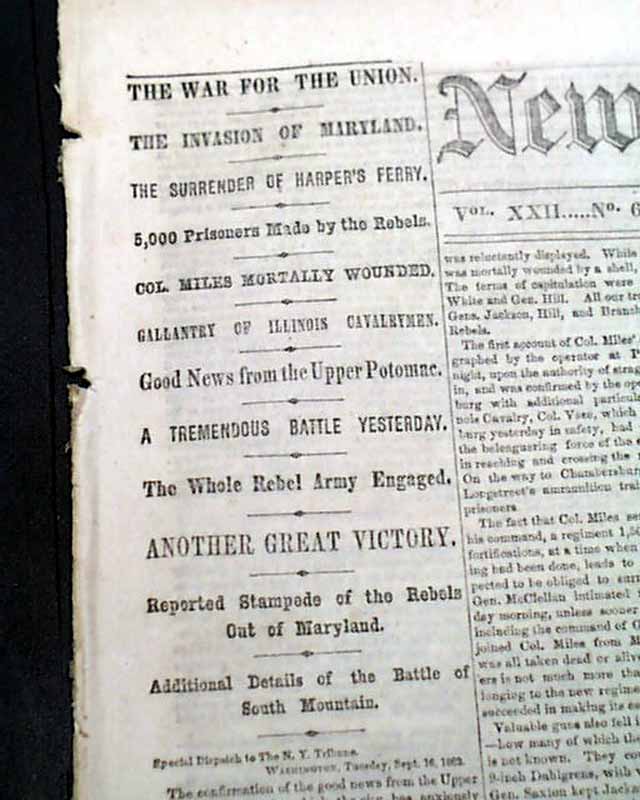
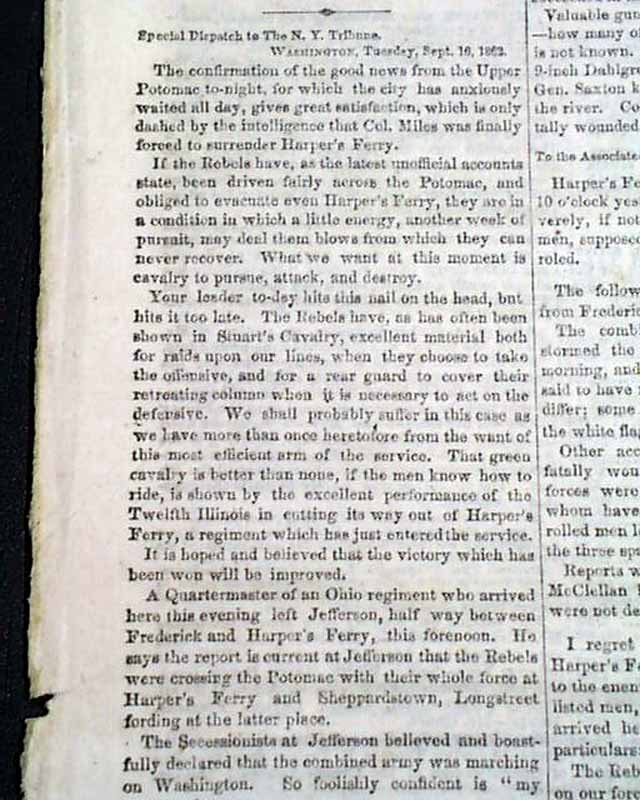
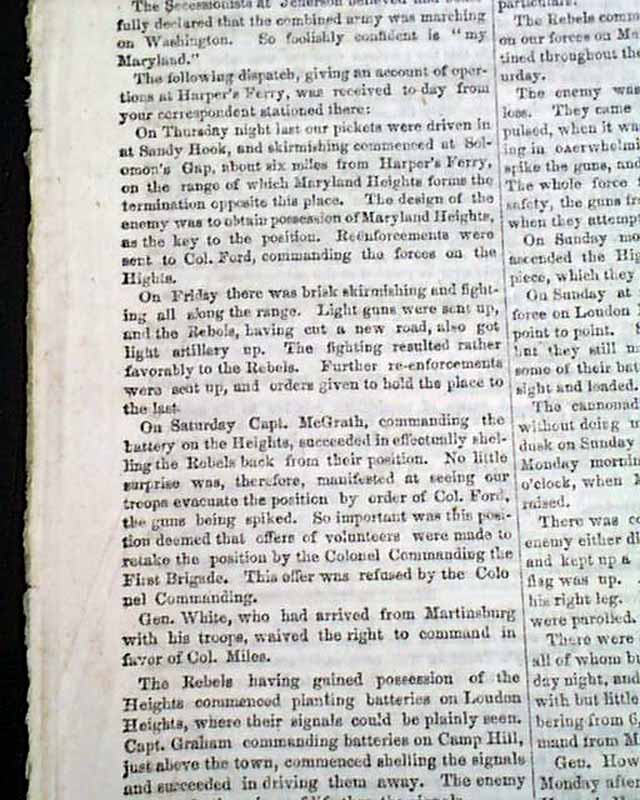
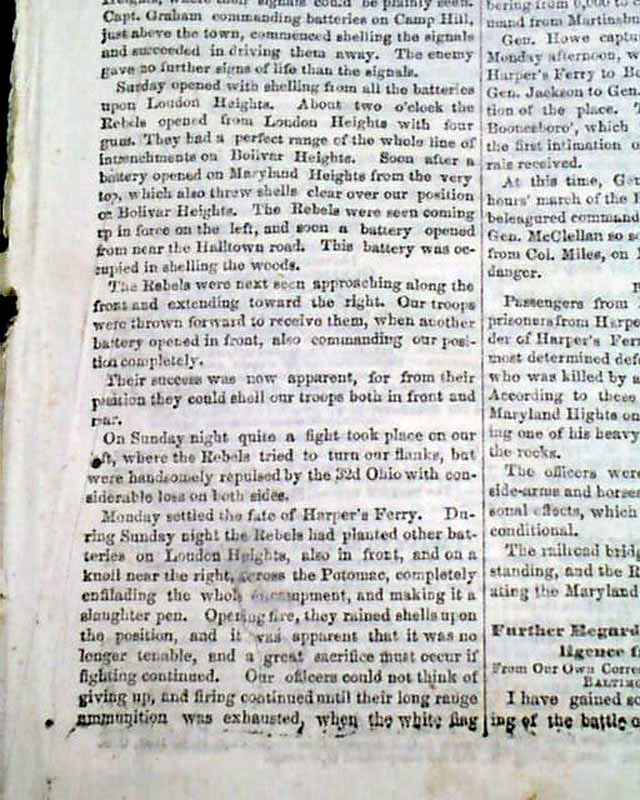
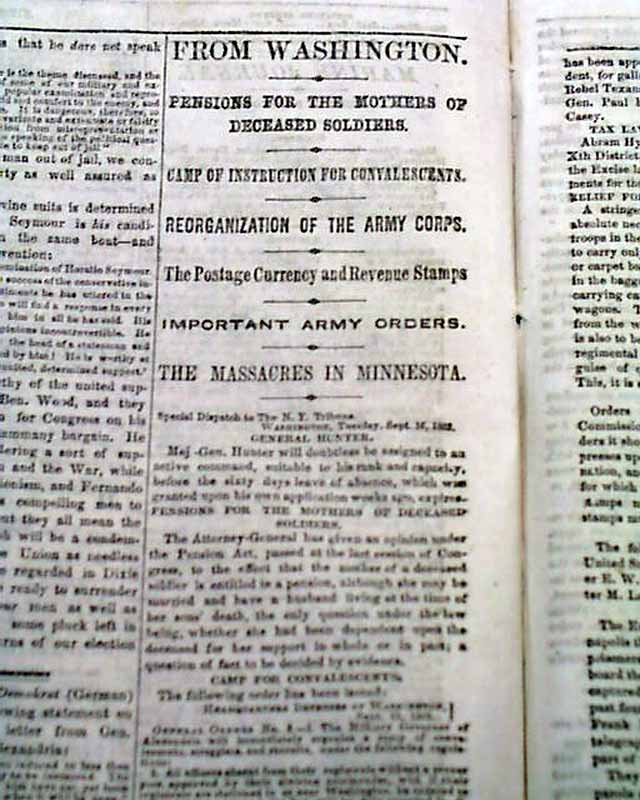
Regarding the surrender of Harper's Ferry...
Item # 710595
·
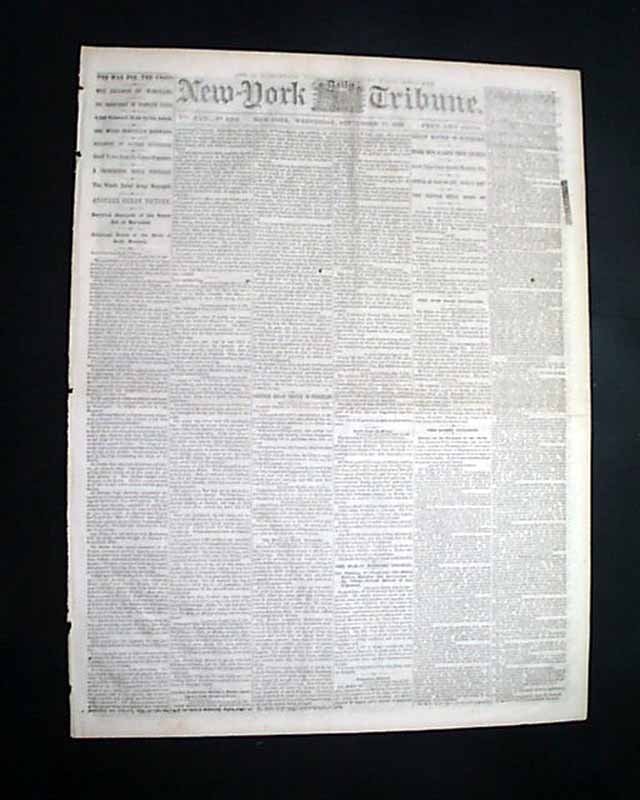
NEW YORK TRIBUNE, Sept. 17, 1862
* Maryland Campaign
* Harper's Ferry, West Virginia
* Battle of Munfordville, Kentucky
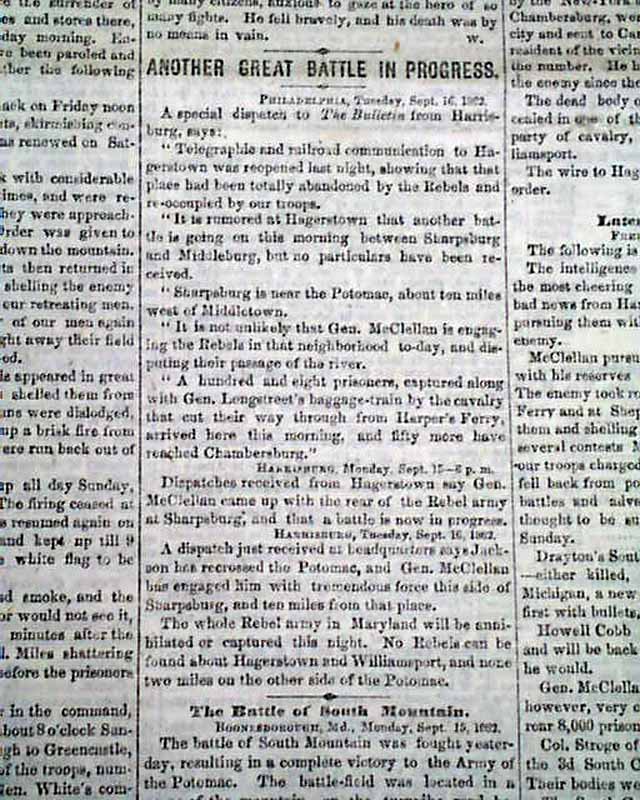
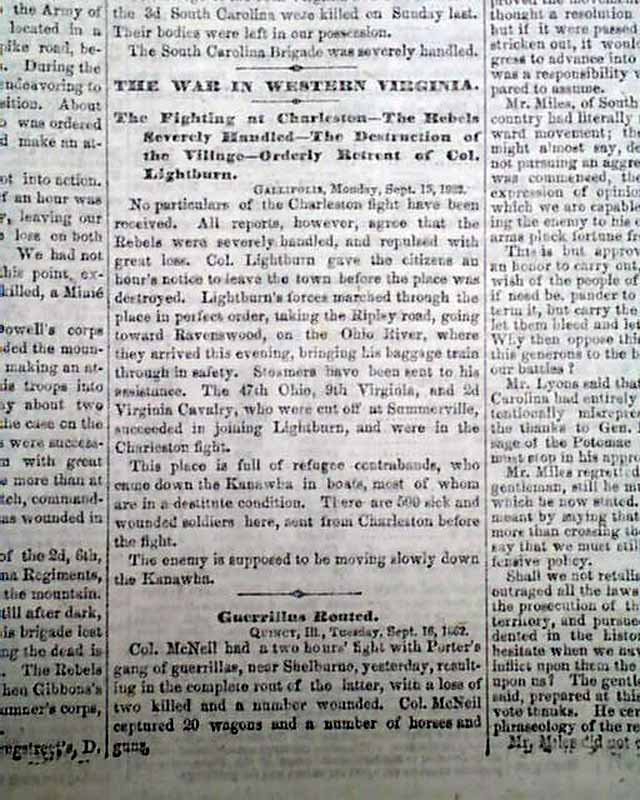
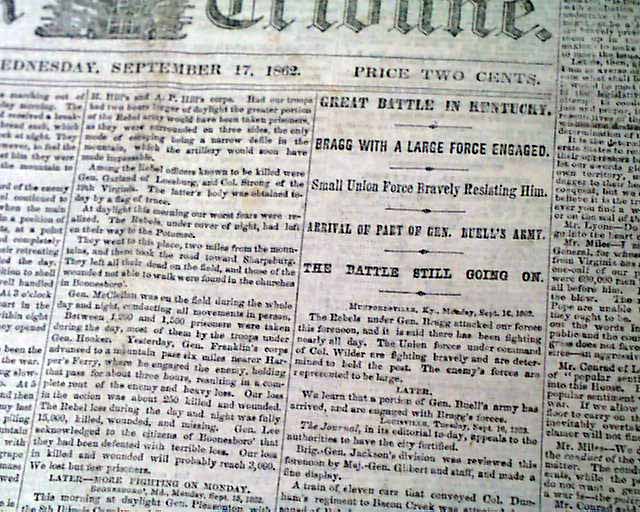
Among the front page column heads on the Civil War are: "The War For The Union" "The Invasion of Maryland" "The Surrender of Harper's Ferry" "5,000 Prisoners Made by the Rebels" "A Tremendous Battle Yesterday" "The Whole Rebel Army Engaged" "Another Great Victory" "Reported Stampede of the Rebels Out of Maryland" "Great Battle in Kentucky" "Bragg With a Large Force Engaged" and more.
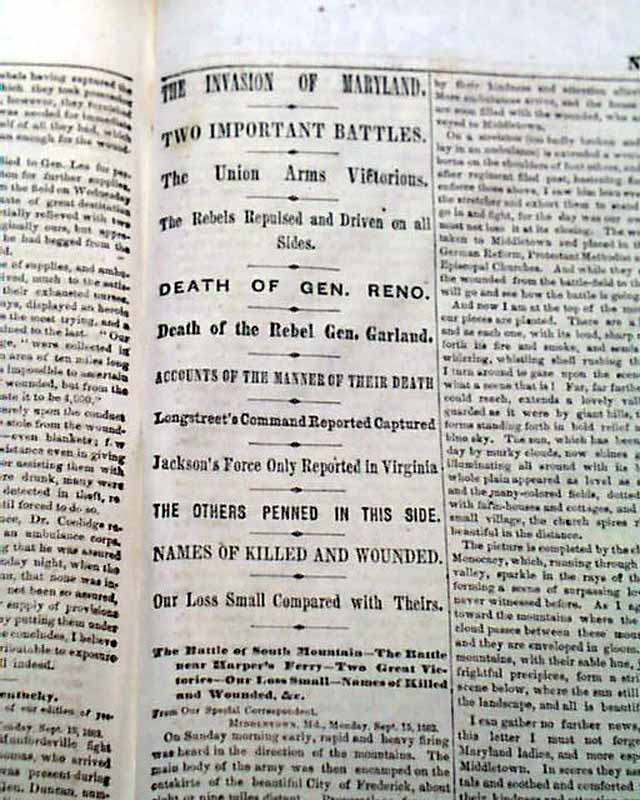
Page 7 has heads concerning the events just before the battle of Antietam, with: "The Invasion of Maryland" "Two Important Battles" "The Union Arms Victorious" "Death of General Reno" and more.
Eight pages, nice condition.
Background: Published on the very morning of September 17, 1862, this edition of the New York Tribune serves as a profound, real-time chronicle of the absolute nadir of the Union's fortunes during the Maryland Campaign, capturing a chaotic convergence of military disasters and premature optimism just hours before the war's trajectory fundamentally shifted. The headlines breathlessly report the catastrophic surrender of Harper’s Ferry on September 15—where Stonewall Jackson captured over 12,000 Union troops in the largest surrender of U.S. forces until World War II—alongside the mortal wounding of Union Major General Jesse Reno at the Battle of South Mountain, and Confederate General Braxton Bragg’s simultaneous, deeply threatening invasion of Kentucky. Yet, the true historical significance of this specific newspaper lies in its staggering dramatic irony: while readers on the home front perused these columns for news of "Another Great Victory" and a "Reported Stampede" based on the previous days' skirmishes, the Union and Confederate armies were at that exact moment colliding along Antietam Creek in Sharpsburg, Maryland. By the time this paper was discarded that evening, the Battle of Antietam had concluded as the bloodiest single day in American military history with over 22,000 casualties. The tactical draw ultimately forced Robert E. Lee's retreat, providing President Abraham Lincoln with the crucial political leverage needed to issue the preliminary Emancipation Proclamation just five days later, thereby transforming the Civil War from a mere struggle for preservation into a revolutionary crusade for human freedom.
* Maryland Campaign
* Harper's Ferry, West Virginia
* Battle of Munfordville, Kentucky
Among the front page column heads on the Civil War are: "The War For The Union" "The Invasion of Maryland" "The Surrender of Harper's Ferry" "5,000 Prisoners Made by the Rebels" "A Tremendous Battle Yesterday" "The Whole Rebel Army Engaged" "Another Great Victory" "Reported Stampede of the Rebels Out of Maryland" "Great Battle in Kentucky" "Bragg With a Large Force Engaged" and more.
Page 7 has heads concerning the events just before the battle of Antietam, with: "The Invasion of Maryland" "Two Important Battles" "The Union Arms Victorious" "Death of General Reno" and more.
Eight pages, nice condition.
Background: Published on the very morning of September 17, 1862, this edition of the New York Tribune serves as a profound, real-time chronicle of the absolute nadir of the Union's fortunes during the Maryland Campaign, capturing a chaotic convergence of military disasters and premature optimism just hours before the war's trajectory fundamentally shifted. The headlines breathlessly report the catastrophic surrender of Harper’s Ferry on September 15—where Stonewall Jackson captured over 12,000 Union troops in the largest surrender of U.S. forces until World War II—alongside the mortal wounding of Union Major General Jesse Reno at the Battle of South Mountain, and Confederate General Braxton Bragg’s simultaneous, deeply threatening invasion of Kentucky. Yet, the true historical significance of this specific newspaper lies in its staggering dramatic irony: while readers on the home front perused these columns for news of "Another Great Victory" and a "Reported Stampede" based on the previous days' skirmishes, the Union and Confederate armies were at that exact moment colliding along Antietam Creek in Sharpsburg, Maryland. By the time this paper was discarded that evening, the Battle of Antietam had concluded as the bloodiest single day in American military history with over 22,000 casualties. The tactical draw ultimately forced Robert E. Lee's retreat, providing President Abraham Lincoln with the crucial political leverage needed to issue the preliminary Emancipation Proclamation just five days later, thereby transforming the Civil War from a mere struggle for preservation into a revolutionary crusade for human freedom.
Category: Yankee
Price
$38
100% Authentic: Original printing, never a reproduction.
Other issues you may like
§ related
Battle of Antietam & Harper's Ferry, in a Confederate newspaper...
THE TRI-WEEKLY MERCURY, Charleston, South Carolina, Sept. 23, 1862
* Rare from the Confederacy
* Battle of Antietam - Sharpsburg
Given the date, it...
* Rare from the Confederacy
* Battle of Antietam - Sharpsburg
Given the date, it...
Sep 1862
$172
Battle of Antietam, from the capital of the Confederacy...
DAILY RICHMOND EXAMINER, Virginia, Sept. 24, 1862
* Battle of Antietam, Sharpsburg, Maryland
* Rare Confederate title from the rebel capital
A terrific and...
* Battle of Antietam, Sharpsburg, Maryland
* Rare Confederate title from the rebel capital
A terrific and...
Sep 1862
$148
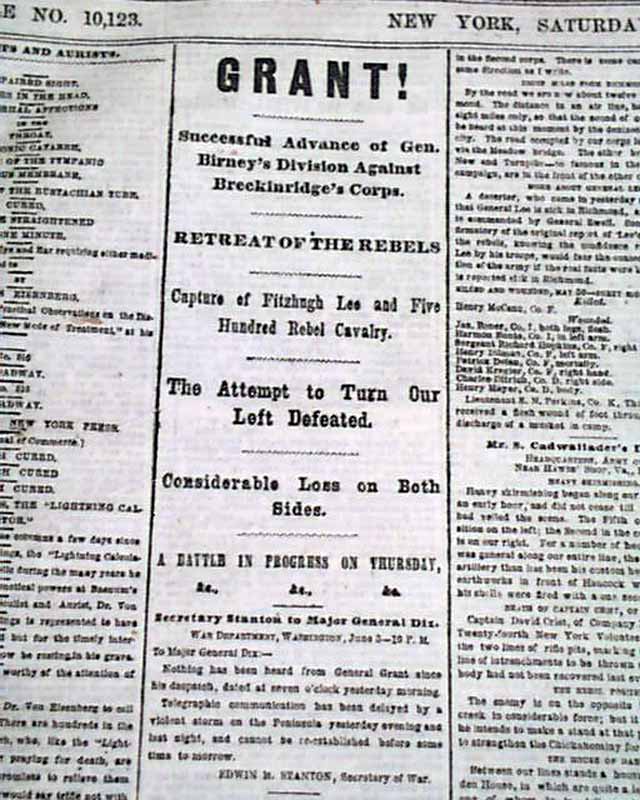
The Rebel cavalry is routed...
NEW YORK HERALD, June 4, 1864
* Battle of Cold Harbor
* Overland Campaign
Among the front page column Civil War heads are: "GRANT ! " "Successful Advance of...
* Battle of Cold Harbor
* Overland Campaign
Among the front page column Civil War heads are: "GRANT ! " "Successful Advance of...
Jun 1864
$30
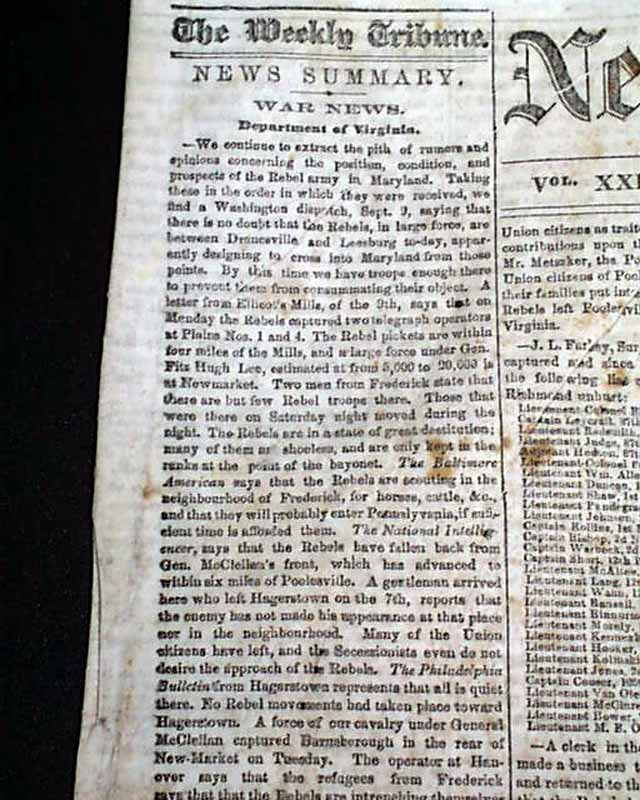
A week's report of Civil War news...
NEW YORK WEEKLY TRIBUNE, Sept. 13, 1862
* Rebels first invasion of the North
* Maryland invaded from the South
A wealth of Civil War reporting scattered...
* Rebels first invasion of the North
* Maryland invaded from the South
A wealth of Civil War reporting scattered...
Sep 1862
$27