Nice report on the Black Hawk Indian War...
Item # 709967
·
Sorry, but this item is no longer available. Please be in touch at info@rarenewspapers.com if you would like to be placed on a want list or are interested in a potential alternate issue.
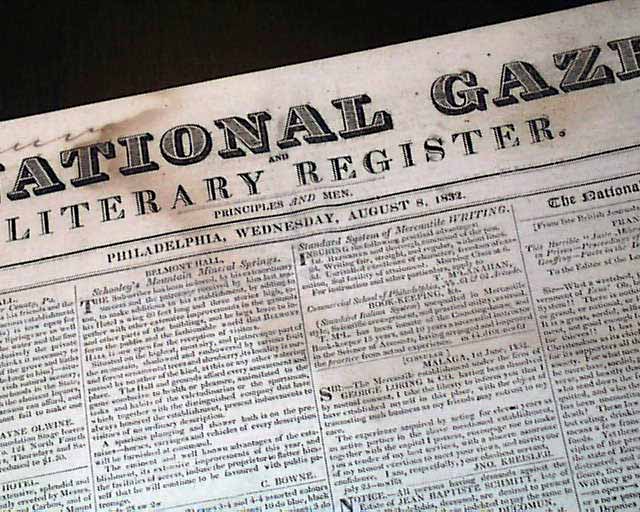
NATIONAL GAZETTE & LITERARY REGISTER, Philadelphia, Aug. 8, 1832
* Black Hawk War
* Illinois & Wisconsin
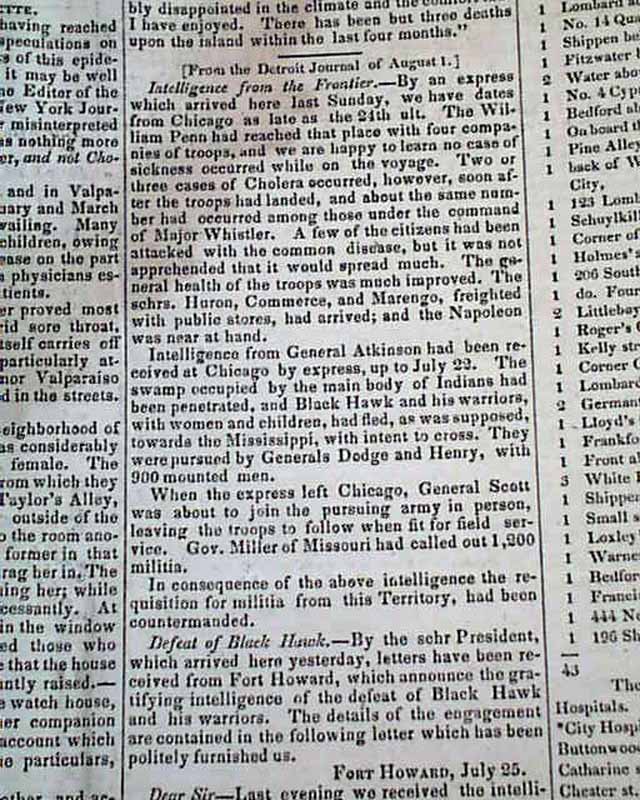
Page 2 has a report on the Black Hawk War, a brief conflict between the United States and Native Americans led by Black Hawk, a Sauk Indian leader. This was the war in which Abraham Lincoln was an Illinois militia soldier, although he saw no combat.
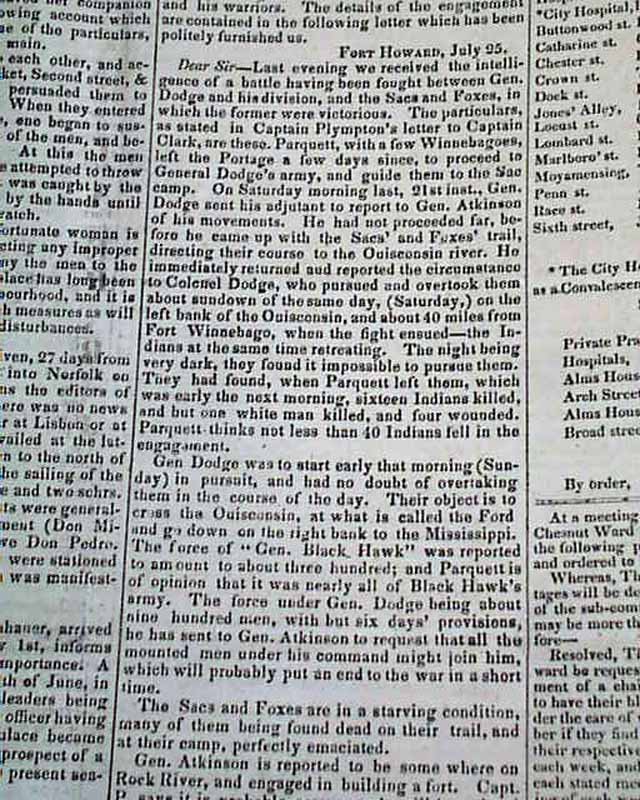
About half a column has several reports, bits including: "...from General Atkinson...The swamp occupied by the main body of Indians had been penetrated, and Black Hawk and his warriors, with women & children, had fled..." and a bit more. Then: "Defeat of Black Hawk" has: "...announce the gratifying intelligence of the defeat of Black Hawk and his warriors...".
Another report is datelined from Fort Howard, with more detail.
Four pages, slightly irregular at the spine margin, a bit of light damp staining near the top, various archival mends inside.
Background: The Black Hawk War serves as a poignant and brutal finale to the era of Native American resistance in the Old Northwest, marking the end of significant armed opposition to white settlement in the region that became Illinois and Wisconsin. Triggered by Black Hawk’s refusal to recognize the disputed 1804 Treaty of St. Louis—which ceded ancestral Sauk lands—his return to Illinois in 1832 with the "British Band" ignited a panic that mobilized federal troops and a massive volunteer militia, including a young Abraham Lincoln. The conflict is historically significant not only for the tactical pursuit of displaced families through the rugged wilderness but for its tragic conclusion at the Battle of Bad Axe, where the use of the steamboat Warrior demonstrated the overwhelming technological and logistical advantages of the United States. This "victory," celebrated in papers like the National Gazette, effectively cleared the way for the rapid expansion of American agriculture and industry, while the subsequent imprisonment and forced "tour" of Black Hawk through Eastern cities served as a symbolic assertion of Jacksonian-era Indian Removal policies.
* Black Hawk War
* Illinois & Wisconsin
Page 2 has a report on the Black Hawk War, a brief conflict between the United States and Native Americans led by Black Hawk, a Sauk Indian leader. This was the war in which Abraham Lincoln was an Illinois militia soldier, although he saw no combat.
About half a column has several reports, bits including: "...from General Atkinson...The swamp occupied by the main body of Indians had been penetrated, and Black Hawk and his warriors, with women & children, had fled..." and a bit more. Then: "Defeat of Black Hawk" has: "...announce the gratifying intelligence of the defeat of Black Hawk and his warriors...".
Another report is datelined from Fort Howard, with more detail.
Four pages, slightly irregular at the spine margin, a bit of light damp staining near the top, various archival mends inside.
Background: The Black Hawk War serves as a poignant and brutal finale to the era of Native American resistance in the Old Northwest, marking the end of significant armed opposition to white settlement in the region that became Illinois and Wisconsin. Triggered by Black Hawk’s refusal to recognize the disputed 1804 Treaty of St. Louis—which ceded ancestral Sauk lands—his return to Illinois in 1832 with the "British Band" ignited a panic that mobilized federal troops and a massive volunteer militia, including a young Abraham Lincoln. The conflict is historically significant not only for the tactical pursuit of displaced families through the rugged wilderness but for its tragic conclusion at the Battle of Bad Axe, where the use of the steamboat Warrior demonstrated the overwhelming technological and logistical advantages of the United States. This "victory," celebrated in papers like the National Gazette, effectively cleared the way for the rapid expansion of American agriculture and industry, while the subsequent imprisonment and forced "tour" of Black Hawk through Eastern cities served as a symbolic assertion of Jacksonian-era Indian Removal policies.
Category: Pre-Civil War
No Longer Available
100% Authentic: Original printing, never a reproduction.
Other issues you may like
§ related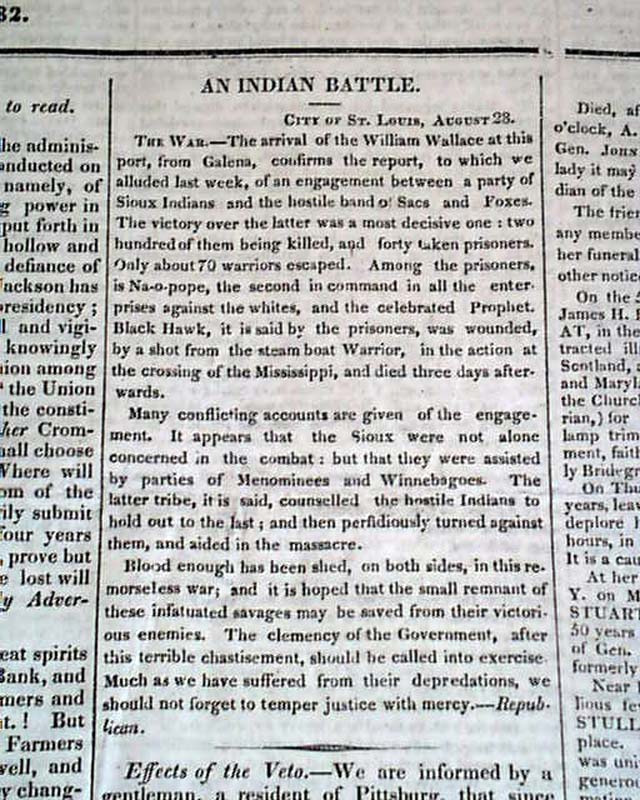
The Black Hawk War...
NATIONAL INTELLIGENCER, Washington, D.C., Sept. 11, 1832 The top of the front page has: "An Indian Battle" being a report from St. Louis concerning the...
Sep 1832
$38
The Black Hawk War...
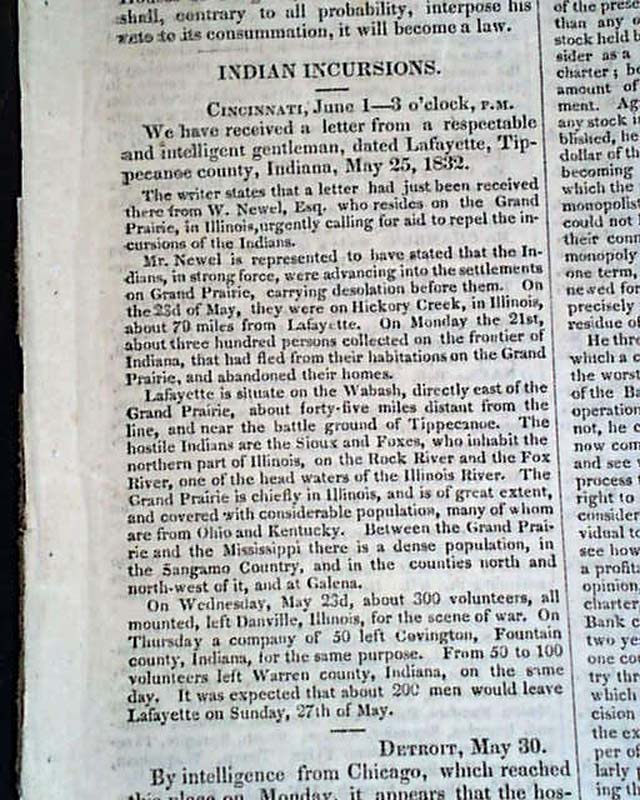
NATIONAL INTELLIGENCER, Washington, D.C., June 9, 1832 The front page has a report: "Indian Incursions" which is on the Black Hawk War, noting in part:...
Jun 1832
$38
The Black Hawk War...
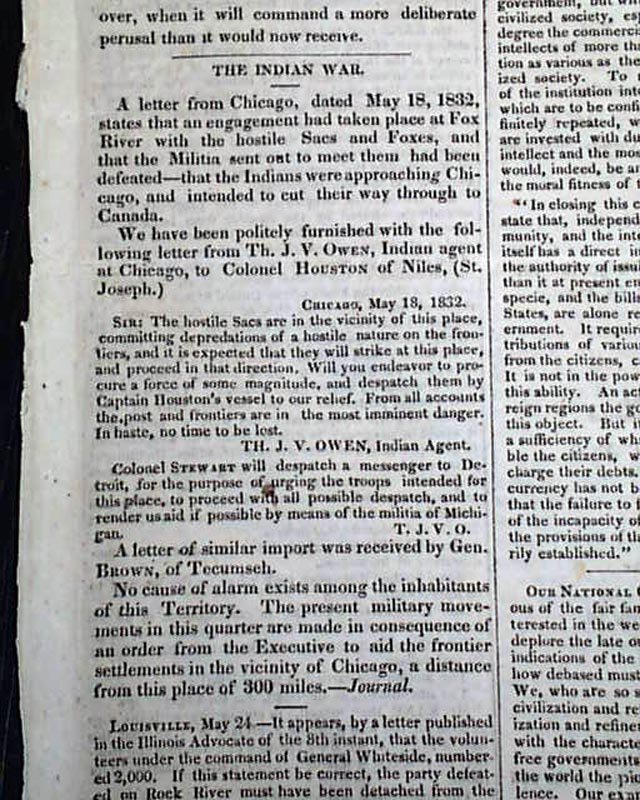
NATIONAL INTELLIGENCER, Washington, D.C., June 2, 1832 The front page has a report: "The Indian War" which is on the Black Hawk War, noting in part: "...an...
Jun 1832
$33
A 'call to arms' for the Black Hawk War...
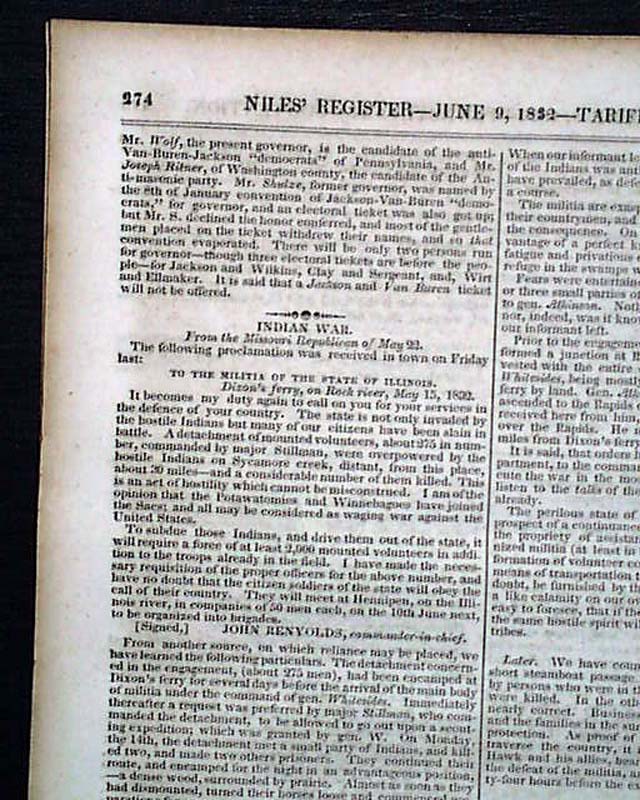
NILES' WEEKLY REGISTER, Baltimore, June 9, 1832 Inside has over half a page headed: "Indian War" which includes a Proclamation from the Rock River, signed...
Jun 1832
$34