The Creole slave mutiny...
Item # 709180
·
Sorry, but this item is no longer available. Please be in touch at info@rarenewspapers.com if you would like to be placed on a want list or are interested in a potential alternate issue.
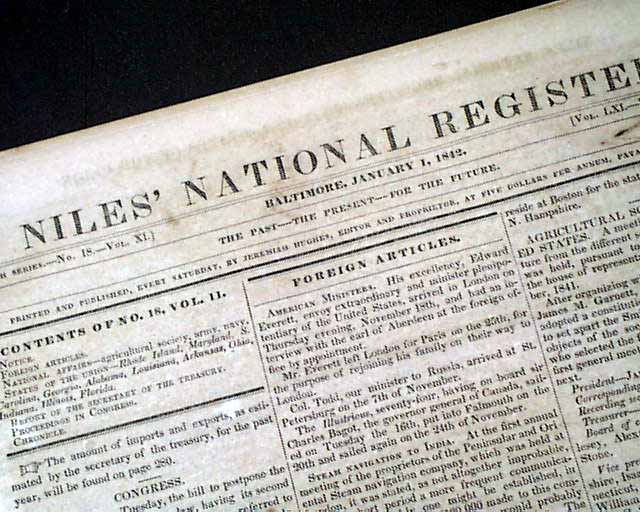
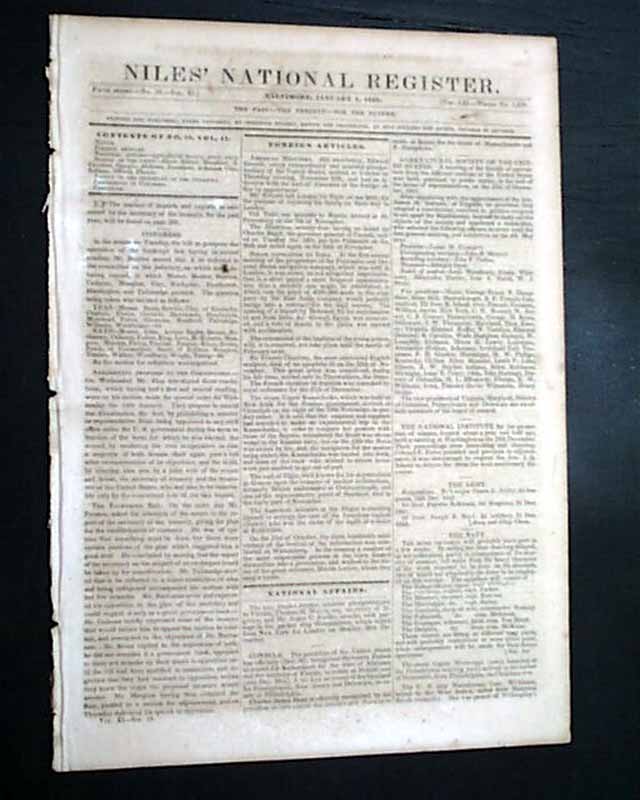
NILES' NATIONAL REGISTER, Baltimore, Jan. 1, 1842
* Creole slavery slaves uprising
* Ship insurrection - revolt - mutiny
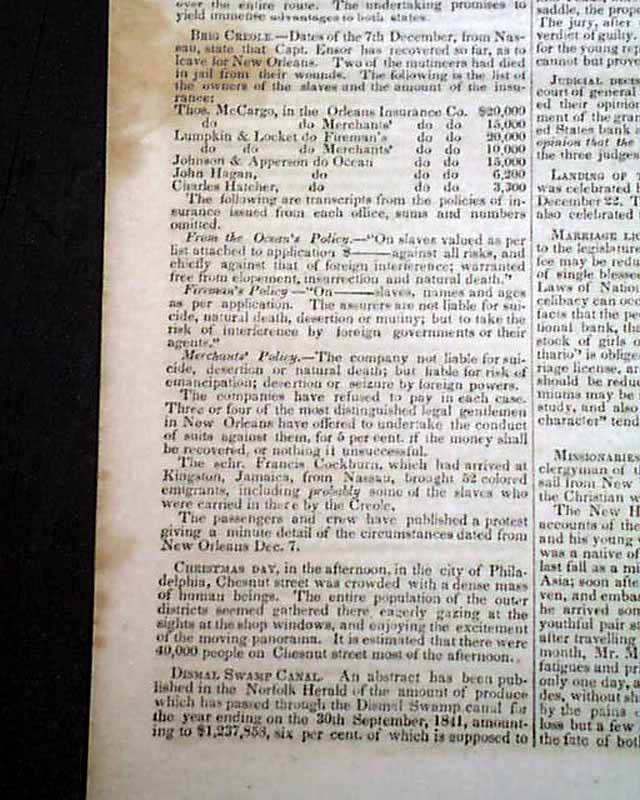
The back page has: "Brig Creole" which is a report on the "Creole Case", the result of an American slave revolt in November on board the Creole, a ship involved in the U. S. slave trade.
As 128 slaves gained freedom after the Africans ordered the ship sailed to Nassau, it has been termed the "most successful slave revolt in US history". Two persons died as a result of the revolt, a black slave and a white slave trader.
The report mentions in part: "...that Capt. Ensor has recovered so far...Two of the mutineers had died in jail from their wounds. The following is the list of the owners of the slaves & the amount of the insurance..." with the chart.
Sixteen pages, 8 1/2 by 12 inches, nice condition.
Background: Published just weeks after the uprising, this January 1, 1842 issue of Niles’ National Register offers a rare, contemporary glimpse into the Creole Case, widely recognized as the most successful revolt of enslaved people in American history. In November 1841, Madison Washington led nineteen enslaved individuals in seizing control of the brig Creole en route to New Orleans, resulting in the deaths of a slave trader and an enslaved person before forcing the crew to steer the vessel to Nassau in the British Bahamas. Because Britain had abolished slavery, British authorities ultimately emancipated 128 enslaved passengers, sparking an intense international diplomatic crisis and fueling fierce domestic debates over the legalities of the coastwise slave trade. The publication's inclusion of a clinical chart detailing "the owners of the slaves & the amount of the insurance" provides stark, primary-source evidence of how human beings were treated as mere insured commodities under American maritime law. Ultimately, this specific record captures a pivotal turning point that electrified the Northern abolitionist movement—which argued that the rebels had simply asserted their natural right to liberty once in international waters—while deepening the existential dread of Southern slaveholders, foreshadowing the irreconcilable sectional tensions that eventually led to the American Civil War.
As noted in Wikipedia, this title: "...(was) one of the most widely-circulated magazines in the United States...Devoted primarily to politics...considered an important source for the history of the period."
* Creole slavery slaves uprising
* Ship insurrection - revolt - mutiny
The back page has: "Brig Creole" which is a report on the "Creole Case", the result of an American slave revolt in November on board the Creole, a ship involved in the U. S. slave trade.
As 128 slaves gained freedom after the Africans ordered the ship sailed to Nassau, it has been termed the "most successful slave revolt in US history". Two persons died as a result of the revolt, a black slave and a white slave trader.
The report mentions in part: "...that Capt. Ensor has recovered so far...Two of the mutineers had died in jail from their wounds. The following is the list of the owners of the slaves & the amount of the insurance..." with the chart.
Sixteen pages, 8 1/2 by 12 inches, nice condition.
Background: Published just weeks after the uprising, this January 1, 1842 issue of Niles’ National Register offers a rare, contemporary glimpse into the Creole Case, widely recognized as the most successful revolt of enslaved people in American history. In November 1841, Madison Washington led nineteen enslaved individuals in seizing control of the brig Creole en route to New Orleans, resulting in the deaths of a slave trader and an enslaved person before forcing the crew to steer the vessel to Nassau in the British Bahamas. Because Britain had abolished slavery, British authorities ultimately emancipated 128 enslaved passengers, sparking an intense international diplomatic crisis and fueling fierce domestic debates over the legalities of the coastwise slave trade. The publication's inclusion of a clinical chart detailing "the owners of the slaves & the amount of the insurance" provides stark, primary-source evidence of how human beings were treated as mere insured commodities under American maritime law. Ultimately, this specific record captures a pivotal turning point that electrified the Northern abolitionist movement—which argued that the rebels had simply asserted their natural right to liberty once in international waters—while deepening the existential dread of Southern slaveholders, foreshadowing the irreconcilable sectional tensions that eventually led to the American Civil War.
As noted in Wikipedia, this title: "...(was) one of the most widely-circulated magazines in the United States...Devoted primarily to politics...considered an important source for the history of the period."
Item from last month's catalog - #366 - released for May, 2026
Category: Pre-Civil War
No Longer Available
100% Authentic: Original printing, never a reproduction.
Other issues you may like
§ related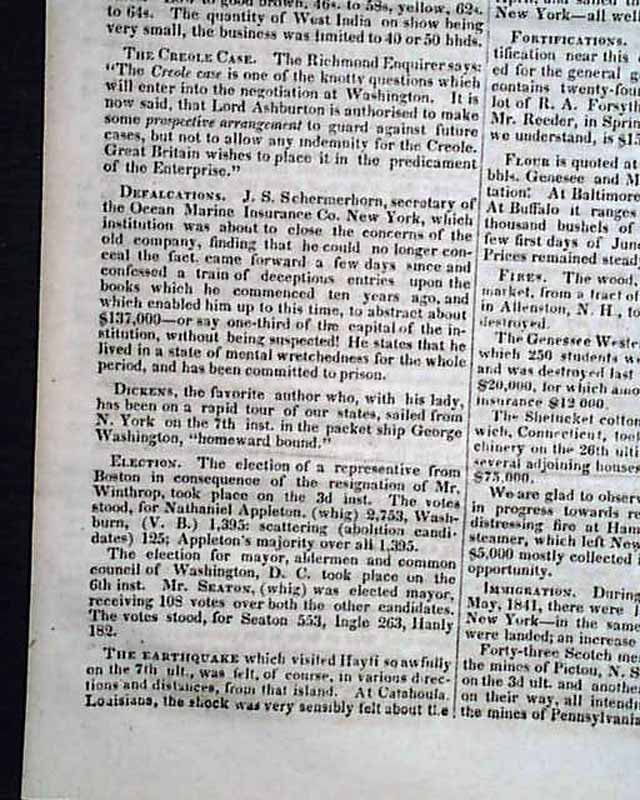
Brief item on the Creole slave ship mutiny case...
NILES'S NATIONAL REGISTER, Baltimore, June 11, 1842
The back page has an article headed: "The Creole Case", which concerns a slave ship upon which the...
The back page has an article headed: "The Creole Case", which concerns a slave ship upon which the...
Jun 1842
$32
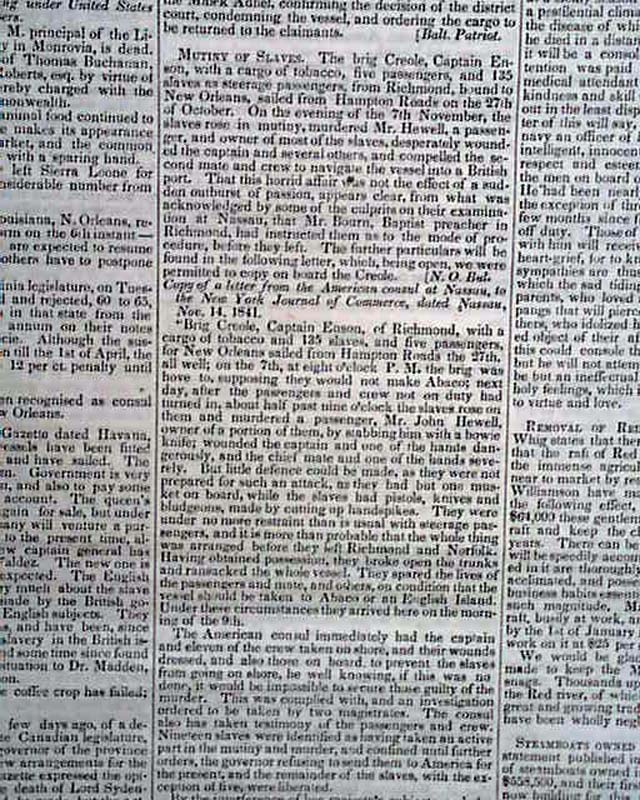
Mutiny of slaves... Bowie knife used...
NILES' NATIONAL REGISTER, Baltimore, Dec. 18, 1841
* Creole slavery slaves case
* Ship insurrection - revolt - mutiny
The back page of this issue...
* Creole slavery slaves case
* Ship insurrection - revolt - mutiny
The back page of this issue...
Dec 1841
$61
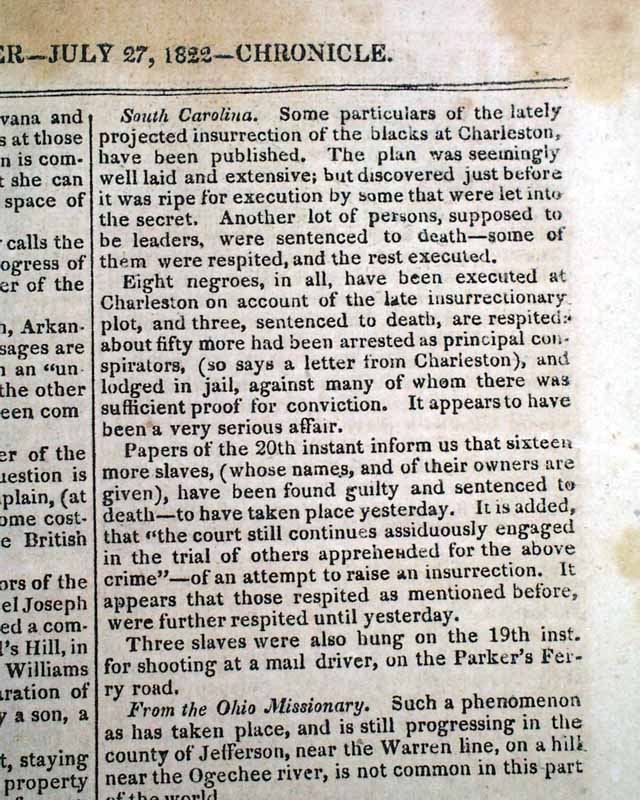
Additional details - the Denmark Vesey slave revolt... Projected population growth of slaves....
NILES' WEEKLY REGISTER, Baltimore, July 27, 1822
* Denmark Vesey slave rebellion... free black man in Charleston, SC
* The 1820 state-by-state slave...
* Denmark Vesey slave rebellion... free black man in Charleston, SC
* The 1820 state-by-state slave...
Jul 1822
$57
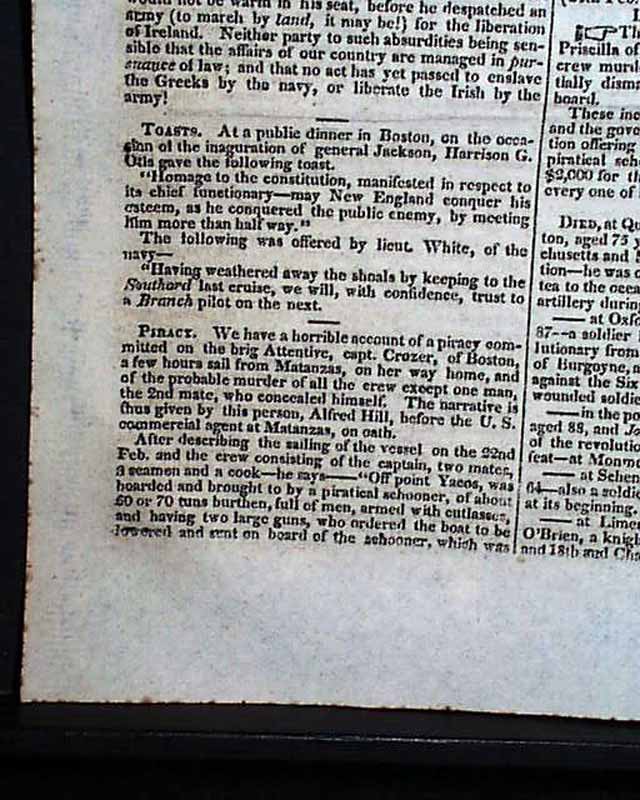
Piracy... Slave up-rising suppressed...
NILES' WEEKLY REGISTER, Baltimore, Maryland, March 21, 1829 A lot of the news in this newspaper is government related from different regions of America....
Mar 1829
$30