


A lighthouse in Penobscot Bay...
SALEM REGISTER, Massachusetts, Sept. 8, 1803 The front page begins with two Acts of the Mass. legislature: "An Act to cede to the United States the jurisdiction of a tract of land on White-head Island in Penobscot Bay, for a lighthouse." The other is: "An Act to cede to the United States the Jurisdiction of a tract of Land on Martha's Vineyard, and the building erected thereon by this Commonwealth as an Hospital" both signed by the governor: Caleb Strong.
Four pages, a bit irregular at the blank spine margin from disbinding, a small piece from the top margin of the back leaf, obviously not affecting front page content.
Background: Commissioned by President Thomas Jefferson in 1803 as Maine’s third lighthouse, Whitehead Light Station sits on Whitehead Island in St. George to mark the critical southwestern entrance of the Muscle Ridge Channel into Penobscot Bay. Originally constructed as a 29-foot octagonal wooden tower paired with a wooden keeper's residence, the facility underwent multiple rebuilds due to harsh maritime exposure, culminating in the historic 41-foot granite stone tower erected in 1852 that still stands today. Beyond its foundational structural history, the station served as a pioneer in maritime safety technology, housing one of the earliest experimental fog bells in the United States—powered by a tidal mechanism—and later installing a steam-driven fog whistle in 1869. Automated by the U.S. Coast Guard in 1982, the iconic granite tower remains an active navigational light, while the fully restored keeper’s dwelling now operates under private ownership as an educational retreat and rental site, preserving its rich two-century legacy along the Maine coast.
Other issues you may like
§ related
COLUMBIAN CENTINEL & MASSACHUSETTS FEDERALISTS, Boston, Aug. 3, 1803
- Whitehead Light Station established
- St. George, Knox County, Maine
The front page has
...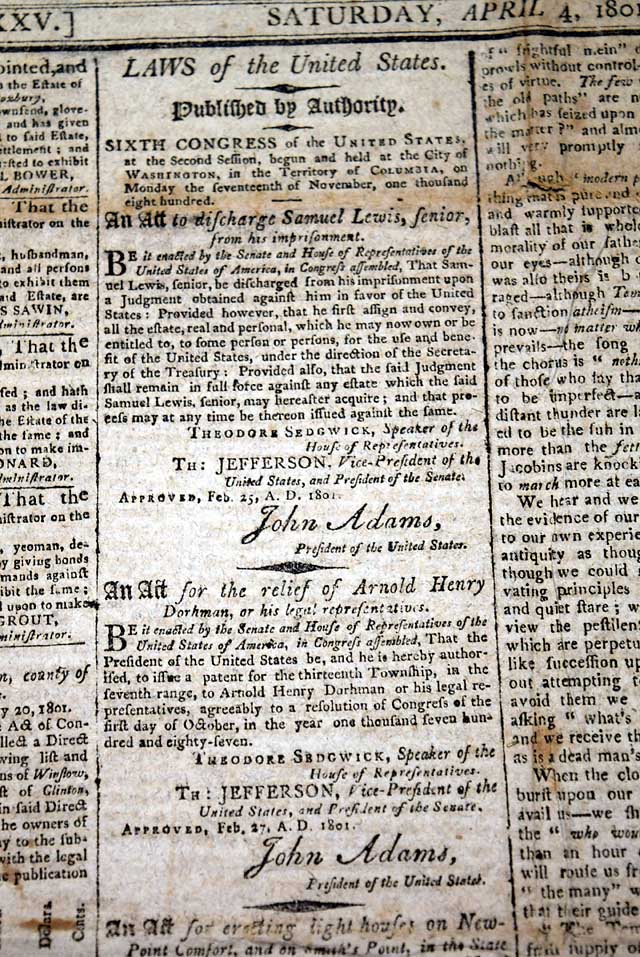
COLUMBIAN CENTINEL, Boston, April 4, 1801 Most of a front page column is taken up with three Acts of Congress, each signed in script type by the President:
...
COLUMBIAN CENTINEL, Boston, March 14, 1795
- President George Washington
- Samuel Adams
The middle of the front page is taken up with 3 Acts of Congress each
...
COLUMBIAN CENTINEL, Boston, April 25, 1795
- President George Washington act of Congress
- Seguin Island Maine Lighthouse proposed
The top of third column on
...