Supporting the cause of Prohibition...
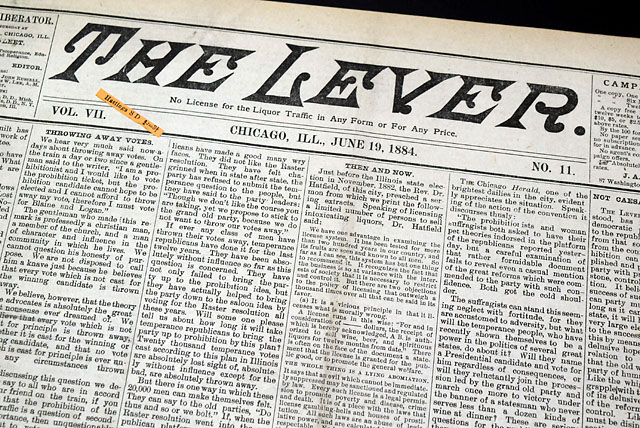
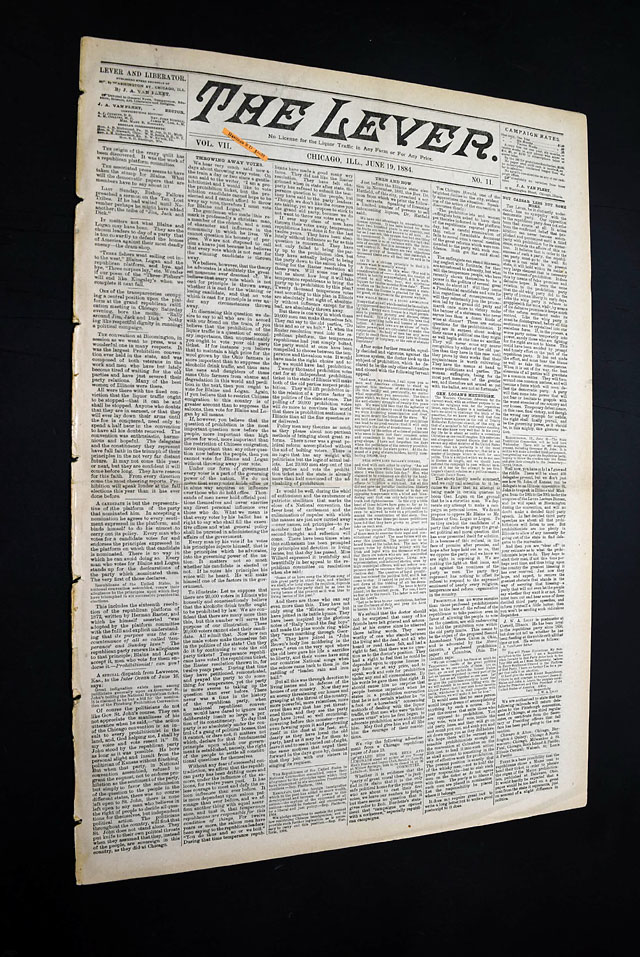
THE LEVER, Chicago, Illinois, June 19, 1884
- Rare Temperance publication
A prohibition newspaper which railed against the sale of alcohol. Their motto in the masthead: "No License for the Liquor Traffic in Any Form or for Any Price." Most of the content is themed on this principle.
That slogan reflected the position of the Prohibition Party and the broader temperance movement. At the time, many reformers opposed not only drunkenness but the legal sale of alcoholic beverages itself. The phrase "No License" meant that governments should not issue liquor licenses under any circumstances, rather than merely regulating alcohol sales.
Chicago in the late 19th century was a major battleground in debates over alcohol. The city had large German, Irish, and other immigrant populations for whom beer and saloons were important social institutions. Temperance advocates, many of them connected with Protestant reform movements, viewed the liquor trade as a source of poverty, crime, and political corruption. These tensions had deep roots in Chicago's history, stretching back to conflicts such as the 1855 Lager Beer Riot over liquor regulations and licensing.
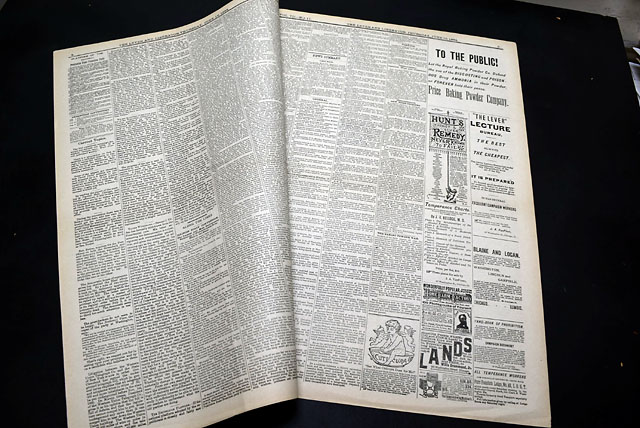
Eight pages, cleanly cut at the blank spine, nice condition.
Background: Published at the height of 19th-century reform fervor, the June 19, 1884 issue of Chicago’s The Lever serves as an uncompromising manifesto for the Prohibition Party and the broader temperance movement, defined by its steadfast masthead banner: "No License for the Liquor Traffic in Any Form or for Any Price". Rather than advocating for incremental regulation or localized temperance, the newspaper's primary content aggressively argues for complete legal abolition, operating on the conviction that state-issued liquor licenses merely legitimize a social evil responsible for rampant crime, systemic poverty, and municipal political corruption. Set against the backdrop of Chicago’s heated culture wars—where Protestant reform crusaders clashed directly with the city’s large German and Irish working-class immigrant populations who viewed saloons and beer gardens as crucial community hubs—the issue highlights a ideological battle line with roots tracing back to the violent 1855 Lager Beer Riot. Across its eight pages, the publication marshals moral appeals, political commentary, and social reform critiques to position total alcohol prohibition not just as a matter of personal abstinence, but as an essential civic duty required to purify American democracy and urban life.
Other issues you may like
§ related
THE LEVER, Chicago, Illinois, April 10, 1884
- Rare publication
A prohibition newspaper which railed against the sale of alcohol. Their motto in the
...THE LEVER, Chicago, Illinois, Dec. 17, 1884 The motto under the title reads: "No License for the Liquor Traffic in Any Form or For Any Price.". The
...
THE KANSAS PROHIBITIONIST, Leavenworth, Kansas, July 9, 1884
- Rare temperance movement publication
- Abstinence of alcohol - beer - liquor
A virulent newspaper
...
THE PROHIBITION BANNER, Pittsburgh, Pennsylvania, Oct. 24, 1884
- Rare temperance movement publication
- Abstinence of alcohol - beer - liquor
As the title would
...