
Medical care of slaves on Alabama plantations...
Item # 695635
·
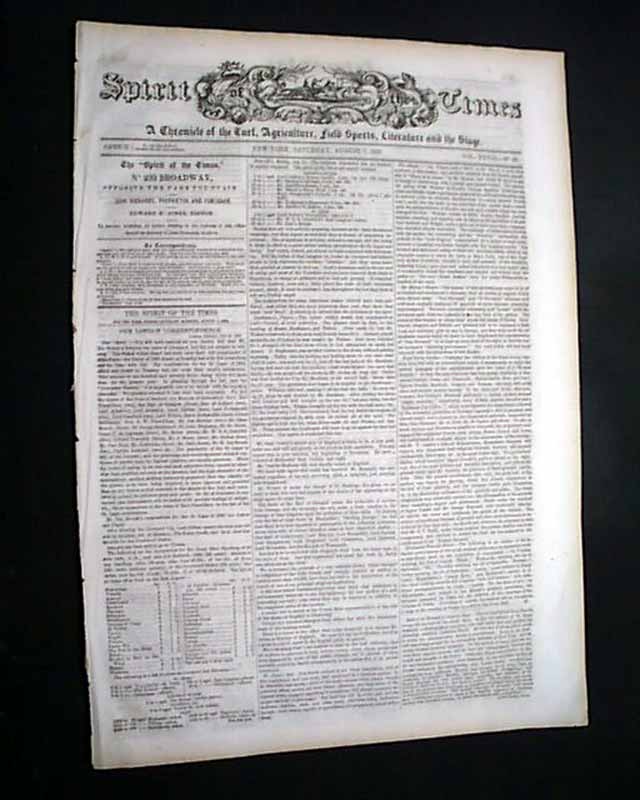
SPIRIT OF THE TIMES, New York, Aug. 7, 1858
* Pre-Civil War Alabama plantations
* Medical care for slaves - slavery
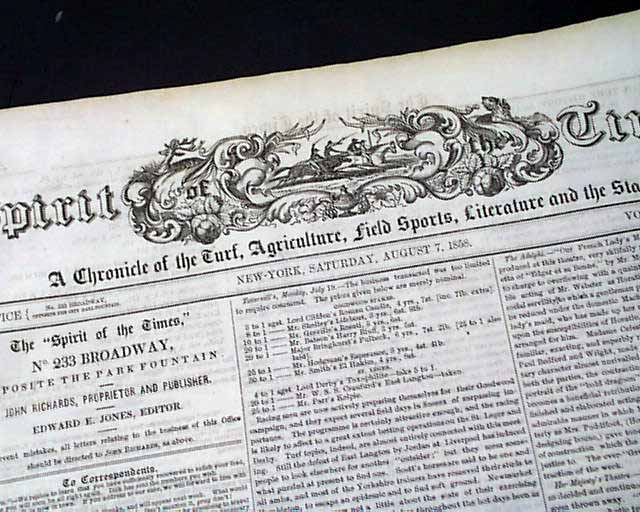
It is subtitled in the masthead: "A Chronicle of the Turf, Agriculture, Field Sports, Literature and the Stage".
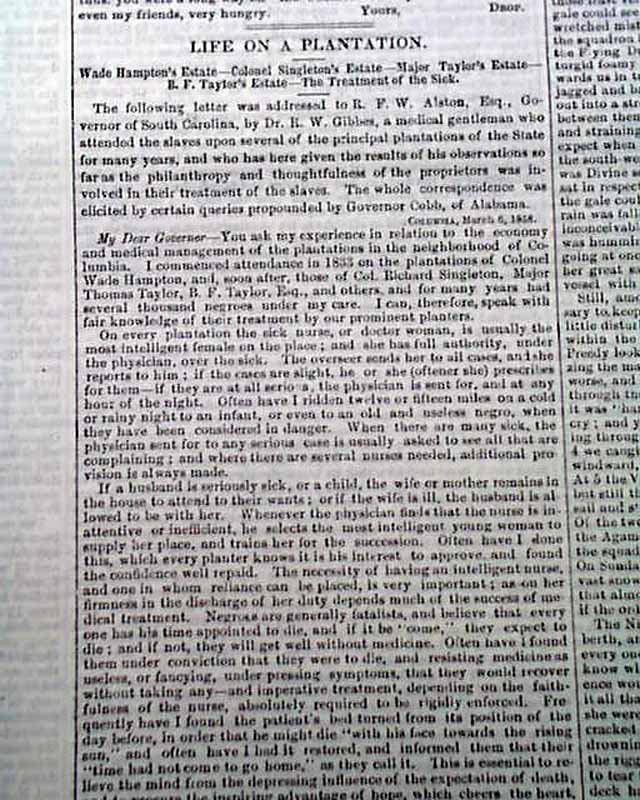
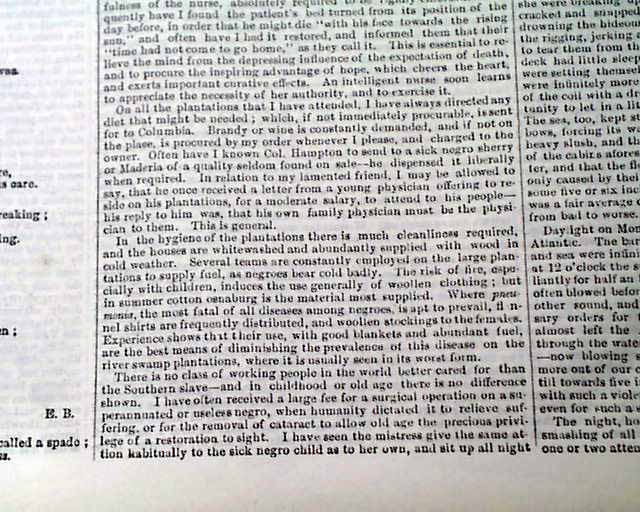
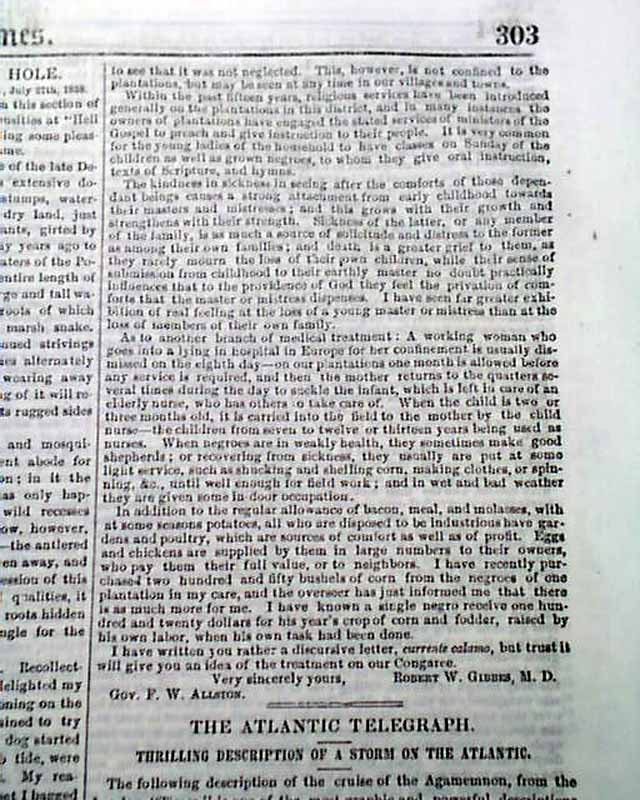
Page 3 has a wonderful article: "Life On A Plantation" being a letter from Dr. Robert Gibbes: "...a medical gentleman who attended the slaves upon several of the principal plantations of the state (Alabama) for many years...involved in their treatment of the slaves...". One of his studies was on: "Wade Hampton's Estate", later to become a famous Confederate General in the Civil War.
The focus is on the medical treatment and care of slaves, with a great analysis of this aspect of plantation life rarely reported.
Twelve pages, 12 1/4 by 17 3/4 inches, a sporting-themed engraving in the masthead, great condition.
Background: The publication of Dr. Robert Wilson Gibbes's medical letter, "Life On A Plantation," detailing his care of enslaved people on Wade Hampton’s massive Alabama estates, holds profound historical significance as a textbook example of how the antebellum South weaponized "plantation medicine" to defend the institution of slavery. By framing the systematic healthcare of enslaved laborers through a lens of professional, scientific management, Gibbes and other Southern intellectuals sought to provide an empirical defense against growing Northern abolitionist critiques, deceptively painting chattel slavery as a benign, paternalistic, and "civilizing" institution rather than a system of violent exploitation. This document gains heightened historical weight due to its focus on the properties of the Hampton dynasty—one of the wealthiest slaveholding families in American history—highlighting how elite planters actively relied on the specialized expertise of high-profile physicians to protect their enormous capital investments and maximize cotton production. Structuring health interventions to combat devastating outbreaks of cholera, malaria, and high infant mortality was not driven by humanitarian benevolence, but by economic necessity, as the 1808 ban on the transatlantic slave trade meant planters were entirely dependent on the physical survival and natural reproduction of their forced labor force. Ultimately, Gibbes's study stands as a chilling artifact of the "scientific racism" that pervaded pre-Civil War academia, laying the exact cultural and intellectual foundations that elite Southern figures like the future Confederate Lieutenant General Wade Hampton III would soon fight a war to preserve.
* Pre-Civil War Alabama plantations
* Medical care for slaves - slavery
It is subtitled in the masthead: "A Chronicle of the Turf, Agriculture, Field Sports, Literature and the Stage".
Page 3 has a wonderful article: "Life On A Plantation" being a letter from Dr. Robert Gibbes: "...a medical gentleman who attended the slaves upon several of the principal plantations of the state (Alabama) for many years...involved in their treatment of the slaves...". One of his studies was on: "Wade Hampton's Estate", later to become a famous Confederate General in the Civil War.
The focus is on the medical treatment and care of slaves, with a great analysis of this aspect of plantation life rarely reported.
Twelve pages, 12 1/4 by 17 3/4 inches, a sporting-themed engraving in the masthead, great condition.
Background: The publication of Dr. Robert Wilson Gibbes's medical letter, "Life On A Plantation," detailing his care of enslaved people on Wade Hampton’s massive Alabama estates, holds profound historical significance as a textbook example of how the antebellum South weaponized "plantation medicine" to defend the institution of slavery. By framing the systematic healthcare of enslaved laborers through a lens of professional, scientific management, Gibbes and other Southern intellectuals sought to provide an empirical defense against growing Northern abolitionist critiques, deceptively painting chattel slavery as a benign, paternalistic, and "civilizing" institution rather than a system of violent exploitation. This document gains heightened historical weight due to its focus on the properties of the Hampton dynasty—one of the wealthiest slaveholding families in American history—highlighting how elite planters actively relied on the specialized expertise of high-profile physicians to protect their enormous capital investments and maximize cotton production. Structuring health interventions to combat devastating outbreaks of cholera, malaria, and high infant mortality was not driven by humanitarian benevolence, but by economic necessity, as the 1808 ban on the transatlantic slave trade meant planters were entirely dependent on the physical survival and natural reproduction of their forced labor force. Ultimately, Gibbes's study stands as a chilling artifact of the "scientific racism" that pervaded pre-Civil War academia, laying the exact cultural and intellectual foundations that elite Southern figures like the future Confederate Lieutenant General Wade Hampton III would soon fight a war to preserve.
Item from last month's catalog - #366 - released for May, 2026
Category: Pre-Civil War
Price
$57
100% Authentic: Original printing, never a reproduction.
Other issues you may like
§ related
Uncommon to find from Savannah, pre-Civil War...
THE DAILY GEORGIAN, Savannah, June 5, 1840
* Very rare publication
* Antebellum periodical
* 21 years prior to Civil War
Rarely do we find...
* Very rare publication
* Antebellum periodical
* 21 years prior to Civil War
Rarely do we find...
Jun 1840
$82
The Southern Negro during post Civil War...
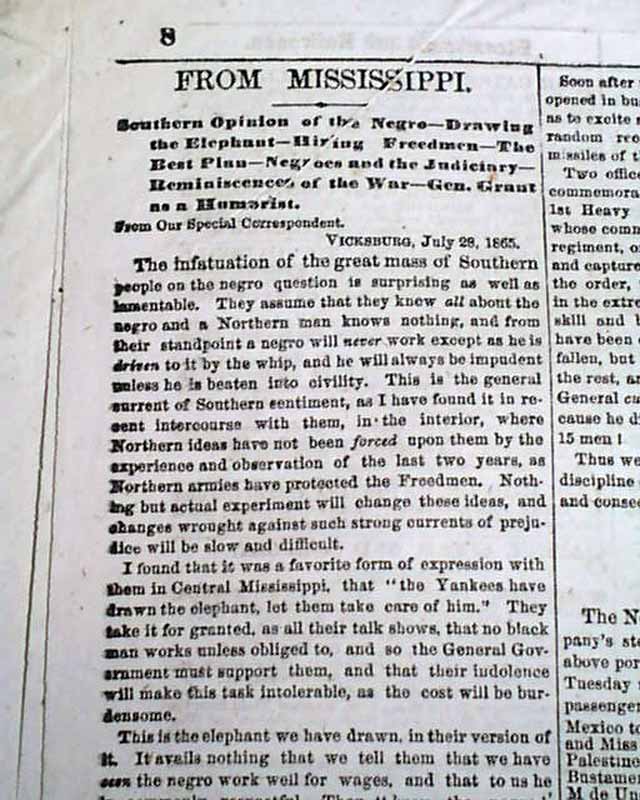
NEW YORK TRIBUNE, Aug. 9, 1865
* Civil War reconstruction era
* Negroes in the Southern States
The top of the back page has a small heading: "From...
* Civil War reconstruction era
* Negroes in the Southern States
The top of the back page has a small heading: "From...
Aug 1865
$33
Uncommon Confederate title from Augusta...
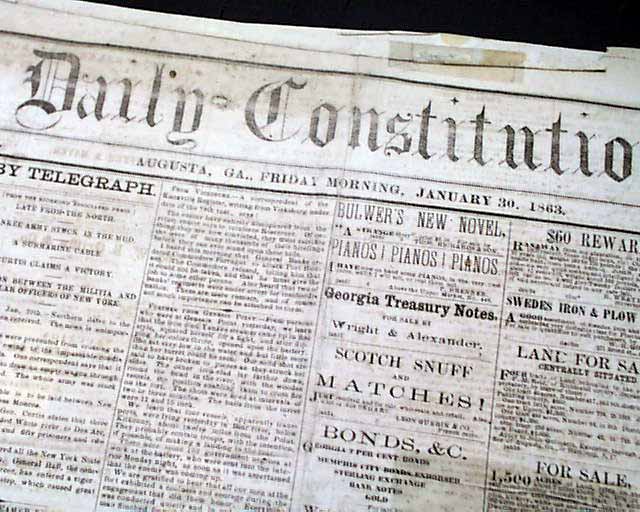
THE DAILY CONSTITUTIONALIST, Augusta, Georgia, Jan. 30, 1863
* Very rare Confederate publication
Among the war reports from this Confederate title: "Yankee...
* Very rare Confederate publication
Among the war reports from this Confederate title: "Yankee...
Jan 1863
$178
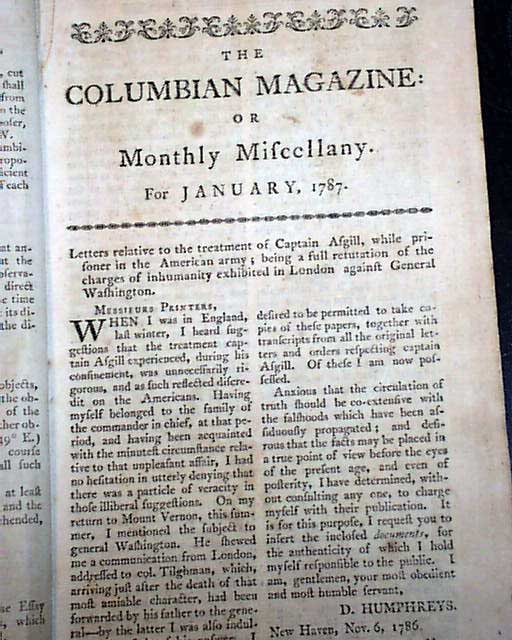
Slavery... The controversial Huddy-Asgill Affair...
THE COLUMBIAN MAGAZINE, Philadelphia, January, 1787 One of the more intriguing articles is: "Letters Relative to the Treatment of Capt. Asgill, while...
$98