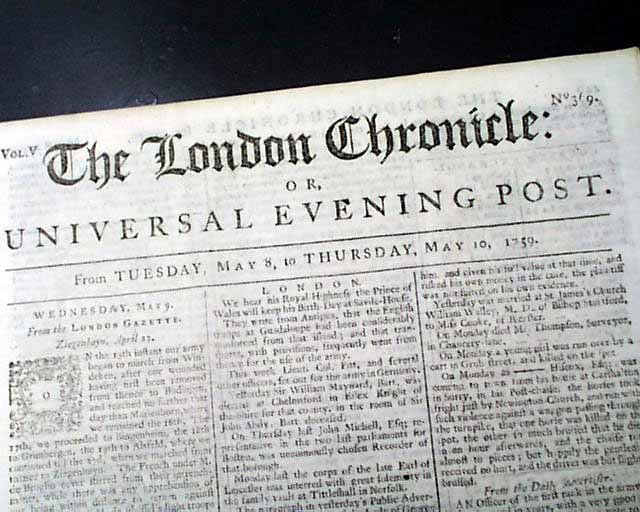
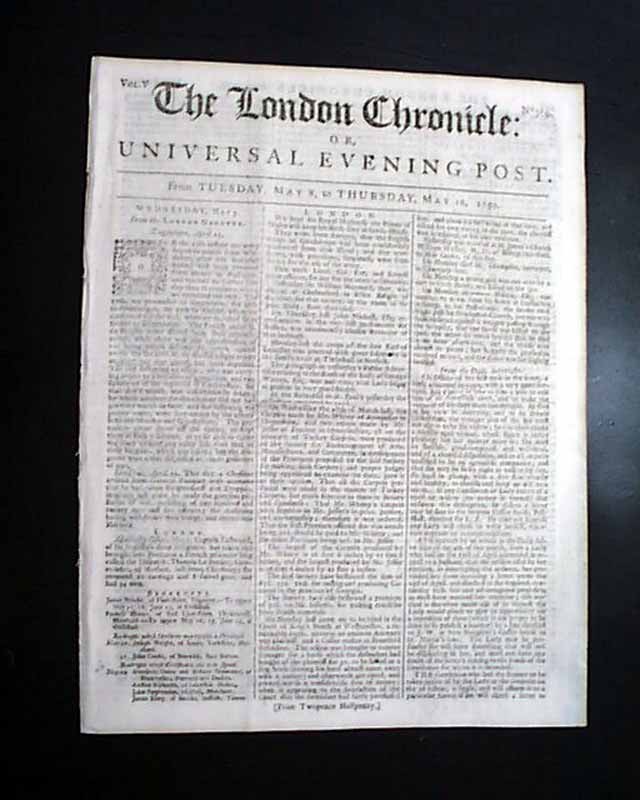
Fine reporting from the French & Indian War...
THE LONDON CHRONICLE, England, May 10, 1759
- French and Indian War
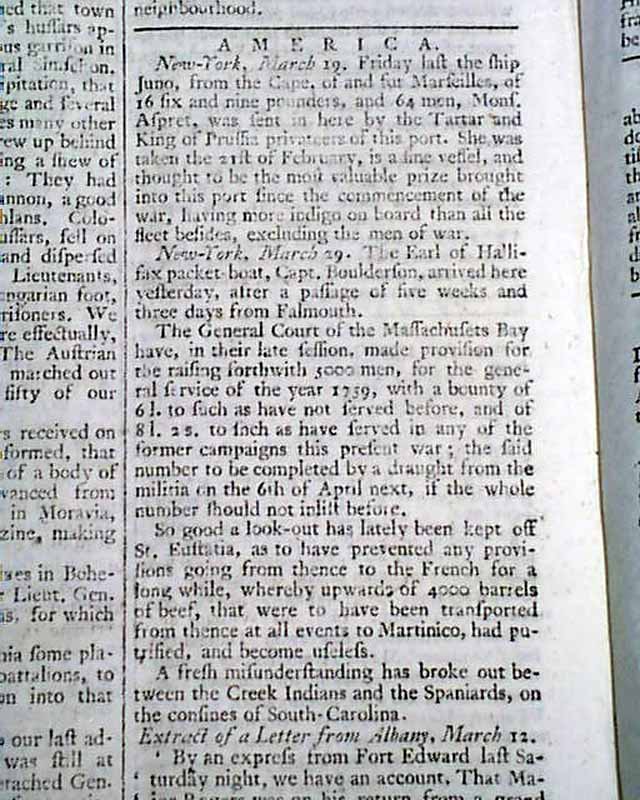
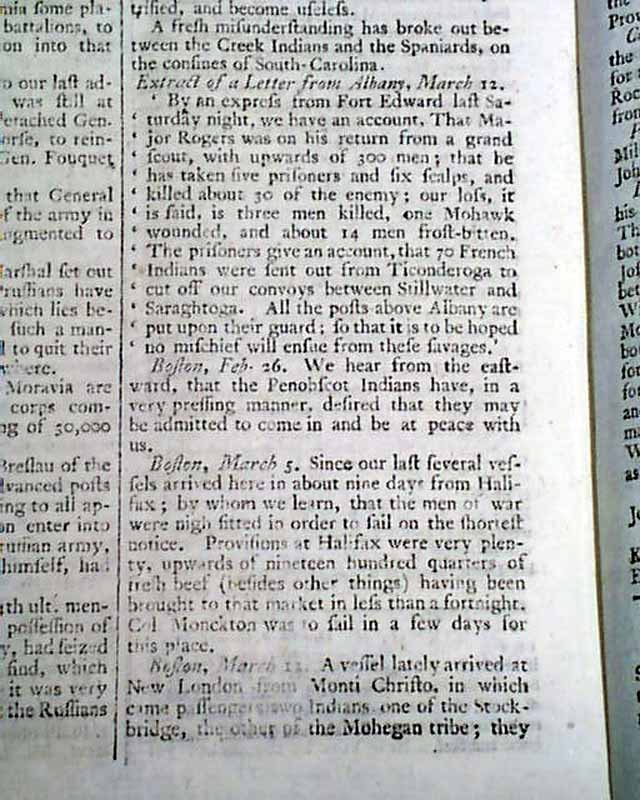
Pages 6 and 7 contain nearly one-third of a page with reports headed: "America" with one report noting in part: "...General Court of the Massachusetts Bay have...made provision for the raising forthwith 5,000 men..." with more on this. Also: "A fresh misunderstanding has broke out between the Creek Indians and the Spaniards on the confines of South Carolina."
There is also a letter from Albany with nice reports on the French & Indian War noting in part: "...from Fort Edward...that Major Rogers was on his return from a grand scout...that he has taken 5 prisoners and six scalps & killed about 30 of the enemy...The prisoners give an account that 70 French Indians were sent out from Ticonderoga to cut off our convoys between Stillwater and Saratoga...".
Also two reports with a Boston dateline.
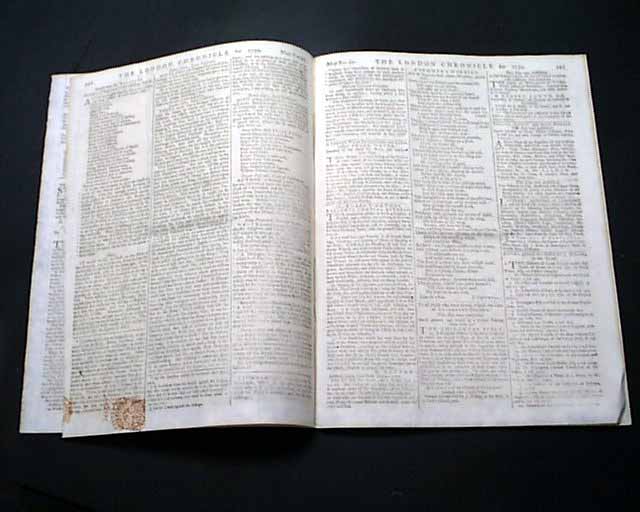
Eight pages, 8 by 10 3/4 inches, very nice condition.
Background: This issue of The London Chronicle from May 10, 1759, captures a pivotal moment during the French and Indian War, detailing Britain's aggressive colonial mobilization and intelligence operations ahead of the decisive 1759 offensive against New France. The report that the General Court of the Massachusetts Bay had made provision for raising 5,000 men underscores the immense military reliance placed on American provincial troops by British commanders like General Jeffrey Amherst to secure manpower for the Lake Champlain campaign. Concurrently, the Albany dispatch detailing Major Rogers—leader of the famed Rogers' Rangers—returning from a "grand scout" out of Fort Edward highlights the vital role of irregular warfare and frontier intelligence gathering, revealing French plans from Ticonderoga to ambush British supply convoys between Stillwater and Saratoga. Meanwhile, reports of a "fresh misunderstanding" between the Creek Indians and the Spaniards near South Carolina emphasize how imperial rivalries extended into the southern borderlands, threatening regional stability. Collectively, these dispatches illustrate the crucial logistical preparations, intelligence networks, and inter-colonial tensions that directly paved the way for the major British victories at Ticonderoga and Quebec later that year.
Other issues you may like
§ related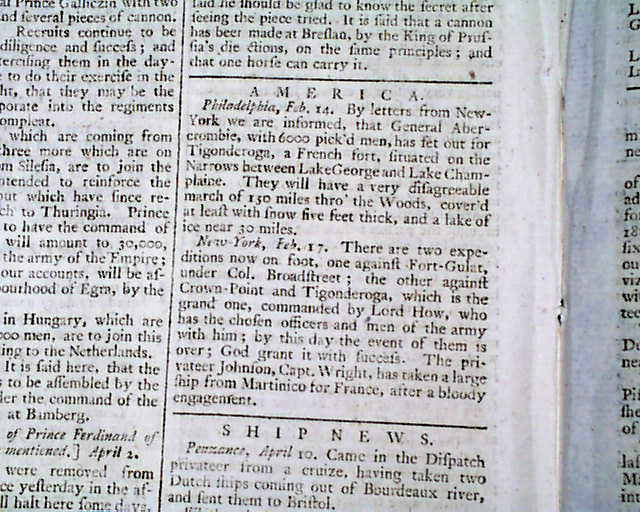
THE LONDON CHRONICLE, England, April 15, 1758
- French and Indian War in North America
- Prelude to Battle of Carillon - Fort Ticonderoga
Page 6 has a report
...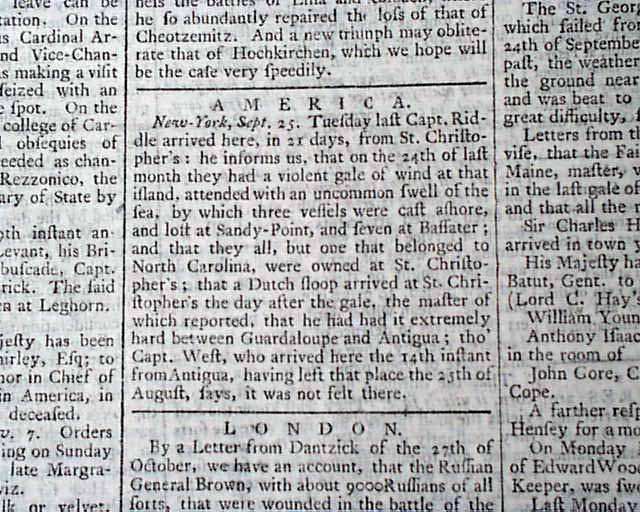
THE LONDON CHRONICLE, England, Nov. 9, 1758 The middle of the front page has a report from New York headed: "America" with naval reports.
Page 6 has
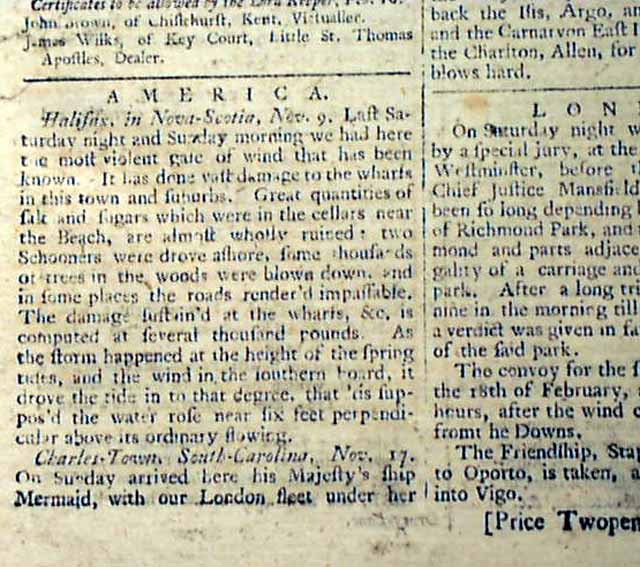
THE LONDON CHRONICLE, England, Jan. 29, 1760 The front page has nearly a full column headed: "America" with datelines from Halifax and Charleston. One
...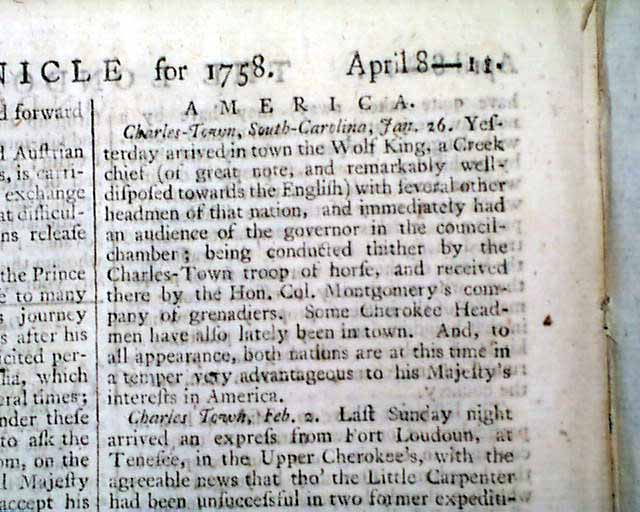
THE LONDON CHRONICLE, England, April 11, 1758 Page 6 has over half a column of reporting headed: "America" with two Charleston datelines, reporting on the
...