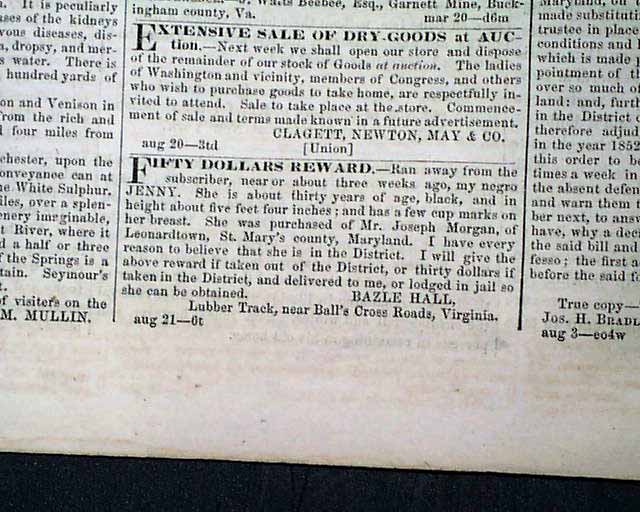
Uncle Tom's Cabin... Runaway reward ads...
Item # 691676
·
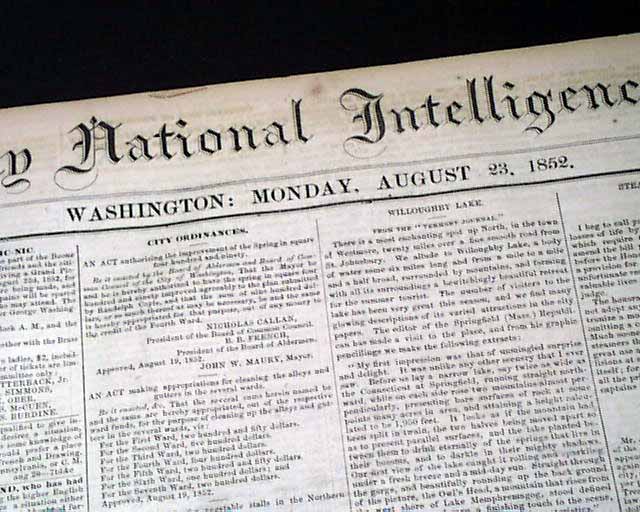
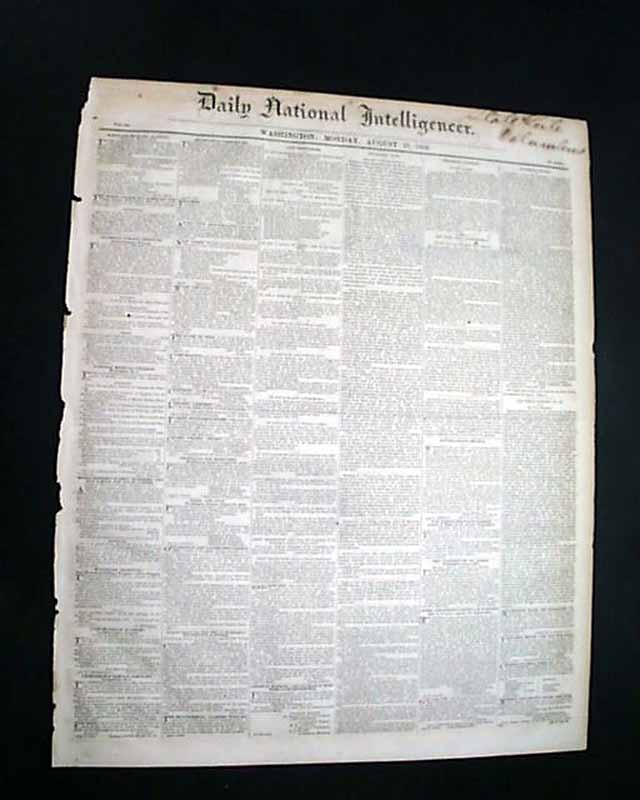
DAILY NATIONAL INTELLIGENCER, Washington, D.C., Aug. 23, 1852
* Uncle Tom's Cabin; or, Life Among the Lowly
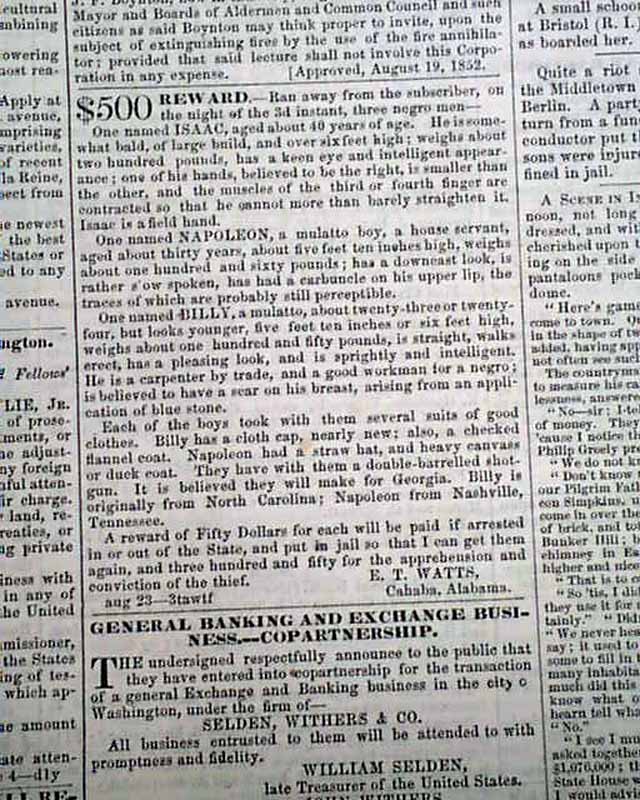
The front page has a very detailed ad: "$500 Reward" for 3 runaways.
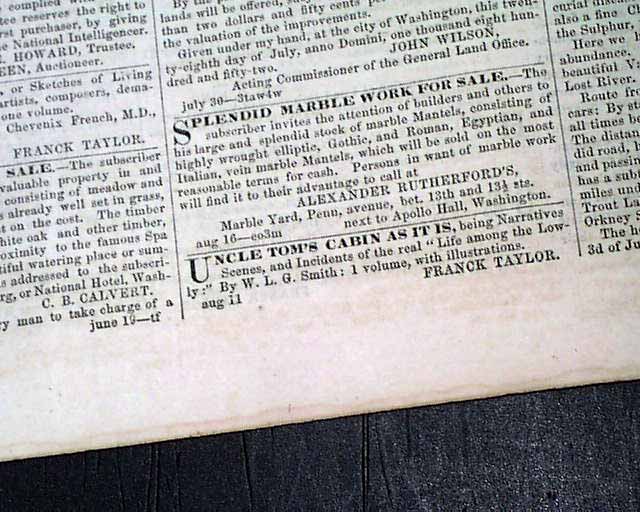
The bottom of the back page has a small notice for: "Uncle Tom's Cabin As It Is, being narratives, scenes, and Incidents of the real 'Life Among the Lowly', by W. L. G. Smith...". Also a: "Fifty Dollars Reward" which begins: "Ran away from the subscriber, near or about three weeks ago my negro Jenny..." with details.
Four pages, binding indents at the blank spine, good condition.
Background: The publisher’s small back-page notice for W. L. G. Smith’s Life at the South; or, "Uncle Tom's Cabin" As It Is highlights a critical turning point in mid-nineteenth-century American political discourse: the immediate, defensive backlash triggered by Harriet Beecher Stowe’s landmark 1852 anti-slavery novel, Uncle Tom's Cabin; or, Life Among the Lowly. By directly co-opting Stowe's subtitle, Smith’s work served as an influential vanguard for the broader "anti-Tom novel" genre, a body of plantation literature authored by Southern defenders and Northern sympathizers aimed at countering Stowe's indictment of human bondage. The historical significance of these published notices lies in how aggressively pro-slavery advocates weaponized print culture during the lead-up to the American Civil War, attempting to reframe chattel slavery as a benign, paternalistic institution while portraying Northern abolitionism and free society as hostile and hypocritical.
* Uncle Tom's Cabin; or, Life Among the Lowly
The front page has a very detailed ad: "$500 Reward" for 3 runaways.
The bottom of the back page has a small notice for: "Uncle Tom's Cabin As It Is, being narratives, scenes, and Incidents of the real 'Life Among the Lowly', by W. L. G. Smith...". Also a: "Fifty Dollars Reward" which begins: "Ran away from the subscriber, near or about three weeks ago my negro Jenny..." with details.
Four pages, binding indents at the blank spine, good condition.
Background: The publisher’s small back-page notice for W. L. G. Smith’s Life at the South; or, "Uncle Tom's Cabin" As It Is highlights a critical turning point in mid-nineteenth-century American political discourse: the immediate, defensive backlash triggered by Harriet Beecher Stowe’s landmark 1852 anti-slavery novel, Uncle Tom's Cabin; or, Life Among the Lowly. By directly co-opting Stowe's subtitle, Smith’s work served as an influential vanguard for the broader "anti-Tom novel" genre, a body of plantation literature authored by Southern defenders and Northern sympathizers aimed at countering Stowe's indictment of human bondage. The historical significance of these published notices lies in how aggressively pro-slavery advocates weaponized print culture during the lead-up to the American Civil War, attempting to reframe chattel slavery as a benign, paternalistic institution while portraying Northern abolitionism and free society as hostile and hypocritical.
Category: Pre-Civil War
Price
$32
100% Authentic: Original printing, never a reproduction.
Other issues you may like
§ related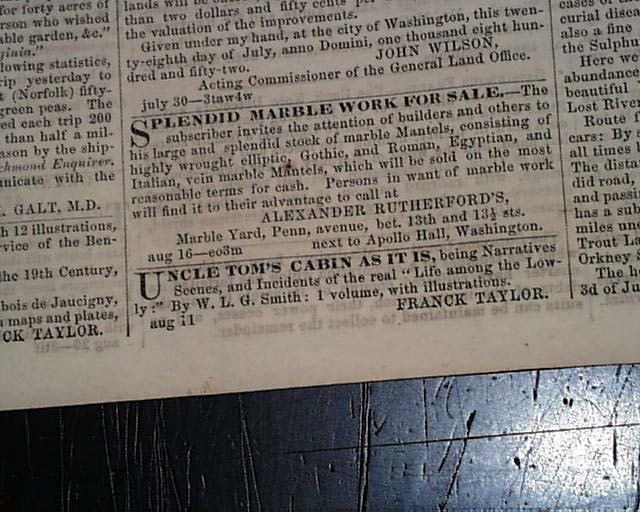
Uncle Tom's Cabin... Slave woman wanted...
DAILY NATIONAL INTELLIGENCER, Washington, D.C., Aug. 24, 1852 The bottom of the back page has a small notice for: "Uncle Tom's Cabin As It Is, being...
Aug 1852
$38
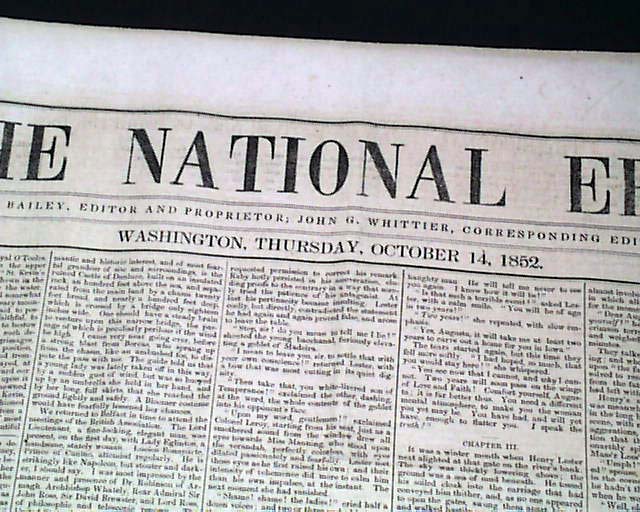
Harriett Beecher Stowe's Uncle Tom's Cabin...
THE NATIONAL ERA, Washington, D.C., Oct. 14, 1852 This newspaper is forever linked to the best-selling novel of the 19th century: "Uncle Tom's Cabin", for...
Oct 1852
$78
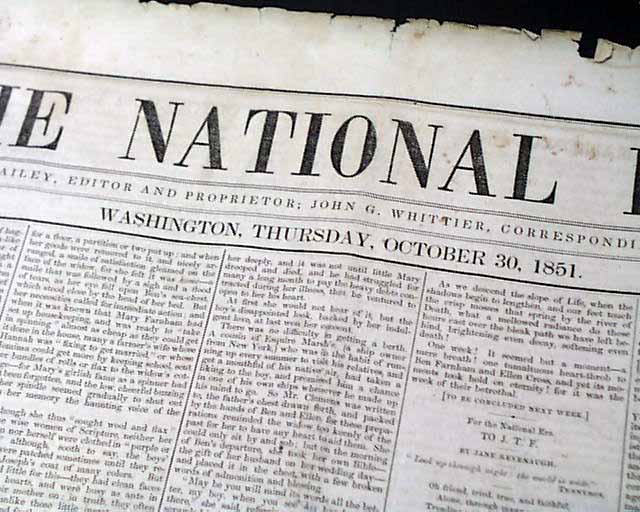
Uncle Tom's Cabin: a letter to the editor... First advertisement for the book 'Uncle Tom's Cabin'...
THE NATIONAL ERA, Washington, D.C., Oct. 30, 1851
* Uncle Tom's Cabin novel in progress
* Harriet Beecher Stowe - pre-book release
* Rare Anti-slavery...
* Uncle Tom's Cabin novel in progress
* Harriet Beecher Stowe - pre-book release
* Rare Anti-slavery...
Oct 1851
$96

Nice issue on Uncle Tom's Cabin...
THE NATIONAL ERA, Washington, D.C., June 3, 1852
* Uncle Tom's Cabin
* Harriet Beecher Stowe
* Book becomes mainstream
* Anti-slavery publication
...
* Uncle Tom's Cabin
* Harriet Beecher Stowe
* Book becomes mainstream
* Anti-slavery publication
...
Jun 1852
$98