


Washington at Morristown... Action in the South...
GENTLEMAN'S MAGAZINE, London, May, 1780
- American Revolutionary War
- General George Washington's army
- At Morristown, New Jersey
- South Carolina events
The first article has: "Summary of Proceedings in the Present Parliament" which includes discussion of the situation in America.
Near the back the "Historical Chronicle" has several items from America concerning the Revolutionary War, including a letter from New York which has: "...since Gen. Clinton's departure from hence...the longest & most severe winter that was ever remembered...horses with heavy carriages could go over the ice into the Jerseys...The rebels though to avail themselves of this easy communication & threaten an attack upon Staten Island...For this purpose Gen. Washington, whose army was hutted at Morris Town, sent a detachment of 2700 men with six pieces of cannon...They formed the line...withdrew in the night after having burnt one house, pillaged some others..." with more on this military encounter.
Another letter from Sir Henry Clinton at James's Island, South Carolina tells of military events there including: "...that their long voyage & unavoidable delays since had given the rebels time to fortify Charles Town...he still entertained great hopes of success...rebels have made the defence of Charles Town their principal object." Plus there is another letter from Major General Pattison to Lord George Germaine from New York which includes talk of the terrible winter: "...detachments of cavalry marched from New York to Staten (11 miles) upon the ice. The East River to Brooklyn on Long Island was also, for many days, blocked up. Thus circumstanced, the city was laid open on many sides to an attack from an enterprising enemy...it was nevertheless strongly reported that Gen. Washington was meditating a great stroke upon New York with his whole force by different attacks..." and much more.
Included also is an act from Congress concerning New Yorkers who have given assistance to the British: "...said persons being enemies of these States, they are hereby outlawed for ever from this Continent & that their property real & personal be seized & confiscated for the use of these States...".
Included is the full page plate called for of "Joseph Highmore, Esqr."
Complete in 48 pages with full title/contents page featuring an engraving of St. John's Gate, 5 1/4 by 8 1/4 inches, very nice condition.
Background: This May 1780 issue of The Gentleman’s Magazine (London) is a historically rich primary source that captures critical military maneuvers and extreme environmental conditions during the American Revolutionary War. Most notably, it features firsthand British military dispatches detailing the infamous "Hard Winter" of 1779–1780—the most severe on record in North America—reporting that ice froze solid enough for heavy carriages and cavalry detachments to cross New York Harbor directly from Manhattan to Staten Island and Brooklyn. This environmental anomaly exposed British-held New York, prompting General Washington’s army at Morristown to launch Lord Stirling's 2,700-man raid on Staten Island in January 1780, as recorded in Major General James Pattison's letter to Lord George Germain. Concurrently, the issue delivers crucial dispatches from General Sir Henry Clinton at James Island outlining the opening moves of the Siege of Charleston, South Carolina, alongside Congressional acts targeting American Loyalists through permanent outlawry and land confiscation. Enhanced by the full-page engraved portrait plate of English painter Joseph Highmore (who died in March 1780) and complete in its original 48-page format, this issue stands out as a highly desirable acquisition for Revolutionary War collectors, offering an immediate, unedited window into contemporary British perspectives during a turning point of the conflict.
A nice Revolutionary War era magazine from the "mother country" with a wide range of varied content beyond the war reports noted. This was the very first periodical to use the word "magazine" in its title, having begun in 1731.
Other issues you may like
§ related
GENTLEMAN'S MAGAZINE, London, May, 1780 The first article has "Summary of Proceedings in the Present Parliament" which includes discussion of the situation
...
GENTLEMAN'S MAGAZINE London, July, 1781 The "Historical Chronicle" begins with: "Plan for Putting an End to the American War & for Laying the Foundation of
...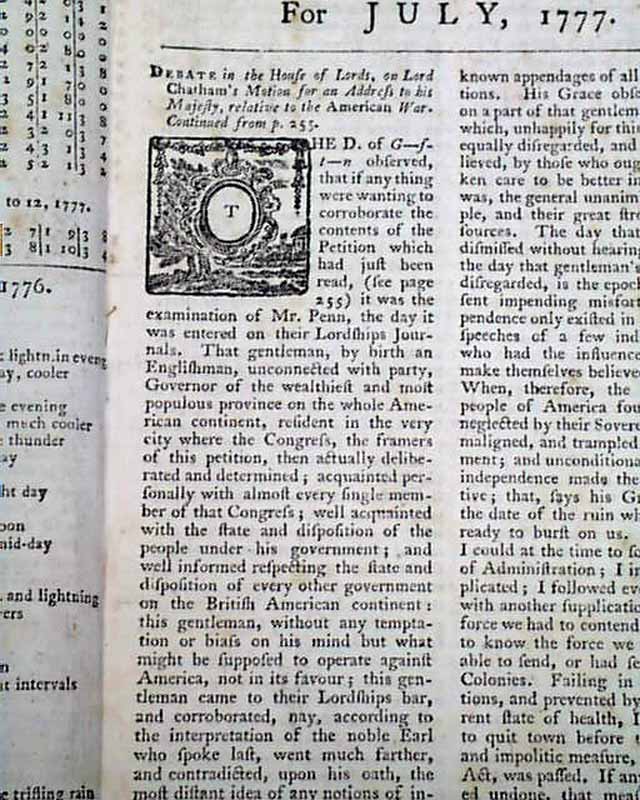
THE GENTLEMAN'S MAGAZINE, London, July, 1777
- General William Howe
- Charles Cornwallis
- American Independence ?
The issue begins with a continuation of the:
...
GENTLEMAN'S MAGAZINE, London, January, 1781
- Revolutionary War events for 1780
- Ethan Allen
Under "Diary of Memorable Occurrences in the year 1780..." is a
...