News of the day from 1734...
Item # 685377
·
Sorry, but this item is no longer available. Please be in touch at info@rarenewspapers.com if you would like to be placed on a want list or are interested in a potential alternate issue.
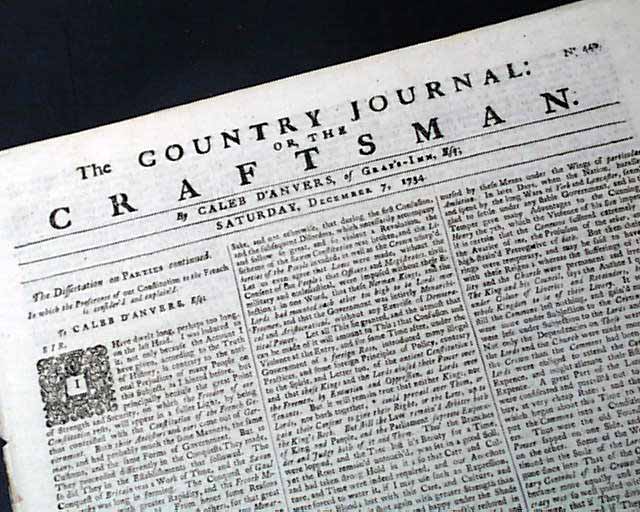
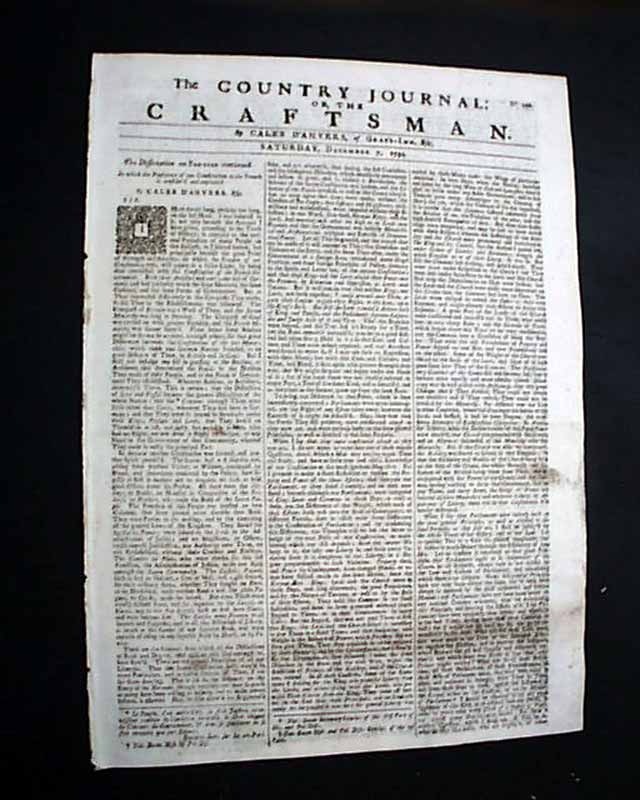
THE COUNTRY JOURNAL: OR THE CRAFTSMAN, London, Dec. 7, 1734
* Rare 18th century publication
This was the leading anti-Walpole political journal of its time: Thomas Lockwood describes it as "the most successful political journal of the first half of the eighteenth century...".
The stated purpose of the newspaper was to expose political craft--hence the title--but the overriding purpose was to unseat Robert Walpole as Chancellor, or as the new term of abuse called him, "Prime Minister".
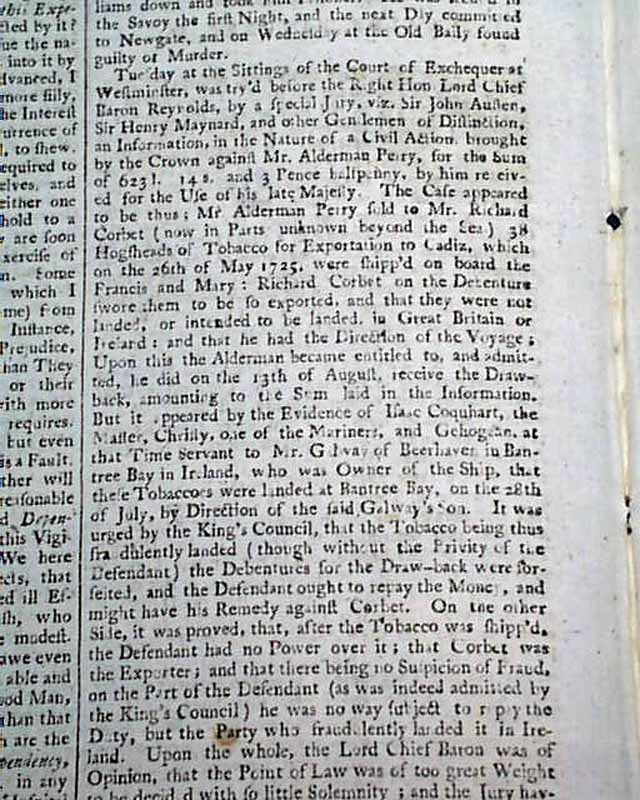
Various news reports of the day with one item noting the shipping of tobacco.
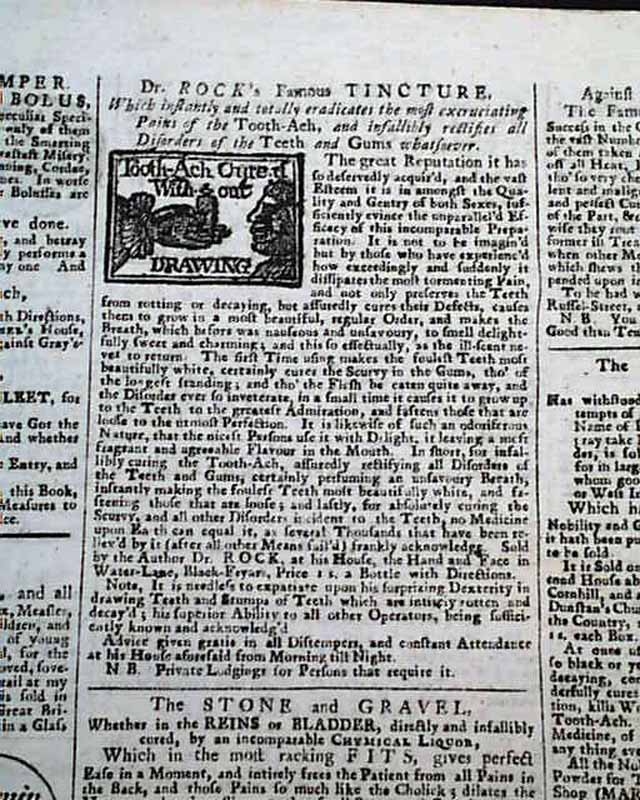
The back page has an illustrated advertisement for "Dr. Richard Rock's Tincture Which Instantly & totally Eradicates the most excruciating Pains of the Tooth--Ach & Infallibly Rectifies all Disorders of the Teeth...".
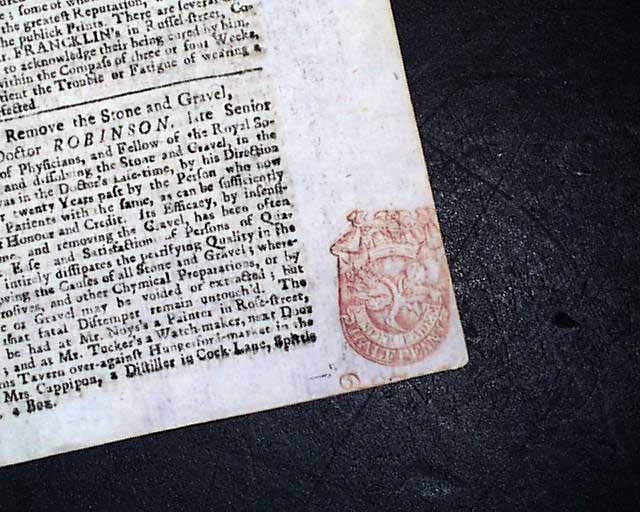
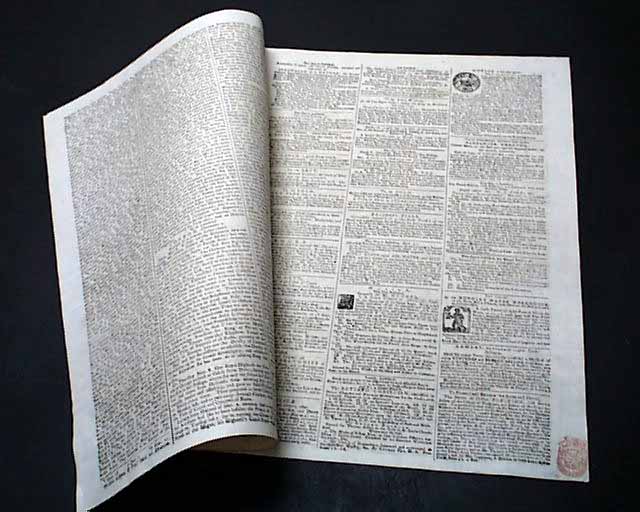
Four pages, 10 1/4 by 14 1/2 inches, red tax stamp on the page 3, bit of foxing on the front page, good condition.
Background: The Country Journal: or, The Craftsman, particularly in issues like that of December 7, 1734, distinguished itself as the premier organ of anti-administration rhetoric in 18th-century Great Britain by blending high-minded constitutional critique, sharp satire, and everyday Georgian commerce. Spearheaded by Henry St. John, Viscount Bolingbroke, and William Pulteney under the collective pseudonym "Caleb D'Anvers," the journal's leading content centered on unmasking "state-craft"—a term it used to frame Sir Robert Walpole’s governance, patronage, and financial influence as systemic bribery and corruption—while actively popularizing the derogatory epithet "Prime Minister" to decry his monopolization of executive power. Beyond its core political essays, ideological volleys, and allegorical attacks on the ministry, individual issues offered a vivid cross-section of London life, featuring shipping and commodity intelligence like tobacco transport alongside colorful period advertisements, such as Dr. Richard Rock’s famous patented toothache tinctures. By combining sophisticated opposition philosophy with accessible cultural satire and daily news items, The Craftsman commanded an unprecedented readership, forever shaping the trajectory of British partisan press and investigative journalism.
* Rare 18th century publication
This was the leading anti-Walpole political journal of its time: Thomas Lockwood describes it as "the most successful political journal of the first half of the eighteenth century...".
The stated purpose of the newspaper was to expose political craft--hence the title--but the overriding purpose was to unseat Robert Walpole as Chancellor, or as the new term of abuse called him, "Prime Minister".
Various news reports of the day with one item noting the shipping of tobacco.
The back page has an illustrated advertisement for "Dr. Richard Rock's Tincture Which Instantly & totally Eradicates the most excruciating Pains of the Tooth--Ach & Infallibly Rectifies all Disorders of the Teeth...".
Four pages, 10 1/4 by 14 1/2 inches, red tax stamp on the page 3, bit of foxing on the front page, good condition.
Background: The Country Journal: or, The Craftsman, particularly in issues like that of December 7, 1734, distinguished itself as the premier organ of anti-administration rhetoric in 18th-century Great Britain by blending high-minded constitutional critique, sharp satire, and everyday Georgian commerce. Spearheaded by Henry St. John, Viscount Bolingbroke, and William Pulteney under the collective pseudonym "Caleb D'Anvers," the journal's leading content centered on unmasking "state-craft"—a term it used to frame Sir Robert Walpole’s governance, patronage, and financial influence as systemic bribery and corruption—while actively popularizing the derogatory epithet "Prime Minister" to decry his monopolization of executive power. Beyond its core political essays, ideological volleys, and allegorical attacks on the ministry, individual issues offered a vivid cross-section of London life, featuring shipping and commodity intelligence like tobacco transport alongside colorful period advertisements, such as Dr. Richard Rock’s famous patented toothache tinctures. By combining sophisticated opposition philosophy with accessible cultural satire and daily news items, The Craftsman commanded an unprecedented readership, forever shaping the trajectory of British partisan press and investigative journalism.
Item from last month's catalog - #368 - released for July, 2026
Categories: The 1600's and 1700's, British
No Longer Available
100% Authentic: Original printing, never a reproduction.
Other issues you may like
§ related
A rare title which rarely comes into hands of collectors...
THE HYP-DOCTOR, London, Oct. 9, 1733
* Very rare 18th century publication
The title is an archaic phrase for a "hodgepodge of nonsense". This curious...
* Very rare 18th century publication
The title is an archaic phrase for a "hodgepodge of nonsense". This curious...
May 1733
$78
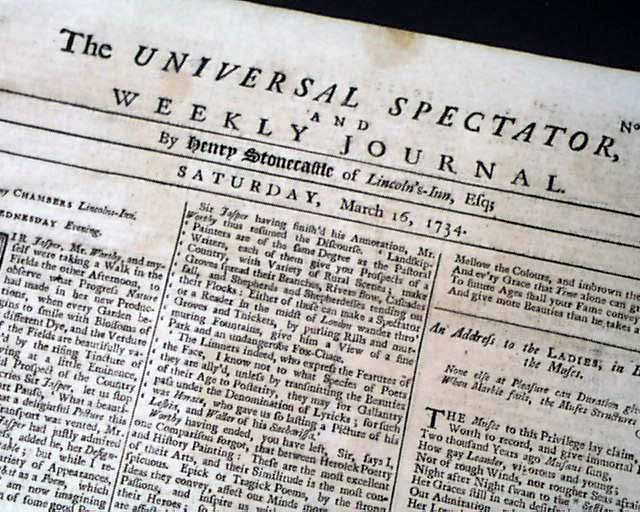
One of the less common titles of the early 18th century...
THE UNIVERSAL SPECTATOR & WEEKLY JOURNAL, London, March 16, 1734
* Rare 18th century publication
An uncommon title that existed from 1728 thru 1746. This is...
* Rare 18th century publication
An uncommon title that existed from 1728 thru 1746. This is...
$68
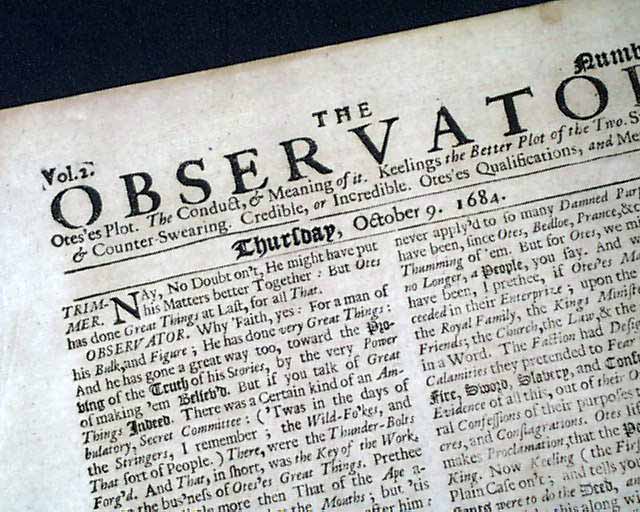
Handsome, 340 year old newspaper... published by Charles Brome...
THE OBSERVATOR, London, England, Oct. 9, 1684
* Architect of the Partisan Press
* A Watershed for Women in Journalism
* During the reign of King Charles II
A...
* Architect of the Partisan Press
* A Watershed for Women in Journalism
* During the reign of King Charles II
A...
$48
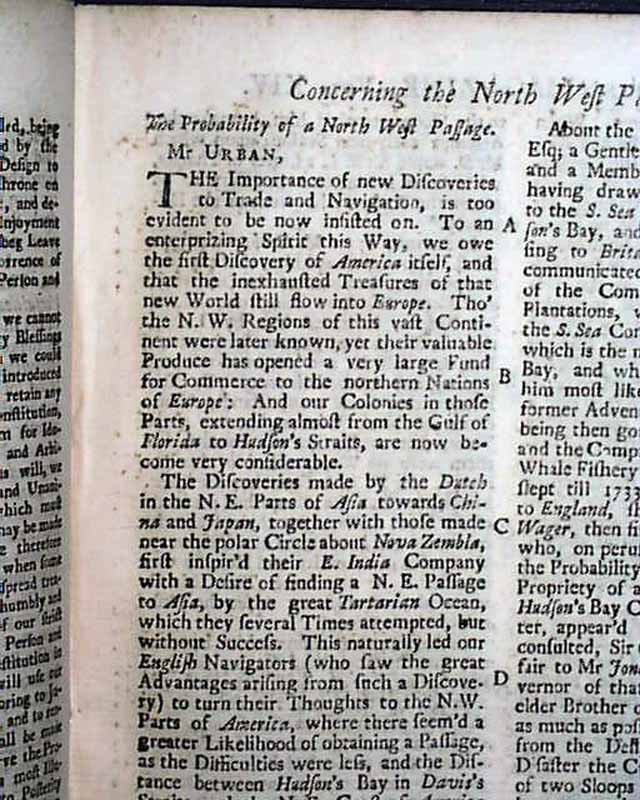
Tobacco... Judaica...
THE GENTLEMAN'S MAGAZINE, London, England, February, 1744
* Judaica mention
* Tobacco is not a poison
* Exploring a northwest passage through
...* Judaica mention
* Tobacco is not a poison
* Exploring a northwest passage through
$40