

Colonies join in to support their rights in the struggle for liberty...
Item # 592319Sorry, but this item is no longer available. Please be in touch at info@rarenewspapers.com if you would like to be placed on a want list or are interested in a potential alternate issue.
August 15, 1768
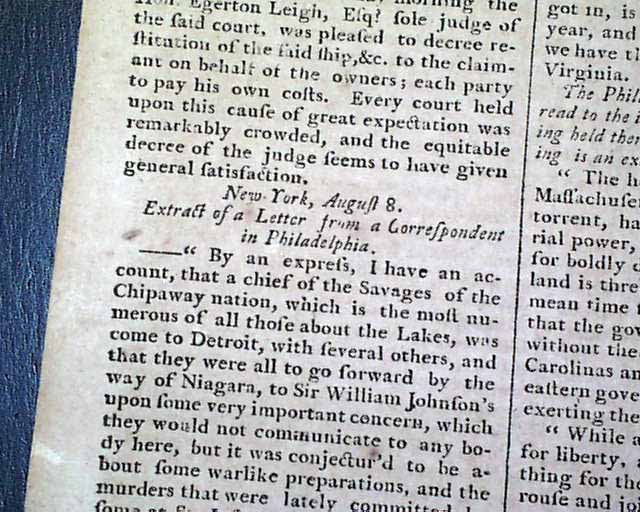
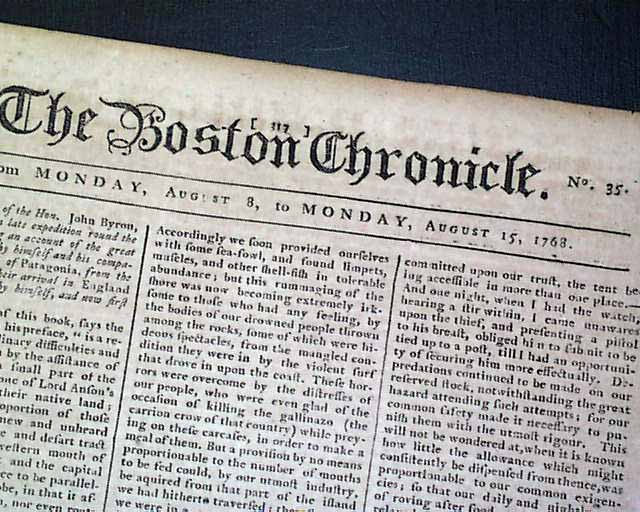
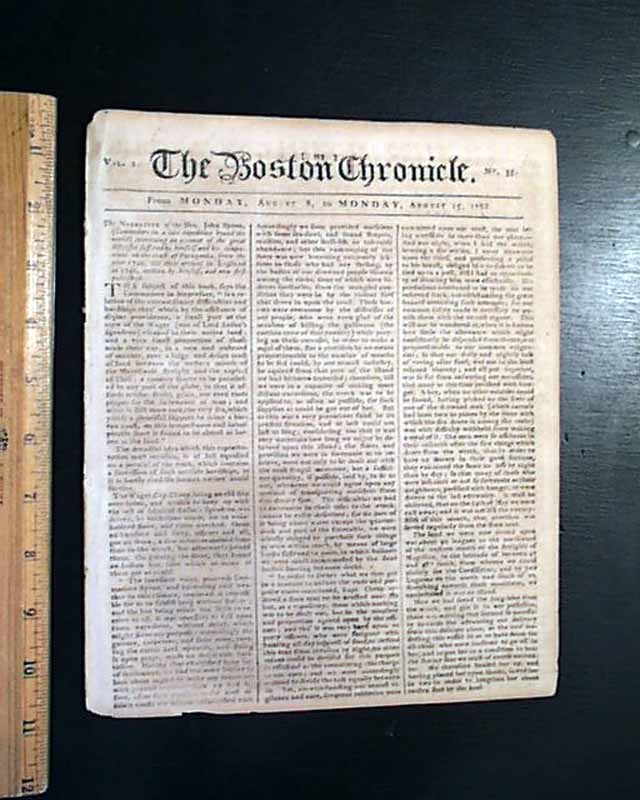
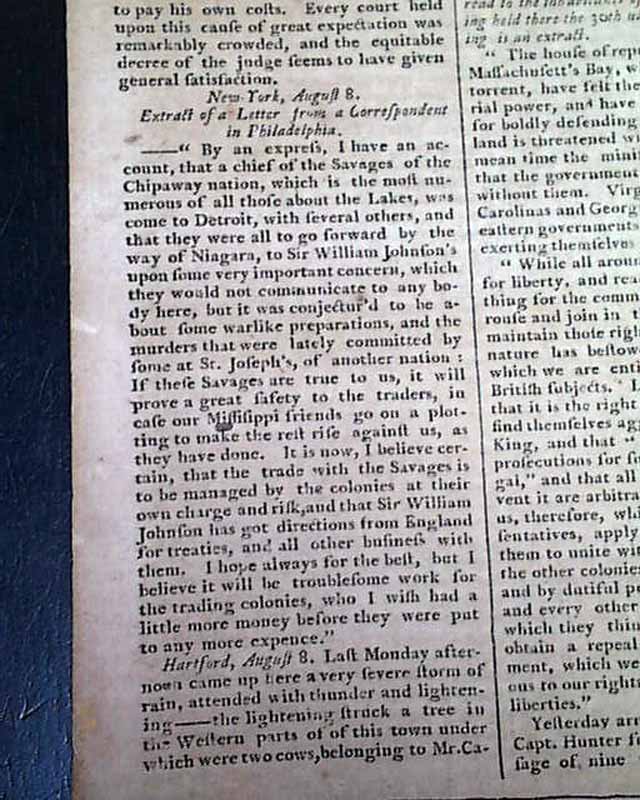
THE BOSTON CHRONICLE, Massachusetts, Aug. 15, 1768 Inside has an interesting article on mineral water as a curative. The back page has a report concerning trouble with the Indians noting: "...that a chief of the savages of the Chipaway nation...was come to Detroit with several others, & that they were all to go forward by the way of Niagara to Sir William Johnson's...conjectur'd to be about some warlike preparations & the murders that were lately committed by some at St. Joseph's of another nation..." with more (see).
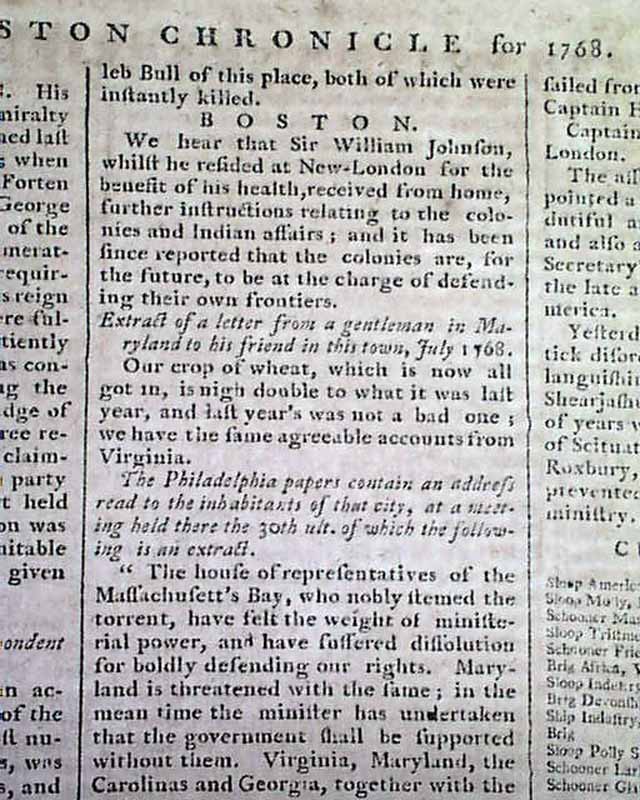
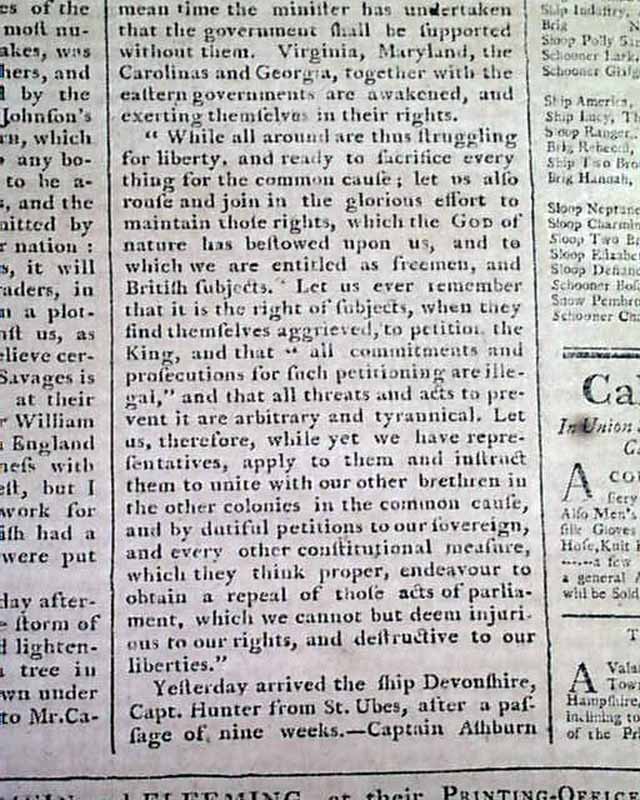
The best content is on the back page as well, with a report noting in part: "The house of representatives of the Massachusett's Bay...have felt the weight of ministerial power & have suffered dissolution for boldly defending our rights. Maryland is threatened with the same...Virginia, Maryland, the Carolinas and Georgia, together with the eastern governments are awakened & exerting themselves in their rights. While all around are thus struggling for liberty, & ready to sacrifice every thing for the common cause, let us also rouse & join in the glorious effort to maintain those rights which the God of nature has bestowed upon us & to which we are entitled as freemen & British subjects..." with more (see).
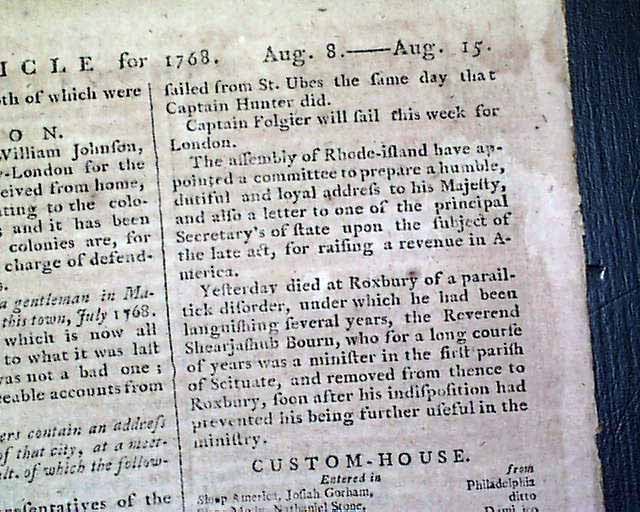
Also on the bkpg. is a report that: "The assembly of Rhode Island have appointed a committee to prepare a humble, dutiful & loyal address to his Majesty & also a letter to one of the principal Secretary's of state upon the subject of the late act for raising a revenue in America." (see).
Eight pages, 8 1/2 by 10 1/2 inches, light, even toning, very nice condition.
This newspaper published only briefly from December 21, 1767 until 1770. The publishers, John Mein and John Fleeming, were both from Scotland. The Chronicle was a Loyalist paper in the time before the American Revolution. In its second year, Mein printed names in the paper that accused some colonial merchants of breaking a British non-importation agreement. In response, Mein's name appeared on a list of merchants who violated the trade agreement. Mein retaliated by accusing the Merchants' Committee of using the non-importation agreement for illegal profiteering. The irritated readership ransacked the offices of the Chronicle, and ultimately, it ceased operations in 1770. (credit Wikipedia)
The best content is on the back page as well, with a report noting in part: "The house of representatives of the Massachusett's Bay...have felt the weight of ministerial power & have suffered dissolution for boldly defending our rights. Maryland is threatened with the same...Virginia, Maryland, the Carolinas and Georgia, together with the eastern governments are awakened & exerting themselves in their rights. While all around are thus struggling for liberty, & ready to sacrifice every thing for the common cause, let us also rouse & join in the glorious effort to maintain those rights which the God of nature has bestowed upon us & to which we are entitled as freemen & British subjects..." with more (see).
Also on the bkpg. is a report that: "The assembly of Rhode Island have appointed a committee to prepare a humble, dutiful & loyal address to his Majesty & also a letter to one of the principal Secretary's of state upon the subject of the late act for raising a revenue in America." (see).
Eight pages, 8 1/2 by 10 1/2 inches, light, even toning, very nice condition.
This newspaper published only briefly from December 21, 1767 until 1770. The publishers, John Mein and John Fleeming, were both from Scotland. The Chronicle was a Loyalist paper in the time before the American Revolution. In its second year, Mein printed names in the paper that accused some colonial merchants of breaking a British non-importation agreement. In response, Mein's name appeared on a list of merchants who violated the trade agreement. Mein retaliated by accusing the Merchants' Committee of using the non-importation agreement for illegal profiteering. The irritated readership ransacked the offices of the Chronicle, and ultimately, it ceased operations in 1770. (credit Wikipedia)
Category: The 1600's and 1700's


