



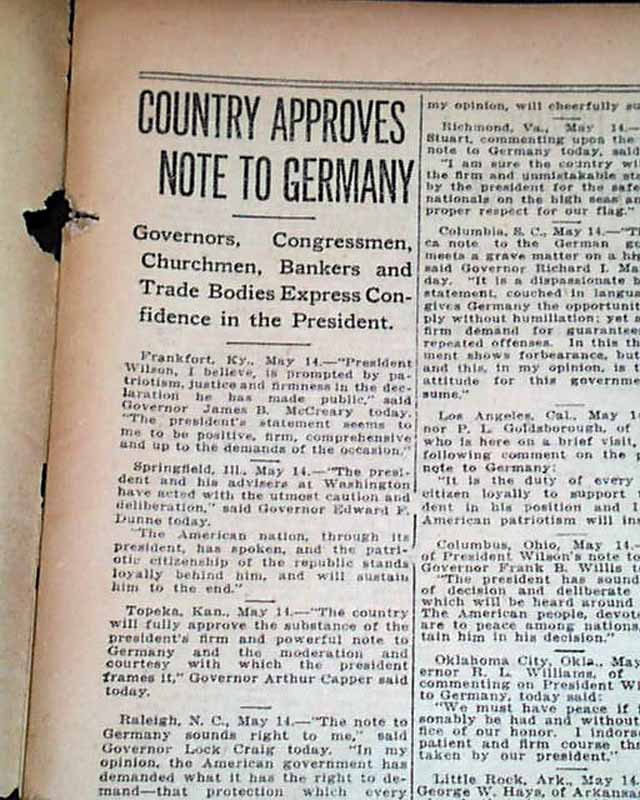
World War I tensions building on the United States... Post RMS Lusitania sinking...
Item # 556795Sorry, but this item is no longer available. Please be in touch at info@rarenewspapers.com if you would like to be placed on a want list or are interested in a potential alternate issue.
May 15, 1915
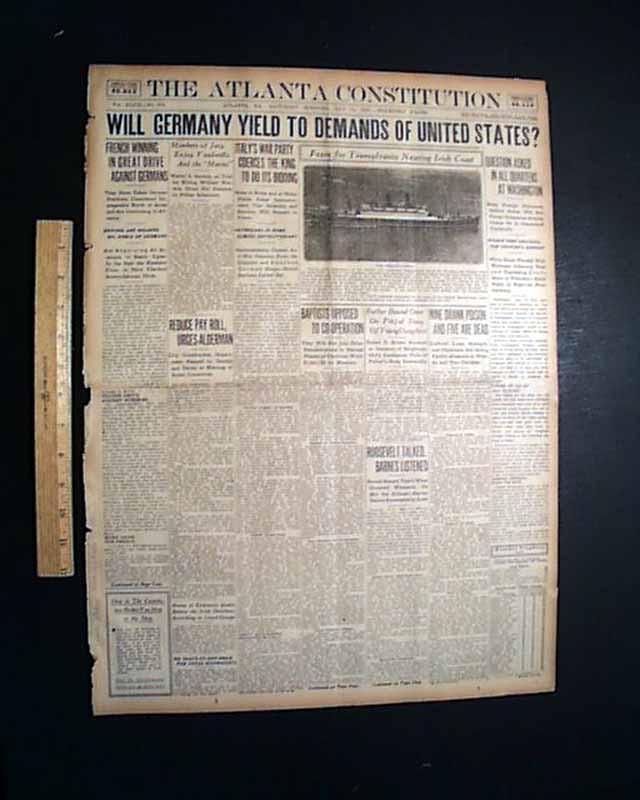
THE ATLANTA CONSTITUTION, Georgia, May 15, 1915
* World War I tensions building on the United States
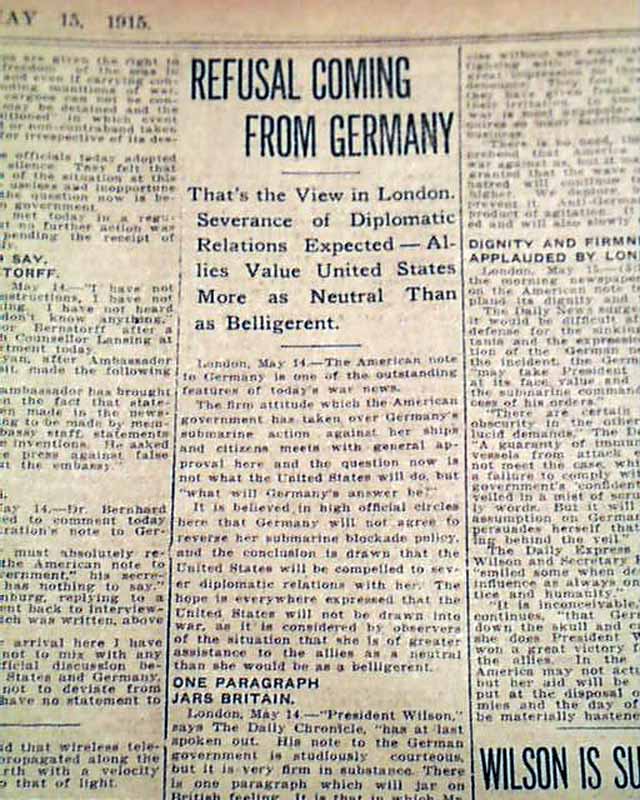
* Germany defying the World with submarine warfare
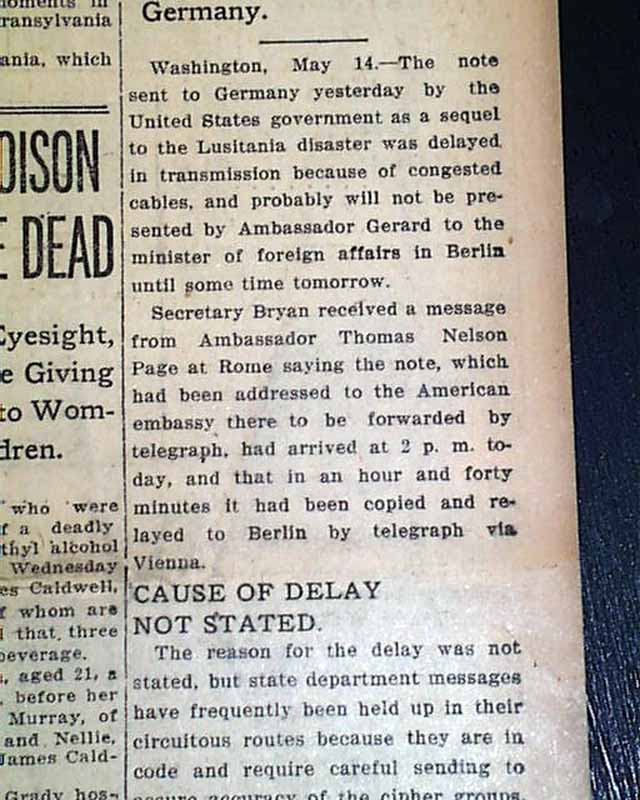
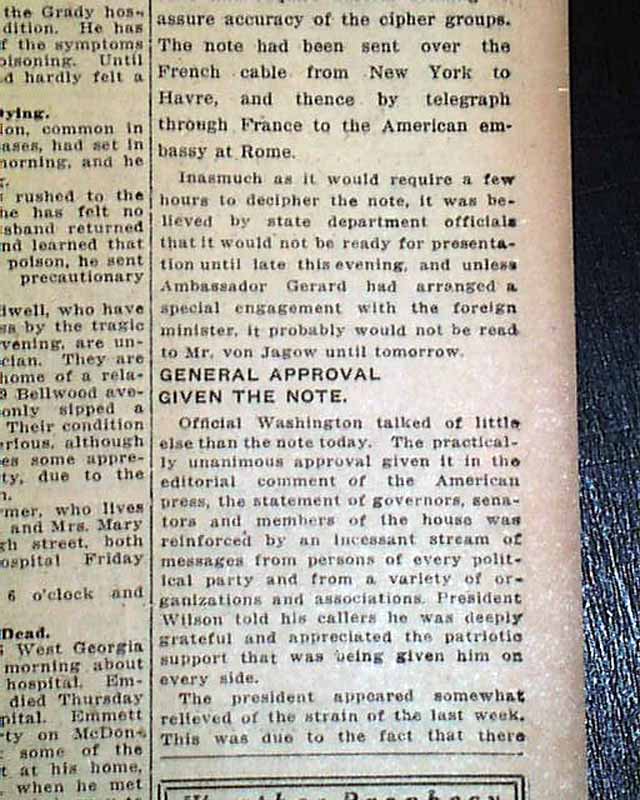
* Post RMS Lusitania sinking
This 14 page newspaper has a nice banner headline on the front page: "WILL GERMANY YIELD TO DEMANDS OF UNITED STATES?" with subheads. (see)
Other news. usual browning with some margin wear, otherwise good.
wikipedia notes: RMS Lusitania was a Lusitania-Class British luxury ocean liner owned by the Cunard Line and built by John Brown and Company of Clydebank, Scotland, torpedoed by a German U-boat on May 7, 1915. The great ship sank in just 18 minutes, eight miles (15 km) off the Old Head of Kinsale, Ireland, killing 1,198 of the 1,959 people aboard. The sinking turned public opinion in many countries against Germany, and was probably a major factor in the eventual decision of the United States to join the war in 1917. It is often considered by historians to be the second most famous civilian passenger liner disaster after the sinking of Titanic.
* World War I tensions building on the United States
* Germany defying the World with submarine warfare
* Post RMS Lusitania sinking
This 14 page newspaper has a nice banner headline on the front page: "WILL GERMANY YIELD TO DEMANDS OF UNITED STATES?" with subheads. (see)
Other news. usual browning with some margin wear, otherwise good.
wikipedia notes: RMS Lusitania was a Lusitania-Class British luxury ocean liner owned by the Cunard Line and built by John Brown and Company of Clydebank, Scotland, torpedoed by a German U-boat on May 7, 1915. The great ship sank in just 18 minutes, eight miles (15 km) off the Old Head of Kinsale, Ireland, killing 1,198 of the 1,959 people aboard. The sinking turned public opinion in many countries against Germany, and was probably a major factor in the eventual decision of the United States to join the war in 1917. It is often considered by historians to be the second most famous civilian passenger liner disaster after the sinking of Titanic.
Category: The 20th Century


