

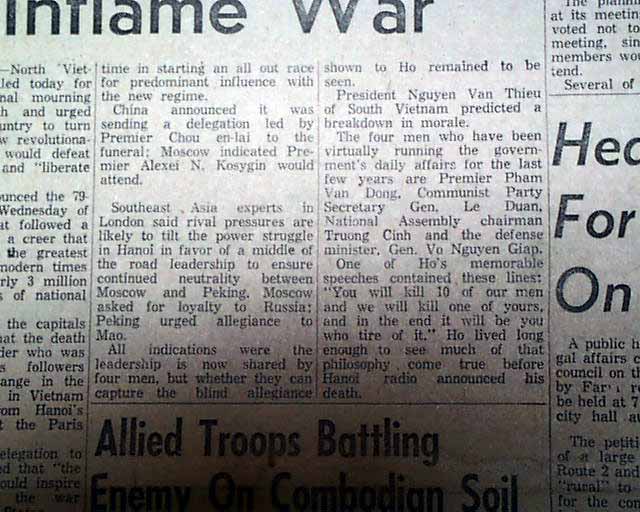
Ho Chi Minh death in 1969....
Item # 537754Sorry, but this item is no longer available. Please be in touch at info@rarenewspapers.com if you would like to be placed on a want list or are interested in a potential alternate issue.
LEOMINSTER ENTERPRISE, Massachusetts, September 4, 1969.
* Ho Chi Minh death
* President of Vietnam
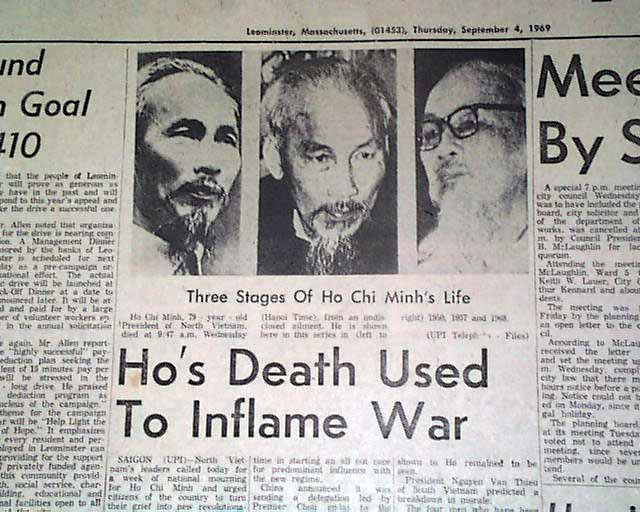
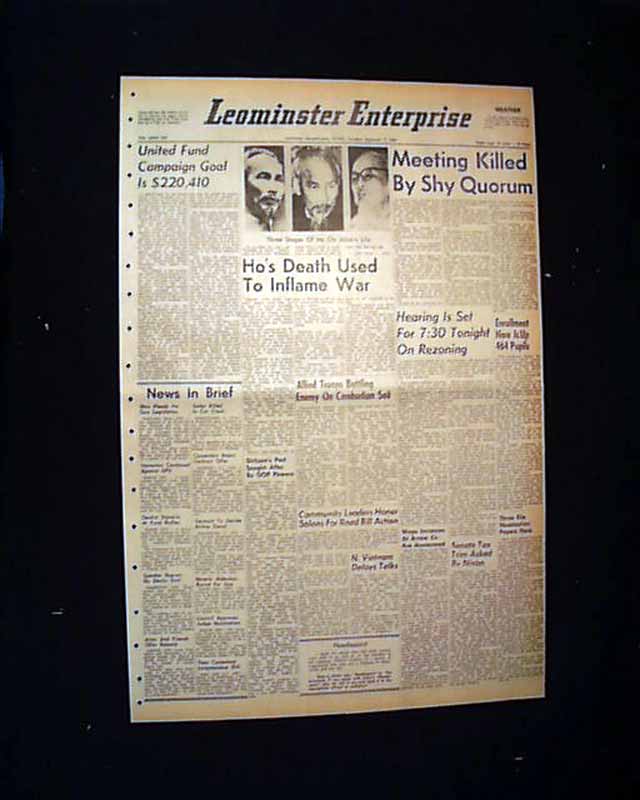
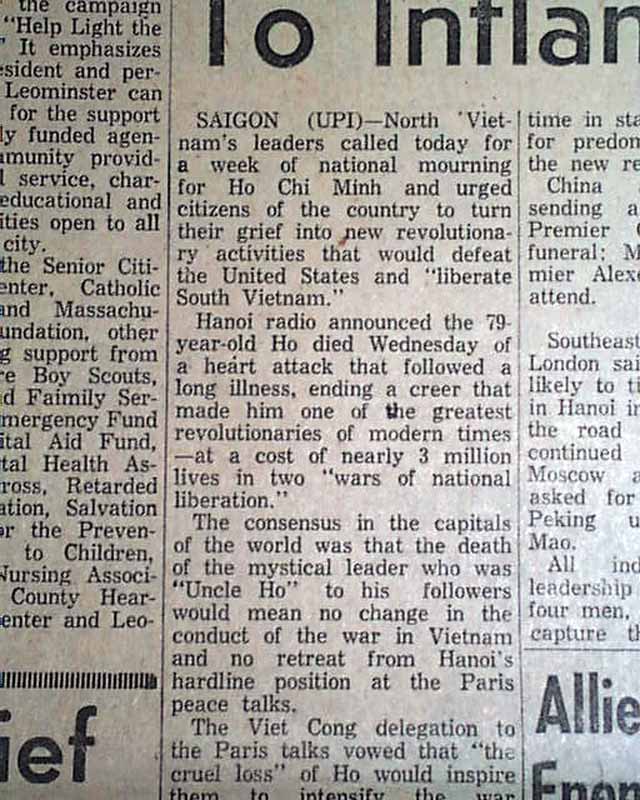
This 12 page newspaper has a two line, three column headline on the front page: "Ho's Death Used To Inflame War" with a three column pictorial of Ho Chi Minh in different stages of life.
Other news of the day throughout. Small binding holes along the spinewith little margin browning, otherwise in good condition.
source: wikipedia: With the outcome of the Vietnam War still in question, Ho Chi Minh died on the morning of September 2, 1969, at his home in Hanoi at age 79 from heart failure. Many in North Vietnam tearfully mourned his death. Santiago Álvarez's 1969 documentary film 'Seventy-Nine Spring Times Of Ho Chi Minh' (much of which was based on found footage) documents some of this, with powerful scenes depicting crying school children and weeping mourners. His death day was initially reported to be September 3[23] as not to coincide with the National Day. Recently the government changed his official death day to September 2[24][25].
The former capital of South Vietnam, Saigon, was renamed Ho Chi Minh City on 1 May 1975 shortly after its capture which officially ended the war.
His embalmed body was put on display in a granite mausoleum modeled after Lenin's Tomb in Moscow. This was consistent with other Communist leaders who have been similarly displayed before and since, including Mao Zedong, Kim Il-Sung, and for a time, Josef Stalin, but the "honor" violated Ho's last wishes. He wished to be cremated and his ashes buried in urns on hilltops of Vietnam (North, Central and South). He wrote, "Not only is cremation good from the point of view of hygiene but also it saves farmland."
In Vietnam today, he is regarded by the Communist government with almost god-like status in a nationwide personality cult, even though the government has abandoned most of his economic policies since the mid-1980s. He is still referred to as "Uncle Ho" in Vietnam. Ho's image appears on the front of every Vietnamese currency note, and Ho is featured prominently in many of Vietnam's public buildings. In 1987, the UNESCO officially recommended the Member States that they "join in the commemoration of the centenary of the birth of President Ho Chi Minh by organizing various events as a tribute to his memory", considering "the important and many-sided contribution of President Ho Chi Minh in the fields of culture, education and the arts" and that Ho Chi Minh "devoted his whole life to the national liberation of the Vietnamese people, contributing to the common struggle of peoples for peace, national independence, democracy and social progress
Category: The 20th Century


