

College of William and Mary in 1815....
Item # 217364Sorry, but this item is no longer available. Please be in touch at info@rarenewspapers.com if you would like to be placed on a want list or are interested in a potential alternate issue.
* College of William and Mary renovation in 1815
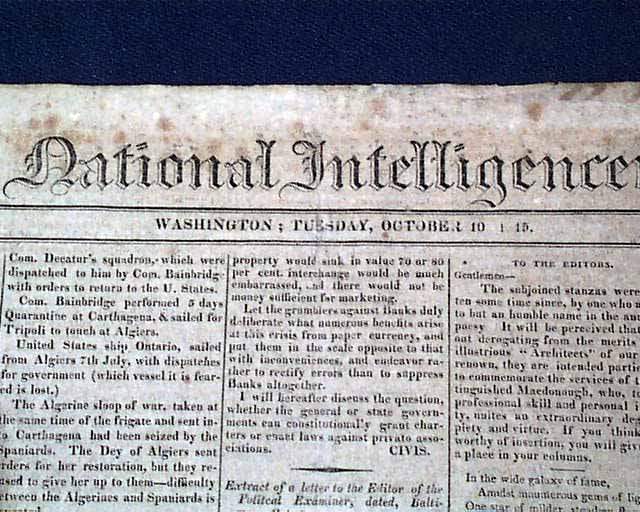
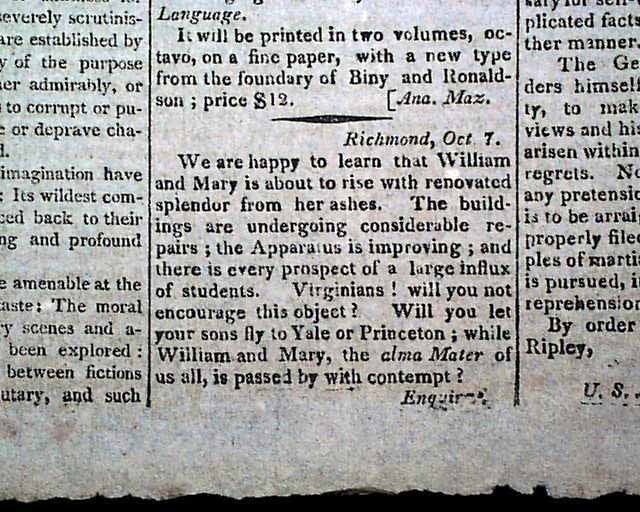
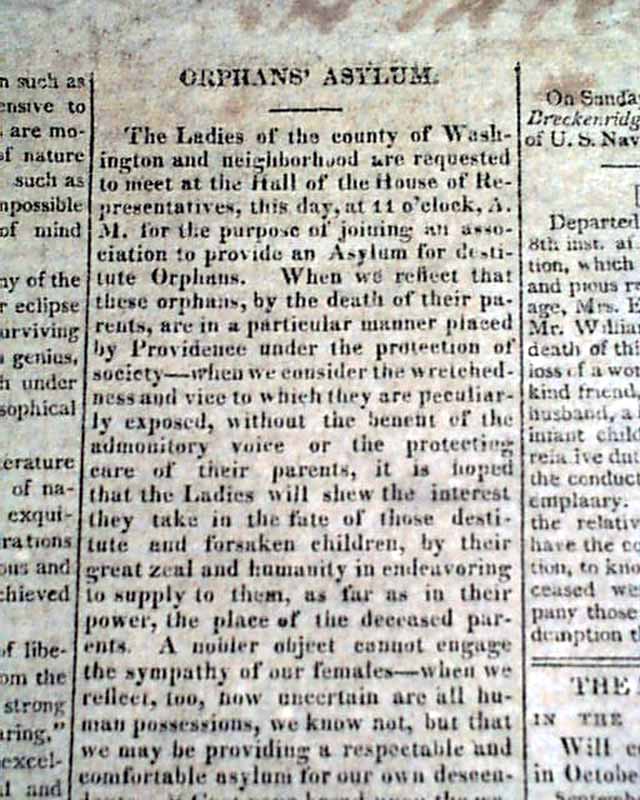
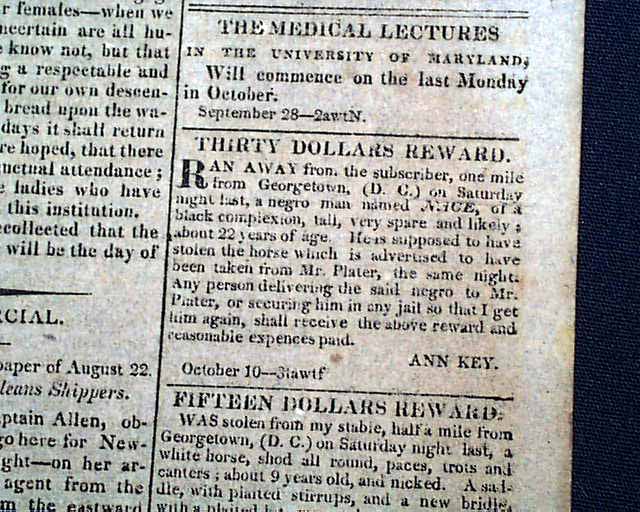
Page 3 has a report from Richmond stating: We are happy to hear that William and Mary is about to rise with renovated splendor from her ashes. The buildings are undergoing considerable repairs, the Apparatus is improving; and there is every prospect of a large influx of students....Virginians!....will you not encourage this object? Will you let your sons fly to Yale or Princeton; while William and Mary, the alma Mater of us all, is passed with contempt? Other news of the day includes: "Sporting Intelligence" "Orphan's Asylum" "Governor's Message" and more. Archival mend to a tear on the first leaf.
Historical Background: The colonies declared their independence in 1776 and William and Mary severed formal ties to England. However, the College's connection to British history remains as a distinct point of pride; it maintains a relationship with the British monarchy and includes former Prime Minister Margaret Thatcher among those who have served as Chancellors.

During portions of the American Civil War (1861-1865), William and Mary was occupied by Union troops. The Battle of Williamsburg was fought nearby during the Peninsula Campaign on May 5, 1862; on September 9, 1862, drunken soldiers of the 5th Pennsylvania Cavalry set fire to the College Building, reportedly in an attempt to prevent Confederate snipers from using it for cover.
Following restoration of the Union, the College's 16th president, Benjamin S. Ewell, sought war reparations from the U.S. Congress, but he was unsuccessful. The College closed in 1882 due to lack of funds. During this time, President Ewell sounded the bell in the Wren Building every year, an act traditionally regarded as the start of the academic term, which, symbolically, kept the College in operation and the charter in effect. [8].
In 1888, William and Mary resumed operations when the Commonwealth of Virginia passed an act appropriating $10,000 to support the College. Lyon Gardiner Tyler (son of US President and alumnus John Tyler) became the 17th president of the College following President Ewell's retirement. Tyler, along with 18th president J.A.C. Chandler, expanded the College into a modern institution. Then, in March of 1906 the general assembly passed an act taking over the grounds of the colonial institution, it has remained publicly supported ever since. In 1918, William and Mary was one of the first universities in Virginia to become coeducational. During this time, enrollment increased from 104 students in 1889 to 1269 students by 1932.
Significant campus construction continued under the College's nineteenth president, John Stewart Bryan. In 1935, the Sunken Gardens were constructed, just west of the Wren Building. The sunken design is taken from a similar landscape feature at Chelsea Hospital in London, designed by Sir Christopher Wren. Thanks to the generosity of John D. Rockefeller, Jr., the Sir Christopher Wren Building, the President's House and the Brafferton (the President's office) were restored to their eighteenth century appearance between 1928 and 1932.
Queen Elizabeth II and Prince Philip, Duke of Edinburgh visited the College on October 16, 1957, where the Queen spoke to the College community from the balcony of the Wren Building.
In 1974, Ash Lawn-Highland, the 535-acre historic Albemarle County, Virginia estate of alumnus and U.S. President James Monroe, was willed to the College by Jay Winston Johns. The College restored this historic Presidential home near Charlottesville and opened it to the public.
Category: Pre-Civil War


