

Hartford, Connecticut Circus Fire...
Item # 216594Sorry, but this item is no longer available. Please be in touch at info@rarenewspapers.com if you would like to be placed on a want list or are interested in a potential alternate issue.
July 07, 1944
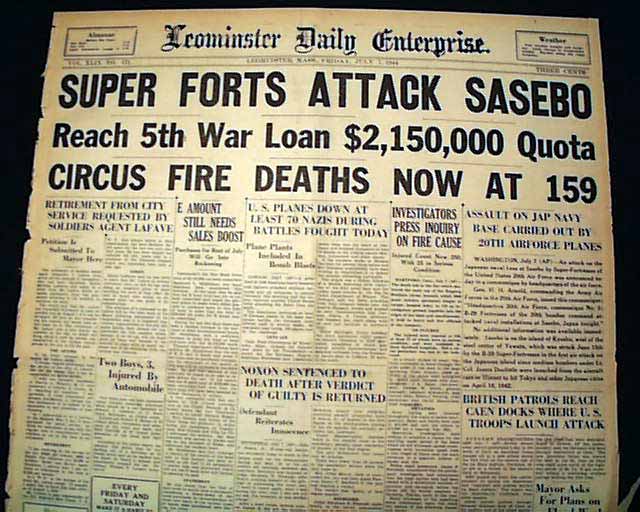
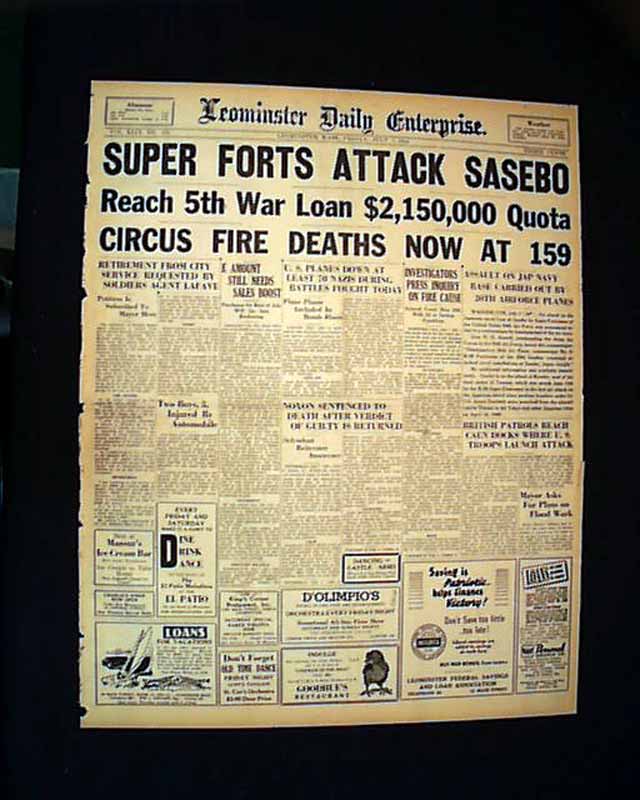
LEOMINSTER DAILY ENTERPRISE, Massachusetts, July 7, 1944.
* Hartford Connecticut Circus Fire
* Barnum and Bailey's Big Apple Circus
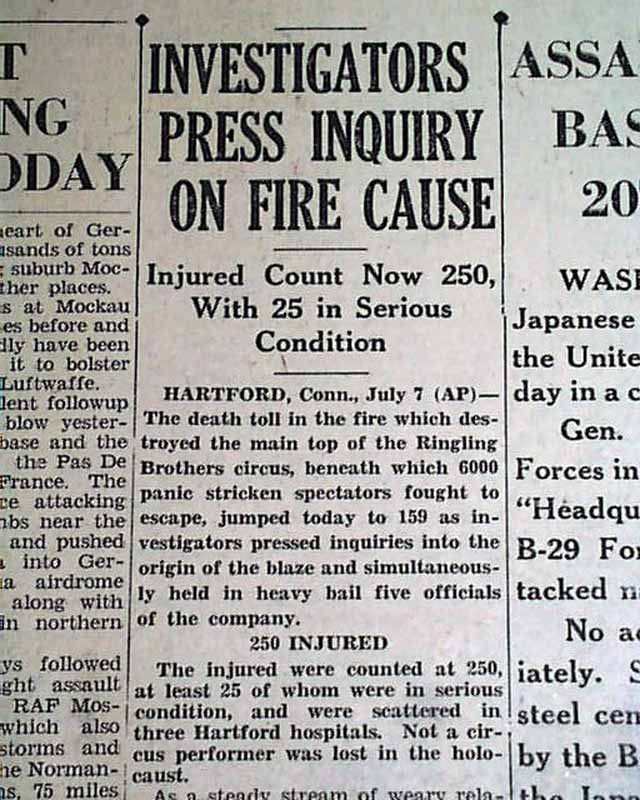
This 8 page newspaper has a banner headline on the front page: "CIRCUS FIRE DEATHS NOW AT 159" with subheads and World War II related headlines as well. Other news of the day. Little margin wear, otherwise in good condition.
Historical Background: The fire began as a small flame about twenty minutes into the show, on the southwest sidewall of the tent, while the Great Wallendas were on. The band leader of P.T. Barnum and James Anthony Bailey's Big Apple Circus, Merle Evans, was one of the first to notice and immediately struck up John Philip Sousa's "Stars and Stripes Forever", show-business code for a life-threatening emergency. The Great Wallendas climbed down and ushers spotted the flame and threw buckets of water on it, but to no avail. Seconds later, the fire reached the roof. At the top of the center pole, the fire split in three directions. The announcer at center stage urged the audience not to panic and to leave in an orderly fashion, but the power went out and he could not be heard.
Sources and investigators differ on how many people were killed and injured. Various people and organizations say it was 167, 168, or 169 persons (the 168 figure is usually based on official tallies that included a collection of body parts that were listed as a "victim," hence 167 is the most probable number) with official treated injury estimates running over 700 people. The number of actual injuries is believed to be higher than those figures, since many people were seen that day heading home in shock without seeking treatment in the city. More than 100 of those killed were under the age of 15. All of the circus animals escaped unharmed since they were far from the tent.
The cause of the fire remains undetermined. Most investigators believe it was caused by a carelessly flicked cigarette or an arsonist. Because the big top tent had been coated with 1,800 lb (816 kg) of paraffin and 6,000 US gallons (23 m) of gasoline (some sources say kerosene), a common waterproofing method of the time, the flames spread rapidly. Many people were badly burned by the melting paraffin, which rained down like napalm from the roof. Eventually, the fiery tent collapsed, trapping hundreds of spectators beneath it.
The circus had been experiencing shortages of personnel and equipment due to World War II. Delays and malfunctions in the ordinarily smooth order of the circus had become commonplace. Two years earlier, on August 4, 1942, a fire had broken out in the menagerie, killing a number of animals. Circus personnel were concerned about the 1944 Hartford show for other reasons. Two shows had been scheduled for July 5, but the first had to be canceled because the circus trains arrived late and could not set up in time. In circus superstition, missing a show is considered extremely bad luck, and although the July 5 evening show was fine, many circus employees may have been on their guard, half-expecting something to go terribly wrong.
It is commonly believed that the number of fatalities is higher than the estimates given, due to poorly kept residency records in rural towns, and the fact that some smaller remains were never identified or claimed. It is also believed that the intense heat from the fire combined with the accelerants in the paraffin and gasoline could have burned people completely, as in cremation, leaving no substantial physical evidence behind. Additionally, free tickets had been handed out that day to many people in and around the city, some of whom appeared to eyewitnesses and circus employees to be drifters, who would never have been reported missing by anyone if they were killed in the disaster. The number of people in the audience that day has never been established with certainty, but the closest estimate is about 7,500 to 8,700.
While many people were burned to death by the fire, many others died as a result of the ensuing chaos. Though most spectators were able to escape the fire, many people were caught up in the hysteria and panicked. Witnesses said some people simply ran around in circles trying to find their loved ones, rather than trying to escape the burning tent. Some escaped but ran back inside to find family members. Others stayed in their seats until it was too late, assuming that the fire would be put out promptly, and the show would continue.
Because at least two of the exits were blocked, one by the chutes used to bring the large felines in and out of the tent, people trying to escape could not bypass them. Some died from injuries sustained after leaping from the tops of the bleachers in hopes they could escape under the sides of the tent, though that method of escape ended up saving more people than it killed. Others died after being trampled by other spectators, with some asphyxiating underneath the piles of people who had fallen down over each other.
Most of the dead were found in piles, some three bodies deep, at the most congested exits. A small number of people were found alive at the bottoms of these piles, protected by the bodies that were on top of them when the burning big top ultimately fell down on those still trapped beneath it. The emotional toll on performers and spectators should not be underestimated, and the event became known as "the day the clowns cried."
* Hartford Connecticut Circus Fire
* Barnum and Bailey's Big Apple Circus
This 8 page newspaper has a banner headline on the front page: "CIRCUS FIRE DEATHS NOW AT 159" with subheads and World War II related headlines as well. Other news of the day. Little margin wear, otherwise in good condition.
Historical Background: The fire began as a small flame about twenty minutes into the show, on the southwest sidewall of the tent, while the Great Wallendas were on. The band leader of P.T. Barnum and James Anthony Bailey's Big Apple Circus, Merle Evans, was one of the first to notice and immediately struck up John Philip Sousa's "Stars and Stripes Forever", show-business code for a life-threatening emergency. The Great Wallendas climbed down and ushers spotted the flame and threw buckets of water on it, but to no avail. Seconds later, the fire reached the roof. At the top of the center pole, the fire split in three directions. The announcer at center stage urged the audience not to panic and to leave in an orderly fashion, but the power went out and he could not be heard.
Sources and investigators differ on how many people were killed and injured. Various people and organizations say it was 167, 168, or 169 persons (the 168 figure is usually based on official tallies that included a collection of body parts that were listed as a "victim," hence 167 is the most probable number) with official treated injury estimates running over 700 people. The number of actual injuries is believed to be higher than those figures, since many people were seen that day heading home in shock without seeking treatment in the city. More than 100 of those killed were under the age of 15. All of the circus animals escaped unharmed since they were far from the tent.
The cause of the fire remains undetermined. Most investigators believe it was caused by a carelessly flicked cigarette or an arsonist. Because the big top tent had been coated with 1,800 lb (816 kg) of paraffin and 6,000 US gallons (23 m) of gasoline (some sources say kerosene), a common waterproofing method of the time, the flames spread rapidly. Many people were badly burned by the melting paraffin, which rained down like napalm from the roof. Eventually, the fiery tent collapsed, trapping hundreds of spectators beneath it.
The circus had been experiencing shortages of personnel and equipment due to World War II. Delays and malfunctions in the ordinarily smooth order of the circus had become commonplace. Two years earlier, on August 4, 1942, a fire had broken out in the menagerie, killing a number of animals. Circus personnel were concerned about the 1944 Hartford show for other reasons. Two shows had been scheduled for July 5, but the first had to be canceled because the circus trains arrived late and could not set up in time. In circus superstition, missing a show is considered extremely bad luck, and although the July 5 evening show was fine, many circus employees may have been on their guard, half-expecting something to go terribly wrong.
It is commonly believed that the number of fatalities is higher than the estimates given, due to poorly kept residency records in rural towns, and the fact that some smaller remains were never identified or claimed. It is also believed that the intense heat from the fire combined with the accelerants in the paraffin and gasoline could have burned people completely, as in cremation, leaving no substantial physical evidence behind. Additionally, free tickets had been handed out that day to many people in and around the city, some of whom appeared to eyewitnesses and circus employees to be drifters, who would never have been reported missing by anyone if they were killed in the disaster. The number of people in the audience that day has never been established with certainty, but the closest estimate is about 7,500 to 8,700.
While many people were burned to death by the fire, many others died as a result of the ensuing chaos. Though most spectators were able to escape the fire, many people were caught up in the hysteria and panicked. Witnesses said some people simply ran around in circles trying to find their loved ones, rather than trying to escape the burning tent. Some escaped but ran back inside to find family members. Others stayed in their seats until it was too late, assuming that the fire would be put out promptly, and the show would continue.
Because at least two of the exits were blocked, one by the chutes used to bring the large felines in and out of the tent, people trying to escape could not bypass them. Some died from injuries sustained after leaping from the tops of the bleachers in hopes they could escape under the sides of the tent, though that method of escape ended up saving more people than it killed. Others died after being trampled by other spectators, with some asphyxiating underneath the piles of people who had fallen down over each other.
Most of the dead were found in piles, some three bodies deep, at the most congested exits. A small number of people were found alive at the bottoms of these piles, protected by the bodies that were on top of them when the burning big top ultimately fell down on those still trapped beneath it. The emotional toll on performers and spectators should not be underestimated, and the event became known as "the day the clowns cried."
Category: The 20th Century


