

1904 Steamer General Slocum disaster...
Item # 563362Sorry, but this item is no longer available. Please be in touch at info@rarenewspapers.com if you would like to be placed on a want list or are interested in a potential alternate issue.
June 16, 1904
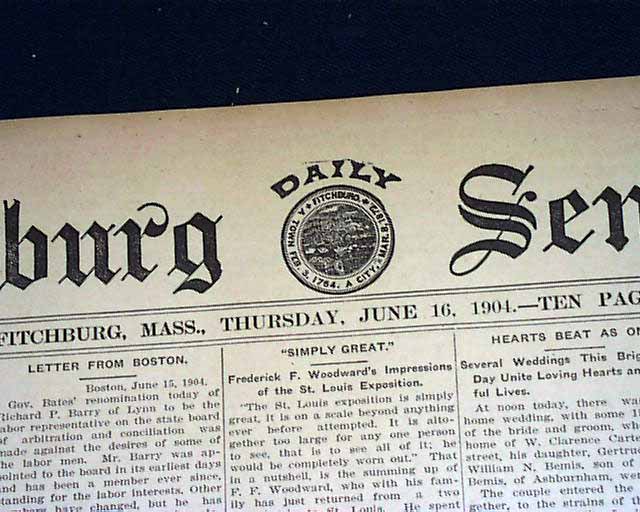
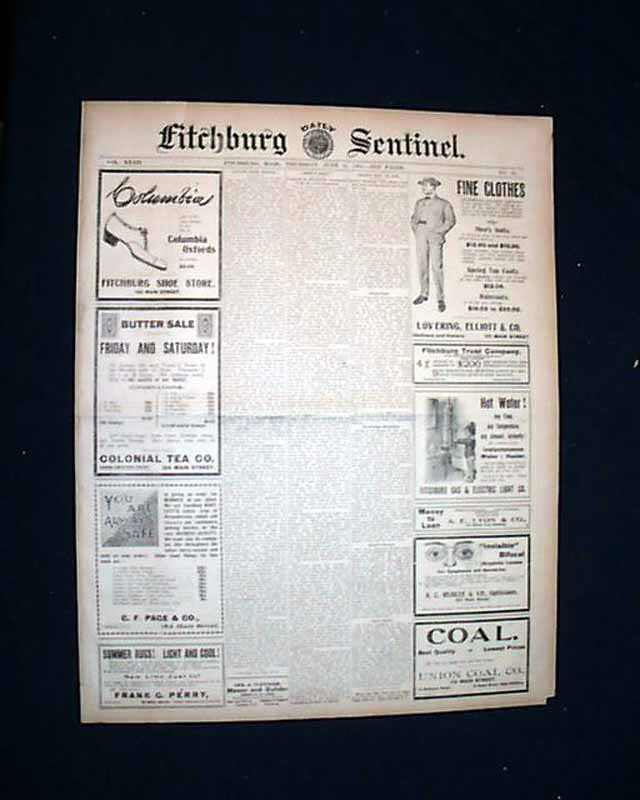
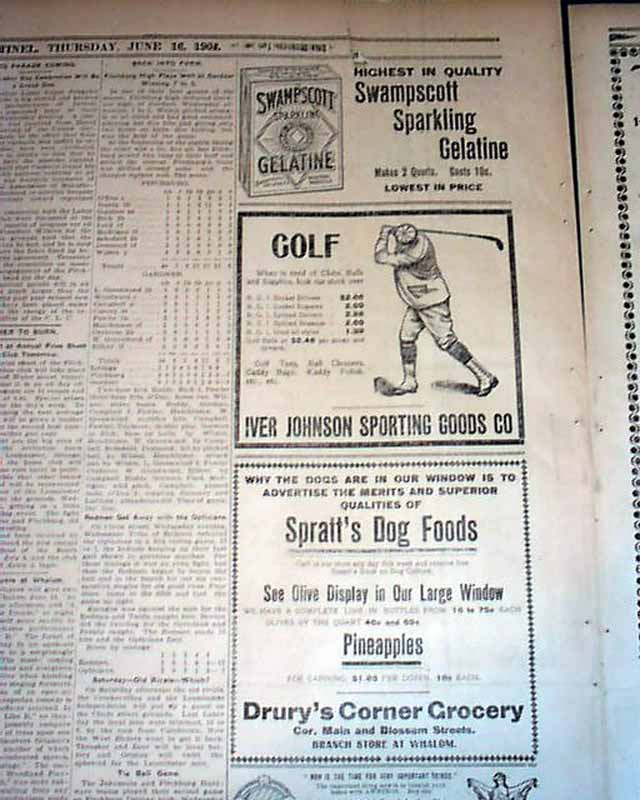
FITCHBURG SENTINEL, Fitchburg, Massachusetts, June 16, 1904
* Steamship General Slocum disaster
* Over 1,000 lives lost
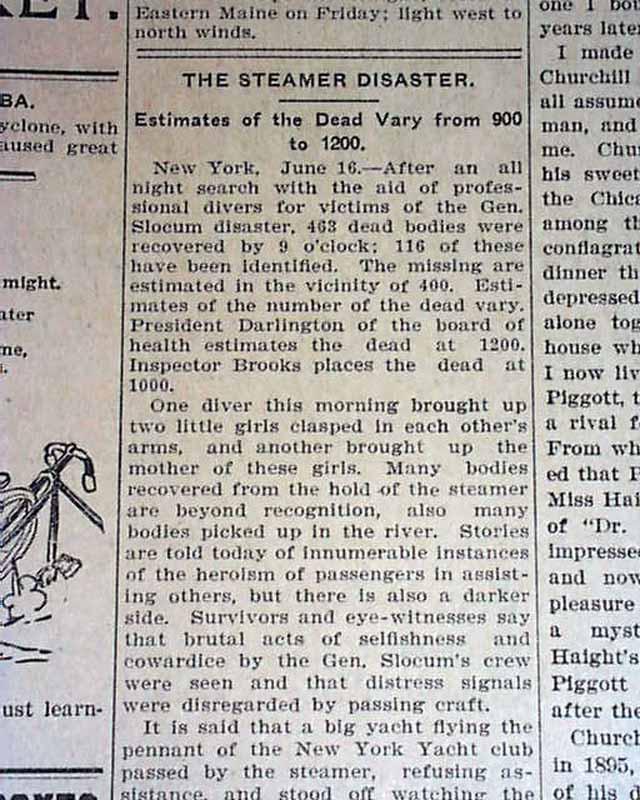
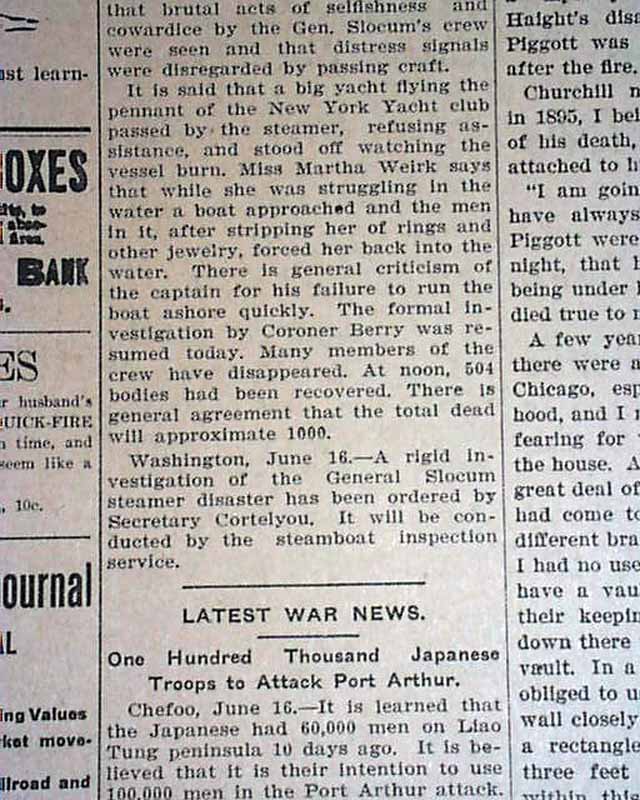
This 10 page newspaper has one column headlines on page 3: "The Steamer Disaster" and "Estimates of the Dead Vary from 900 to 1200".
Other news of the day throughout. Usual browning with little margin wear. Should be handled with care.
source: wikipedia: The General Slocum worked as a passenger ship, taking people on excursions around New York City. On June 15, 1904, the ship had been chartered for $350 by the St. Mark's Evangelical Lutheran Church in the German district Little Germany, Manhattan. This was an annual rite for the group, which had made the trip for 17 consecutive years. Over 1,300 passengers, mostly women and children, boarded the General Slocum. It was to sail up the East River and then eastward across Long Island Sound to Locust Grove, a picnic site in Eatons Neck, Long Island.
The ship got underway at 9:30am. As it was passing East 90th Street, a fire started in a storage compartment in the forward section, possibly caused by a discarded cigarette or match. The first notice of a fire was at 10am - eyewitnesses locate the initial blaze at several locations, including a paint locker filled with flammable liquids or a cabin filled with gasoline. Captain Van Schiack was only notified ten minutes after the fire was discovered - a twelve year old boy had tried to warn him earlier, but was not believed.
On board the Slocum, where the Captain has ultimate safety authority, he did not demand that hoses and faulty lifejackets be replaced. The fire hoses fell apart when the crew attempted to put out the fire. Also, the crew had never had a fire drill. Although the ship had lifeboats and life preservers, they were useless. Survivors reported that the life preservers were rotten and fell apart in their hands. The lifeboats were tied up and inaccessible. Desperate mothers placed life jackets on their children and tossed them into the water, only to watch in horror as their children sank instead of floated, due to the condition of the jackets. Also, the population of the boat consisted mainly of women and children, most of whom could not swim.
It has been suggested that the manager of the life preserveriron bars inside the Cork preservers to meet minimum weight requirements at the time. Managers of the company (Nonpareil Cork Works) were indicted, but not convicted. Many of the life preservers had been filled with cheap and less effective granulated cork and brought up to proper weight by the inclusion of the iron weights. Canvas covers, rotten with age, split and scattered the powdered cork. manufacturer actually placed
Captain Van Schaick badly mishandled the situation. He decided to continue his course rather than run the ship aground or stop at a nearby landing. (Van Schaick would later argue he was attempting to prevent the fire from spreading to riverside buildings and oil tanks.) By going into headwinds and failing to immediately ground the vessel, he actually fanned the fire. Highly flammable paint also helped the fire to spread out of control.
Some passengers attempted to jump into the river, but the clothing of the day made swimming almost impossible. Many died instantly when the 3-level floors of the overloaded boat collapsed; others were mauled by the still turning paddles.[1]
By the time the General Slocum was beached at North Brother Island, just off the Bronx shore, an estimated 1,021 people had been killed by fire or drowning, with 321 survivors. Two of the 30 crewmembers died. The Captain lost sight in one eye due to the fire. Reports indicate that Van Schaick deserted the Slocum as soon as it ran aground, jumping into a nearby tug, along with several crew. Some say his jacket was hardly rumpled. He was hospitalized at Lebanon Hospital.
There were many acts of heroism among the passengers, witnesses, and emergency personnel. Staff and patients from the hospital on North Brother Island participated in the rescue efforts, forming human chains and pulling victims from the water.
* Steamship General Slocum disaster
* Over 1,000 lives lost
This 10 page newspaper has one column headlines on page 3: "The Steamer Disaster" and "Estimates of the Dead Vary from 900 to 1200".
Other news of the day throughout. Usual browning with little margin wear. Should be handled with care.
source: wikipedia: The General Slocum worked as a passenger ship, taking people on excursions around New York City. On June 15, 1904, the ship had been chartered for $350 by the St. Mark's Evangelical Lutheran Church in the German district Little Germany, Manhattan. This was an annual rite for the group, which had made the trip for 17 consecutive years. Over 1,300 passengers, mostly women and children, boarded the General Slocum. It was to sail up the East River and then eastward across Long Island Sound to Locust Grove, a picnic site in Eatons Neck, Long Island.
The ship got underway at 9:30am. As it was passing East 90th Street, a fire started in a storage compartment in the forward section, possibly caused by a discarded cigarette or match. The first notice of a fire was at 10am - eyewitnesses locate the initial blaze at several locations, including a paint locker filled with flammable liquids or a cabin filled with gasoline. Captain Van Schiack was only notified ten minutes after the fire was discovered - a twelve year old boy had tried to warn him earlier, but was not believed.
On board the Slocum, where the Captain has ultimate safety authority, he did not demand that hoses and faulty lifejackets be replaced. The fire hoses fell apart when the crew attempted to put out the fire. Also, the crew had never had a fire drill. Although the ship had lifeboats and life preservers, they were useless. Survivors reported that the life preservers were rotten and fell apart in their hands. The lifeboats were tied up and inaccessible. Desperate mothers placed life jackets on their children and tossed them into the water, only to watch in horror as their children sank instead of floated, due to the condition of the jackets. Also, the population of the boat consisted mainly of women and children, most of whom could not swim.
It has been suggested that the manager of the life preserveriron bars inside the Cork preservers to meet minimum weight requirements at the time. Managers of the company (Nonpareil Cork Works) were indicted, but not convicted. Many of the life preservers had been filled with cheap and less effective granulated cork and brought up to proper weight by the inclusion of the iron weights. Canvas covers, rotten with age, split and scattered the powdered cork. manufacturer actually placed
Captain Van Schaick badly mishandled the situation. He decided to continue his course rather than run the ship aground or stop at a nearby landing. (Van Schaick would later argue he was attempting to prevent the fire from spreading to riverside buildings and oil tanks.) By going into headwinds and failing to immediately ground the vessel, he actually fanned the fire. Highly flammable paint also helped the fire to spread out of control.
Some passengers attempted to jump into the river, but the clothing of the day made swimming almost impossible. Many died instantly when the 3-level floors of the overloaded boat collapsed; others were mauled by the still turning paddles.[1]
By the time the General Slocum was beached at North Brother Island, just off the Bronx shore, an estimated 1,021 people had been killed by fire or drowning, with 321 survivors. Two of the 30 crewmembers died. The Captain lost sight in one eye due to the fire. Reports indicate that Van Schaick deserted the Slocum as soon as it ran aground, jumping into a nearby tug, along with several crew. Some say his jacket was hardly rumpled. He was hospitalized at Lebanon Hospital.
There were many acts of heroism among the passengers, witnesses, and emergency personnel. Staff and patients from the hospital on North Brother Island participated in the rescue efforts, forming human chains and pulling victims from the water.
Category: The 20th Century


