

Traveling to the upper Mississippi...
Item # 554396Sorry, but this item is no longer available. Please be in touch at info@rarenewspapers.com if you would like to be placed on a want list or are interested in a potential alternate issue.
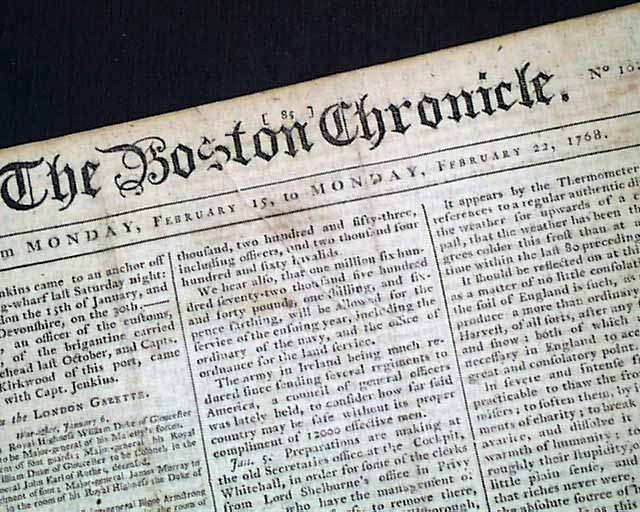
February 22, 1768
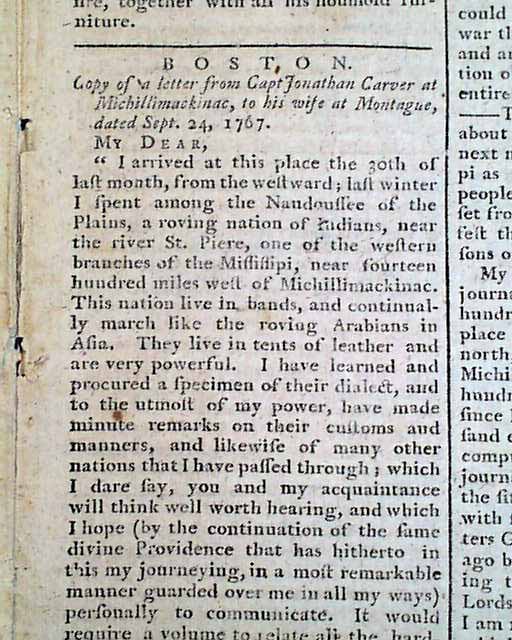
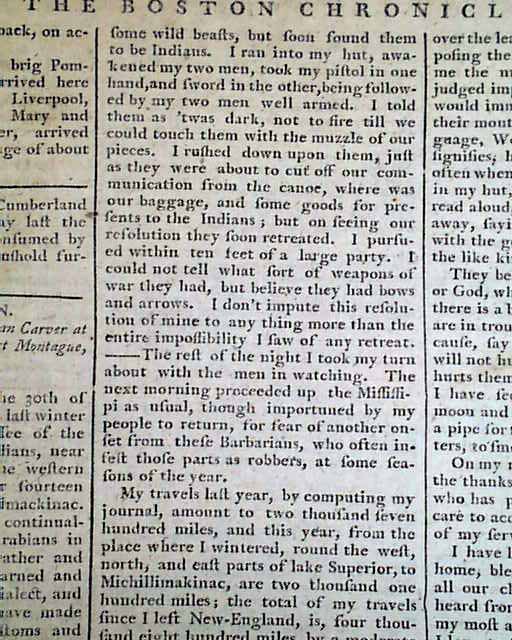
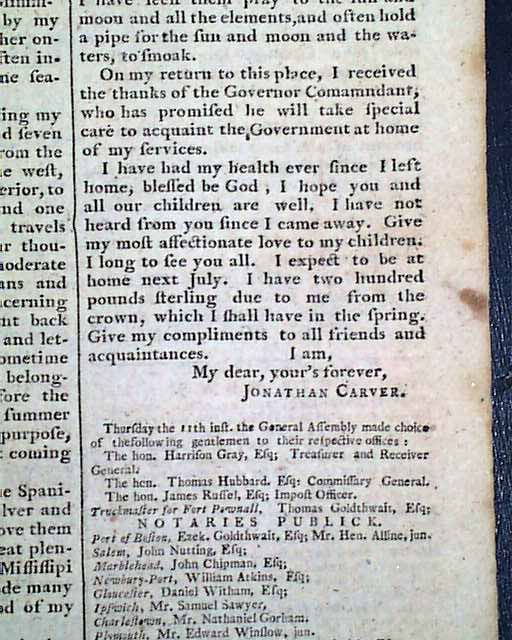
THE BOSTON CHRONICLE, February 22, 1768 Inside under "Boston" is a "Copy of a letter from Jonathan Carver at Michillmackinac, to his wife at Montague, Sept. 24, 1767." Carver begins his letter by stating that he spent the previous winter among the "...Naudoussee of the Plains, a roving nation of Indians near the river St. Piere, one of the western branches of the Mississippi, near 1400 miles west of Michillimackinac"
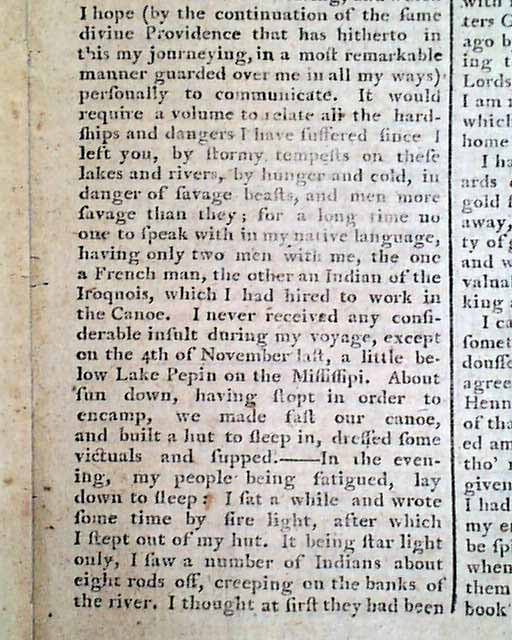
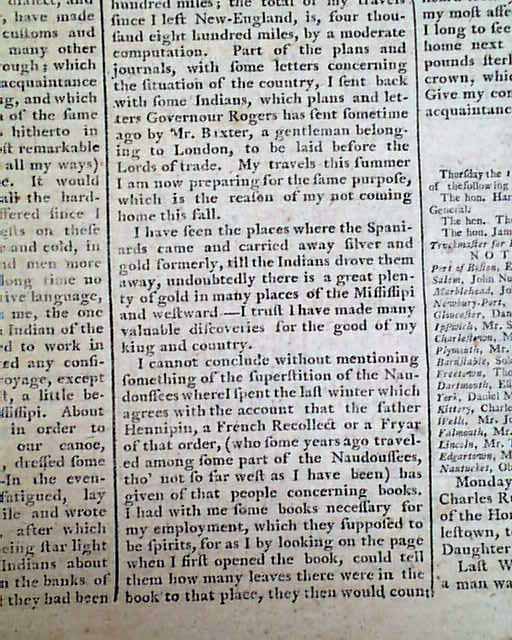
A bit more about his experience with this nation of nomadic Indians, plus more general talk about his journey up the Mississippi which includes mention of Lake Pepin. He then discusses his travel mileage from the previous year, that took him "...round the west, north, and east parts of lake Superior, to Michillmakinac ...", about 4,800 miles since he departed from Boston.
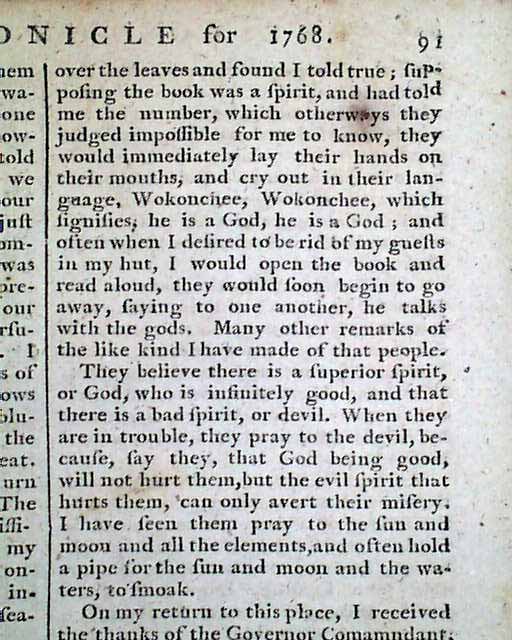
Carver continues, mentioning that he had "...seen places where the Spaniards came and carried away silver and gold formerly, 'till the Indians drove them away, undoubtedly there is...plenty of gold in many places of the Mississippi...". The letter concludes with details about a certain superstition among the Naudoussees that was witnessed by Carver, plus there is some discussion about their spiritual beliefs as well.
Elsewhere are two reports, one from Carlisle concerning: "...made prisoners Frederick Stump and John Ironcutter who were suspected to have murdered ten of our friend Indians near fort Augusta..." which is near present-day Sunbury, Pennsylvania (see).
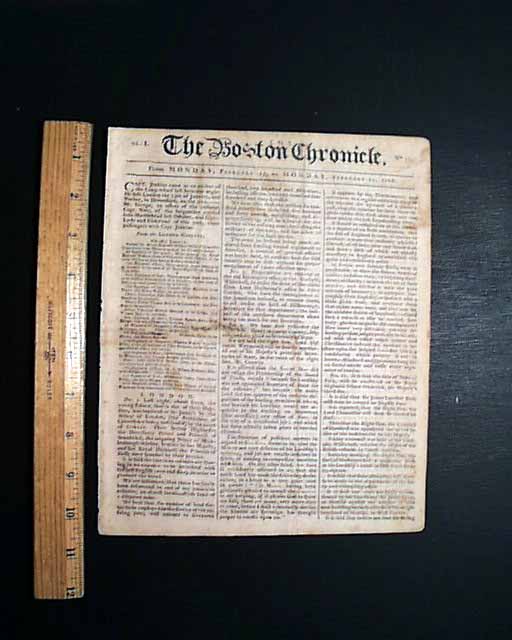
Eight pages, 8 1/2 by 10 1/4 inches, some rubbing to the front page.
This newspaper published only briefly from December 21, 1767 until 1770. The publishers, John Mein and John Fleeming, were both from Scotland. The Chronicle was a Loyalist paper in the time before the American Revolution. In its second year, Mein printed names in the paper that accused some colonial merchants of breaking a British non-importation agreement. In response, Mein's name appeared on a list of merchants who violated the trade agreement. Mein retaliated by accusing the Merchants' Committee of using the non-importation agreement for illegal profiteering. The irritated readership ransacked the offices of the Chronicle, and ultimately, it ceased operations in 1770. (credit Wikipedia)
A bit more about his experience with this nation of nomadic Indians, plus more general talk about his journey up the Mississippi which includes mention of Lake Pepin. He then discusses his travel mileage from the previous year, that took him "...round the west, north, and east parts of lake Superior, to Michillmakinac ...", about 4,800 miles since he departed from Boston.
Carver continues, mentioning that he had "...seen places where the Spaniards came and carried away silver and gold formerly, 'till the Indians drove them away, undoubtedly there is...plenty of gold in many places of the Mississippi...". The letter concludes with details about a certain superstition among the Naudoussees that was witnessed by Carver, plus there is some discussion about their spiritual beliefs as well.
Elsewhere are two reports, one from Carlisle concerning: "...made prisoners Frederick Stump and John Ironcutter who were suspected to have murdered ten of our friend Indians near fort Augusta..." which is near present-day Sunbury, Pennsylvania (see).
Eight pages, 8 1/2 by 10 1/4 inches, some rubbing to the front page.
This newspaper published only briefly from December 21, 1767 until 1770. The publishers, John Mein and John Fleeming, were both from Scotland. The Chronicle was a Loyalist paper in the time before the American Revolution. In its second year, Mein printed names in the paper that accused some colonial merchants of breaking a British non-importation agreement. In response, Mein's name appeared on a list of merchants who violated the trade agreement. Mein retaliated by accusing the Merchants' Committee of using the non-importation agreement for illegal profiteering. The irritated readership ransacked the offices of the Chronicle, and ultimately, it ceased operations in 1770. (credit Wikipedia)
Category: The 1600's and 1700's


