

Arctic expedition...
Item # 552553Sorry, but this item is no longer available. Please be in touch at info@rarenewspapers.com if you would like to be placed on a want list or are interested in a potential alternate issue.
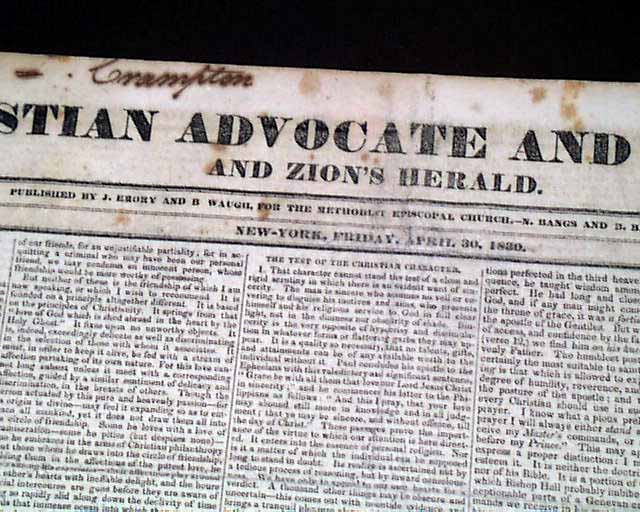
April 30, 1830
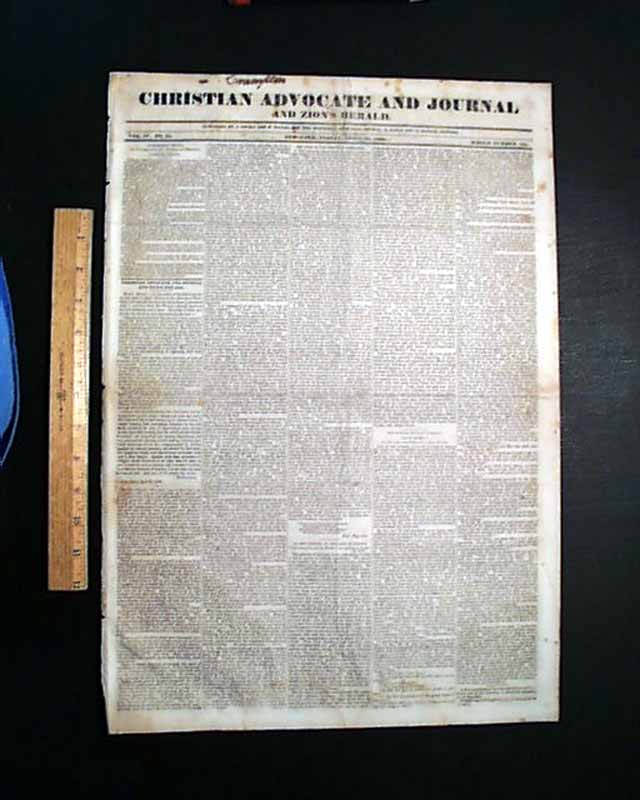
CHRISTIAN ADVOCATE & JOURNAL, & ZION'S HERALD, New York, NY, April 30, 1830
* Captain John Ross
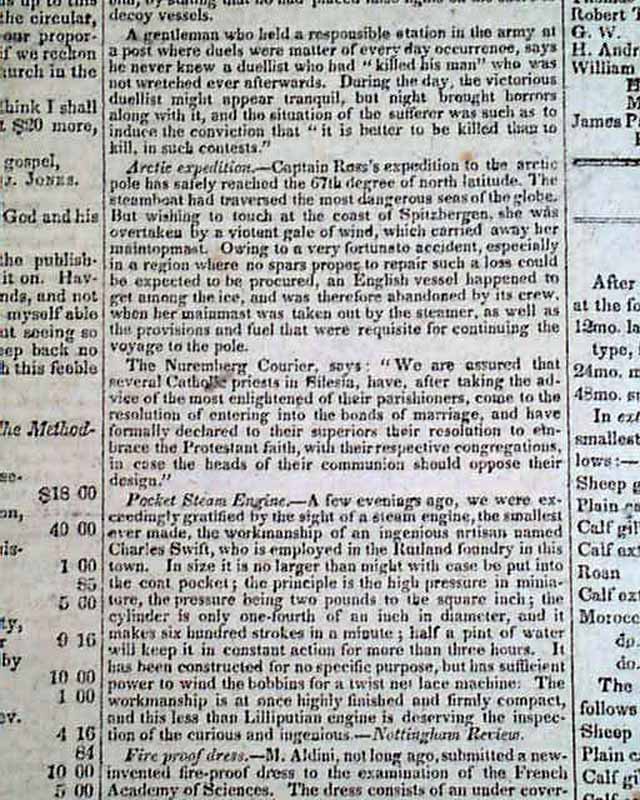
* Arctic expedition
Page 3 has a report about the "Arctic Expedition" that begins: "Capt. Ross's expedition to the arctic pole has safely reached the 67th degree of north latitude..." and more, with mention of an attempt to reach Spitzbergen.
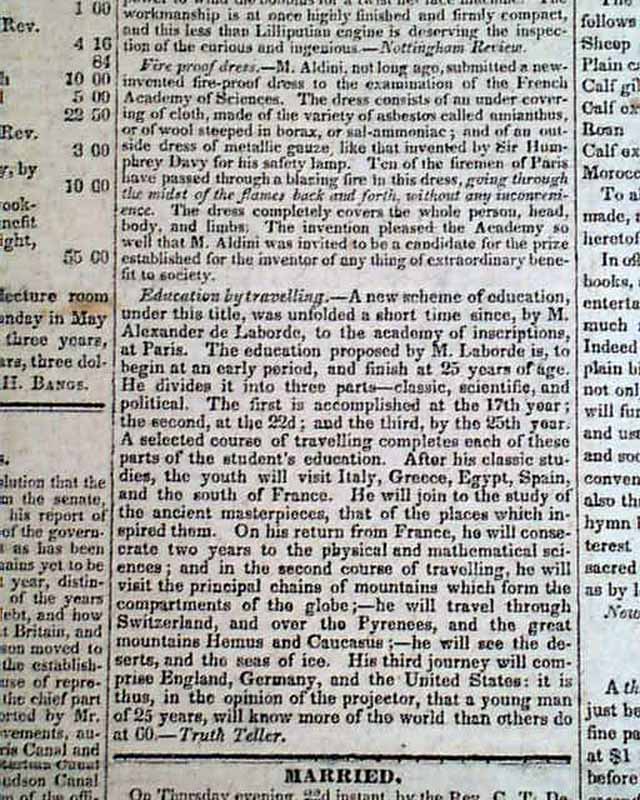
Also reports about a "Pocket Steam Engine"& a "Fire Proof Dress".
4 pages in good condition.
wikipedia notes: Sir John Ross, CB, (24 June 1777 – 30 August 1856) was a Scottish rear admiral and Arctic explorer.
Ross was the son of the Rev. Andrew Ross, minister of Inch, near Stranraer in Scotland. In 1786, aged only nine, he joined the Royal Navy as an apprentice. He served in the Mediterranean until 1789 and then in the English Channel. In 1808, he acted as a captain of the Swedish Navy and in 1812 became a Commander.
Six years later, in 1818, he received the command of an Arctic expedition organised by the Admiralty, the first of a new series of attempts to solve the question of a Northwest Passage. This entailed going around the extreme northeast coast of America and sailing to the Bering Strait. He was also to note the currents, tides, the state of ice and magnetism and to collect specimens he found on the way. In April of that year, Ross left London with two ships, and in August reached Lancaster Sound, in Canada.
There he re-examined the observations William Baffin, a previous British explorer, had made two hundred years before. But Ross went no further, for he suffered from mirages that appeared as mountains at the end of the strait. He named them "Crocker Hills," and returned to England despite the protests of several of his officers, including First Mate William Edward Parry and Edward Sabine.[1] The account of his voyage, published a year later, brought to light their disagreement, and the ensuing controversy over the existence of Crocker Hills ruined his reputation.
This expedition failed to discover much that was new, and somewhat prejudiced the Arctic reputation of its leader, who attained the rank of captain on his return.
In 1829, Ross admitted he may have been wrong, and convinced one of his friends, Mr (afterwards Sir) Felix Booth, to finance a second expedition. He left in May of that year, this time on the Victory, a side-wheel steam ship.[2] They sailed past Lancaster Sound to a previously unexplored area, where their ship became stuck in the ice. The crew was stranded for four years, during which they explored the regions to the west and north, with the help of local Inuit. On one of these explorations, Ross found the magnetic north pole on the Boothia Peninsula.
In 1832, Ross and his crew abandoned their ship and walked to another shipwreck which had been abandoned by a different expedition many years earlier. A year went by before a break in the ice allowed them to leave, on that ship's longboats. They were eventually picked up by a British vessel and taken home. "This impressive experience, as well as the scientific and ethnological information gathered by Ross's team, brought him the renown that he had long sought." [3] However, Ross encountered controversy again with his cartography. His nephew, Commander (later Sir) James Clark Ross charted three islands in James Ross Strait and named them Beaufort Islands in 1830. John Ross never saw the islands, but charted 8 or 9 and named them Clarence Islands.[4][5]
Captain Ross received gold medals from the English and French geographical societies, and various foreign orders, including a knighthood of the Pole Star of Sweden, and in the following year (1834) received a knighthood and a CB in Britain.
In 1850, he undertook a third voyage to the Arctic regions, this time in search of the missing expedition party of Sir John Franklin. He did not find them. In the following year he attained flag-rank. Upon returning, he settled in Scotland, and died in London in 1856.
* Captain John Ross
* Arctic expedition
Page 3 has a report about the "Arctic Expedition" that begins: "Capt. Ross's expedition to the arctic pole has safely reached the 67th degree of north latitude..." and more, with mention of an attempt to reach Spitzbergen.
Also reports about a "Pocket Steam Engine"& a "Fire Proof Dress".
4 pages in good condition.
wikipedia notes: Sir John Ross, CB, (24 June 1777 – 30 August 1856) was a Scottish rear admiral and Arctic explorer.
Ross was the son of the Rev. Andrew Ross, minister of Inch, near Stranraer in Scotland. In 1786, aged only nine, he joined the Royal Navy as an apprentice. He served in the Mediterranean until 1789 and then in the English Channel. In 1808, he acted as a captain of the Swedish Navy and in 1812 became a Commander.
Six years later, in 1818, he received the command of an Arctic expedition organised by the Admiralty, the first of a new series of attempts to solve the question of a Northwest Passage. This entailed going around the extreme northeast coast of America and sailing to the Bering Strait. He was also to note the currents, tides, the state of ice and magnetism and to collect specimens he found on the way. In April of that year, Ross left London with two ships, and in August reached Lancaster Sound, in Canada.
There he re-examined the observations William Baffin, a previous British explorer, had made two hundred years before. But Ross went no further, for he suffered from mirages that appeared as mountains at the end of the strait. He named them "Crocker Hills," and returned to England despite the protests of several of his officers, including First Mate William Edward Parry and Edward Sabine.[1] The account of his voyage, published a year later, brought to light their disagreement, and the ensuing controversy over the existence of Crocker Hills ruined his reputation.
This expedition failed to discover much that was new, and somewhat prejudiced the Arctic reputation of its leader, who attained the rank of captain on his return.
In 1829, Ross admitted he may have been wrong, and convinced one of his friends, Mr (afterwards Sir) Felix Booth, to finance a second expedition. He left in May of that year, this time on the Victory, a side-wheel steam ship.[2] They sailed past Lancaster Sound to a previously unexplored area, where their ship became stuck in the ice. The crew was stranded for four years, during which they explored the regions to the west and north, with the help of local Inuit. On one of these explorations, Ross found the magnetic north pole on the Boothia Peninsula.
In 1832, Ross and his crew abandoned their ship and walked to another shipwreck which had been abandoned by a different expedition many years earlier. A year went by before a break in the ice allowed them to leave, on that ship's longboats. They were eventually picked up by a British vessel and taken home. "This impressive experience, as well as the scientific and ethnological information gathered by Ross's team, brought him the renown that he had long sought." [3] However, Ross encountered controversy again with his cartography. His nephew, Commander (later Sir) James Clark Ross charted three islands in James Ross Strait and named them Beaufort Islands in 1830. John Ross never saw the islands, but charted 8 or 9 and named them Clarence Islands.[4][5]
Captain Ross received gold medals from the English and French geographical societies, and various foreign orders, including a knighthood of the Pole Star of Sweden, and in the following year (1834) received a knighthood and a CB in Britain.
In 1850, he undertook a third voyage to the Arctic regions, this time in search of the missing expedition party of Sir John Franklin. He did not find them. In the following year he attained flag-rank. Upon returning, he settled in Scotland, and died in London in 1856.
Category: Pre-Civil War


